













Salta al contenuto principale

Sistemi Didattici GUNT Hamburg

22 sistemi didattici professionali per laboratori di ingegneria, energie rinnovabili, termodinamica, fluidotecnica e prove su materiali. Distributore esclusivo Italia.

GUNT

GUNT Hamburg

Distributore Esclusivo Italia

Sistemi didattici per formazione tecnica e ingegneristica dal 1951

Catalogo internazionale

Tutto il catalogo GUNT Hamburg

Mekhan è distributore esclusivo Italia di GUNT Hamburg. Esplora le 11 aree, 61 sotto-aree e 2590+ apparecchiature didattiche direttamente dal catalogo internazionale gunt.de. Ogni prodotto rimanda alla scheda tecnica completa sul sito ufficiale.

📐

Meccanica e Progettazione Ingegneristica

6 sotto-aree · 366 apparecchiature

  • Statica

    36 prodotti

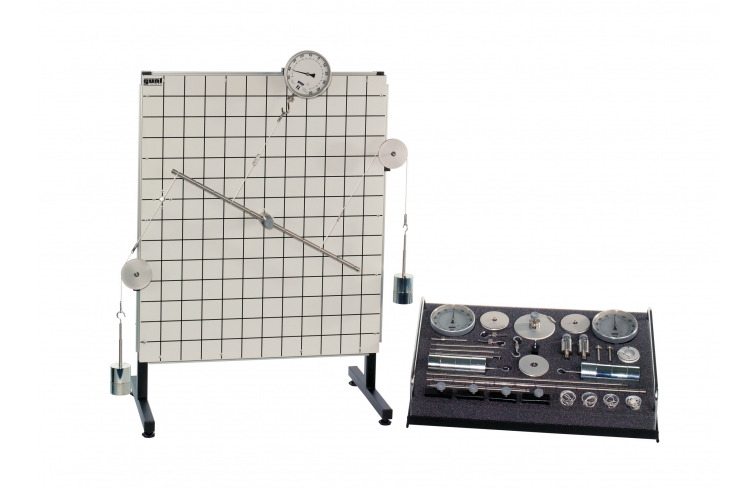
    TM 110

    • versatile experimental unit demonstrating planar mechanical force systems
    • scope of experimentation can be extended by supplementary sets
    Obiettivi didattici (6)
    • · accumulation and resolution of forces with force parallelogram
    • · equilibrium of forces
    • · law of levers, determination of moments and equilibrium of moments
    • · combined lever systems
    • · forces in bearings
    • · deflection and resolution of force by fixed and free pulleys
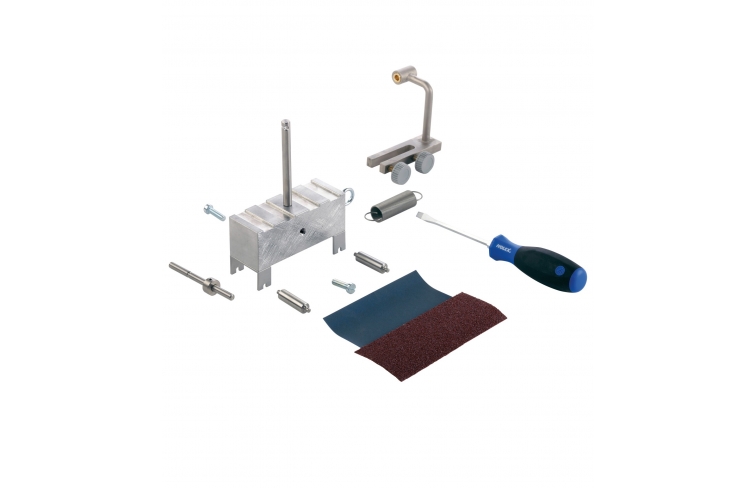
    TM 110.01

    • measurement and demonstration of spring deflection, inclined plane and mechanical friction
    Obiettivi didattici (5)
    • · elastic deflection of a helical spring (Hooke’s law)
    • · dynamic friction as a function of the normal force, contact area and surface properties of the friction body
    • · determination of the friction coefficient
    • · rolling friction
    • · forces on the inclined plane
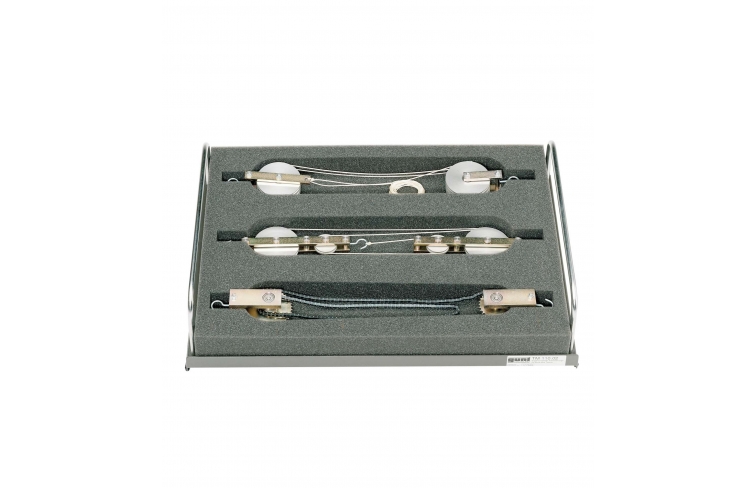
    TM 110.02

    • setup and principle of three different pulley blocks
    Obiettivi didattici (2)
    • · setup and principle of pulley blocks with 4 pulleys and with 6 pulleys; differential pulley block
    • · principle of “simple machines”: force transmission, lifting work and potential energy
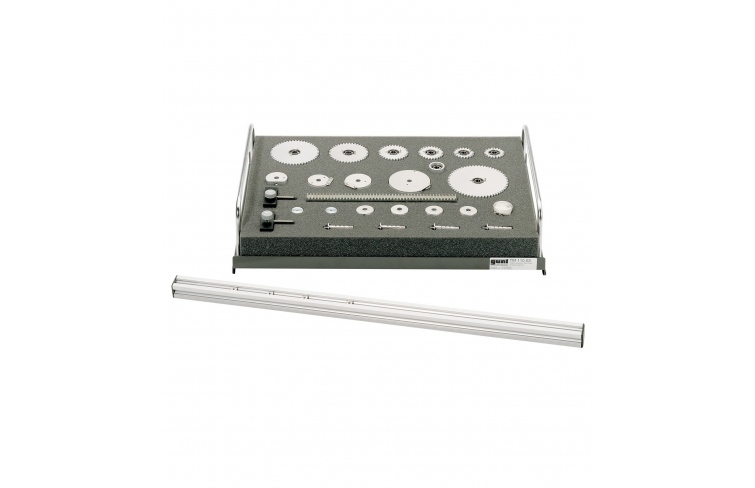
    TM 110.03

    • mode of operation of single-stage and multistage gears
    Obiettivi didattici (4)
    • · transmission ratio of speed and moment on a single-stage gear
    • · influence of intermediate wheels on the direction of rotation
    • · transmission ratio on a two-stage gear
    • · conversion of rotation into linear motion and vice versa
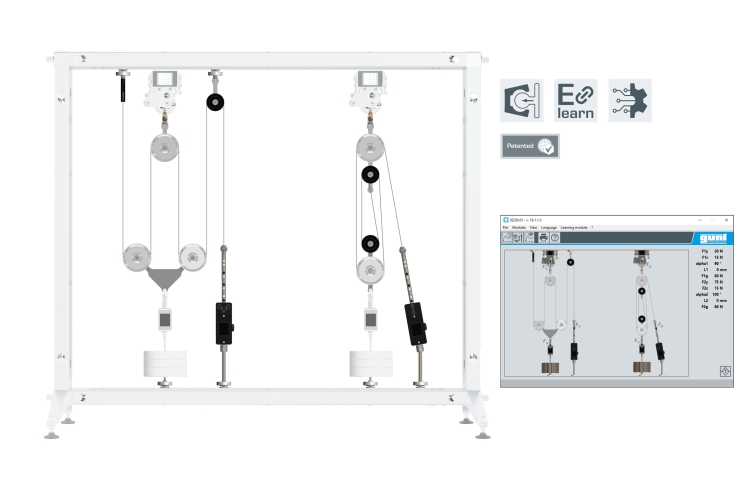
    SE 200.05

    • wireless setup of pulley blocks together with smart, communication-enabled suspension cables and accessories
    • investigate 2 different pulley blocks at the same time
    • 2 setup variants possible for each pulley block
    Obiettivi didattici (9)
    • · familiarisation with different pulley blocks
    • · cable forces
    • · support forces
    • · displacement
    • · angular dependence of forces
    • · force measurement under different loads
    • · retrieve information from digital networks
    • · E-Learning course with fundamental knowledge and detailed presentation of the experiment procedure and engaging animations
    • · assured learning success through digital worksheets
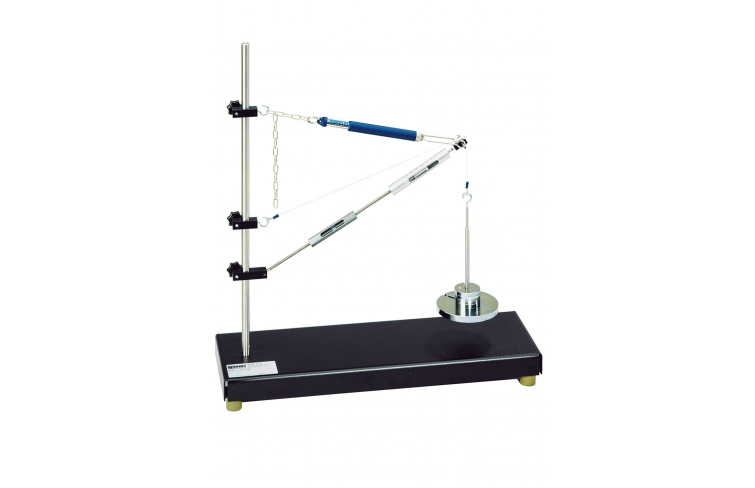
    TM 115

    • vectoral handling of forces in a planar central force system
    Obiettivi didattici (3)
    • · graphical breakdown of forces by force parallelogram
    • · determination of the bar forces on various jib forms
    • · comparison of: measuring result – calculation – graphical method
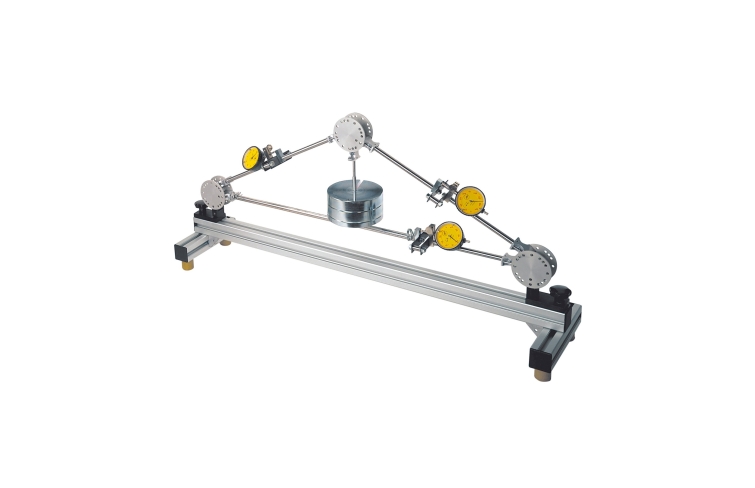
    FL 111

    • resolution of forces in simple bar structures
    Obiettivi didattici (3)
    • · measurement of bar forces
    • · calculation of bar forces by the method of joints
    • · comparison: measuring result – calculation – graphical method
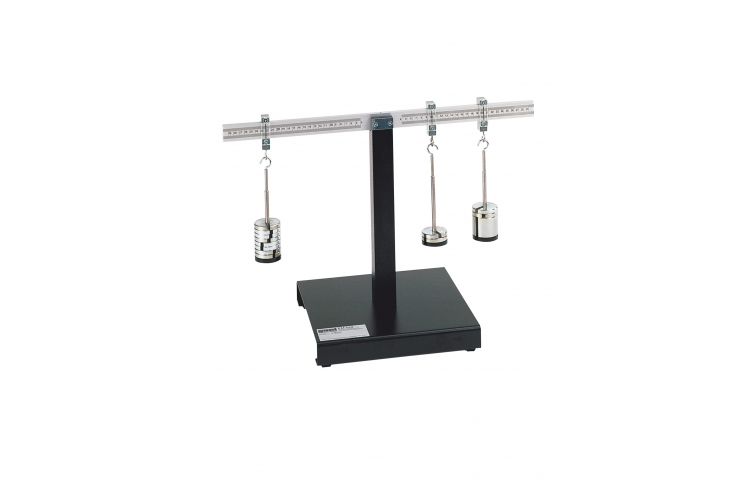
    EM 049

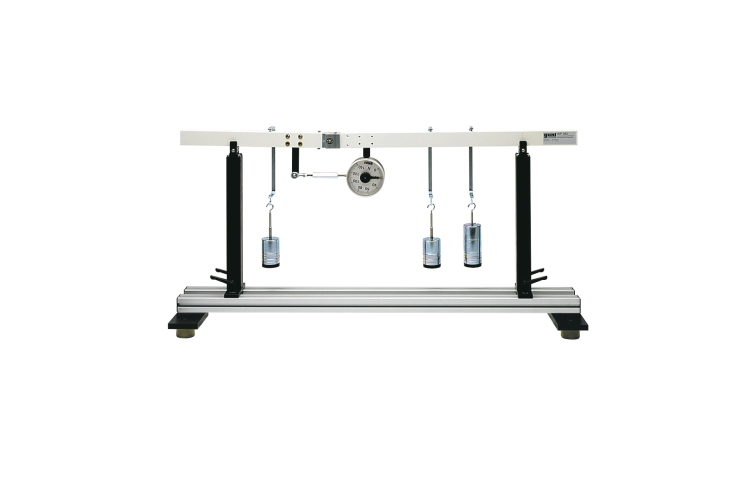
    • fundamentals of the equilibrium of moments and application of the law of levers
    Obiettivi didattici (2)
    • · fundamentals of the equilibrium of moments: applied forces, generated moments and equilibrium
    • · action of forces dependent on the lever arm
    SE 110.53

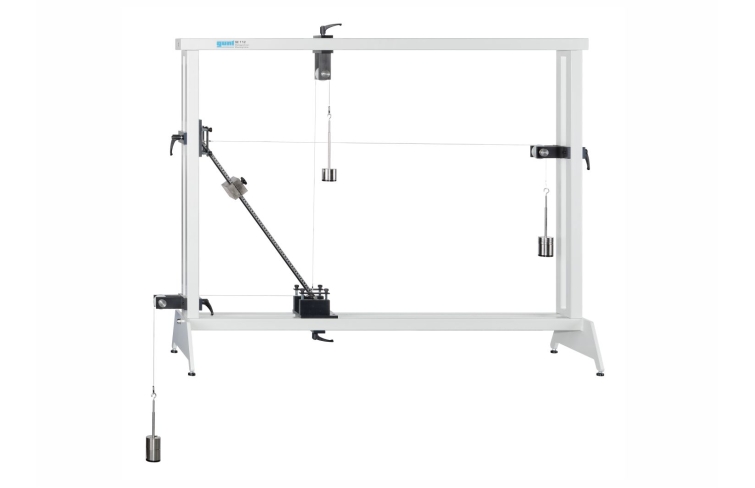
    • equilibrium conditions and support reactions of a leaning ladder
    Obiettivi didattici (5)
    • · experimental development of the core principle of “freeing” in statics
    • · calculation of the support forces for a given position of the clamp weight and for a known angle of inclination
    • · and full compensation of the support forces by cable forces
    • · how does the clamp weight position affect the support forces
    • · how the angle of inclination affects the support forces
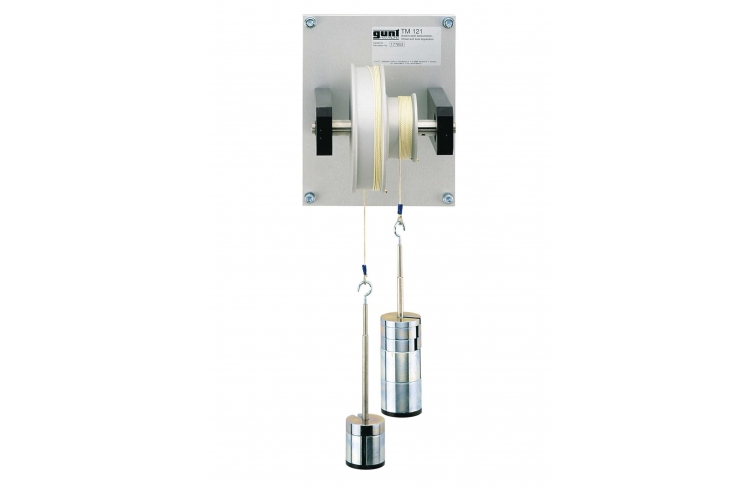
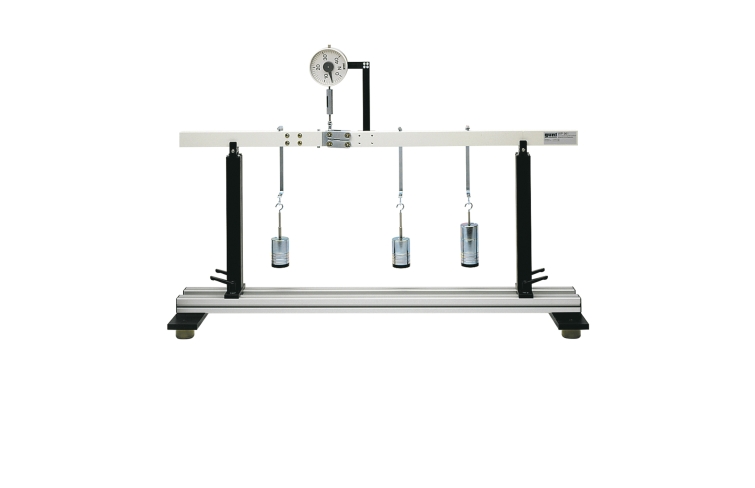
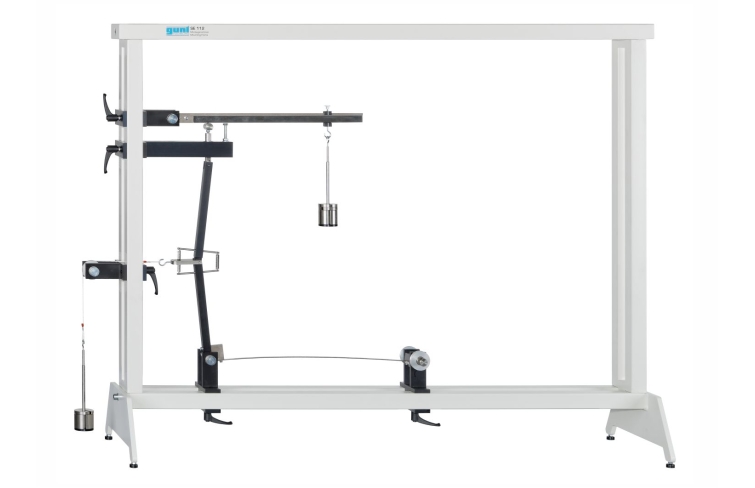
    TM 121

    • memorable demonstration of the equilibrium of moments
    Obiettivi didattici (2)
    • · fundamentals of the equilibrium of moments: acting forces, generated moments and equilibrium
    • · effect of forces as a function of pulley diameter
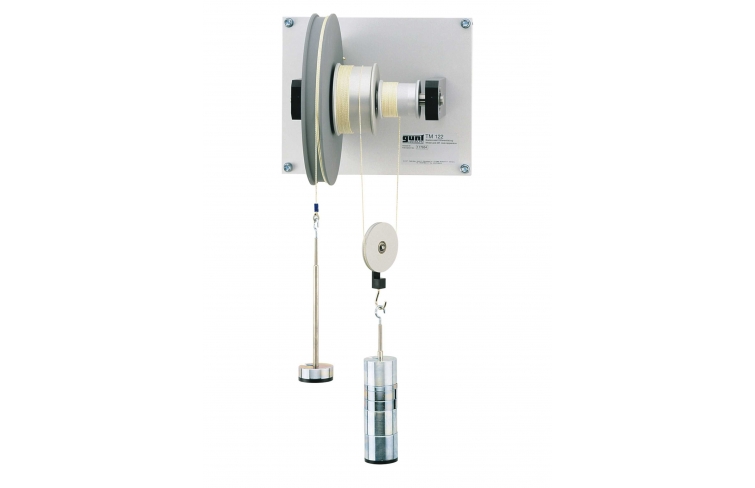
    TM 122

    • demonstration of power savings on the differential pulley block
    Obiettivi didattici (2)
    • · fundamentals of the equilibrium of moments: acting forces, generated moments and equilibrium
    • · relation between power savings and cable route
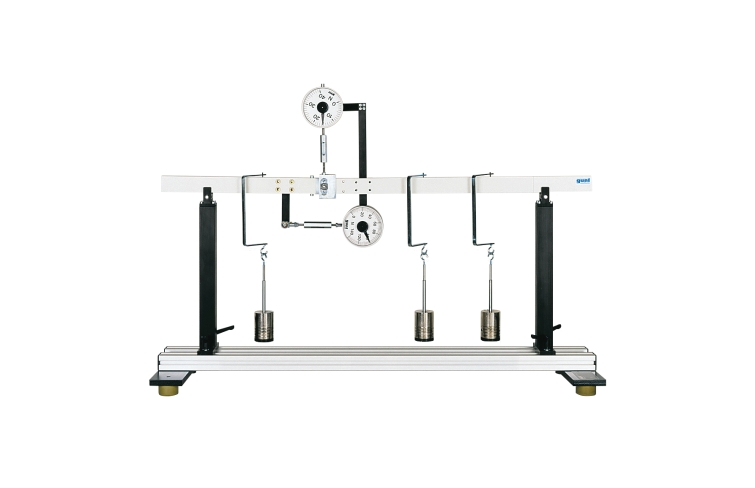
    WP 960

    • application of the method of sections to determine internal reactions of the beam
    • direct indication of shear force and bending moment at a section on the beam
    Obiettivi didattici (6)
    • · calculation of the reactions arising from the static conditions of equilibrium
    • · under a point load
    • · under multiple point loads
    • · calculation of the shear force diagram
    • · calculation of the bending moment diagram
    • · comparison of calculated and measured values for shear force and bending moment
    WP 961

    • application of the method of sections to determine the shear force
    Obiettivi didattici (5)
    • · calculation of the reactions arising from the static conditions of equilibrium
    • · under a point load
    • · under multiple point loads
    • · calculation of the shear force diagram
    • · comparison of calculated and measured shear force values
    WP 962

    • application of the method of sections to determine the bending moment
    Obiettivi didattici (5)
    • · calculation of the reactions arising from the static conditions of equilibrium
    • · under a point load
    • · under multiple point loads
    • · calculation of the bending moment curve
    • · comparison of calculated and measured bending moment values
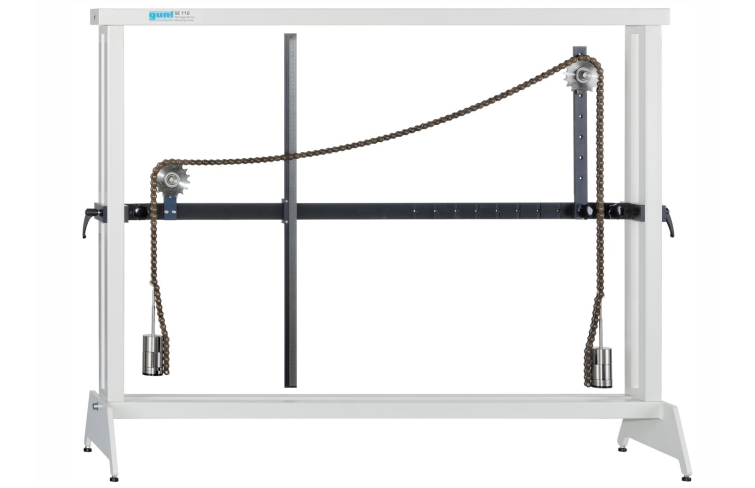
    SE 110.50

    • catenary of a free-hanging cable under dead-weight
    Obiettivi didattici (6)
    • · under dead-weight only
    • · with additional weights
    • · with a symmetrical setup (chain wheels at same height)
    • · with an unsymmetrical setup
    • · measurement of the sag
    • · comparison of calculated and measured values
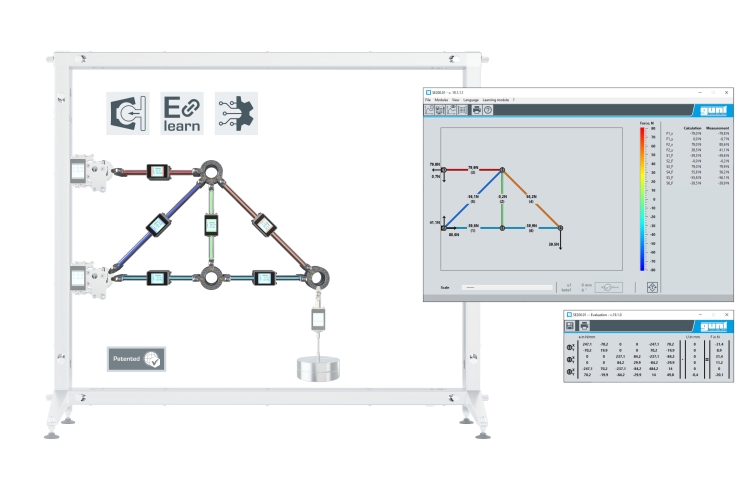
    SE 200.01

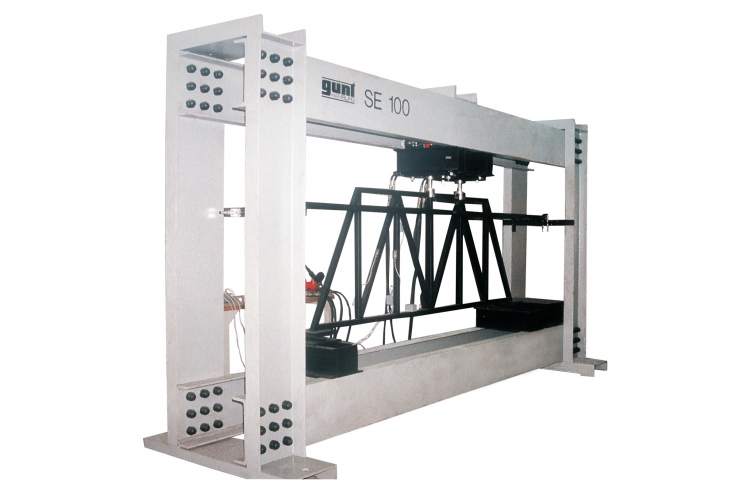
    • wireless setup of trusses together with smart, communication-enabled bars and accessories
    • measured values and coloured display of the force directly on the bar and in the software
    • click system for easy setup and reconfiguration
    Obiettivi didattici (9)
    • · measurement of the bar forces in a statically determinate and statically indeterminate plane truss
    • · quantity, direction, point of application
    • · measurement and determination of support reactions
    • · method of joints
    • · Ritter’s method of sections
    • · basic principle: measurement of forces using strain gauges
    • · retrieve information from digital networks
    • · E-Learning course with fundamental knowledge and detailed presentation of the experiment procedure and engaging animations
    • · assured learning success through digital worksheets
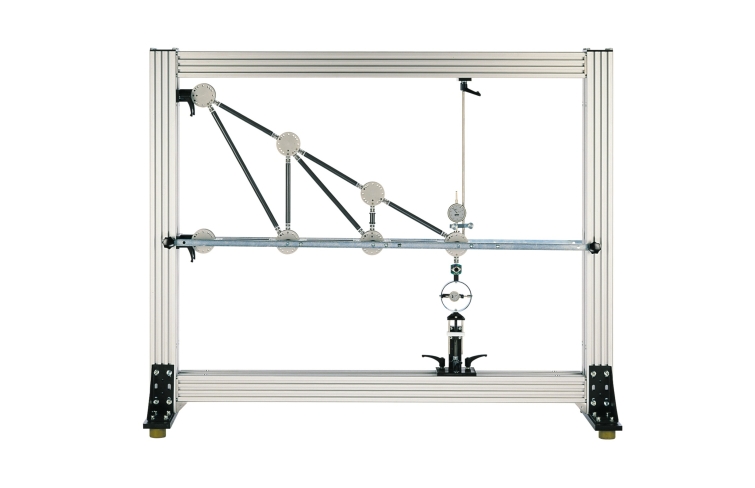
    SE 110.21

    • measurement of the bar forces in a single plane truss
    • construction of various truss forms
    • bars with strain gauge measurement to measure bar force
    Obiettivi didattici (7)
    • · measurement of the bar forces in various single plane trusses
    • · magnitude
    • · direction
    • · point of application
    • · method of joints
    • · Ritter’s method of sections
    • · basic principle: measurement of forces using strain gauge measurement
    SE 110.22

    • comparison of forces in statically determinate and indeterminate trusses
    • bars with strain gauge measurement to measure bar force
    Obiettivi didattici (6)
    • · measurement of the bar forces in a statically determinate and a statically indeterminate, single plane truss
    • · distribution of forces in the single plane truss dependent on the use of a surplus bar
    • · magnitude, direction, point of application
    • · method of joints
    • · Ritter’s method of sections
    • · basic principle: measurement of forces using strain gauge measurement
    SE 130

    • measurement of bar forces on a single plane truss, Howe type
    • measurement of bar forces by strain gauge measurement
    • external load may be applied at different angles
    Obiettivi didattici (6)
    • · measurement of the bar forces in a single plane truss, Howe type
    • · magnitude, direction, point ofapplication
    • · method of joints
    • · Ritter’s method of sections
    • · Cremona diagram
    • · basic principle: measurement of forces using strain gauge measurement
    SE 130.01

    • ready assembled Warren truss
    • bars with strain gauge measurement to measure bar force
    Obiettivi didattici (4)
    • · calculation of tensile and compressive forces in bars in different load cases: straight and inclined forces
    • · method of joints
    • · Ritter’s method of sections
    • · Cremona diagram
    SE 200.02

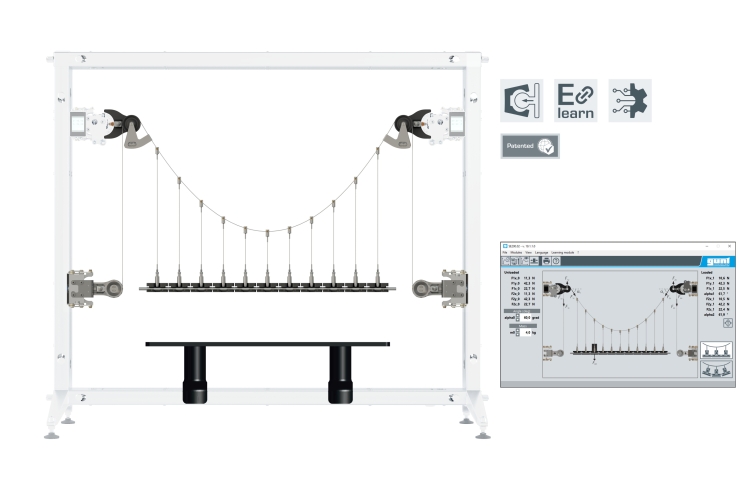
    • wireless setup of a suspension bridge together with smart, communication-enabled accessories
    • experiments with rigid or flexible roadway
    • click system for easy setup and reconfiguration
    Obiettivi didattici (8)
    • · unloaded suspension bridge
    • · loaded suspension bridge
    • · measurement of the support forces as a function of the loading on the suspension bridge
    • · effect of a moving load
    • · behaviour of a suspension bridge with a rigid or flexible roadway
    • · retrieve information from digital networks
    • · E-Learning course with fundamental knowledge and detailed presentation of the experiment procedure and engaging animations
    • · assured learning success through digital worksheets
    SE 110.18

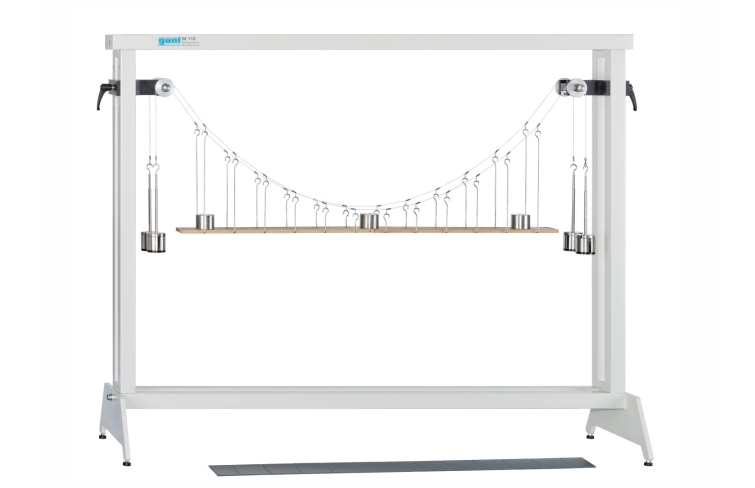
    • rigid or elastic roadway for the suspension bridge
    • different load cases possible: point or line load
    • catenary of a free-hanging cable
    Obiettivi didattici (9)
    • · under dead-weight
    • · under additional weight
    • · under evenly distributed load (line load)
    • · under unevenly distributed loads (point load)
    • · calculation of the supporting cable force
    • · comparison between calculated and measured values of the supporting cable force
    • · for a rigid roadway
    • · for an elastic roadway
    • · determination of the catenary of a free-hanging cable
    SE 200.07

    • wireless setup of a Gerber beam together with smart, communication-enabled accessories
    • experiments with different support positions and loads
    • click system for easy setup and reconfiguration
    Obiettivi didattici (11)
    • · familiarisation with Gerber beam
    • · point load
    • · line load
    • · moving load
    • · shear force diagram
    • · bending moment diagram
    • · determine lines of influence under moving load
    • · comparison of calculated and measured support reactions for static load and moving load
    • · retrieve information from digital networks
    • · E-Learning course with fundamental knowledge and detailed presentation of the experiment procedure and engaging animations
    • · assured learning success through digital worksheets
    SE 110.12

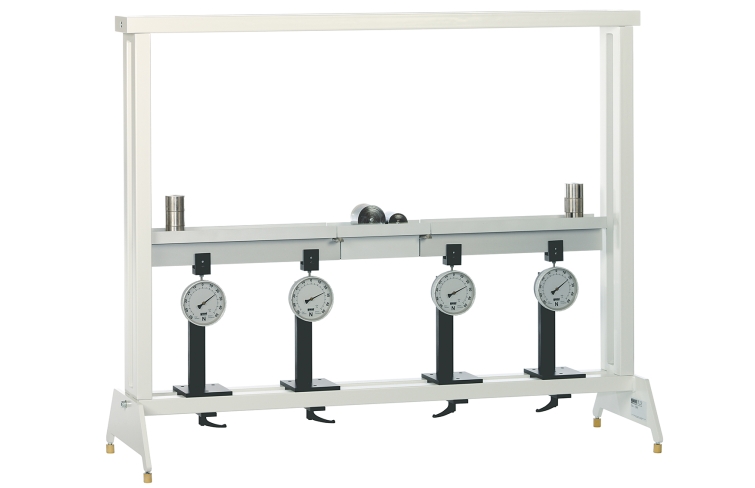
    • articulated beam with two cantilever beams and a suspended beam as an example of a typical bridge
    • direct indication of reactions
    • lines of influence for different load cases
    Obiettivi didattici (8)
    • · familiarisation with a Gerber beam
    • · point load
    • · line load
    • · moving load
    • · shear force curve
    • · bending moment diagram
    • · determination of the lines of influence under moving load
    • · comparison of the calculated and measured reactions for static and moving load
    SE 200.06

    • wireless setup of a statically determinate three-hinged arch together with smart, communication-enabled accessories
    • symmetrical or asymmetrical setup possible
    • click system for easy setup and reconfiguration
    Obiettivi didattici (10)
    • · familiarisation with three-hinged arches (asymmetrical and symmetrical)
    • · point load
    • · moving load
    • · measurement of internal forces on a beam, clamped on one end, and three-hinged arch
    • · influence of the load on the horizontal thrust in the supports
    • · determination of the lines of influence for the supports under a moving load
    • · comparison of the calculated and measured support reactions for static load and moving load
    • · retrieve information from digital networks
    • · E-Learning course with fundamental knowledge and detailed presentation of the experiment procedure and engaging animations
    • · assured learning success through digital worksheets
    SE 110.17

    • statically determinate three-hinged arch
    • symmetrical or unsymmetrical arch
    • various load cases: point load, line load, moving load
    Obiettivi didattici (5)
    • · familiarisation with three-hinged arches (unsymmetrical and symmetrical)
    • · point load, line load, moving load
    • · investigation of the influence of the load on the horizontal thrust in the supports
    • · determination of the lines of influence for the supports under a moving load
    • · comparison of the calculated and measured support reactions for static and moving load
    SE 200.03

    • wireless setup of an arch bridge together with smart, communication-enabled accessories
    • bearing for measuring force and displacement
    • click system for easy setup and reconfiguration
    Obiettivi didattici (7)
    • · unloaded arch bridge
    • · loaded arch bridge
    • · measurement of the support forces as a function of the loading on the arch bridge
    • · effect of a moving load
    • · retrieve information from digital networks
    • · E-Learning course with fundamental knowledge and detailed presentation of the experiment procedure and engaging animations
    • · assured learning success through digital worksheets
    SE 110.16

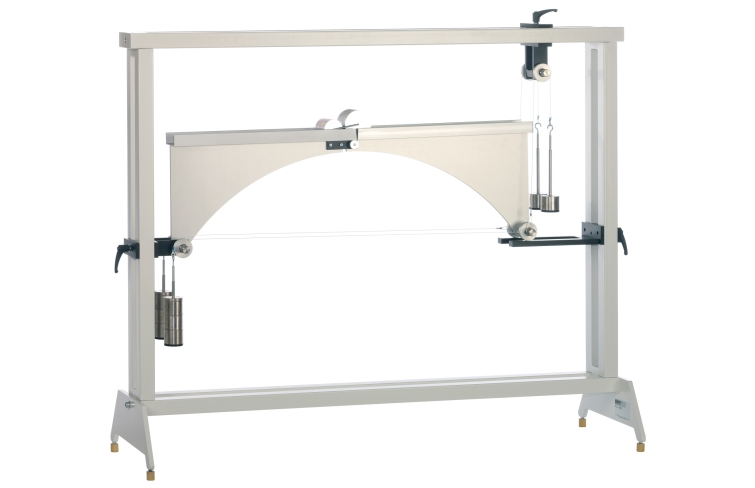
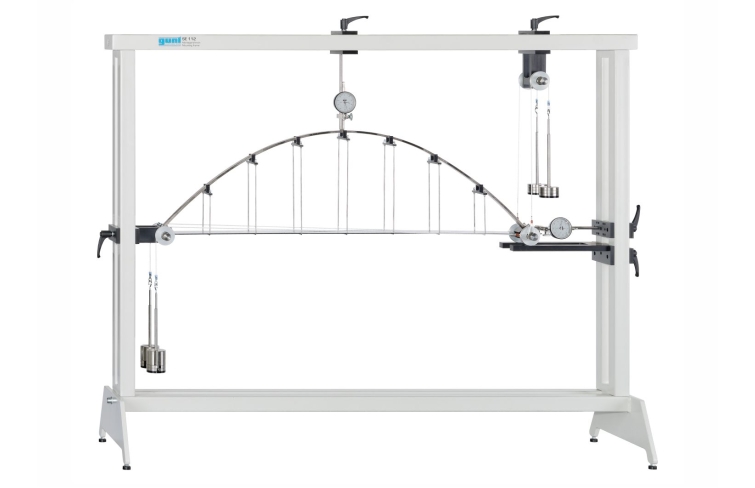
    • statically determinate or statically indeterminate parabolic arch under load
    • deformations of the arch under load
    • bearing reactions of the arch
    Obiettivi didattici (8)
    • · mechanical principles of the parabolic arch
    • · differences between statically determinate and statically indeterminate arches
    • · measurement of the deformations of the arch under load
    • · measurement of the bearing reactions on the statically indeterminate arch under load
    • · calculation of the bearing reactions
    • · point load
    • · line load
    • · suspended elastic roadway under load
    SE 110.30

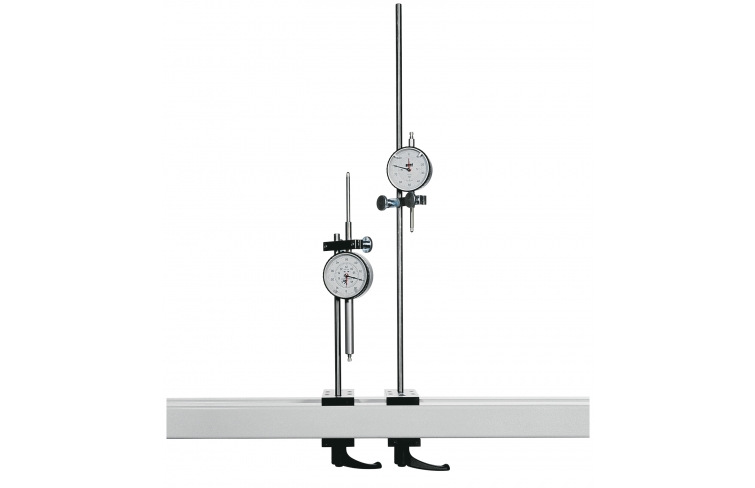
    • position measurement gauges for measuring deformation and displacement in mechanical experiments
    SE 112

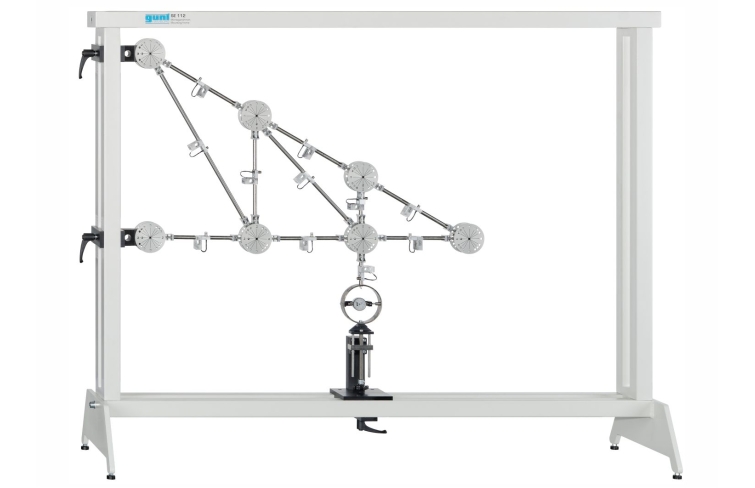
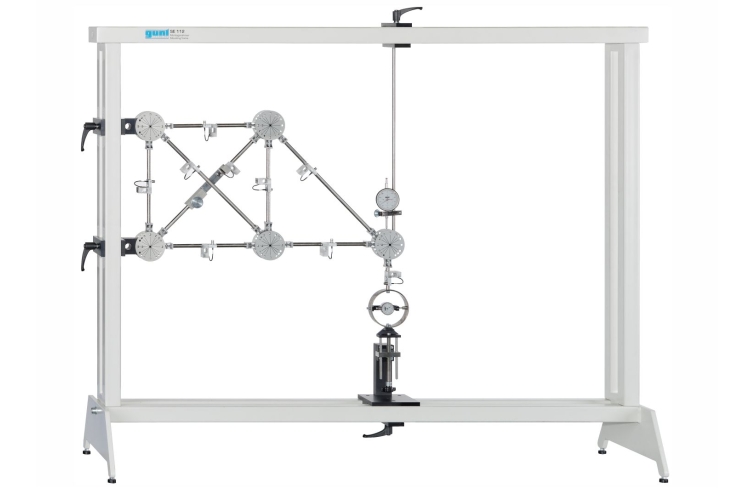
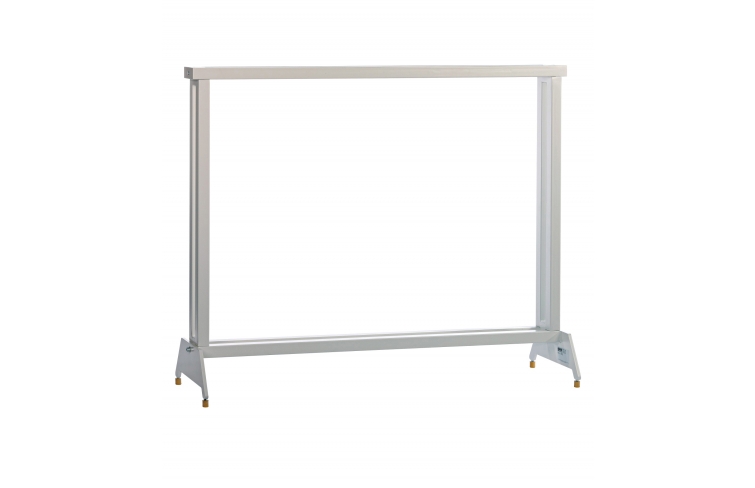
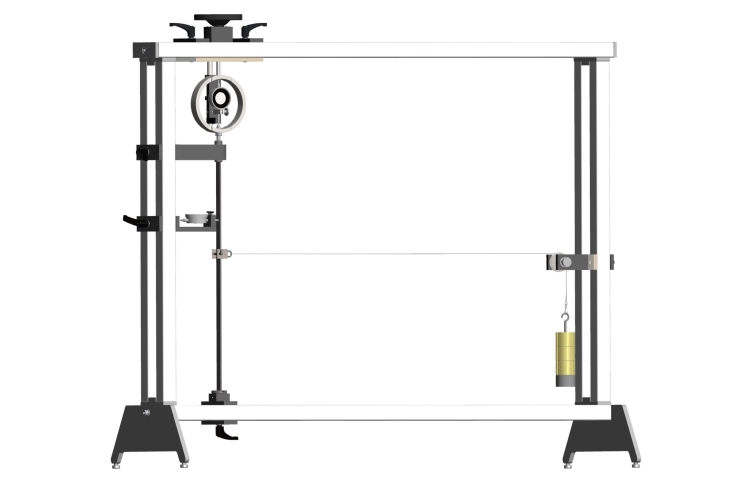
    • mounting frame for setup of experiments in statics, strength of materials and dynamics
    SE 200

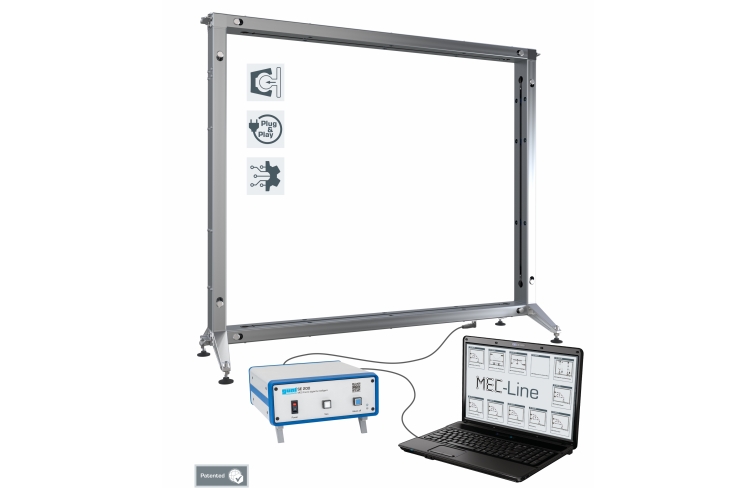
    • mounting frame for holding smart, communication-enabled components for experiments in engineering mechanics
    • Plug&Play: wireless and digital connection of the components, automatic identification with position and alignment
    • click system for easy experiment setup and reconfiguration
    TM 200

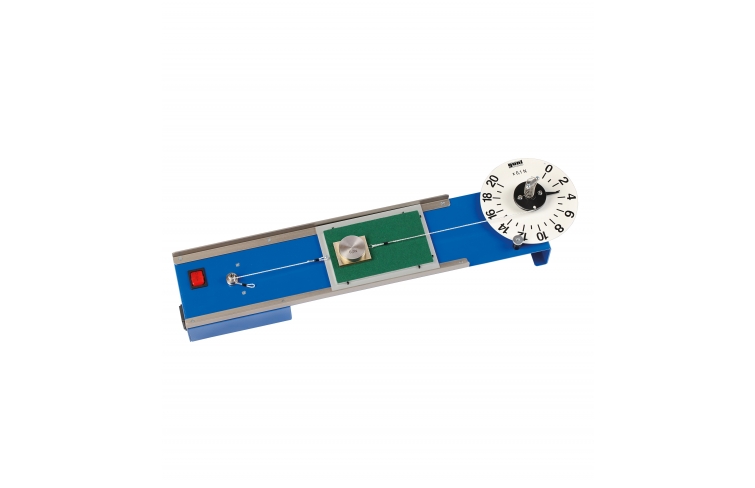
    • stationary friction body, uniformly moving friction plate
    Obiettivi didattici (5)
    • · difference between static and dynamic friction
    • · normal force, material pairing, size of contact area
    • · sliding velocity (relative velocities of the friction partners)
    • · surface properties of the friction partners
    • · determine coefficients of friction
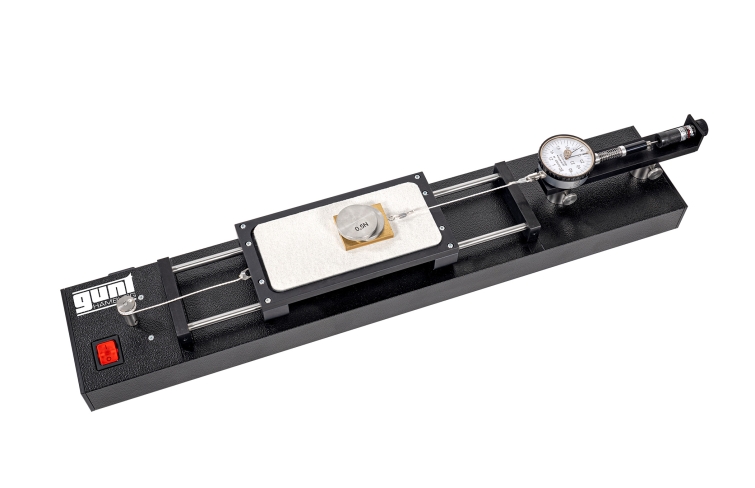
    TM 210

    • fundamentals of mechanical friction
    • stationary friction body, uniformly moving friction plate
    • force gauge with air damping cylinder
    Obiettivi didattici (8)
    • · difference between static and dynamic friction
    • · normal force
    • · sliding velocity (relative velocities of the friction partners)
    • · material pairing
    • · surface properties of the friction partners
    • · size of contact area
    • · slip/stick effect
    • · determination of friction coefficients
    SE 200.04

    • wireless setup of an inclined plane with smart, communication-enabled components
    • experiments with different material pairings
    • click system for easy setup and reconfiguration
    Obiettivi didattici (9)
    • · adhesion
    • · friction
    • · determination of angular dependence
    • · determination of material dependence
    • · measurement of distance travelled and time passed
    • · determination of velocity and acceleration
    • · retrieve information from digital networks
    • · E-Learning course with fundamental knowledge and detailed presentation of the experiment procedure and engaging animations
    • · assured learning success through digital worksheets
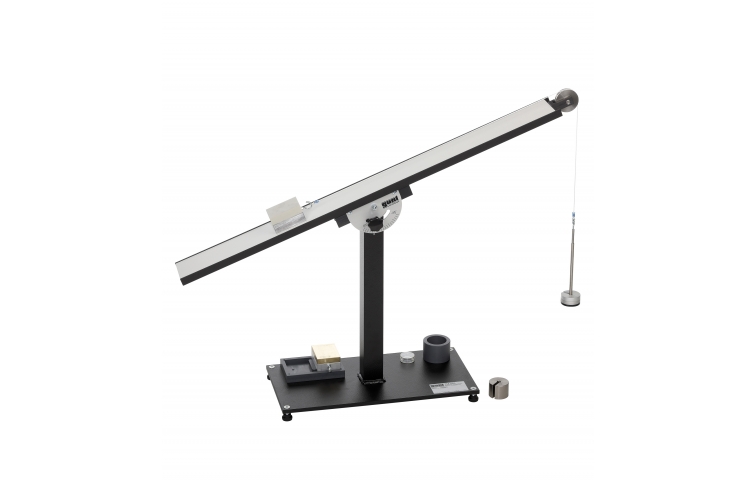
    TM 225

    • dry friction on the inclined plane
    • fundamentals of mechanical friction
    Obiettivi didattici (4)
    • · determination of the friction coefficients of various material pairings
    • · transition from static to dynamic
    • · static equilibrium of forces on the inclined plane
    • · determination of the angle of inclination as from which sliding occurs (calculation and verification by experiment)
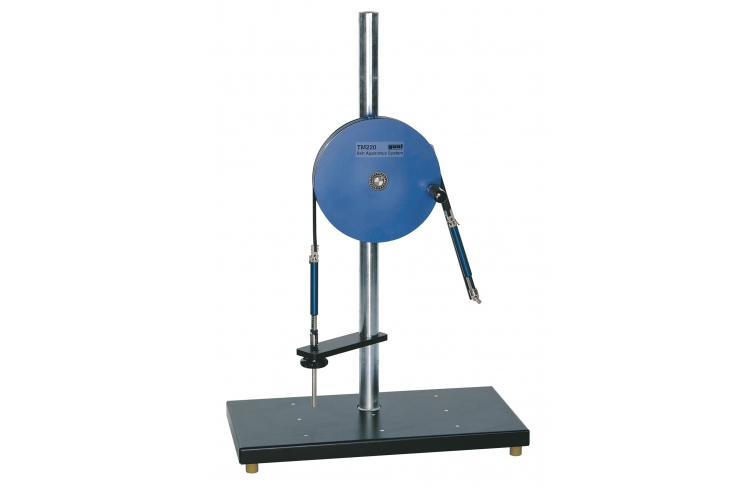
    TM 220

    • function of a belt drive
    • friction of different belt types on a metal pulley
    Obiettivi didattici (3)
    • · effect of wrap angle, coefficient of friction and cable force (Eytelwein’s belt friction formula)
    • · comparison of flat belts and V-belts
    • · consequences of an unadapted V-belt groove
  • Resistenza dei materiali

    29 prodotti

    SE 110.14

    • beams of different materials: steel, brass and aluminium
    Obiettivi didattici (4)
    • · elastic line under varying load
    • · elastic line under various support conditions
    • · demonstration of Maxwell–Betti’s theorem
    • · elastic line in statically indeterminate systems
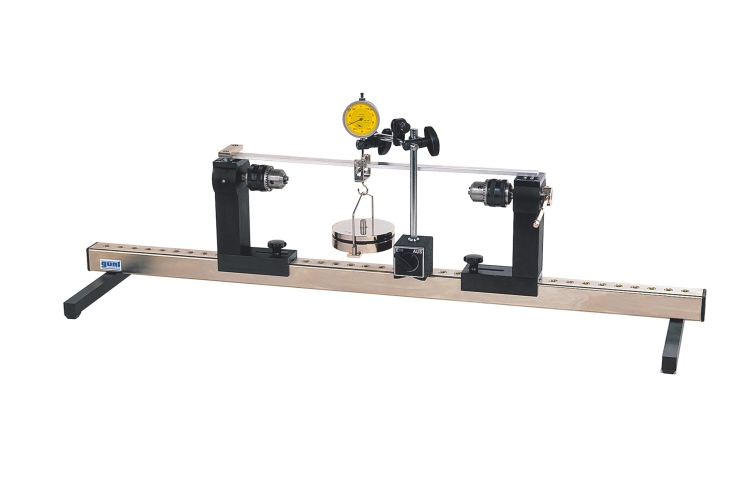
    WP 950

    • deformation of a beam on two or more supports under point loads (e.g. single-span beam)
    • deformation of a cantilever beam under point loads
    • statically determinate or indeterminate systems
    Obiettivi didattici (11)
    • · cantilever beam
    • · single-span beam, dual- or triple-span beam
    • · formulation of the differential equation for the elastic line
    • · measurement of deflection at the force application point
    • · measurement of the support reactions
    • · measurement of the deformations
    • · influence of the material (modulus of elasticity) and the beam cross-section (geometry) on the elastic line
    • · Maxwell-Betti coefficients and law
    • · application of the principle of virtual work on statically determinate and indeterminate beams
    • · arithmetically
    • · qualitatively by way of force method (Müller-Breslau)
    SE 110.47

    • comparison of different methods to determine the elastic line: virtual work, Mohr’s analogy
    • statically determinate and indeterminate systems
    • various load cases: point load or bending moment
    Obiettivi didattici (7)
    • · elastic lines for statically determinate or indeterminate beams under load
    • · the principle of virtual work (calculation)
    • · Mohr’s analogy (area moment method devised by Mohr; graphical representation)
    • · application of the principle of superposition
    • · maximum deflection of the beam
    • · angle of inclination of the beam
    • · comparison between calculated and measured values for angle of inclination and deflection
    SE 200.10

    • wireless setup of a torsional test with smart, communication-enabled components
    • elastic torsion of bars under torsional moment
    • click system for easy setup and reconfiguration
    Obiettivi didattici (12)
    • · torsion of a bar
    • · shear modulus and polar moment of inertia
    • · angle of twist as a function of torsional moment
    • · round bar with full cross-section
    • · stainless steel and titanium tubes
    • · flat profile
    • · U-profile
    • · calculate angle of twist
    • · comparison of calculated and measured angles of twist
    • · retrieve information from digital networks
    • · E-Learning course with fundamental knowledge and detailed presentation of the experiment procedure and engaging animations
    • · assured learning success through digital worksheets
    SE 110.29

    • elastic torsion of a bar under a torque
    • round bar, tube, longitudinally slotted tube and square tube as test bars
    • indication of the angle of twist at two random points on the bar
    Obiettivi didattici (10)
    • · torsion of a bar
    • · shear modulus of elasticity and second polar moment of area
    • · angle of twist dependent on clamping length
    • · angle of twist dependent on torque
    • · round bar with full cross-section
    • · tube
    • · tube, longitudinally slotted
    • · square tube
    • · calculation of angle of twist
    • · comparison of calculated and measured angle of twist
    WP 100

    • elastic deformation of statically determinate or indeterminate beams under bending load
    • elastic torsion of round bars under twisting moment
    • influence of material, cross-section and clamping length on deformation
    Obiettivi didattici (8)
    • · determination of the modulus of elasticity
    • · statically determinate systems (beam mounted on two supports; cantilever beam)
    • · statically indeterminate systems (dual-span beam)
    • · deformation of a beam dependent on material, geometry (section width, height and length), type of support and length of span
    • · formulation of proportional relationships for the deformation
    • · determination of the shear modulus of various materials
    • · angle of twist dependent on clamping length, bar diameter
    • · formulation of proportional relationships for the angle of twist
    SE 200.09

    • wireless setup together with smart, communication-enabled accessories
    • elastic deformation of a statically indeterminate frame under point load
    • U-shaped and arched frame made of stainless steel
    Obiettivi didattici (6)
    • · relationship between load and deformation on the frame
    • · theory of elasticity, Castigliano’s theorem
    • · application of the principle of virtual work on statically determinate cantilever beam and statically indeterminate frames
    • · retrieve information from digital networks
    • · E-Learning course with fundamental knowledge and detailed presentation of the experiment procedure and engaging animations
    • · assured learning success through digital worksheets
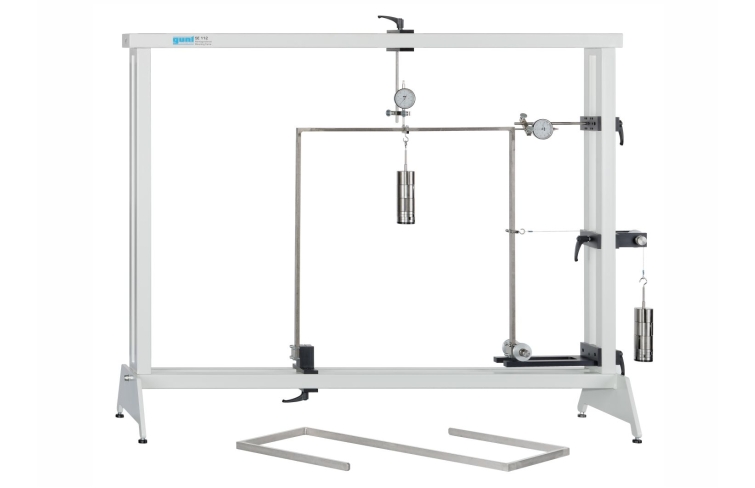
    SE 110.20

    • elastic deformation of a statically determinate or indeterminate frame under point load
    • U-shaped and S-shaped frame
    • principle of virtual work to calculate the deformation and support reaction in a statically indeterminate system
    Obiettivi didattici (7)
    • · relationship between load application and deformation on the frame
    • · differences between statically determinate and statically indeterminate frames
    • · familiarisation with the first-order elasticity theory for statically determinate and indeterminate systems
    • · application of the principle of superposition
    • · determination of a deformation by the principle of virtual forces
    • · determination of a load by the principle of virtual displacement
    • · comparison of calculated and measured deformations
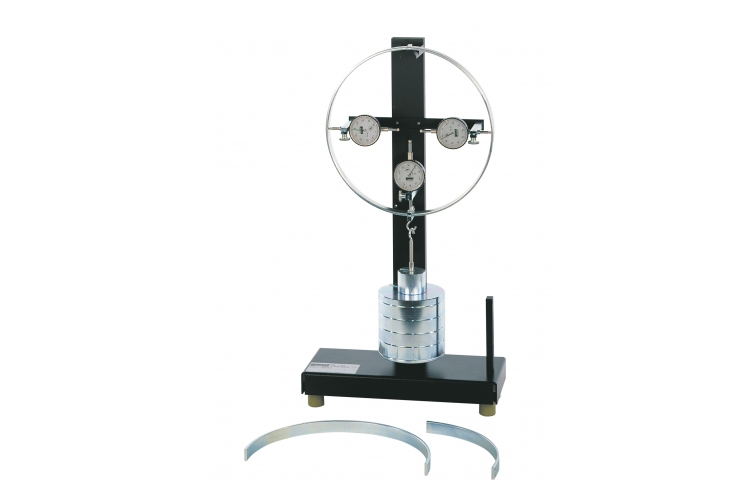
    FL 170

    • elastic deformation of curved-axis beams
    • circular, semi-circular and quadrant beams
    Obiettivi didattici (6)
    • · circular beam
    • · semi-circular beam
    • · quadrant beam
    • · application of the principle of virtual forces (the force method) to calculate deformation
    • · second moment of area
    • · comparison of calculated and measured deformations
    SE 110.44

    • elastic deformation in a single plane truss
    • construction of various truss
    • application of Castigliano’s first theorem
    Obiettivi didattici (7)
    • · elastic deformation of truss under point load
    • · calculation of support reaction and bar forces
    • · principle of work and strain energy
    • · application of Castigliano’s first theorem to calculate the deformation at a defined point
    • · verification of the calculated deformation possible by the principle of virtual work
    • · comparison of the deformations of different trusses under the same load
    • · comparison of measured and calculated deformation
    SE 200.01

    • wireless setup of trusses together with smart, communication-enabled bars and accessories
    • measured values and coloured display of the force directly on the bar and in the software
    • click system for easy setup and reconfiguration
    Obiettivi didattici (9)
    • · measurement of the bar forces in a statically determinate and statically indeterminate plane truss
    • · quantity, direction, point of application
    • · measurement and determination of support reactions
    • · method of joints
    • · Ritter’s method of sections
    • · basic principle: measurement of forces using strain gauges
    • · retrieve information from digital networks
    • · E-Learning course with fundamental knowledge and detailed presentation of the experiment procedure and engaging animations
    • · assured learning success through digital worksheets
    TM 262

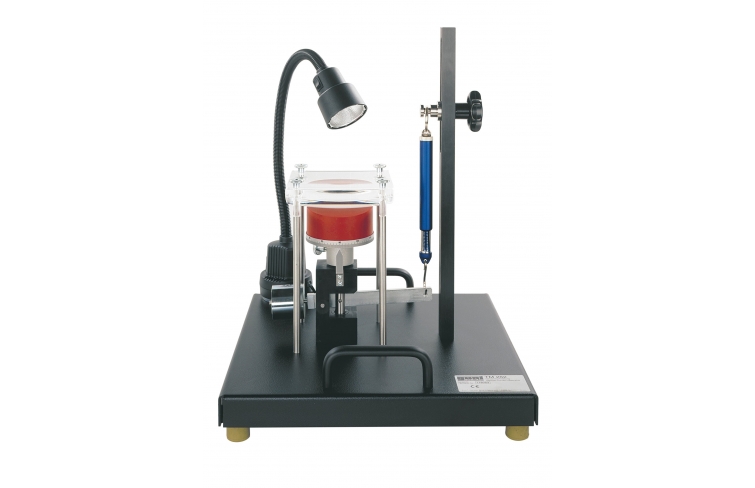
    • demonstration of the contact area under Hertzian pressure
    • generation of circular or elliptical contact areas
    • especially clear results due to pairing transparent plastic with silicone rubber
    Obiettivi didattici (3)
    • · resulting shape of the contact area under point contact with different radii of curvature
    • · shape of the contact area as a function of the contact force
    • · influence of an additional transverse component of the contact force
    TM 400

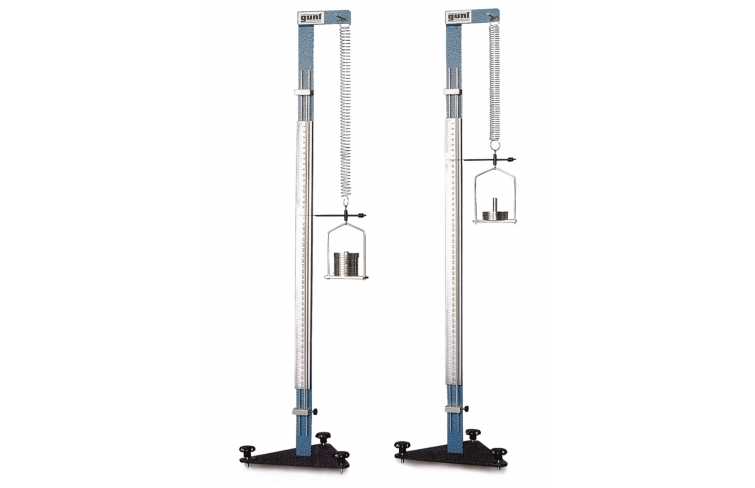
    • elastic behaviour of tension springs under load
    Obiettivi didattici (4)
    • · investigation of the proportionality of the active force and the spring deflection
    • · determination of the spring constant
    • · series configuration of two tension springs
    • · investigation of the influence of the spring constant on the frequency of a spring-mass system
    SE 200.08

    • wireless setup of a buckling device together with smart, communication-enabled accessories
    • stainless steel test bars
    • different types of support for test bars: free, hinged and clamped
    Obiettivi didattici (7)
    • · investigation of buckling behaviour under the influence of different bearings
    • · verification of the Euler theory: buckling of elastic bars
    • · calculation of the expected buckling force using the Euler formulae
    • · measure force and deflection
    • · retrieve information from digital networks
    • · E-Learning course with fundamental knowledge and detailed presentation of the experiment procedure and engaging animations
    • · assured learning success through digital worksheets
    SE 110.19

    • representation of simple stability problems on a buckling bar
    • determination of the buckling load under different conditions
    • continuously variable load application on the buckling bar
    Obiettivi didattici (4)
    • · elastic joint
    • · elastic fixed end support
    • · of additional shear forces
    • · of pre-deformation
    SE 110.57

    • demonstration of buckling in bars
    • test bars made of different materials and for different support types
    • experiments with eccentric application of force and shear forces
    Obiettivi didattici (8)
    • · different supports, clamps
    • · different cross-sections
    • · different materials
    • · additional shear forces
    • · testing Euler’s theory: buckling on elastic bars
    • · measure force and displacement
    • · calculate the expected buckling force with Euler’s buckling formula
    • · graphical analysis of the deflection and the force
    WP 120

    • investigation of all relevant buckling problems
    • verification of Euler’s theory of buckling
    • experiments with eccentric application of force and lateral load
    Obiettivi didattici (10)
    • · different supports and clamps
    • · different bar lengths and cross-sections
    • · different materials
    • · additional lateral load
    • · testing Euler’s theory: buckling on elastic bars
    • · calculating the expected buckling force with Euler’s formula
    • · graphical analysis of the deflection and the force
    • · measure force and deflection
    • · different cross-section shapes
    • · eccentric application of force
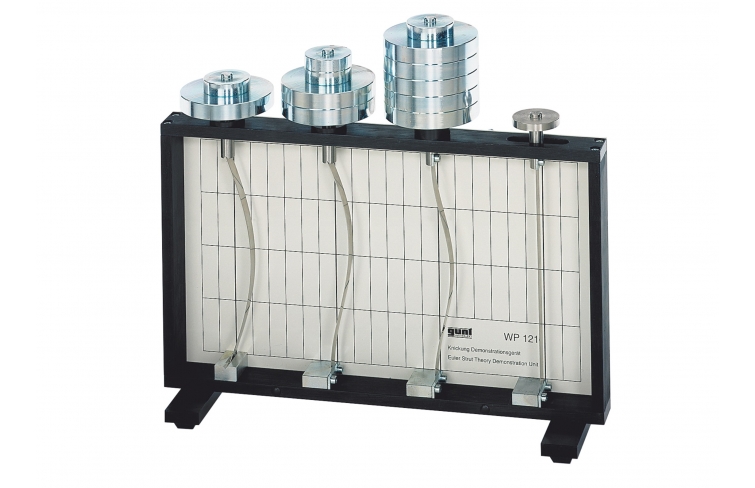
    WP 121

    • demonstration of all buckling cases of Euler buckling
    • buckling length clearly visible with various methods of support
    • test bars made of spring steel
    Obiettivi didattici (5)
    • · Euler case 1 – fixed-free bar
    • · Euler case 2 – pinned-pinned bar
    • · Euler case 3 – fixed-pinned bar
    • · Euler case 4 – fixed-fixed bar
    • · familiarisation with the correlation between buckling length, buckling load and various methods of support
    FL 160

    • symmetrical and unsymmetrical bending on a beam
    • symmetrical and unsymmetrical cross-sectional profiles: I, L and U
    • combined bending and torsion loading by way of eccentric force application
    Obiettivi didattici (8)
    • · Bernoulli hypothesis
    • · with I-profile
    • · with L-profile
    • · with U-profile
    • · calculation of the neutral fibres
    • · combined bending and torsion loading by way of eccentric force application
    • · familiarisation with shear flow (shear forces in a cross-section)
    • · comparison of calculated and measured values
    WP 130

    • verification of the Rankine yield criterion and the Tresca yield criterion
    • multi-axial loads of test specimens made of ductile metals by pure bending, pure torsion or a combination of the two
    • loading of the test specimen without shear force by compensation for the influence of dead-load
    Obiettivi didattici (8)
    • · steel, copper, brass, aluminium
    • · pure bending moment
    • · pure twisting moment
    • · combined bending moment and twisting moment
    • · determination of the yield point
    • · verification of the Rankine yield criterion
    • · verification of the Tresca yield criterion
    • · representation in Mohr’s circle of stresses and strains
    FL 100

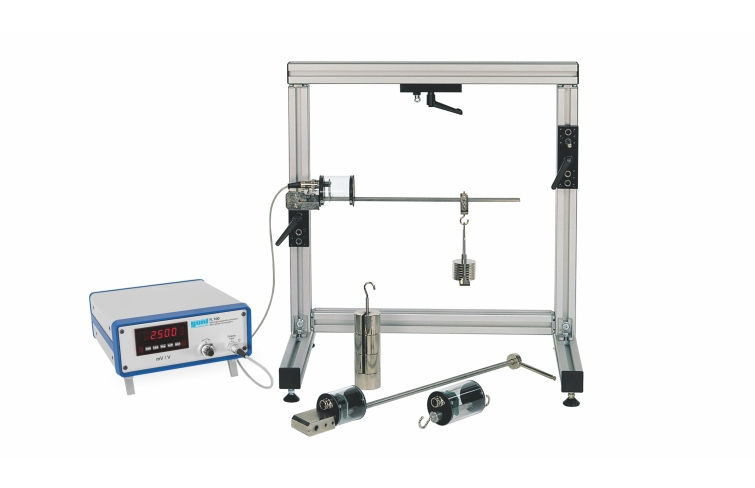
    • basic introduction to measurement with strain gauges
    • test bars for tension, bending and torsion with strain gauge measuring points as full bridge
    • universal 1-channel measuring amplifier
    Obiettivi didattici (4)
    • · fundamentals of measuring with strain gauges
    • · strain gauge types and application techniques
    • · calculation of the mechanical deformations under tension, bending and torsion
    • · correlation between mechanical strain and electrical resistance in a strain gauge
    FL 101

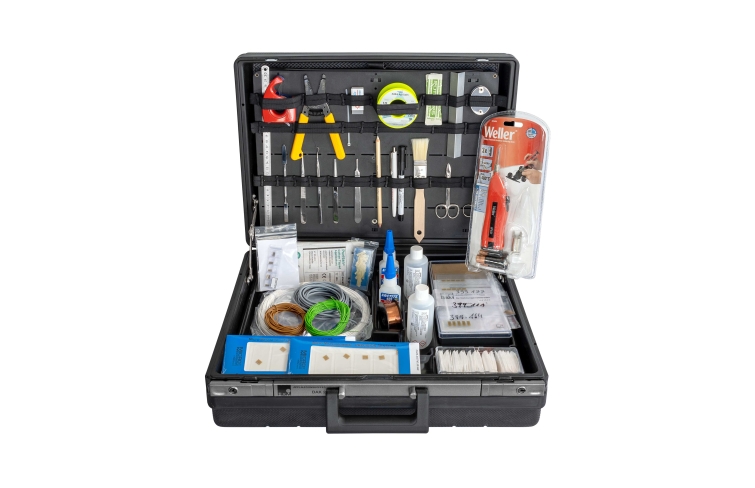
    • complete equipment for application of strain gauges with wiring and connecting of strain gauges
    • supporting the development of strain gauge measuring techniques
    Obiettivi didattici (6)
    • · fundamentals of electrical resistance strain gauges
    • · preparation of the measuring point
    • · selection of a suitable strain gauge
    • · attaching, wiring up and configuring strain gauges on mechanically stressed components
    • · protection of the strain gauge measuring point against external influences
    • · interpretation of measured values (theoretical)
    FL 102

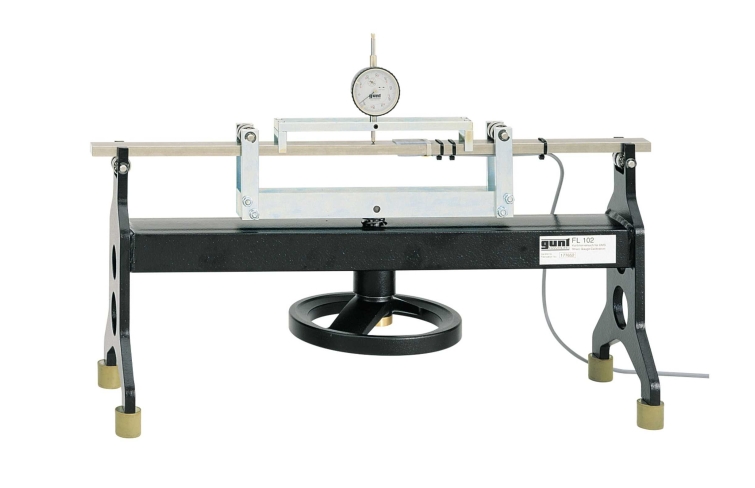
    • measurement of deflection and strain
    • determination of the gauge factor of strain gauges
    Obiettivi didattici (3)
    • · fundamentals of measurement using strain gauges
    • · measurement of deflection using a dial gauge
    • · determination of the gauge factor of strain gauges
    FL 120

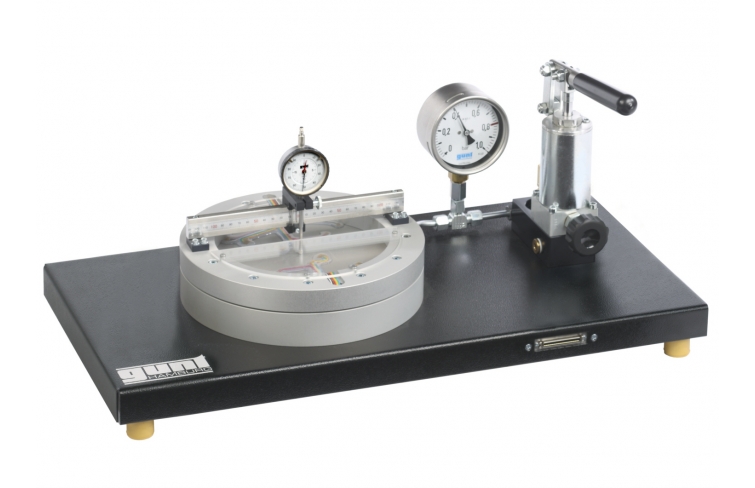
    • deflection and strain of a membrane under compressive load
    • membrane with strain gauge application
    • determine radial and tangential stress profiles from measured strains
    Obiettivi didattici (6)
    • · measure radial and tangential strain using strain gauges
    • · measure deflection using a dial gauge
    • · calculate the stresses from the measured strains: radial stress, tangential stress
    • · determine direction of principal stress
    • · application of Mohr’s strain circle to determine the principal strains
    • · fundamental principle: using strain gauge technology to measure strains
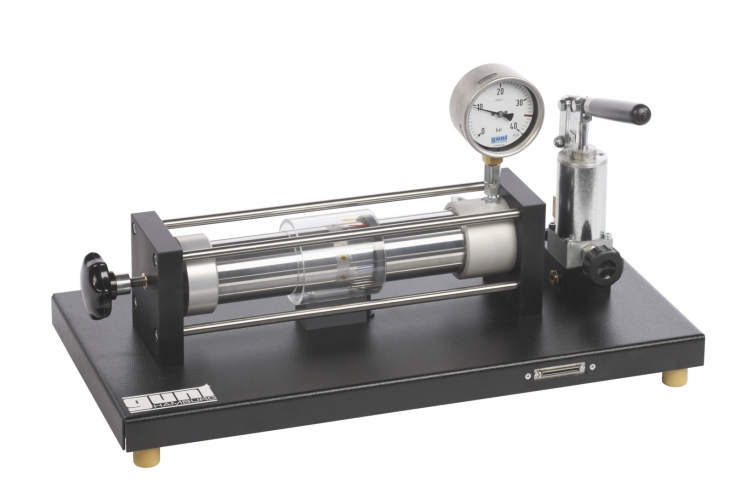
    FL 130

    • strain on a vessel under internal pressure
    • cylinder with strain gauge application as vessel
    • uniaxial or biaxial stress state shown in the experiment
    Obiettivi didattici (7)
    • · measure strains with strain gauges
    • · application of Mohr’s stress circle to determine the principal strain
    • · in an open vessel (pipe)
    • · in a closed vessel (boiler)
    • · comparison of open/closed vessels
    • · determine Poisson’s ratio
    • · investigation of relations between strains, pressure and stresses in a plane biaxial stress state
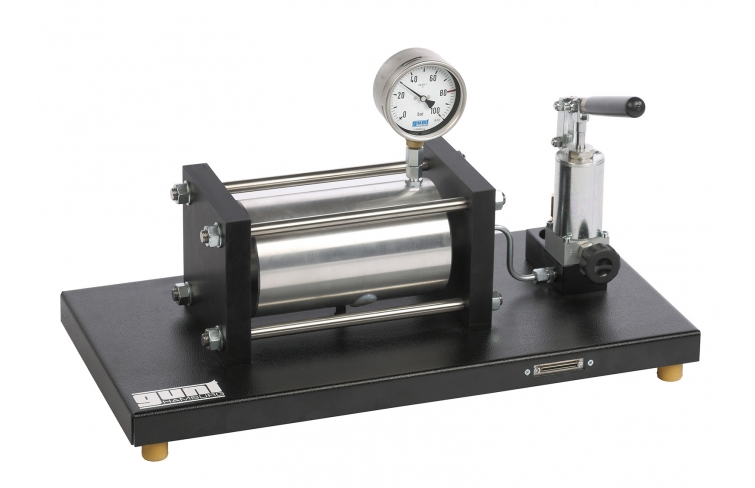
    FL 140

    • direct stresses and strains of a thick cylinder under internal pressure
    • cylinder with strain gauge application on surface and in wall
    • triaxial stress state in cylinder wall
    Obiettivi didattici (4)
    • · measurement of elongations by strain gauges
    • · application of Mohr’s circle for the triaxial stress state
    • · radial, tangential and axial direction
    • · investigation of correlations between elongation, pressure and stress in the triaxial stress state
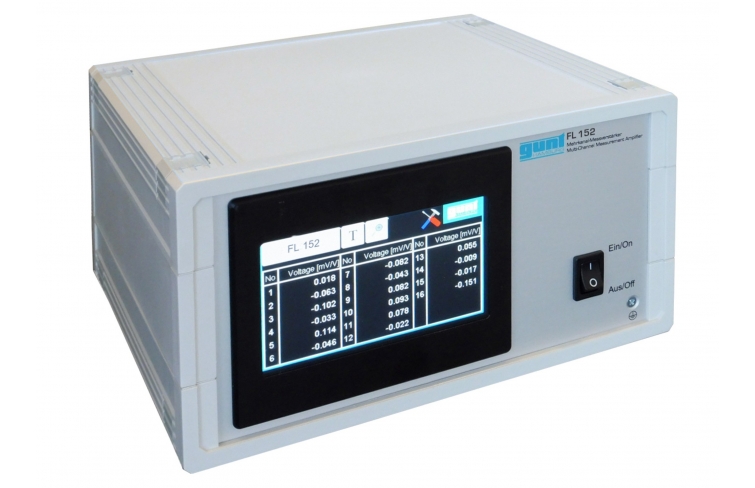
    FL 152

    • 16 input channels for processing of analogue strain gauge measuring signals, easy connection by multi-pin input port
    Obiettivi didattici (2)
    • · amplification and display of signals from strain gauge measuring points
    • · processing of measured values on computer
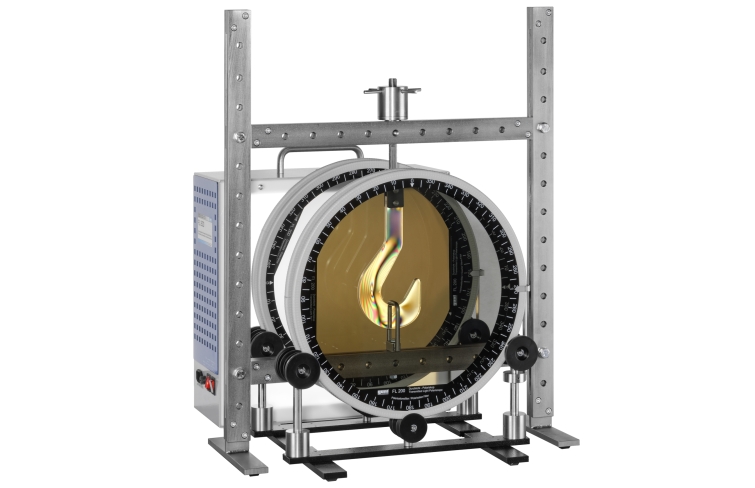
    FL 200

    • monochromatic or white light
    • generate stress patterns with linear or circular polarised light
    • models for specific problems can be prepared by the user
    Obiettivi didattici (4)
    • · generate plane stress states in various models under load: bending, tensile load and compressive load
    • · investigate stress distributions with linear or circular polarised light
    • · interpret photoelastic fringe patterns: stress concentrations, zero points, neutral strands, areas of constant stress and stress gradients
    • · graphically and computationally determine the stresses
    FL 210

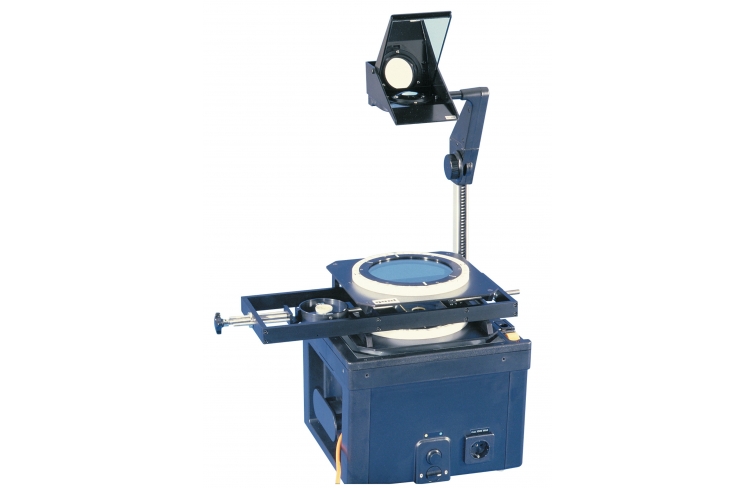
    • demonstration unit as an attachment for an overhead projector
    • generate stress patterns with linear or circular polarised light in typical polycarbonate components
    • detect stress concentrations
    Obiettivi didattici (5)
    • · compressive load
    • · tensile load
    • · investigate stress distributions with linear and circular polarised light
    • · stress distribution
    • · stress concentration
  • Dinamica

    25 prodotti

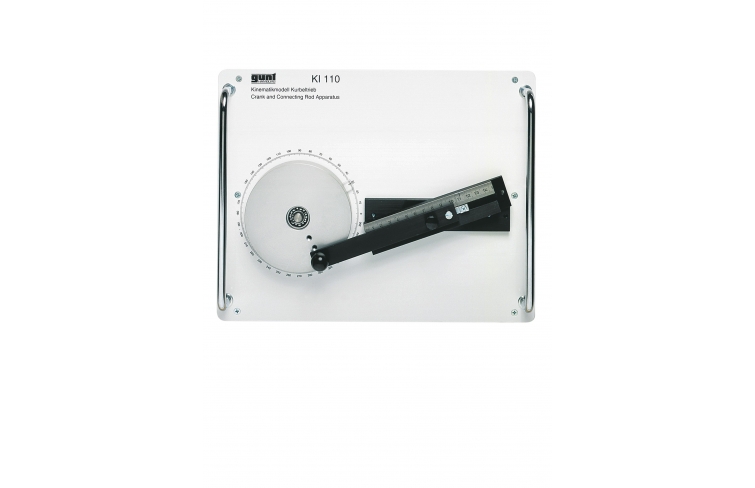
    KI 110

    • crank mechanism with fixed or oscillating cylinder
    Obiettivi didattici (1)
    • · crank mechanism with fixed and oscillating cylinder
    KI 120

    • representation of a purely harmonic reciprocating motion
    Obiettivi didattici (3)
    • · conversion of a uniform rotary motion into a purely harmonic reciprocating motion
    • · influence of crank length and input angle on the output stroke
    • · recording the transmission function of a crank slider
    KI 130

    • conversion of rotary motion into oscillating motion
    Obiettivi didattici (3)
    • · investigation of the mechanical relationships on the four-joint link
    • · investigation of the principle of the crank-rocker mechanism, double rocker mechanism and double crank
    • · verification of the Grashof condition by varying the crank radius, oscillation radius and coupling length
    KI 140

    • representation of a non-uniform reciprocating motion
    Obiettivi didattici (3)
    • · investigation of a revolving crank slider
    • · influence of crank length and input angle on the output stroke
    • · recording the transmission function of a revolving crank slider
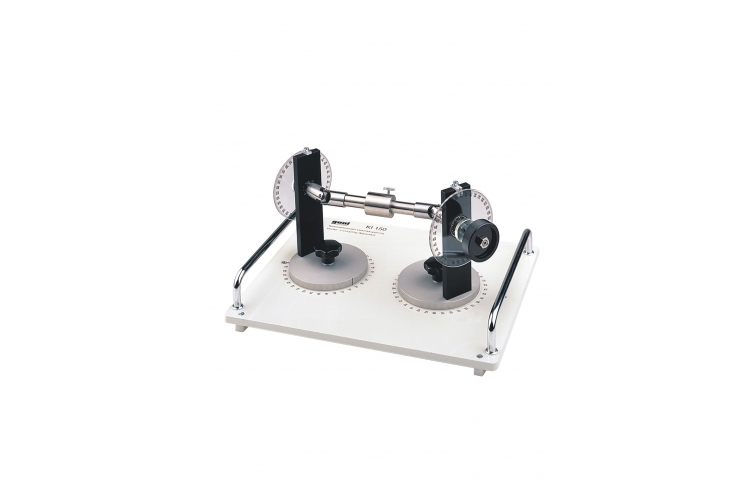
    KI 150

    • investigation of a universal joint shaft
    Obiettivi didattici (3)
    • · representation of the non-uniform transmission of a universal joint
    • · determine the gimbal error
    • · how the arrangement of the universal joints and the deflection angle affect the gimbal error
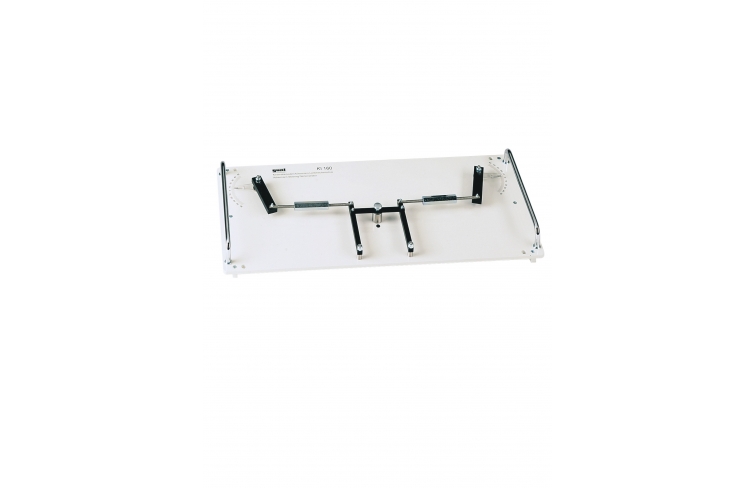
    KI 160

    • investigation of the steering geometry according to Ackermann
    Obiettivi didattici (3)
    • · verifying Ackermann’s steering principle
    • · calculate the wheelbase
    • · determine the lead angle and the steering error
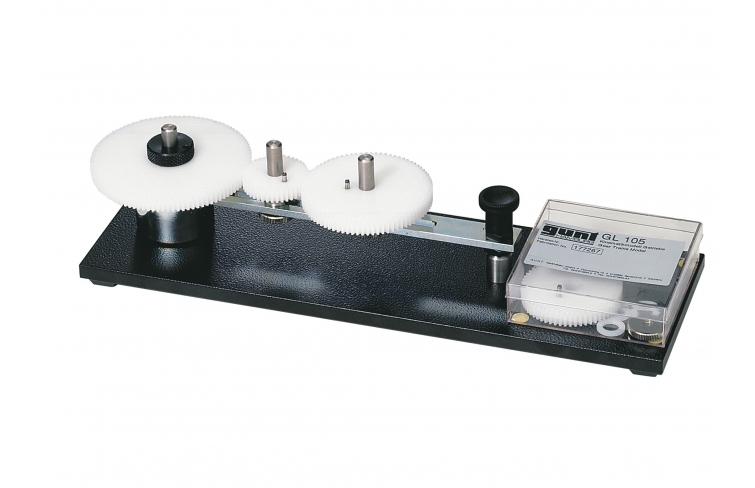
    GL 105

    • investigation of single-stage and multistage spur gears
    • investigation of planetary gears
    Obiettivi didattici (3)
    • · investigation of single-stage or multistage spur gears
    • · investigation of planetary gears
    • · determine the transmission ratio
    TM 610

    • investigation of mass moments of inertia in rotating, rigid bodies
    Obiettivi didattici (3)
    • · investigation of the inertia of rigid bodies in rotational motion
    • · determine mass moments of inertia of different, regularly shaped bodies
    • · investigation of the mass moment of inertia as a function of the radius
    TM 611

    • inertia in rotational motion on an inclined plane and in a physical pendulum
    Obiettivi didattici (4)
    • · proof of the law of falling bodies on the inclined plane
    • · influence of the mass of a body on its acceleration
    • · determine the mass moment of inertia by rolling experiment and pendulum experiment
    • · Steiner’s theorem
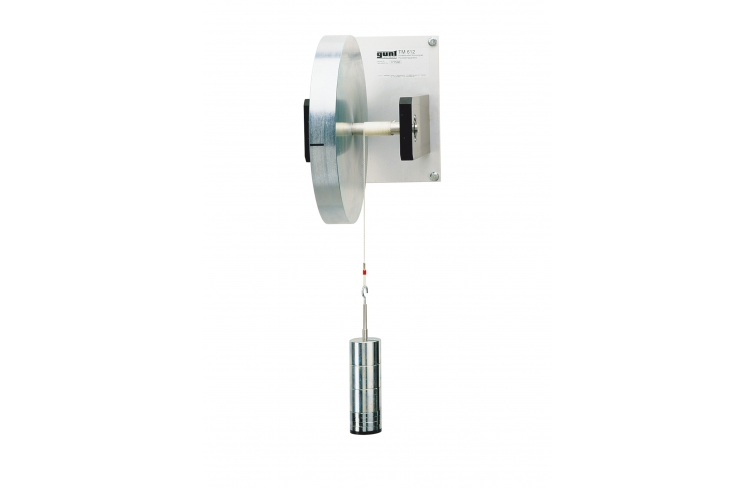
    TM 612

    • investigation of uniformly accelerated rotational motion
    Obiettivi didattici (2)
    • · determine the mass moment of inertia by experiment
    • · dynamic fundamental law of rotational movement
    GL 210

    • single-stage, two-stage or three-stage spur gear with distributed rotational inertia
    • drive via cable drum and variable set of weights
    • inductive speed sensors on all shafts
    Obiettivi didattici (4)
    • · determining the angular acceleration on gears
    • · determining the mass moment of inertia of the gear
    • · determining the friction
    • · determining the gear efficiency
    GL 212

    • two-stage planetary gears with three planet gears each
    • four different transmissions can be configured
    • bending beams to measure force
    Obiettivi didattici (8)
    • · determine the transmission ratio for a locked gear
    • · measure transmitted forces for a locked gear
    • · gear acceleration under constant driving torque
    • · influence of the transmission ratio
    • · determine reduced mass moment of inertia
    • · conversion of potential energy into kinetic energy
    • · determine friction
    • · determine gear efficiency
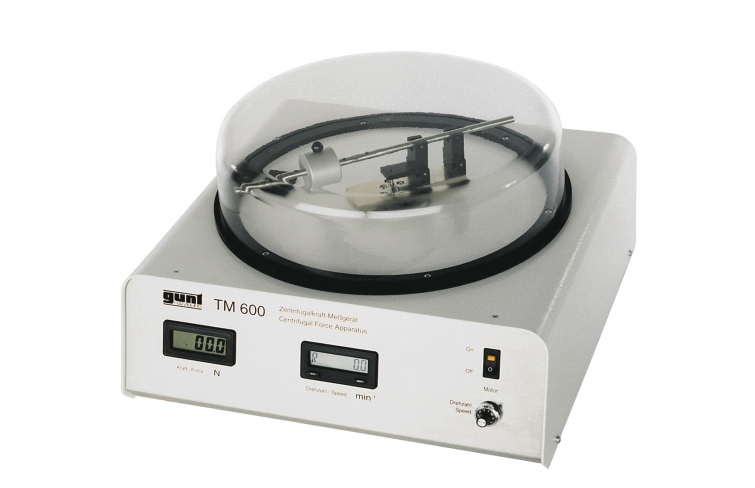
    TM 600

    • laws of the behaviour of rotating masses
    Obiettivi didattici (3)
    • · the speed
    • · the size of the rotating mass
    • · the rotation radius
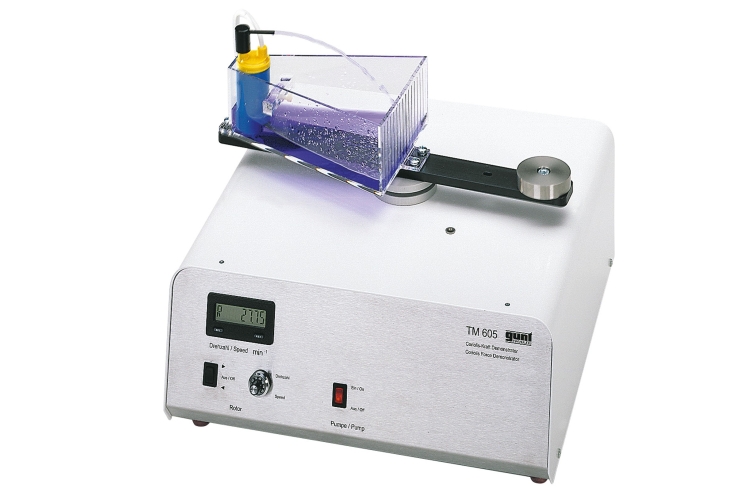
    TM 605

    • visualisation of the Coriolis force effect
    • rotating reference system
    • water jet as moving mass
    Obiettivi didattici (3)
    • · inertial or apparent force
    • · interference of a rotational movement on a translational movement
    • · visualisation of the Coriolis force effect
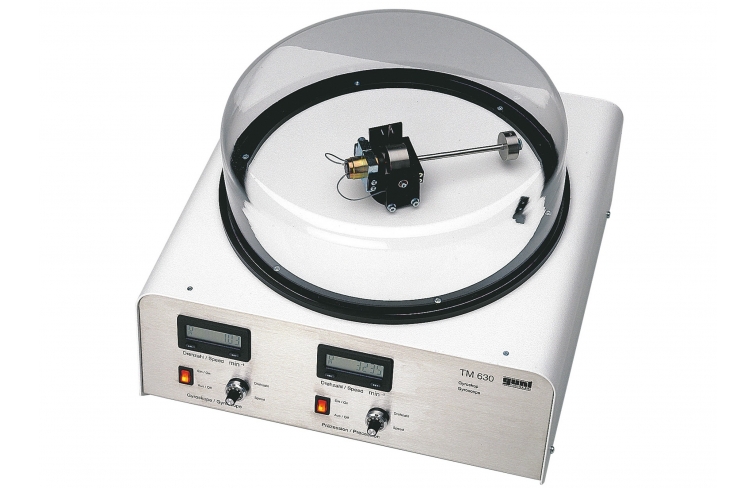
    TM 630

    • properties of a guided gyro
    • effect of precession
    Obiettivi didattici (4)
    • · experimental verification of the gyroscopic laws
    • · familiarisation with the three gyro axes
    • · calculation of gyroscopic moments
    • · study the effect of precession
    TM 632

    • visualisation of the effect of centrifugal force
    • how various centrifugal systems work
    • determination of characteristic curves and setting curves of different centrifugal governors
    Obiettivi didattici (6)
    • · Porter governor
    • · Proell governor
    • · Hartnell governor
    • · adjustment of centrifugal governors
    • · recording the governor characteristic curves and setting curves
    • · calculation of the structural design and adjustment of different governors
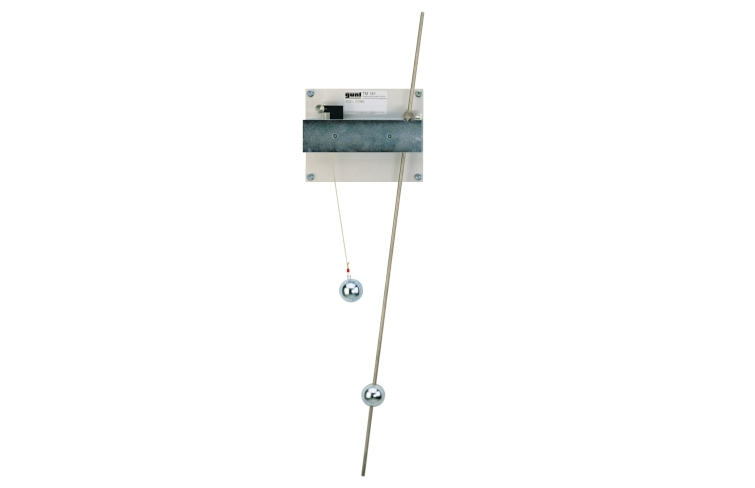
    TM 161

    • investigation of pendulum swings
    • comparing physical and mathematical pendulums
    Obiettivi didattici (3)
    • · oscillation period of thread pendulum and rod pendulum
    • · determine centre of gravity on the rod pendulum
    • · reduced pendulum length and centre of inertia of the rod pendulum
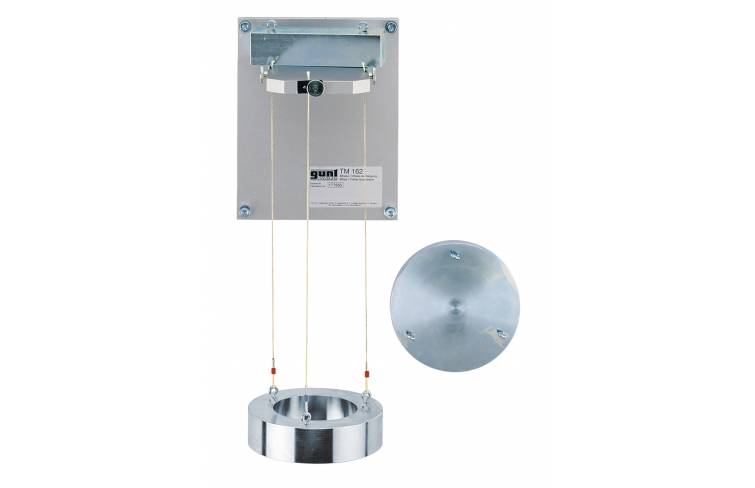
    TM 162

    • ideal mathematical pendulum can be demonstrated
    • moment of inertia in an experiment on a rotary pendulum
    Obiettivi didattici (2)
    • · influence of thread length on the oscillation period
    • · determine the mass moment of inertia
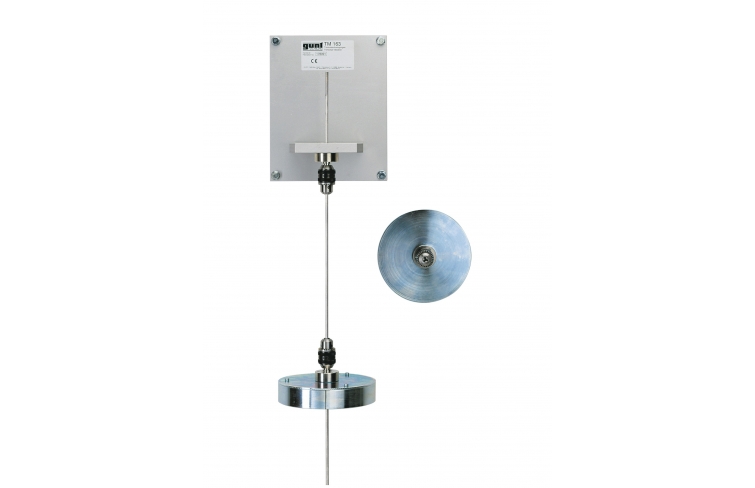
    TM 163

    • vibrations of different torsion bars
    Obiettivi didattici (3)
    • · the length of the torsion bar
    • · the diameter of the torsion bar
    • · the rotating mass and its shape
    TM 164

    • torsional oscillations of a spring-mass system
    Obiettivi didattici (3)
    • · determine the rigidity of a helical spring
    • · determine the natural frequency of a spring-mass system
    • · investigate the effect of mass and mass distribution
    TM 150

    • detailed, wide-ranging series of experiments on the mechanical vibration theory
    • experiments on various pendulums, bar-type oscillators and spring-mass systems
    • damping, resonance and absorber effects in forced vibrations
    Obiettivi didattici (8)
    • · Kater’s pendulum
    • · reduced pendulum length
    • · spring-mass system
    • · undamped oscillation
    • · damped oscillation
    • · forced vibration
    • · damped and undamped resonance
    • · absorber effect in multi-mass oscillators
    TM 150.20

    • measurement and illustration of frequency and phase response
    • digital storage oscilloscope
    Obiettivi didattici (5)
    • · natural vibration of a bar-type oscillator
    • · damped vibration of a bar-type oscillator
    • · forced vibration of a bar-type oscillator (damped and undamped resonance)
    • · frequency and period time measurements
    • · Kater’s pendulum
    TM 150.02

    • influence of mass, torsional rigidity and damping on the behaviour of a rotary oscillator
    Obiettivi didattici (2)
    • · natural frequency of a rotary oscillator
    • · influence of torsional stiffness, mass and damping
    TM 155

    • demonstration of basic fundamentals of mechanical vibration theory
    • damping and resonance in forced vibrations
    • two different principles of vibrational excitation
    Obiettivi didattici (6)
    • · free vibrations
    • · damped vibrations
    • · inertia force and displacement excitation
    • · forced vibrations
    • · resonance
    • · amplitude response and phase response
    SE 110.58

    • natural frequency on the freely vibrating bending beam
    • approximation method according to Rayleigh
    Obiettivi didattici (3)
    • · free vibration in a vertical and horizontal bending beam
    • · determine the natural frequency according to Rayleigh
    • · how clamping length and mass affect the natural frequency
  • Dinamica delle macchine

    27 prodotti

    TM 155

    • demonstration of basic fundamentals of mechanical vibration theory
    • damping and resonance in forced vibrations
    • two different principles of vibrational excitation
    Obiettivi didattici (6)
    • · free vibrations
    • · damped vibrations
    • · inertia force and displacement excitation
    • · forced vibrations
    • · resonance
    • · amplitude response and phase response
    TM 150.02

    • influence of mass, torsional rigidity and damping on the behaviour of a rotary oscillator
    Obiettivi didattici (2)
    • · natural frequency of a rotary oscillator
    • · influence of torsional stiffness, mass and damping
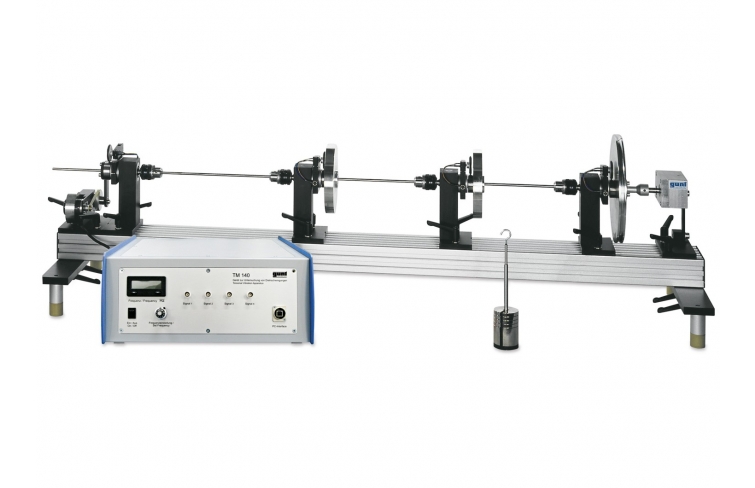
    TM 140

    • investigation of torsional stiffness and torsional vibrations
    • behaviour of two-mass and three-mass torsional oscillators
    Obiettivi didattici (7)
    • · determine the torsional stiffness of a torsion bar
    • · determine the mass moments of inertia
    • · decay behaviour of torsional vibrations
    • · determine the damping in torsional vibrations
    • · forced torsional vibrations, resonance
    • · two-mass torsional oscillator
    • · three-mass torsional oscillator
    HM 159.11

    • dynamic behaviour of a ship structure
    • simple ship form simplifies the mathematical approach
    • different excitation signals possible
    Obiettivi didattici (5)
    • · measure and record natural frequencies and modes of the model ship (in air)
    • · vibration behaviour of the model shipin air
    • · comparison between theory (approximation formula for determining the first bending frequency) and practice (measured natural frequency)
    • · influence of discrete additional masses or ballast on natural frequency and mode (ballast and extra weights not included)
    • · vibration behaviour of floating model ship (possible with additional tank)
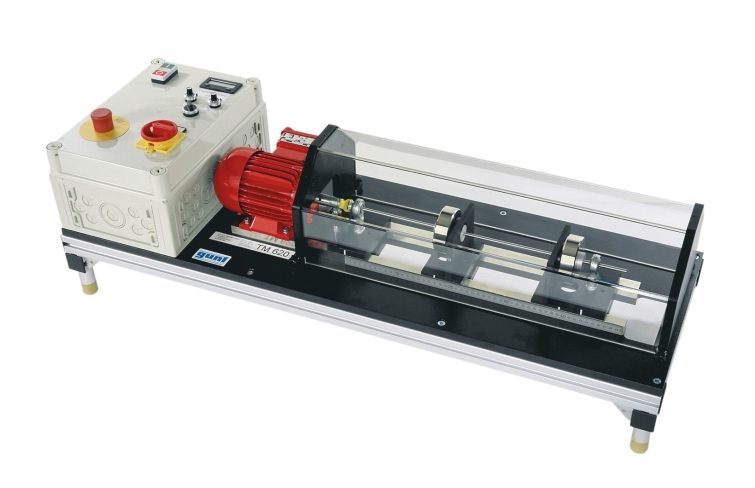
    TM 620

    • investigation of bending vibrations in rotors
    • determine critical speeds
    • positions of rotor bearing and rotating mass can be adjusted
    Obiettivi didattici (3)
    • · investigate bending vibrations and resonance of a rotating shaft
    • · determine critical speeds with different arrangements of the bearing and masses on the rotor shaft and compare with theory
    • · investigation of the rotor’s self-centring effect
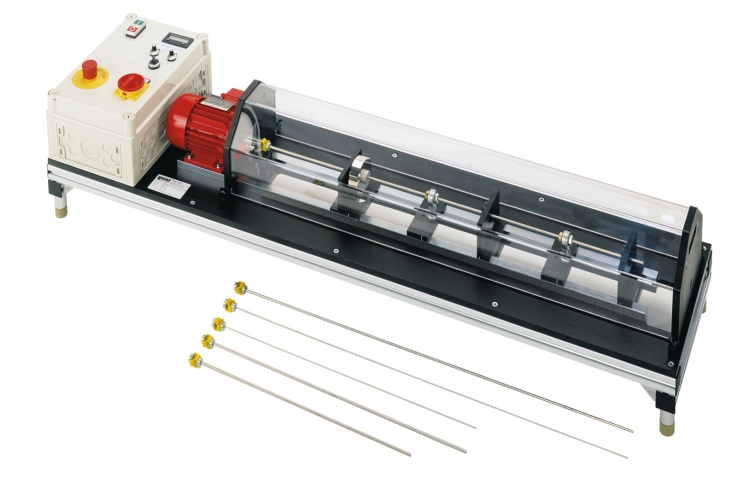
    TM 625

    • investigation of the natural modes of various shafts with continuous mass distribution and of a Laval rotor
    • optimal visibility and simultaneous protection thanks to transparent protective cover
    Obiettivi didattici (5)
    • · critical speed
    • · self-alignment
    • · different bearing clearances
    • · different shaft diameters
    • · different shaft lengths
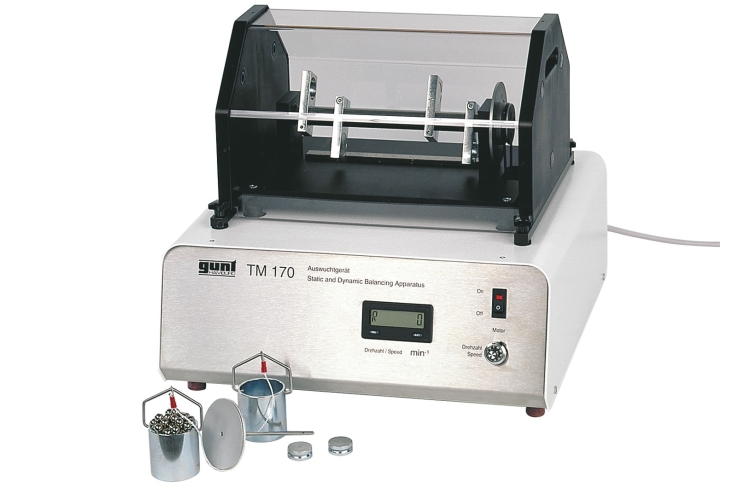
    TM 170

    • representation of the fundamental processes involved in balancing
    • static and dynamic imbalance
    Obiettivi didattici (4)
    • · demonstration of imbalance vibrations at different speeds
    • · comparison of static, dynamic or general imbalance
    • · determine an imbalance
    • · perform a balancing operation
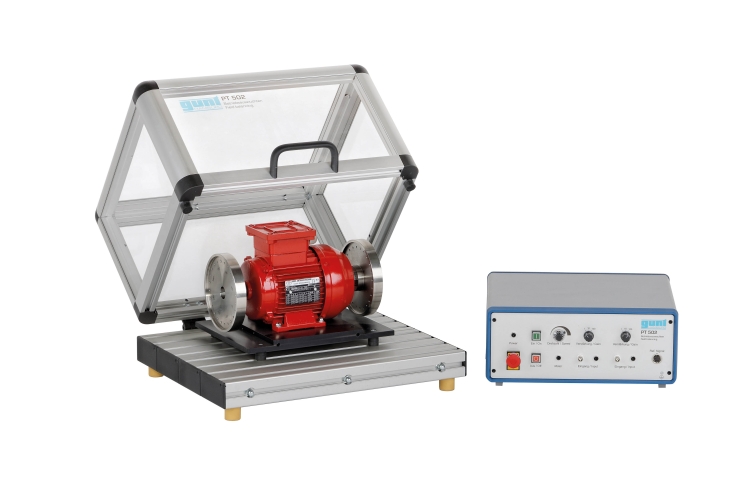
    PT 502

    • measurement of imbalance vibrations
    • single and two-plane balancing
    Obiettivi didattici (9)
    • · measure and assess machine vibrations
    • · occurrence of imbalance vibrations
    • · static, dynamic or general imbalance
    • · dependence of imbalance vibration on position and magnitude of the imbalance
    • · basic principles of balancing
    • · field balancing in one plane
    • · field balancing in two planes
    • · assessment of balancing quality
    • · using a computerised vibration analyser
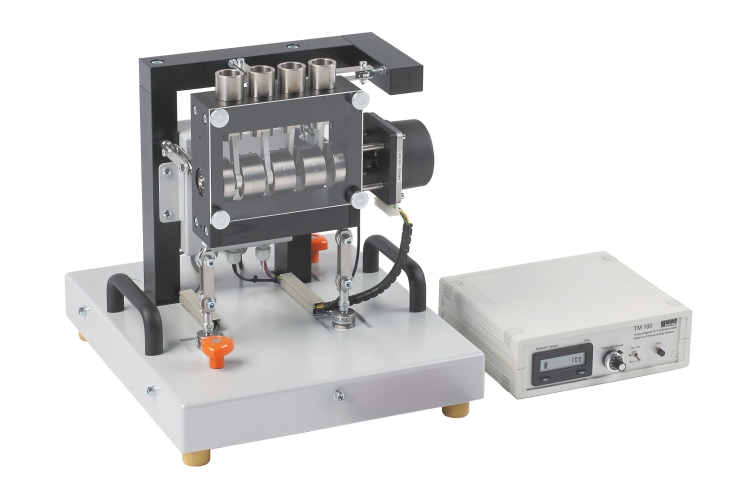
    TM 180

    • investigation of free mass forces and moments of a reciprocating engine
    • continuous adjustment of the angle between cranks
    • simulation of single, two- or four-cylinder engines
    Obiettivi didattici (7)
    • · mass forces in dependence on the speed
    • · mass forces in dependence on the piston mass
    • · first and second order mass forces
    • · 4-cylinder, symmetrical, 180° angle between cranks
    • · 4-cylinder, non-symmetrical, 90° angle between cranks
    • · 2-cylinder, 180° angle between cranks
    • · single cylinder
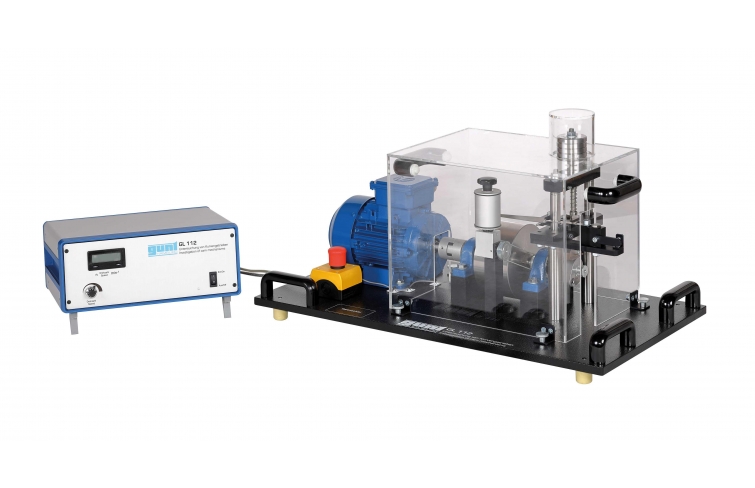
    GL 112

    • record elevation curves of cam mechanisms
    • four different cam members, two different engaging members
    • influence of spring stiffness and mass on the dynamic behaviour
    Obiettivi didattici (7)
    • · elevation curves in non-matching engaging member
    • · elevation curve in sprung-engaging member
    • · determine the limit speed and compare with theory
    • · influence of moving mass on the motion of cam member/plunger
    • · influence of return-spring stiffness and preload on the motion of cam member/plunger
    • · comparison of the elevation curves of different cam-member shapes
    • · comparison of elevation curves with theory
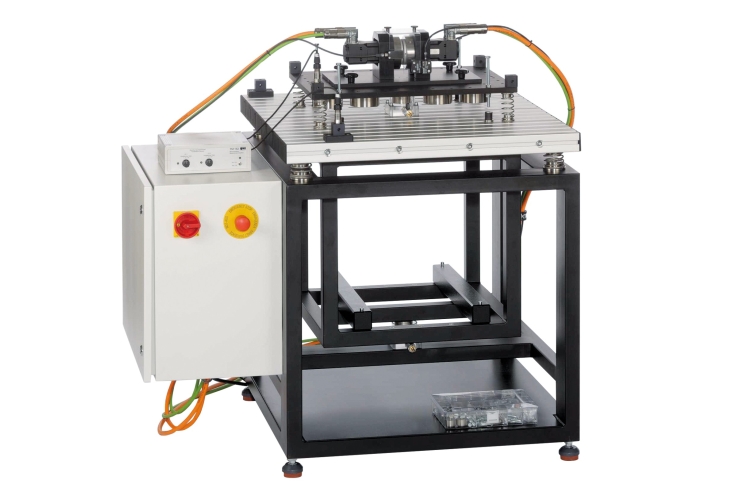
    TM 182

    • vibrations generated via imbalance
    Obiettivi didattici (7)
    • · familiarisation with vibration phenomena on machine foundations
    • · adjust the foundation for different excitation forces
    • · investigate vibration absorbers
    • · investigate the effect of additional damping
    • · compare metal springs and rubber springs
    • · measure and analyse vibrations
    • · determine operational vibration modes
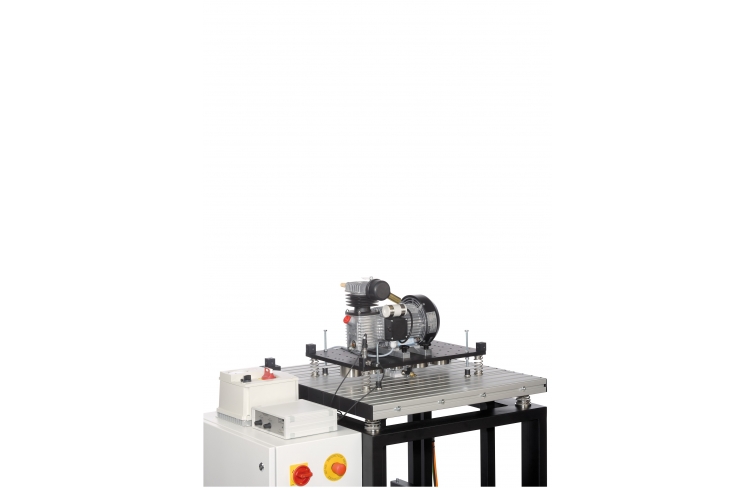
    TM 182.01

    Obiettivi didattici (1)
    • · generating vibrations on machine foundations with a “real machine”
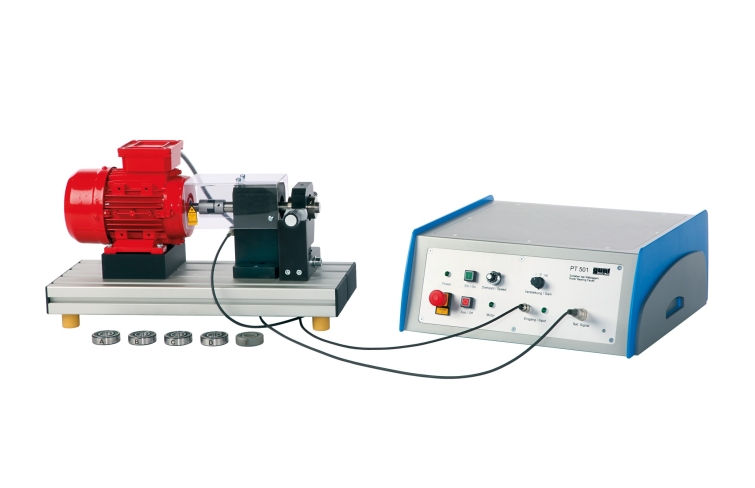
    PT 501

    • assessment of bearing condition by vibration analysis
    • comparison of bearings with different faults
    Obiettivi didattici (7)
    • · vibrational spectrum of the running noise of roller bearings
    • · familiarisation with the envelope analysis
    • · influence of damage to outer race, inner race or roller body, on the spectrum
    • · estimating service lives of roller bearings
    • · influence of the lubricant on the vibration spectrum
    • · detection of faulty roller bearings
    • · use of a computerised vibration analyser
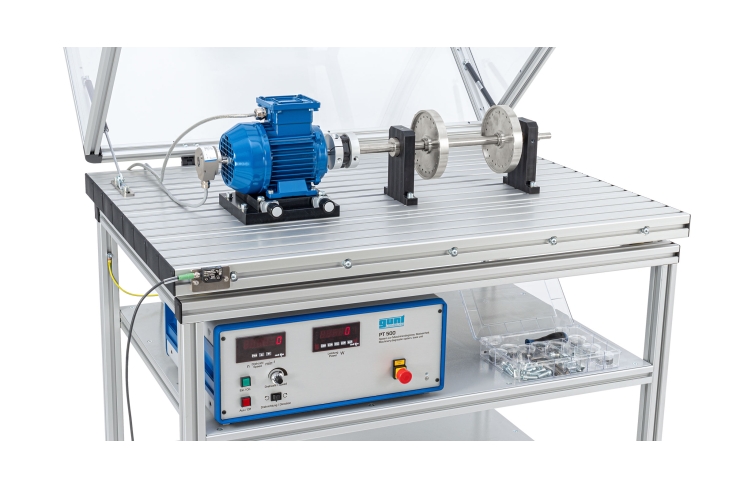
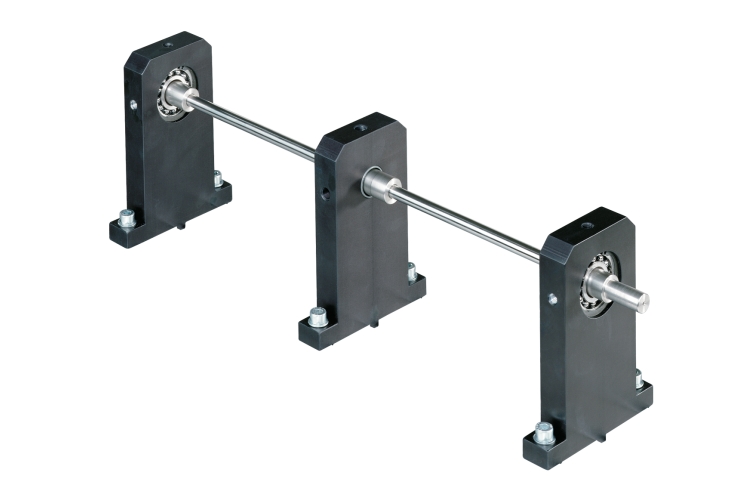
    PT 500

    • base unit for setting up wide ranging experiments in machinery diagnostics using modular accessory sets
    • aluminium base plate with slots for quick, flexible assembly of different experimental setups
    Obiettivi didattici (9)
    • · fundamentals of measurement of shaft and bearing vibrations
    • · basic variables and parameters
    • · sensors and measuring devices
    • · influences of speed and shaft layout
    • · influence of sensor positioning
    • · field balancing of rigid shafts
    • · influence of alignment between motor and coupling
    • · understanding and interpreting frequency spectra
    • · use of a computerised vibration analyser
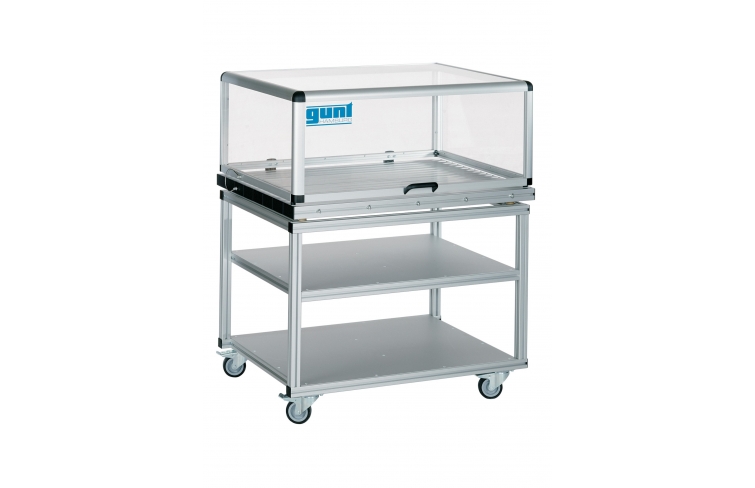
    PT 500.01

    • trolley for base unit
    • four castors guarantee mobility
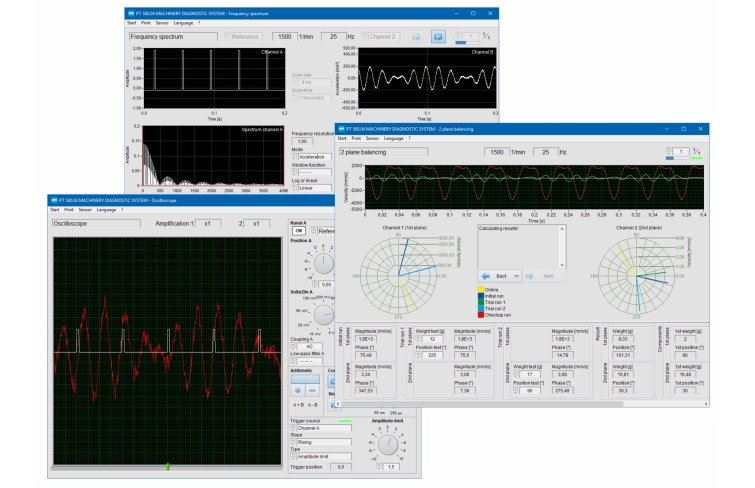
    PT 500.04

    • versatile, powerful software for vibration analysis
    • suitable for field balancing of rotors in one and two planes
    Obiettivi didattici (6)
    • · familiarisation with vibration signals
    • · measurement of speed, vibration displacement, vibration velocity and acceleration
    • · assessment of the vibration state of a machine
    • · damage analysis of roller bearings and gears by means of envelope spectra
    • · detection of cracks in shafts by means of run-up curves and order analysis
    • · measurement of imbalance vibrations and field balancing of rigid rotors in 1 and 2 planes
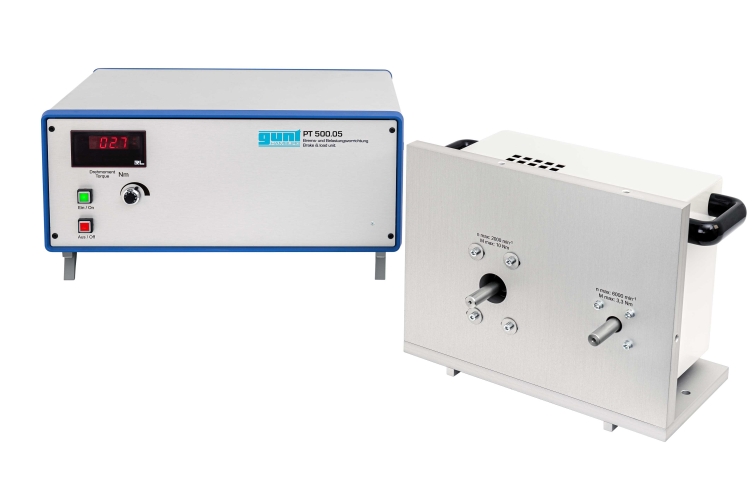
    PT 500.05

    • generation of a loading torque
    • two speed and torque ranges
    • vented magnetic particle brake with display and control unit
    PT 500.10

    • flexural vibration of the elastic shaft
    • resonance and critical speed
    Obiettivi didattici (7)
    • · familiarisation with the terms “critical speed” and “resonance”
    • · influence of unbalanced excitation
    • · alignment of the elastic rotor
    • · influence of alignment errors
    • · understanding and interpreting frequency spectra
    • · use of a computerised vibration analyser
    • · study of the orbit in the subcritical and supercritical range
    PT 500.11

    • vibration behaviour of shaft with radial crack
    • identification of damage
    Obiettivi didattici (6)
    • · change in characteristic vibration behaviour (natural frequency, resonance speed, amplitude and phase of vibrations) due to a crack
    • · crack identification from the change in vibration spectrum
    • · detection of cracks in rotating shafts at the protruding shaft end
    • · understanding and interpreting frequency spectra
    • · use of a computerised vibration analyser
    • · detection of cracks in rotating shafts (the elastic rotor)
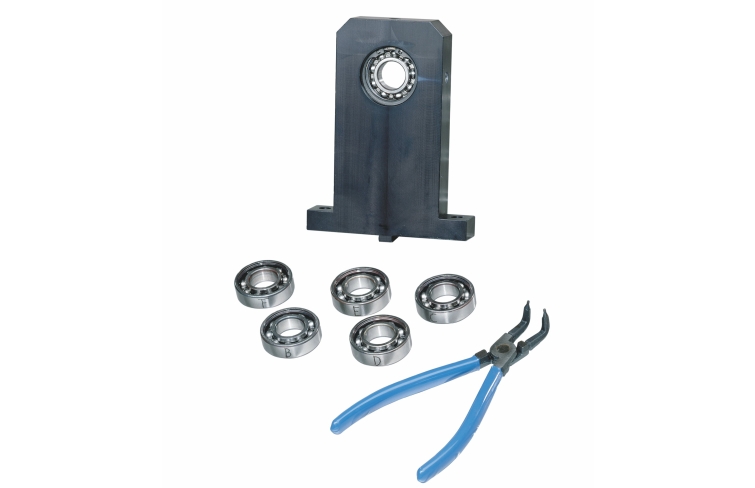
    PT 500.12

    • assessment of bearing condition by vibration analysis
    • comparison of bearings with different faults
    Obiettivi didattici (8)
    • · vibrational spectrum of the running noise of roller bearings
    • · familiarisation with the envelope analysis
    • · influence of damage to outer race, inner race or roller body, on the spectrum
    • · estimating service lives of roller bearings
    • · influence of the lubricant on the vibration spectrum
    • · detection of faulty roller bearings
    • · understanding and interpreting frequency spectra
    • · use of a computerised vibration analyser
    PT 500.13

    • vibration analysis of couplings
    • radial run-out, axial run-out and pitch fault
    • properties of different coupling types: pin coupling, curved teeth coupling, flange coupling, claw coupling
    Obiettivi didattici (13)
    • · pin coupling with offset
    • · claw coupling with offset
    • · flange coupling with no fault
    • · flange coupling with radial run-out
    • · flange coupling with axial run-out
    • · pin coupling with no fault
    • · pin coupling with pitch fault
    • · identification of coupling faults from the vibration signal
    • · load dependency of running behaviour
    • · influence of gear rim hardness on claw couplings
    • · comparison of curved teeth, pin, flange and claw couplings
    • · understanding and interpreting frequency spectra
    • · use of a computerised vibration analyser
    PT 500.14

    • vibrations in belt drives
    • resonance and critical speed
    Obiettivi didattici (8)
    • · influence of belt tension on vibration behaviour
    • · influence of speed on vibration behaviour
    • · influence of pulleys running untrue, and off-track running
    • · power split across multiple belt drive
    • · influence of slip on vibration running spectrum
    • · comparison between fault-free and damaged belts
    • · understanding and interpreting frequency spectra
    • · use of a computerised vibration analyser
    PT 500.15

    • vibration analysis of tooth damage
    • fault localisation on gears
    Obiettivi didattici (8)
    • · identification of gear damage from vibration behaviour
    • · spur toothed
    • · helical
    • · localisation of damage
    • · influence of lubrication
    • · influence of centre distance and of backlash
    • · understanding and interpreting frequency spectra
    • · use of a computerised vibration analyser
    PT 500.16

    • vibrations of crank drives
    • bearing clearance or slack in oscillating machine components
    Obiettivi didattici (9)
    • · experimental modal analysis of mechanical systems
    • · familiarisation with the envelope analysis
    • · influence of bearing clearance and shock impact
    • · inconsistent torque characteristic
    • · wear measurement on piston rods
    • · understanding and interpreting frequency spectra
    • · use of a computerised vibration analyser
    • · transmission of alternating torque in toothed gearing mechanisms
    • · influence of gas forces on the vibration spectrum
    PT 500.17

    • observation and measurement of cavitation
    • understanding conditions for cavitation
    Obiettivi didattici (6)
    • · visually
    • · stroboscopically (customer’s own stroboscope)
    • · by vibration analysis
    • · investigation of the operational vibrations of a centrifugal pump
    • · understanding and interpreting frequency spectra
    • · use of a computerised vibration analyser
    PT 500.18

    • vibration measurements on fans
    • simulation of blade-induced vibrations
    Obiettivi didattici (6)
    • · vibration measurement on fans
    • · measurement of blade pass frequency
    • · identification of the vibration induced by the blades from the vibration spectrum
    • · effect of dynamic imbalance on the fan
    • · understanding and interpreting frequency spectra
    • · use of a computerised vibration analyser
    PT 500.19

    • interaction of electromagnetic and mechanical elements of the system
    • adjustable asymmetric gap between stator and rotor
    • electromagnetic asymmetry with winding that can be switched off
    Obiettivi didattici (8)
    • · influence of the gap on vibration behaviour
    • · influence of electromagnetic asymmetry on vibration behaviour
    • · influence of the load on the level of vibration
    • · influence of the gap on electromagnetic losses and efficiency
    • · influence of speed on vibration behaviour
    • · understanding and interpreting frequency spectra
    • · use of a computerised vibration analyser
    • · measurement of current consumption per phase
  • Progettazione meccanica

    44 prodotti

    TZ 100

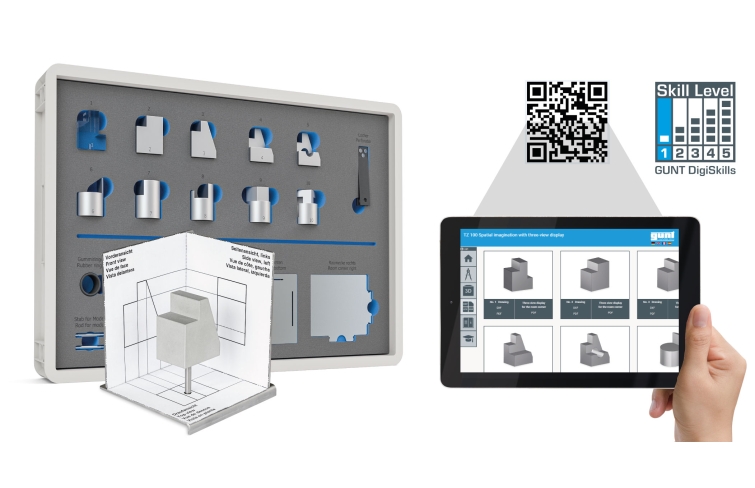
    • model set for developing spatial imagination
    • fundamentals of three-view display
    Obiettivi didattici (4)
    • · familiarisation with three-view display as a basic principle of engineering drawing
    • · step-by-step development of spatial thinking: from the concrete situation to the abstract representation in an engineering drawing
    • · measuring exercises
    • · retrieve information from digital networks and obtaining it from digital networks
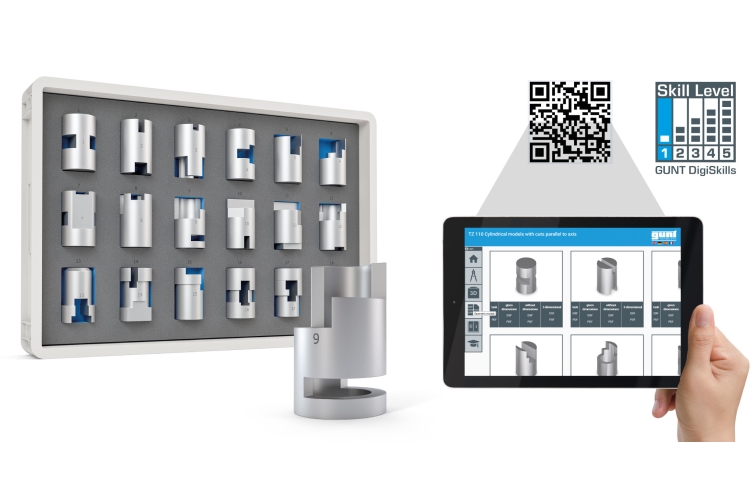
    TZ 110

    • collection of cylindrical models with cuts parallel to the spatial axes
    • introduction to engineering drawing
    • systematically graduated degrees of difficulty
    Obiettivi didattici (6)
    • · familiarisation with three-view display as a basic principle of engineering drawing
    • · step-by-step development of spatial thinking: from the concrete situation to the abstract representation in an engineering drawing
    • · systematic familiarisation with a wide range of features on cylindrical base forms
    • · exercises in production-oriented and standard dimensioning
    • · measurement exercises: outer dimensions, inner dimensions, tolerances
    • · retrieve information from digital networks and obtaining it from digital networks
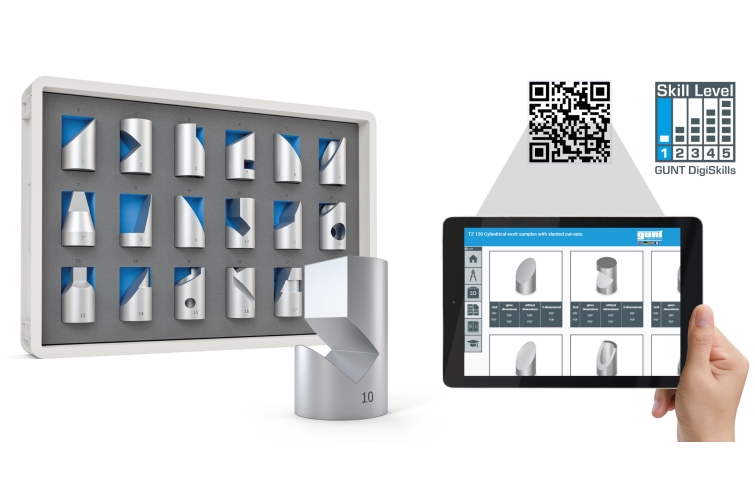
    TZ 120

    • collection of cylindrical models with cuts parallel and oblique to the spatial axes
    • introduction to engineering drawing
    • systematically graduated degrees of difficulty
    Obiettivi didattici (6)
    • · familiarisation with three-view display as a basic principle of engineering drawing
    • · step-by-step development of spatial thinking: from the concrete situation to the abstract representation in an engineering drawing
    • · systematic familiarisation with a wide range of features on cylindrical base forms
    • · exercises in production-oriented and standard dimensioning
    • · measurement exercises: outer dimensions, inner dimensions, angles, tolerances
    • · retrieve information from digital networks and obtaining it from digital networks
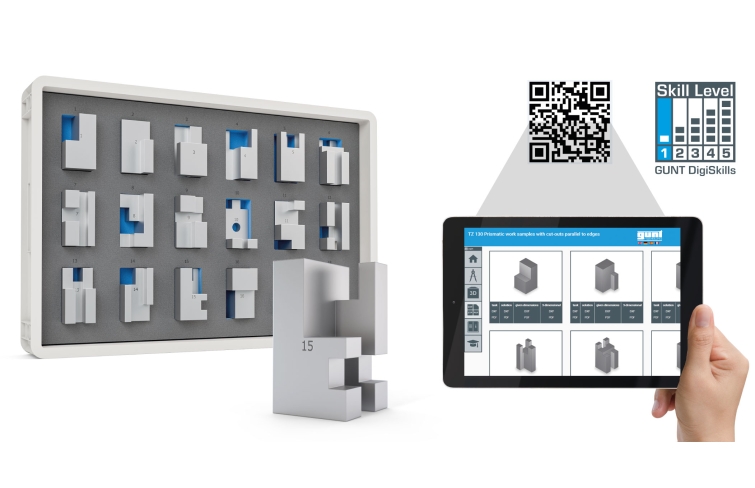
    TZ 130

    • collection of prismatic models with cuts parallel to the spatial axes
    • introduction to engineering drawing
    • systematically graduated degrees of difficulty
    Obiettivi didattici (6)
    • · familiarisation with three-view display as a basic principle of engineering drawing
    • · step-by-step development of spatial thinking: from the concrete situation to the abstract representation in an engineering drawing
    • · systematic familiarisation with a wide range of features on prismatic base forms
    • · exercises in production-oriented and standard dimensioning
    • · measurement exercises: outer dimensions, inner dimensions, tolerances
    • · retrieve information from digital networks and obtaining it from digital networks
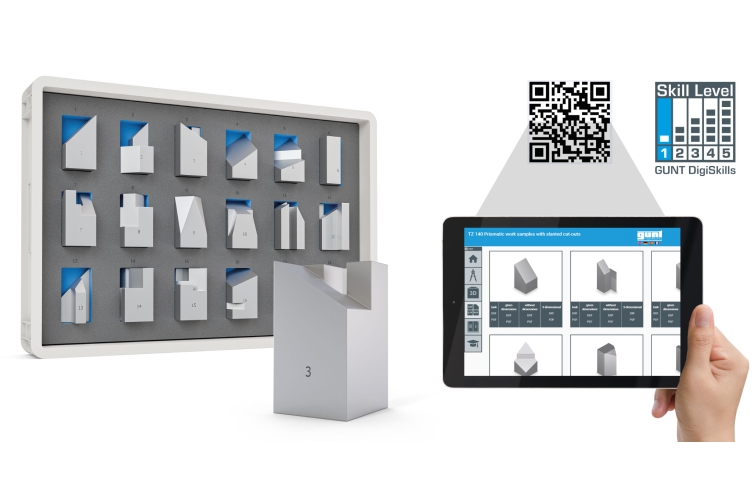
    TZ 140

    • collection of geometric models with cuts parallel and oblique to the spatial axes
    • introduction to engineering drawing
    • systematically graduated degrees of difficulty
    Obiettivi didattici (6)
    • · familiarisation with three-view display as a basic principle of engineering drawing
    • · step-by-step development of spatial thinking: from the concrete situation to the abstract representation in an engineering drawing
    • · systematic familiarisation with a wide range of features on prismatic base forms
    • · exercises in production-oriented and standard dimensioning
    • · measurement exercises: outer dimensions, inner dimensions, angles, tolerances
    • · retrieve information from digital networks and obtaining it from digital networks
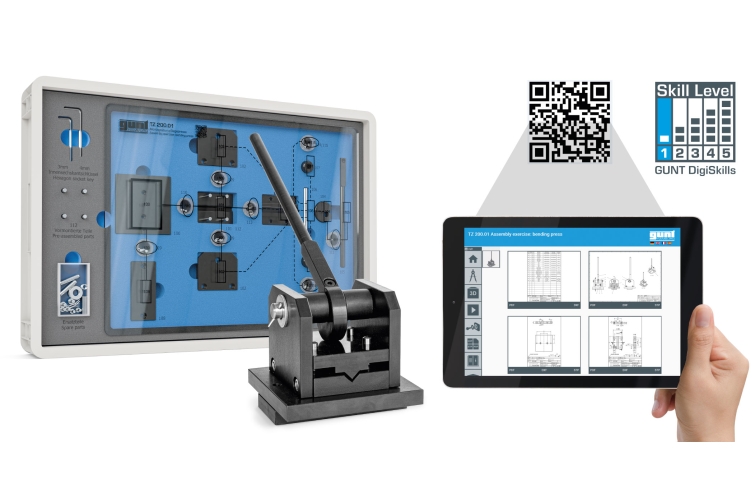
    TZ 200.01

    • functional bending press as a practice model
    • introduction to engineering drawing
    Obiettivi didattici (16)
    • · engineering drawing
    • · production-oriented and standardised representation of parts
    • · surface finish and tolerance specifications
    • · overview drawing
    • · parts list
    • · standard parts
    • · 3D views
    • · material specifications
    • · assembly and disassembly
    • · planning an assembly sequence
    • · functions
    • · material selection
    • · manufacturing methods
    • · length measurements
    • · angle measurements
    • · retrieve information from digital networks and obtaining it from digital networks
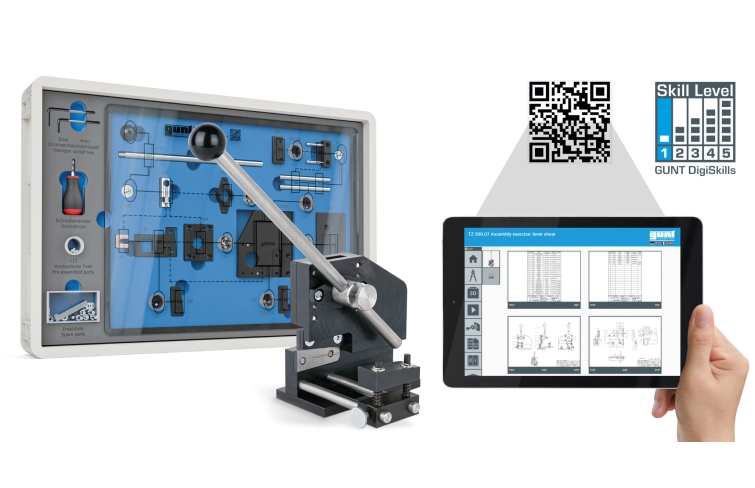
    TZ 200.07

    • functional lever shear as a practice model
    • introduction to engineering drawing
    Obiettivi didattici (15)
    • · engineering drawing
    • · production-oriented and standardised representation of parts
    • · surface finish and tolerance specifications
    • · overview drawing
    • · parts list
    • · standard parts
    • · 3D views
    • · material specifications
    • · assembly and disassembly
    • · planning an assembly sequence
    • · functions
    • · material selection
    • · manufacturing methods
    • · measurement exercises: length measurements
    • · retrieve information from digital networks and obtaining it from digital networks
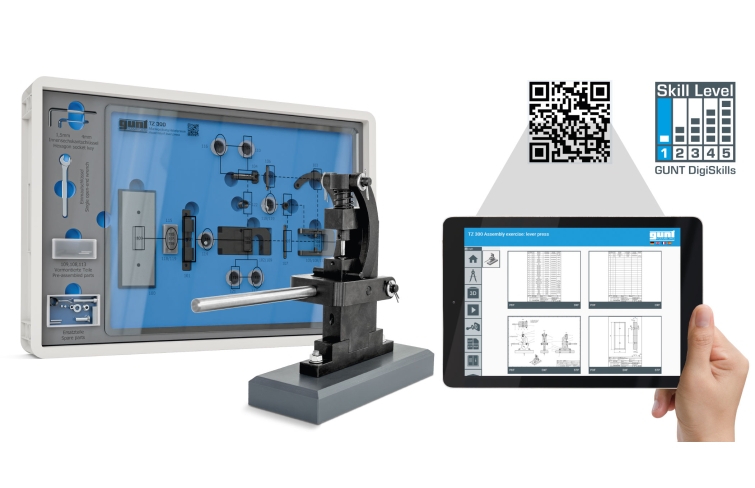
    TZ 300

    • functional lever press as a practice model
    • introduction to engineering drawing
    Obiettivi didattici (14)
    • · engineering drawing
    • · production-oriented and standardised representation of parts
    • · surface finish and tolerance specifications
    • · overview drawing, parts list
    • · standard parts
    • · 3D views
    • · material specifications
    • · assembly/disassembly, planning an assembly sequence, functions
    • · material selection
    • · manufacturing methods
    • · longitudinal measurements
    • · angular measurements
    • · working examples of handmade production and production on machine tools
    • · retrieve information from digital networks and obtaining it from digital networks
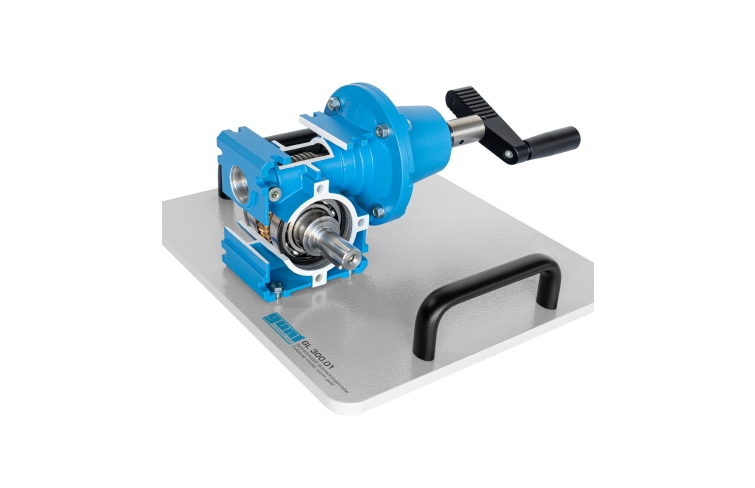
    GL 300.01

    • demonstration of complex machine elements and demonstration of their principle of operation
    Obiettivi didattici (1)
    • · principle of operation and design of a worm gear
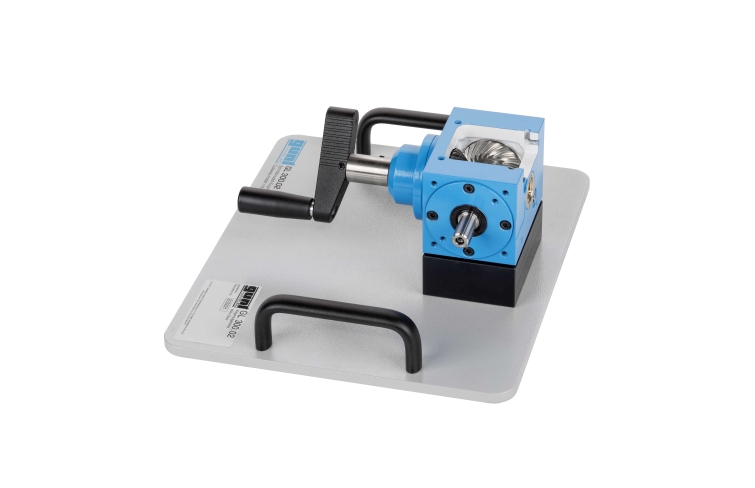
    GL 300.02

    • demonstration of complex machine elements and demonstration of their principle of operation
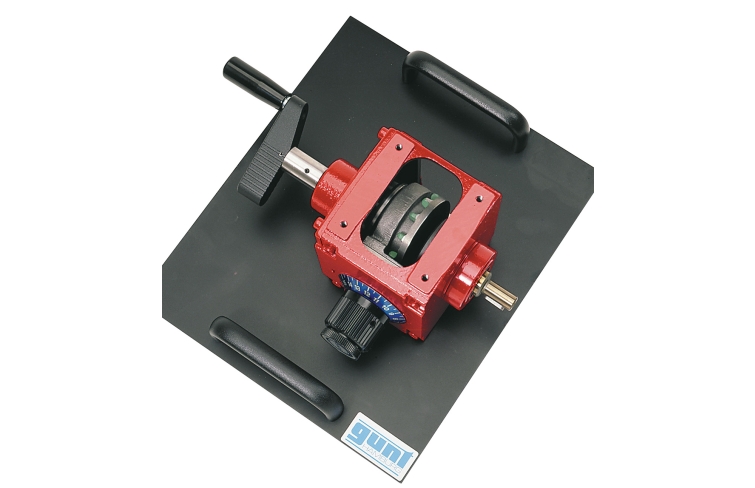
    Obiettivi didattici (1)
    • · principle of operation and design of a mitre gear
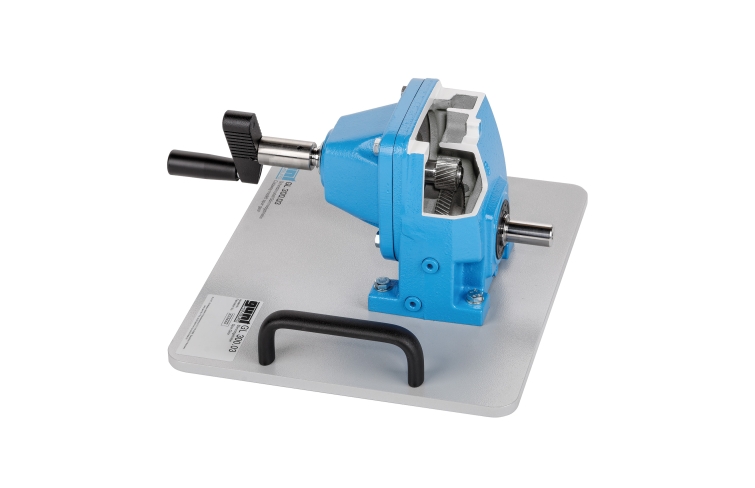
    GL 300.03

    • demonstration of complex machine elements and demonstration of their principle of operation
    Obiettivi didattici (1)
    • · principle of operation and design of a spur gear
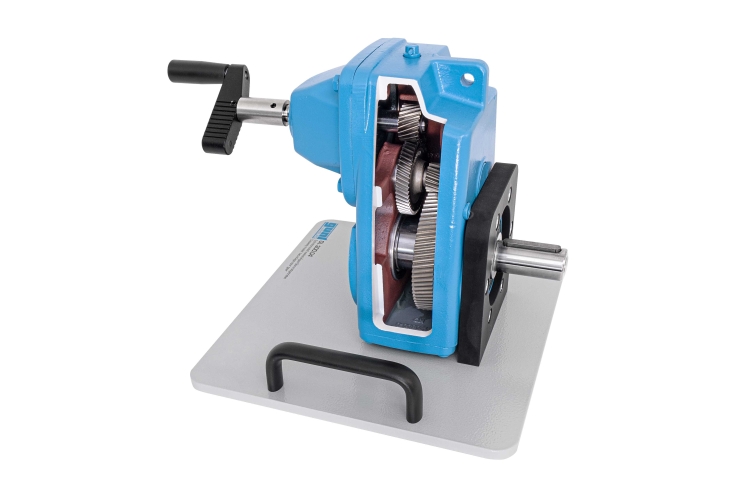
    GL 300.04

    • demonstration of complex machine elements and demonstration of their principle of operation
    Obiettivi didattici (1)
    • · principle of operation and design of a two-stage spur gear
    GL 300.05

    • demonstration of complex machine elements and demonstration of their principle of operation
    Obiettivi didattici (1)
    • · principle of operation and design of a planetary gear
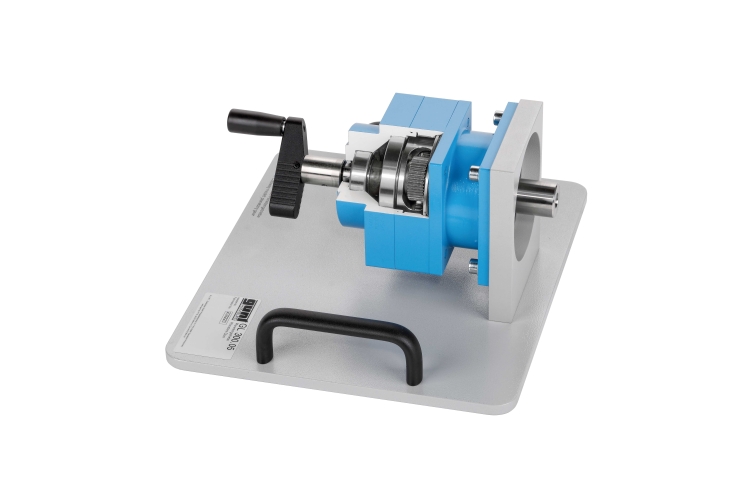
    GL 300.06

    • demonstration of complex machine elements and demonstration of their principle of operation
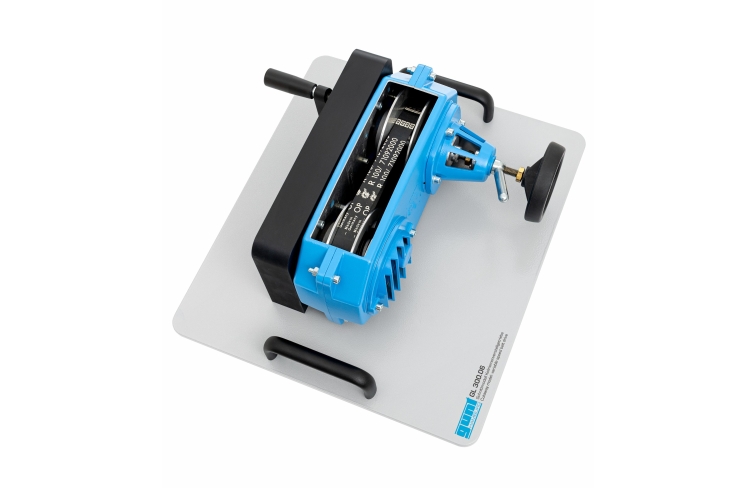
    Obiettivi didattici (1)
    • · principle of operation and design of a variable speed belt drive
    GL 300.07

    • demonstration of complex machine elements and demonstration of their principle of operation
    Obiettivi didattici (1)
    • · principle of operation and design of a control gear
    GL 300.08

    • demonstration of complex machine elements and demonstration of their principle of operation
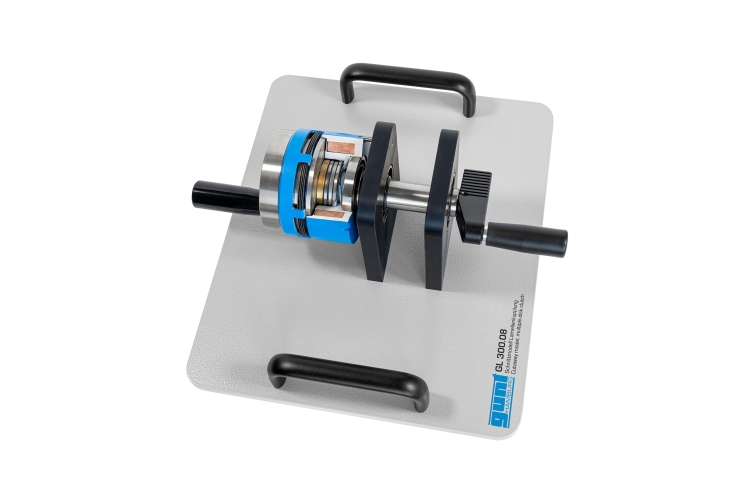
    Obiettivi didattici (1)
    • · principle of operation and design of a multiple-disc clutch
    GL 300.10

    • demonstration of complex machine elements and demonstration of their principle of operation
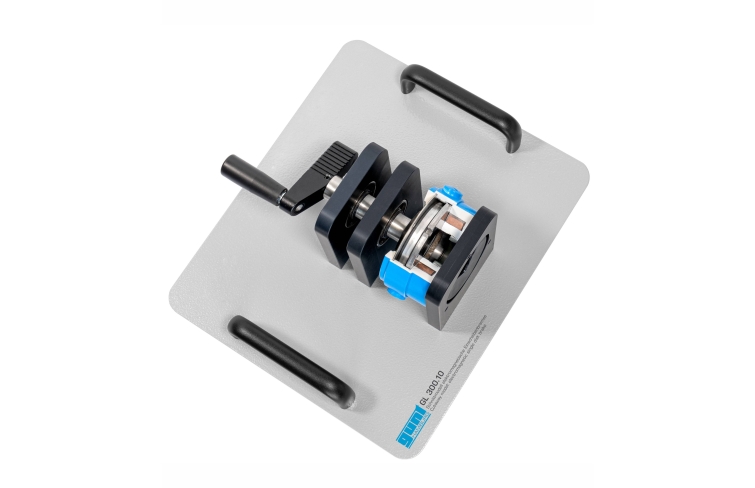
    Obiettivi didattici (1)
    • · principle of operation and design of an electromagnetic single disk brake
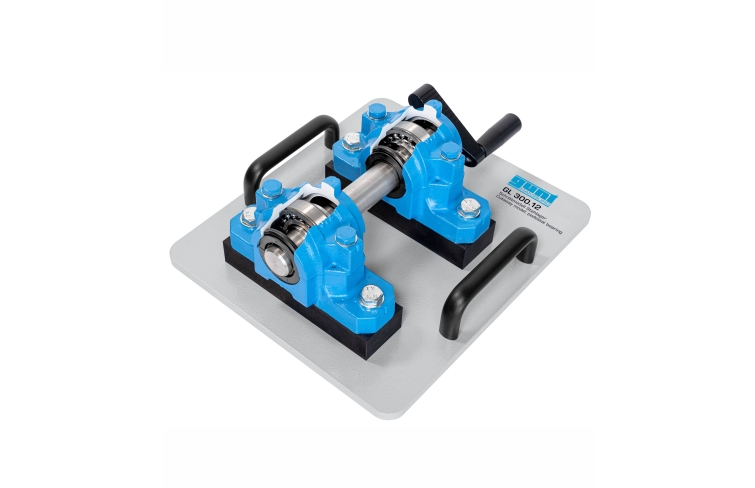
    GL 300.12

    • demonstration of complex machine elements and demonstration of their principle of operation
    Obiettivi didattici (1)
    • · principle of operation and design of a pedestal bearing
    MG 901

    • extensive kit comprising the most important screws and nuts used in mechanical engineering
    • standard designations, terms and graphical representation
    Obiettivi didattici (2)
    • · familiarisation with the most important screws and nuts used in mechanical engineering and their specific applications
    • · familiarisation with relevant standardised designations and terms including their graphical representations
    MG 903

    • extensive kit of screw-locking devices
    • standardised designations, terms and applications
    Obiettivi didattici (2)
    • · familiarisation with screw-locking devices and their specific applications
    • · familiarisation with relevant standardised designations and terms including the graphical representation
    MG 905

    • extensive teaching kit of the most important thread types used in mechanical engineering
    • standardised designations, terms and specific applications
    Obiettivi didattici (2)
    • · familiarisation with the most important thread types used in mechanical engineering and their specific applications
    • · use the thread gauge to determine the thread type
    TM 320

    • correlation between tightening torque and tension force on standardised bolts
    • breakaway torque of a threaded joint
    Obiettivi didattici (3)
    • · axial tension force in a threaded joint dependent on the tightening torque or the elastic deformation of a slotted block
    • · measurement of the breakaway torque, including for different fitting situations of the threaded joint
    • · measurement of thread friction and overall friction
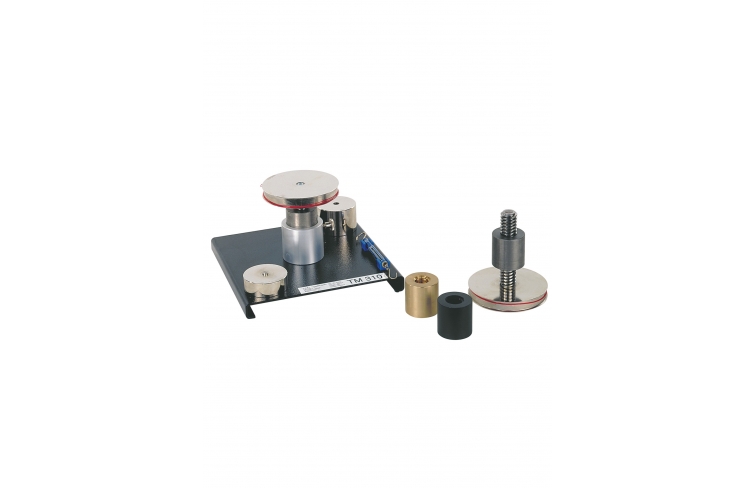
    TM 310

    • determine the thread efficiency with different thread-material pairings
    Obiettivi didattici (4)
    • · a cast iron nut
    • · a bronze nut
    • · a plastic nut
    • · determine the relevant thread efficiency
    MG 911

    • extensive teaching kit of the most important roller bearings used in mechanical engineering
    • standardised designations, terms and applications
    Obiettivi didattici (3)
    • · familiarisation with the most important roller bearing types used in mechanical engineering and their specific applications
    • · familiarisation with relevant standardised designations and terms
    • · discussion of applications
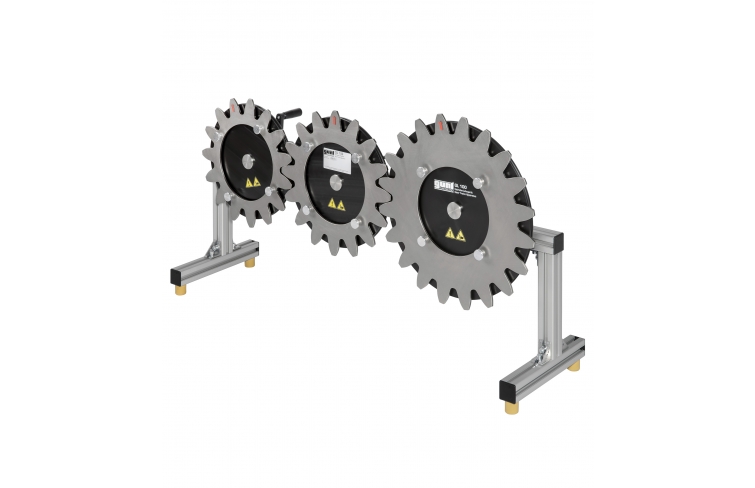
    GL 100

    • demonstration of function and structure of various gears
    Obiettivi didattici (5)
    • · principle and differences of belt drives, friction wheels and gear drives
    • · gear ratio
    • · pitch
    • · module
    • · function of intermediate gears
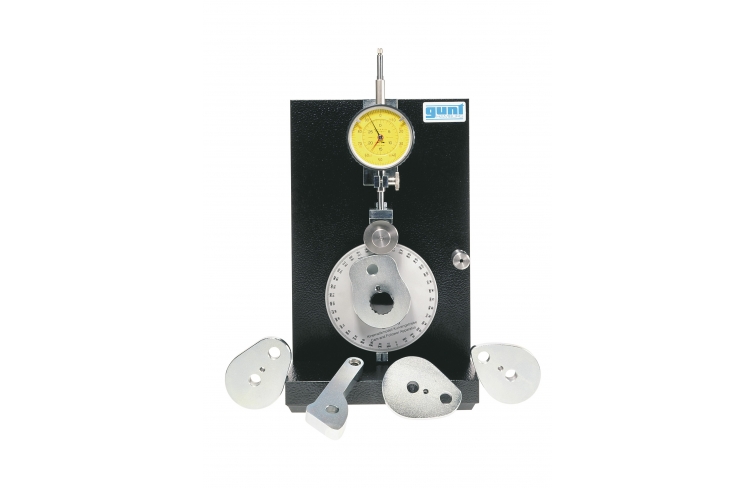
    GL 110

    • demonstration and measurement of elevation curves in cam mechanisms
    Obiettivi didattici (3)
    • · elevation curves in cam mechanisms
    • · circular arc, tangent, hollow, asymmetric
    • · optionally with roller plunger, flat plunger or cam follower as engaging member
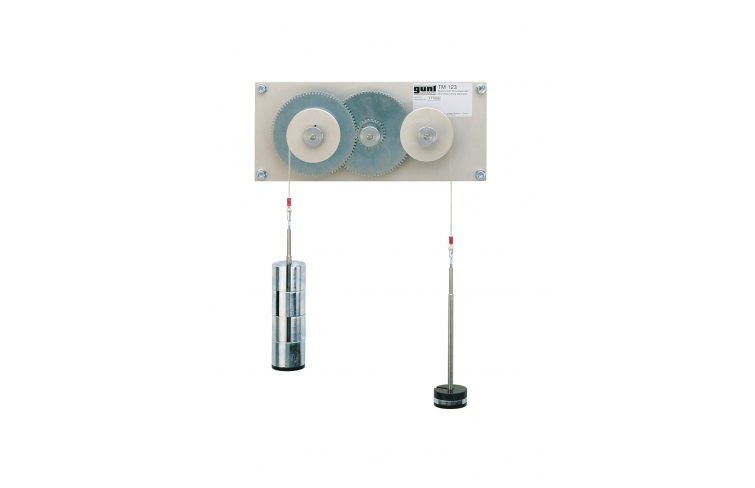
    TM 123

    • design and principle of gear drives
    Obiettivi didattici (4)
    • · velocity ratios in spur gears
    • · gear with intermediate wheel or two-stage gear
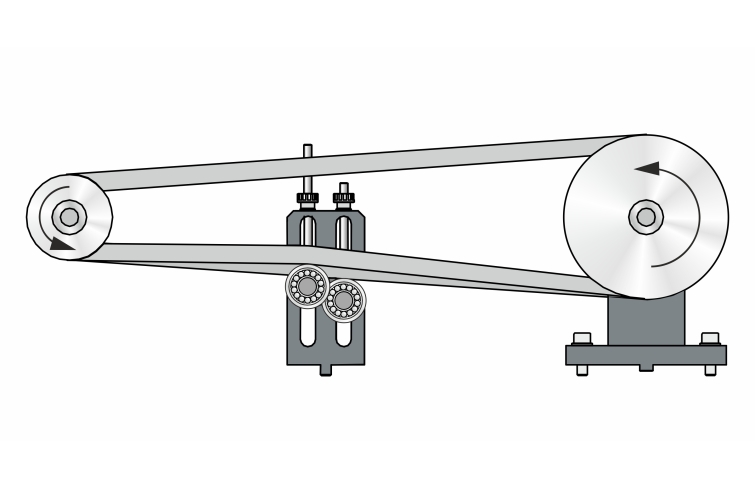
    • · influence of gear ratio on friction
    • · determine the efficiency
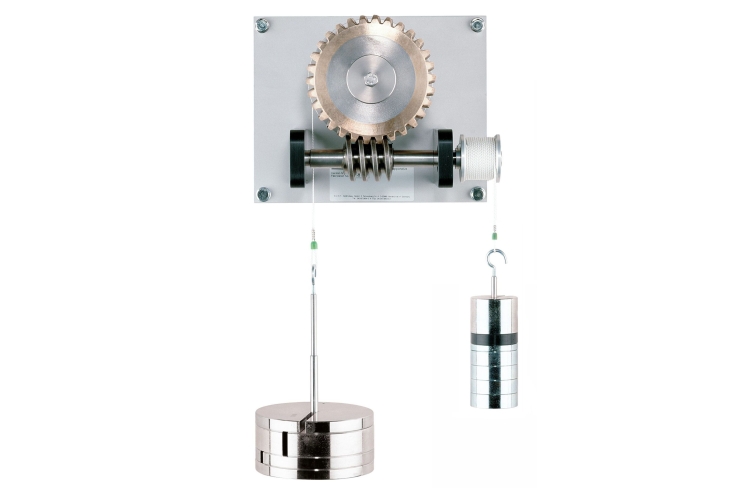
    TM 124

    • design and principle of worm gears
    Obiettivi didattici (2)
    • · investigation of transmission ratio, torque, friction and self-locking
    • · determine the efficiency
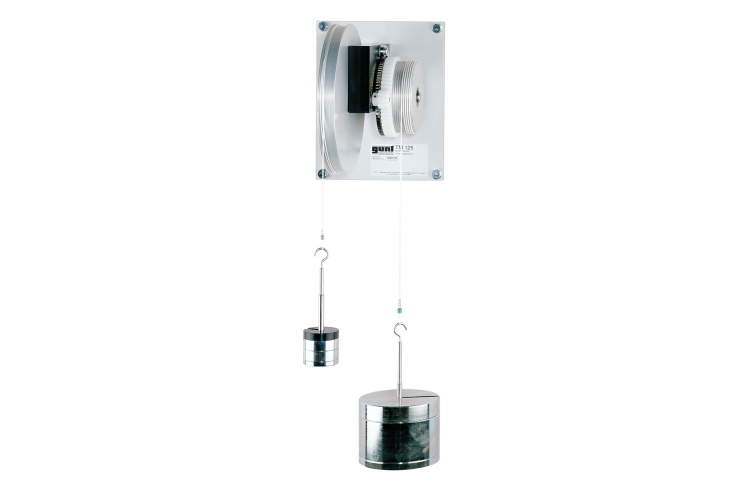
    TM 125

    • structure and principle of a cable winch
    Obiettivi didattici (5)
    • · transmission ratio
    • · unwinding rate
    • · angular velocity
    • · efficiency
    • · behaviour under load
    TM 220

    • function of a belt drive
    • friction of different belt types on a metal pulley
    Obiettivi didattici (3)
    • · effect of wrap angle, coefficient of friction and cable force (Eytelwein’s belt friction formula)
    • · comparison of flat belts and V-belts
    • · consequences of an unadapted V-belt groove
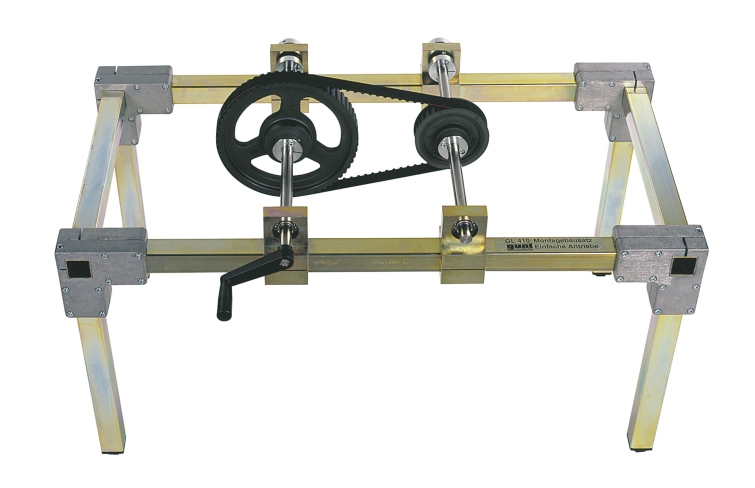
    GL 410

    • flexible and robust assembly kit for the fundamentals of mechanical gear engineering
    • uses industrial components to represent the real world accurately
    • quick and simple assembly
    Obiettivi didattici (10)
    • · familiarisation with main components of mechanical gear engineering
    • · simple belt drive
    • · simple chain gear
    • · simple spur gear
    • · bevel gear
    • · worm gear
    • · rack-and-pinion drive
    • · calculations on mechanical gears
    • · practical setup of different gears, associated with simple setup and configuration exercises
    • · read and understand engineering drawings, familiarisation with technical terms
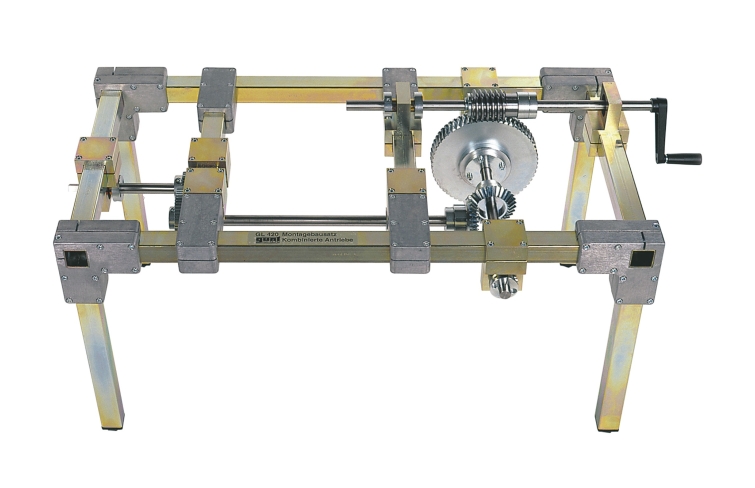
    GL 420

    • flexible and robust assembly kit for continuing mechanical gear engineering
    • uses industrial components to represent the real world accurately
    • quick and simple assembly
    Obiettivi didattici (9)
    • · two-stage belt drive
    • · chain gear with tensioning wheel and spur gear ratio
    • · two-stage spur gear
    • · combined bevel and spur gears
    • · combined worm and bevel gears
    • · rack-and-pinion drive with spur gear
    • · calculations on mechanical gears
    • · practical setup of different gears, associated with setup and configuration exercises
    • · read and understand engineering drawings, familiarisation with technical terms
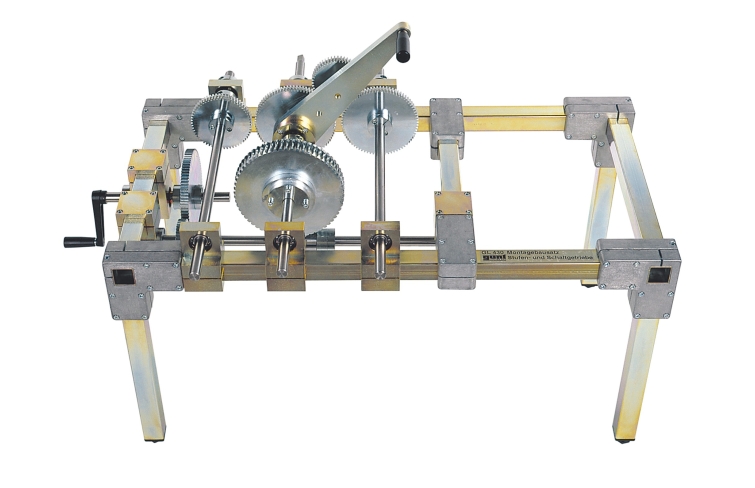
    GL 430

    • flexible and robust assembly kit for continuing mechanical gear engineering
    • uses industrial components to represent the real world accurately
    • quick and simple assembly
    Obiettivi didattici (9)
    • · step pulley gear
    • · sliding gear drive
    • · Norton gear
    • · tumbler gear
    • · change gear
    • · cam box (tripping device for lathe)
    • · calculations on mechanical gears
    • · practical setup of different gears, associated with setup and configuration exercises
    • · read and understand engineering drawings, familiarisation with technical terms
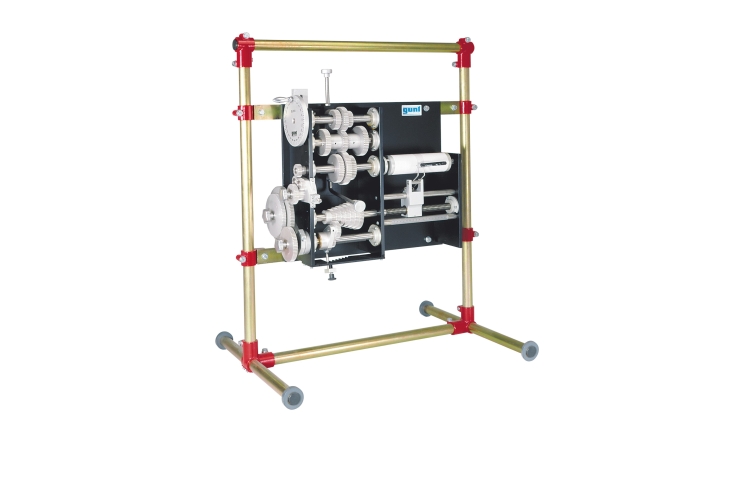
    GL 200

    • safe and clear demonstration of the gear functions on a lathe
    Obiettivi didattici (5)
    • · investigation of all essential gear functions of a lathe
    • · main gear
    • · change gear
    • · tumbler gear
    • · feed gear (Norton gear)
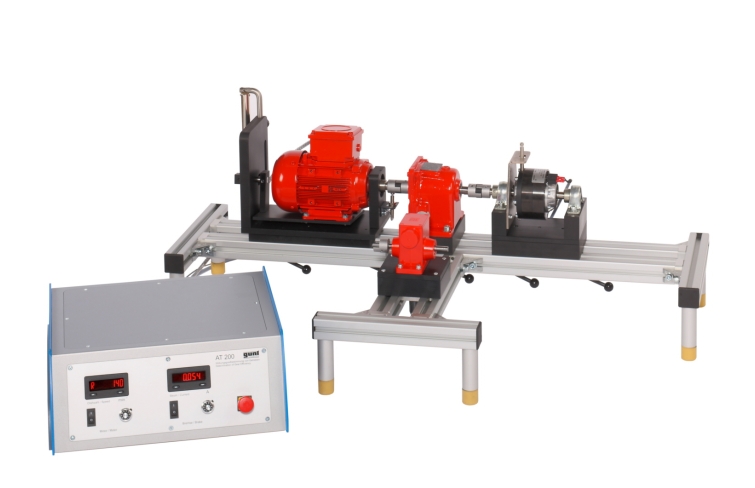
    AT 200

    • mechanical efficiency of gears
    • three-phase AC motor as the drive and magnetic particle brake as the brake unit
    • comparison of worm and spur gears
    Obiettivi didattici (4)
    • · spur gear, two-stage
    • · worm gear
    • · plot the torque/current characteristic curve for a magnetic particle brake
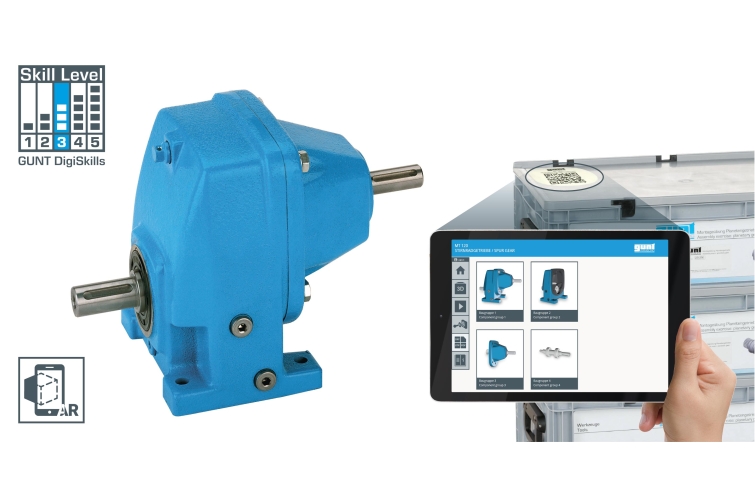
    • · drive and control engineering
    MT 120

    • supported by augmented reality
    Obiettivi didattici (7)
    • · function and design of a helical spur gear unit
    • · planning and presentation of the assembly process, supported by augmented reality
    • · assembly and disassembly, including for the purposes of maintenance and repair
    • · familiarisation with various machine elements: ball bearings, shaft seals
    • · familiarisation with assembly aids and jigs
    • · functional testing of the assembled gear unit
    • · preventive maintenance
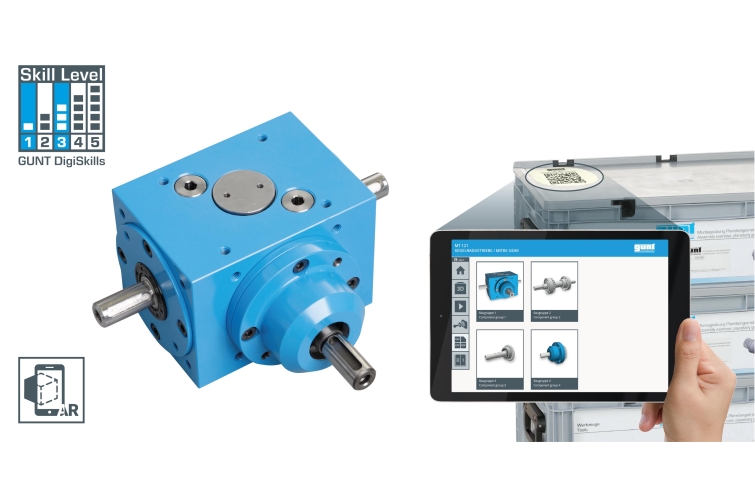
    MT 121

    • supported by augmented reality
    Obiettivi didattici (6)
    • · function and design of a mitre gear unit
    • · planning and presentation of the assembly process, supported by augmented reality
    • · assembly and disassembly, including for the purposes of maintenance and repair
    • · familiarisation with various machine elements: ball bearings, shaft seals
    • · familiarisation with assembly aids and jigs
    • · functional testing of the assembled gear unit
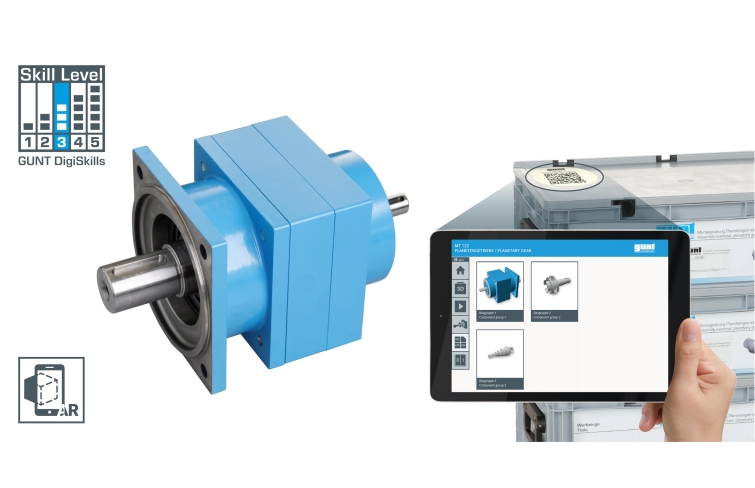
    MT 122

    • supported by augmented reality
    Obiettivi didattici (7)
    • · function and design of a planetary gear with fixed hollow wheel
    • · planning and presentation of the assembly process, supported by augmented reality
    • · assembly and disassembly, including for the purposes of maintenance and repair
    • · familiarisation with various machine elements: ball bearings, shaft seals
    • · familiarisation with assembly aids and jigs
    • · functional testing of the assembled gear unit
    • · preventive maintenance
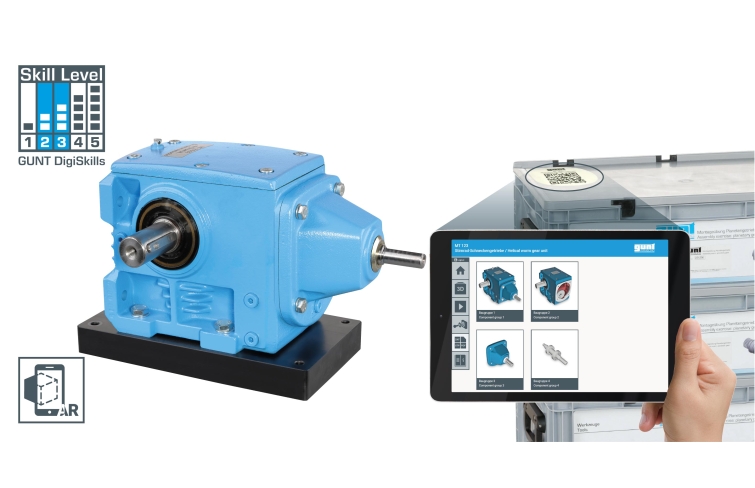
    MT 123

    • supported by augmented reality
    Obiettivi didattici (7)
    • · function and design of a spur and worm gear
    • · planning and presentation of the assembly process, supported by augmented reality
    • · assembly and disassembly, including for the purposes of maintenance and repair
    • · familiarisation with various machine elements: gear wheels, ball bearings
    • · familiarisation with assembly aids and jigs
    • · functional testing of the assembled gear unit
    • · preventive maintenance
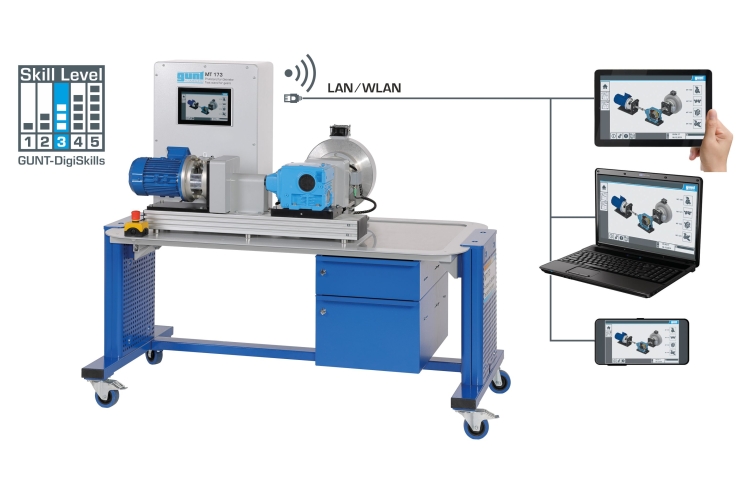
    MT 173

    • investigation of mechanical efficiency of gears
    • three-phase motor as the drive unit and magnetic particle brake as the brake unit
    • integrated router for operation and control via an end device and for screen mirroring on additional end devices: PC, tablet, smartphone
    Obiettivi didattici (5)
    • · determination of the mechanical efficiency of gears by comparing the mechanical driving and braking power for: spur and worm gears, spur gears, bevel gears, planetary gears
    • · efficiency dependent on speed
    • · efficiency dependent on torque
    • · menu navigation independent of the user interface shown on the touch screen
    • · different user levels available on the end device: for observing the experiments or for operation and control
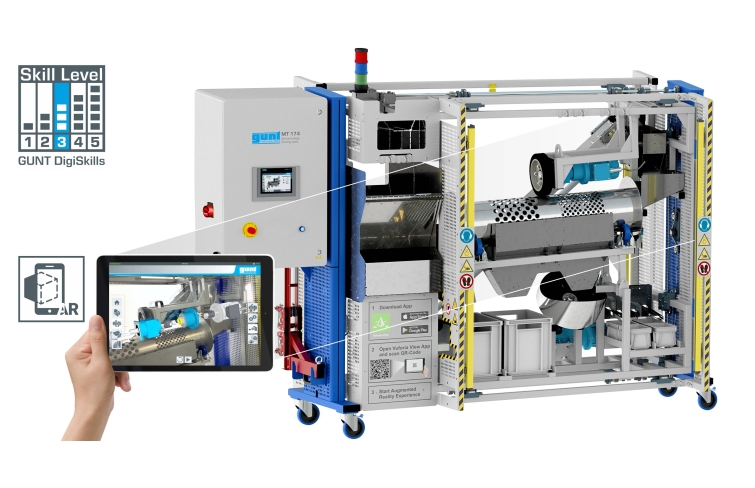
    MT 174

    • application example for preventive maintenance
    • augmented reality for visualisation of maintenance work
    Obiettivi didattici (17)
    • · time-controlled
    • · sensor-controlled
    • · supported by augmented reality
    • · spur gear
    • · planetary gear
    • · spur and worm gear
    • · investigate how various parameters affect the separation process
    • · vibrating trough
    • · conveyor belt
    • · drum screen
    • · rotary storage table
    • · colour sorting
    • · familiarisation with IO-Link as a communication interface for smart sensors
    • · retrieve information from digital networks
    • · use digital learning media
    • · use visualisation systems, e.g. augmented reality, QR codes
    • · assembly / disassembly of gears
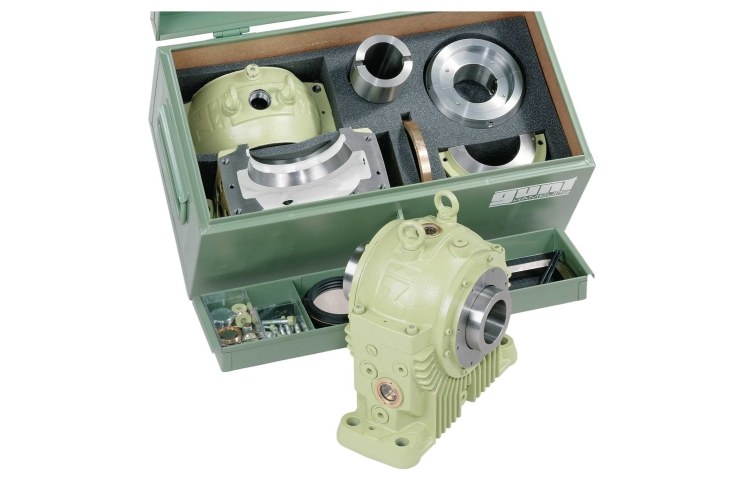
    MT 171

    • practical kit of a hydrodynamic journal bearing
    Obiettivi didattici (4)
    • · function and design of a hydrodynamic journal bearing
    • · principles of lubrication and sealing elements
    • · assembly and disassembly, including for the purposes of maintenance and repair
    • · read and understand engineering drawings and operating instructions
    MT 190

    • kit of a unit for basic experiments in materials testing
    • can be expanded with electronic data acquisition
    Obiettivi didattici (10)
    • · read and understand technical documentation
    • · plan and execute assembly steps and sequences
    • · familiarisation with machine elements and components
    • · commission and inspect materials tester after successful assembly
    • · plan, implement and evaluate maintenance operations
    • · fault analysis: troubleshooting, fault analysis and remedy
    • · tensile test on metallic specimens
    • · plot load–extension diagrams
    • · compression test
    • · Brinell hardness test
    MT 190.01

    • interdisciplinary and interlinking kit from the fields of mechanics and electronics
    Obiettivi didattici (8)
    • · fundamentals of data acquisition: familiarisation with sensors, electronics for recording and outputting measured values, interfaces, software
    • · read and understand technical documentation
    • · plan and execute assembly steps and sequences
    • · commissioning and inspection of a data acquisition system following assembly
    • · system integration: connect materials tester and data acquisition
    • · record load–extension diagrams or stress–strain diagrams
    • · prepare, display and store data
    • · output diagrams to printer
  • Prove sui materiali

    22 prodotti

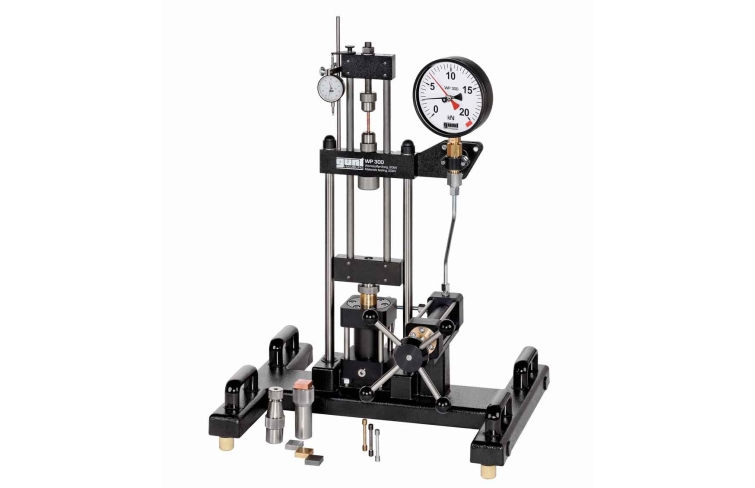
    WP 300

    • compact, simple experimental unit for basic destructive tests
    • tensile tests, compression tests, Brinell hardness test
    Obiettivi didattici (9)
    • · tensile tests
    • · plot stress–strain diagrams
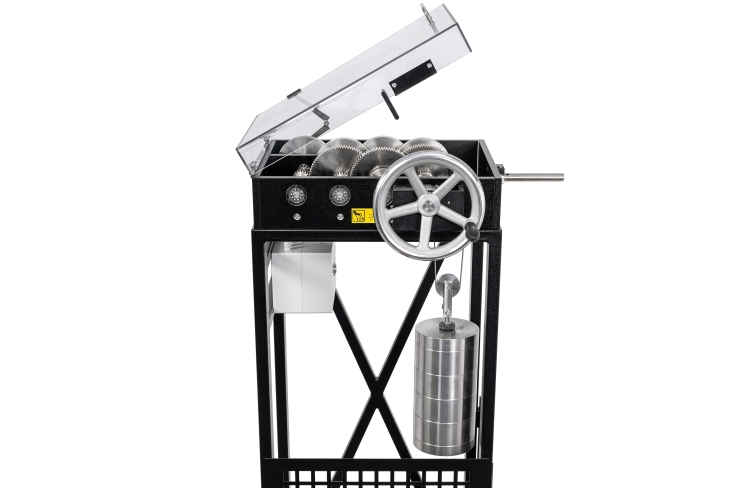
    • · compression tests
    • · Brinell hardness test
    • · compression tests for own specimens
    • · bending tests
    • · cupping tests
    • · shear tests
    • · testing of disk and coil springs
    WP 310

    • hydraulically operated trainer, based on industrial standards
    • direct generation of tensile and compressive forces
    • extensive accessories for experiments from destructive materials testing
    Obiettivi didattici (7)
    • · tensile test
    • · compression test
    • · Brinell hardness test
    • · bending test
    • · shear test
    • · cupping test
    • · spring testing
    SE 110.48

    • observe and determine the transition from elastic to plastic deformation
    • plot load–extension diagrams
    Obiettivi didattici (4)
    • · load on a beam with a point load
    • · plot a load–extension diagram and determine the nonlinear behaviour
    • · compare the load and relief curves
    • · demonstrate the invalidity of the superposition principle in the plastic region
    SE 100

    • load tests on components from steelwork and civil engineering
    • specially designed for large components at a 1:1 scale
    • wide range of applications thanks to extensive accessories
    Obiettivi didattici (3)
    • · bending tests
    • · load tests
    • · compression tests
    WP 400

    • Charpy notched-bar impact test
    • classic method from destructive materials testing for quality control and analysis of the fracture behaviour of metallic materials
    Obiettivi didattici (5)
    • · determine the notched-bar impact work
    • · determine the notched-bar impact strength
    • · analyse the fracture surface characteristics
    • · plot a notched-bar impact work–temperature diagram
    • · influence of notch shape, material and specimen temperature on the notched-bar impact work
    WP 410

    Obiettivi didattici (5)
    • · determine the notched-bar impact work
    • · determine the notched-bar impact strength
    • · analyse the fracture surface characteristics
    • · plot a notched-bar impact work–temperature diagram
    • · influence of notch shape, material and specimen temperature on the notched-bar impact work
    WP 500

    • generate the twisting moment by means of a worm gear
    • measure the twisting moment by means of a strain-gauge measuring shaft
    • incremental encoder for measuring the twisting angle
    Obiettivi didattici (6)
    • · torsion tests with different materials and load until specimen fracture
    • · determine the twisting strength
    • · plot the diagram of twisting moment over twisting angle
    • · specimen material
    • · specimen cross-section
    • · specimen length
    WP 510

    • measure the test moment by means of strain gauge
    • incremental encoder for measuring the twisting angle
    • four different deformation rates can be configured
    Obiettivi didattici (5)
    • · torsion tests with different materials and load until specimen fracture
    • · determine the twisting strength
    • · plot the diagram of twisting moment over twisting angle
    • · determine the elastic region
    • · influence of specimen material
    WP 140

    • different specimens show the influence of notching and surface quality
    • continuous adjustment of the load amplitude
    • automatically shuts down when the specimen fractures
    Obiettivi didattici (3)
    • · fatigue strength of bars under reverse bending stress
    • · influence of different fillet radii and surface qualities on the fatigue strength
    • · Wöhler diagram
    WP 600

    • typical phenomena of creep processes
    • experiments at or below room temperature are possible
    Obiettivi didattici (4)
    • · creep in specimens of various materials
    • · record a strain–time diagram (creep curve)
    • · influence of temperature and load on the creep
    • · load and recovery in plastics
    TM 260

    • base module for studying various cases of sliding and rolling friction
    • contact force by means of weights and lever
    • electronic measurement of the frictional force between friction partners
    Obiettivi didattici (5)
    • · rolling friction of two disks with slip
    • · wear test: pin against disk
    • · wear test: friction wheel experiment
    • · frictional vibrations and slip–stick phenomenon
    • · pressure distribution in the journal bearing
    TM 260.01

    • frictional forces between two rolling friction wheels
    • how slip affects the frictional force
    • use of different lubricants possible
    Obiettivi didattici (3)
    • · determine the frictional forces as a function of load, lubrication and operating speed
    • · how slip affects the frictional force
    • · determine the coefficients of friction
    TM 260.02

    • elasto-hydrodynamic behaviour between the sphere and rotating-glass-plate friction pair
    • investigation of the thickness and shape of the lubricating film
    Obiettivi didattici (2)
    • · determine the thickness of the lubricating film at the contact point of a sphere with a plane surface – compare with theoretical value
    • · study the effect of load and speed on the thickness of the lubricating film
    TM 260.03

    • frictional forces between two sliding friction pairs
    • investigation of wear
    • use of different lubricants possible
    Obiettivi didattici (4)
    • · frictional forces in different friction pairs and loads
    • · frictional forces with different lubrication
    • · frictional forces at different relative speeds of the friction partners
    • · wear under different friction parameters and lubrication conditions
    TM 260.04

    • slip–stick phenomenon at the transition from static to dynamic friction
    • friction rings of different materials for the study of different friction pairings
    Obiettivi didattici (4)
    • · observation of the transition from static to dynamic friction
    • · influence of lubrication on slip–stick phenomenon
    • · influence of the force between the friction partners on the slip–stick phenomenon
    • · influence of the relative velocity of the friction partners on the slip–stick phenomenon
    TM 260.05

    • frictional forces between two sliding friction pairs
    • investigation of wear
    • use of different lubricants possible
    Obiettivi didattici (4)
    • · frictional forces in different friction pairs and loads
    • · frictional forces with different lubrication
    • · frictional forces at different relative speeds of the friction partners
    • · wear under different friction parameters
    TM 260.06

    • depiction of radial pressure distribution in a journal bearing at different bearing gap widths
    • bearing housing made of transparent plastic
    Obiettivi didattici (3)
    • · pressure distribution in the journal bearing depending on speed
    • · pressure distribution in the journal bearing depending on load or bearing gap width
    • · stability limit as a function of the gap width
    TM 232

    • friction in slide bearings and roller bearings
    • interchangeable bearing shells for slide bearings of different materials
    Obiettivi didattici (4)
    • · determine the frictional moment in slide bearings with various friction pairs
    • · determine the frictional moment of a rolling bearing
    • · comparison of slide and rolling bearings
    • · basic experiments on rotational dynamics
    TM 280

    • ideal observation of the function thanks to transparent bearing housing
    • clear representation of the pressure distribution in the journal bearing
    • investigation and visualisation of instability in journal bearings
    Obiettivi didattici (5)
    • · visualisation and investigation of instability in journal bearings
    • · displacement of the shaft journal as a function of the speed
    • · pressure distribution in the bearing under constant load and different speeds
    • · critical speed as a function of the load
    • · critical speed as a function of the oil temperature
    TM 282

    • fundamentals of hydrodynamic lubrication
    • friction states under different operating conditions
    • electronic speed control and digital display of speed and lubricant temperature
    Obiettivi didattici (4)
    • · develop an understanding of technological relationships of hydrodynamic lubrication by experimentation
    • · speed
    • · bearing load
    • · lubricant and lubricant temperature
    TM 290

    • frictional moment under different bearing clearances and loads
    • pressure distribution in the journal bearing
    • locus of the shaft under different loads and speeds
    Obiettivi didattici (4)
    • · determine the coefficients of friction at various loads and speeds, compare with Stribeck curves
    • · influence of speed, bearing clearance and bearing load on the displacement of the shaft
    • · influence of speed, bearing clearance, bearing load and lubricant on the frictional moment
    • · locus of the shaft
    CE 105

    • principles of corrosion and corrosion protection on metallic materials
    • oxygen corrosion
    • electrochemical corrosion (local elements)
    Obiettivi didattici (8)
    • · corrosion behaviour of different metallic materials (rust / passivation)
    • · formation of local elements
    • · influence of pH value of the electrolyte solution
    • · influence of salt concentration in the electrolyte solution
    • · oxygen corrosion
    • · external voltage
    • · sacrificial anodes
    • · protective layers
🤖

Meccatronica

9 sotto-aree · 396 apparecchiature

  • Disegno tecnico – Comunicazione tecnica

    9 prodotti

    TZ 100

    • model set for developing spatial imagination
    • fundamentals of three-view display
    Obiettivi didattici (4)
    • · familiarisation with three-view display as a basic principle of engineering drawing
    • · step-by-step development of spatial thinking: from the concrete situation to the abstract representation in an engineering drawing
    • · measuring exercises
    • · retrieve information from digital networks and obtaining it from digital networks
    TZ 110

    • collection of cylindrical models with cuts parallel to the spatial axes
    • introduction to engineering drawing
    • systematically graduated degrees of difficulty
    Obiettivi didattici (6)
    • · familiarisation with three-view display as a basic principle of engineering drawing
    • · step-by-step development of spatial thinking: from the concrete situation to the abstract representation in an engineering drawing
    • · systematic familiarisation with a wide range of features on cylindrical base forms
    • · exercises in production-oriented and standard dimensioning
    • · measurement exercises: outer dimensions, inner dimensions, tolerances
    • · retrieve information from digital networks and obtaining it from digital networks
    TZ 120

    • collection of cylindrical models with cuts parallel and oblique to the spatial axes
    • introduction to engineering drawing
    • systematically graduated degrees of difficulty
    Obiettivi didattici (6)
    • · familiarisation with three-view display as a basic principle of engineering drawing
    • · step-by-step development of spatial thinking: from the concrete situation to the abstract representation in an engineering drawing
    • · systematic familiarisation with a wide range of features on cylindrical base forms
    • · exercises in production-oriented and standard dimensioning
    • · measurement exercises: outer dimensions, inner dimensions, angles, tolerances
    • · retrieve information from digital networks and obtaining it from digital networks
    TZ 130

    • collection of prismatic models with cuts parallel to the spatial axes
    • introduction to engineering drawing
    • systematically graduated degrees of difficulty
    Obiettivi didattici (6)
    • · familiarisation with three-view display as a basic principle of engineering drawing
    • · step-by-step development of spatial thinking: from the concrete situation to the abstract representation in an engineering drawing
    • · systematic familiarisation with a wide range of features on prismatic base forms
    • · exercises in production-oriented and standard dimensioning
    • · measurement exercises: outer dimensions, inner dimensions, tolerances
    • · retrieve information from digital networks and obtaining it from digital networks
    TZ 140

    • collection of geometric models with cuts parallel and oblique to the spatial axes
    • introduction to engineering drawing
    • systematically graduated degrees of difficulty
    Obiettivi didattici (6)
    • · familiarisation with three-view display as a basic principle of engineering drawing
    • · step-by-step development of spatial thinking: from the concrete situation to the abstract representation in an engineering drawing
    • · systematic familiarisation with a wide range of features on prismatic base forms
    • · exercises in production-oriented and standard dimensioning
    • · measurement exercises: outer dimensions, inner dimensions, angles, tolerances
    • · retrieve information from digital networks and obtaining it from digital networks
    TZ 200.01

    • functional bending press as a practice model
    • introduction to engineering drawing
    Obiettivi didattici (16)
    • · engineering drawing
    • · production-oriented and standardised representation of parts
    • · surface finish and tolerance specifications
    • · overview drawing
    • · parts list
    • · standard parts
    • · 3D views
    • · material specifications
    • · assembly and disassembly
    • · planning an assembly sequence
    • · functions
    • · material selection
    • · manufacturing methods
    • · length measurements
    • · angle measurements
    • · retrieve information from digital networks and obtaining it from digital networks
    TZ 200.07

    • functional lever shear as a practice model
    • introduction to engineering drawing
    Obiettivi didattici (15)
    • · engineering drawing
    • · production-oriented and standardised representation of parts
    • · surface finish and tolerance specifications
    • · overview drawing
    • · parts list
    • · standard parts
    • · 3D views
    • · material specifications
    • · assembly and disassembly
    • · planning an assembly sequence
    • · functions
    • · material selection
    • · manufacturing methods
    • · measurement exercises: length measurements
    • · retrieve information from digital networks and obtaining it from digital networks
    TZ 300

    • functional lever press as a practice model
    • introduction to engineering drawing
    Obiettivi didattici (14)
    • · engineering drawing
    • · production-oriented and standardised representation of parts
    • · surface finish and tolerance specifications
    • · overview drawing, parts list
    • · standard parts
    • · 3D views
    • · material specifications
    • · assembly/disassembly, planning an assembly sequence, functions
    • · material selection
    • · manufacturing methods
    • · longitudinal measurements
    • · angular measurements
    • · working examples of handmade production and production on machine tools
    • · retrieve information from digital networks and obtaining it from digital networks
    MT 121

    • supported by augmented reality
    Obiettivi didattici (6)
    • · function and design of a mitre gear unit
    • · planning and presentation of the assembly process, supported by augmented reality
    • · assembly and disassembly, including for the purposes of maintenance and repair
    • · familiarisation with various machine elements: ball bearings, shaft seals
    • · familiarisation with assembly aids and jigs
    • · functional testing of the assembled gear unit
  • Modelli sezionati

    51 prodotti

    GL 300.01

    • demonstration of complex machine elements and demonstration of their principle of operation
    Obiettivi didattici (1)
    • · principle of operation and design of a worm gear
    GL 300.02

    • demonstration of complex machine elements and demonstration of their principle of operation
    Obiettivi didattici (1)
    • · principle of operation and design of a mitre gear
    GL 300.03

    • demonstration of complex machine elements and demonstration of their principle of operation
    Obiettivi didattici (1)
    • · principle of operation and design of a spur gear
    MT 110.10

    • demonstration of a spur and worm gear and demonstration of its principle of operation
    Obiettivi didattici (1)
    • · principle of operation and design of a spur and worm gear
    GL 300.04

    • demonstration of complex machine elements and demonstration of their principle of operation
    Obiettivi didattici (1)
    • · principle of operation and design of a two-stage spur gear
    GL 300.05

    • demonstration of complex machine elements and demonstration of their principle of operation
    Obiettivi didattici (1)
    • · principle of operation and design of a planetary gear
    GL 300.06

    • demonstration of complex machine elements and demonstration of their principle of operation
    Obiettivi didattici (1)
    • · principle of operation and design of a variable speed belt drive
    GL 300.07

    • demonstration of complex machine elements and demonstration of their principle of operation
    Obiettivi didattici (1)
    • · principle of operation and design of a control gear
    GL 300.08

    • demonstration of complex machine elements and demonstration of their principle of operation
    Obiettivi didattici (1)
    • · principle of operation and design of a multiple-disc clutch
    GL 300.12

    • demonstration of complex machine elements and demonstration of their principle of operation
    Obiettivi didattici (1)
    • · principle of operation and design of a pedestal bearing
    ET 499.01

    • cutaway model of an industrial refrigerant compressor
    Obiettivi didattici (1)
    • · layout and function of a hermetic refrigerant compressor
    ET 499.02

    • cutaway model of an industrial semi-hermetic refrigerant compressor
    Obiettivi didattici (1)
    • · layout and function of a semi-hermetic refrigerant compressor
    ET 499.03

    • cutaway model of an industrial refrigerant compressor
    Obiettivi didattici (1)
    • · layout and function of an open refrigerant compressor with 2 cylinders
    ET 499.12

    • cutaway model of a block drier
    Obiettivi didattici (1)
    • · layout and function of a block drier
    ET 499.13

    • cutaway model of an oil separator
    Obiettivi didattici (1)
    • · layout and function of an oil separator
    ET 499.14

    • cutaway model of a liquid separator
    Obiettivi didattici (1)
    • · layout and function of a liquid separator
    ET 499.16

    • cutaway model of a ball valve
    Obiettivi didattici (1)
    • · layout and function of a ball valve
    ET 499.18

    • cutaway model of a thermostatic expansion valve
    Obiettivi didattici (1)
    • · layout and function of a thermostatic expansion valve
    ET 499.19

    • cutaway model of an automatic expansion valve
    Obiettivi didattici (1)
    • · layout and function of an automatic expansion valve
    ET 499.21

    • cutaway model of a sight glass with moisture indicator
    Obiettivi didattici (1)
    • · function and design of a sight glass with moisture indicator
    ET 499.30

    • cutaway models of industrial components used in refrigeration engineering
    Obiettivi didattici (3)
    • · principle of operation and layout of an expansion vessel
    • · principle of operation and layout of an evaporator
    • · principle of operation and layout of a filter/drier
    CE 810

    • high pressure equipment
    • online access via QR code to digital information on the gas booster
    • supported by augmented reality
    Obiettivi didattici (9)
    • · connection
    • · sealing
    • · required wall thickness
    • · familiarization with pneumatic piston drive
    • · functional principle of a single-stage gas booster
    • · read and understand engineering drawings
    • · retrieve information from digital networks
    • · use digital learning media
    • · use visualisation systems, e.g. augmented reality, QR codes
    CE 815

    • high pressure equipment
    Obiettivi didattici (11)
    • · connection
    • · sealing
    • · required wall thickness
    • · bursting disc safety device
    • · safety valve
    • · flashback arrestor
    • · dielectric clamping ring fittings
    • · read and understand engineering drawings
    • · retrieve information from digital networks
    • · use digital learning media
    • · use visualisation systems, e.g. QR codes
    HM 700.01

    • cutaway model of a standard orifice plate
    Obiettivi didattici (1)
    • · familiarization with the construction and functionality of all parts
    HM 700.02

    • cutaway model of a standard nozzle
    Obiettivi didattici (1)
    • · familiarization with construction and functionality of all parts
    HM 700.03

    • cutaway model of a standard Venturi meter
    Obiettivi didattici (1)
    • · familiarization with the construction and functionality of all parts
    HM 700.04

    • cutaway model of a standard straight-way valve
    Obiettivi didattici (1)
    • · familiarization with the construction and functionality of all parts
    HM 700.05

    • cutaway model of a standard corner valve
    Obiettivi didattici (1)
    • · familiarization with the construction and functionality of all parts
    HM 700.06

    • cutaway model of a standard angle seat valve
    Obiettivi didattici (1)
    • · familiarization with the construction and functionality of all parts
    HM 700.07

    • cutaway model of a standard flanged non-return valve
    Obiettivi didattici (1)
    • · familiarization with the construction and functionality of all parts
    HM 700.08

    • Cutaway model of a standard pressure reducing valve
    Obiettivi didattici (1)
    • · familiarization with the construction and functionality of all parts
    HM 700.09

    • cutaway model of a standard strainer
    Obiettivi didattici (1)
    • · familiarization with the construction and functionality of all parts
    HM 700.10

    • cutaway model of a standard gate valve
    Obiettivi didattici (1)
    • · familiarization with the construction and functionality of all parts
    HM 700.11

    • cutaway model of a standard straight-way plug valve
    Obiettivi didattici (1)
    • · familiarization with the construction and functionality of all parts
    HM 700.12

    • cutaway model of a standard flanged three-way plug valve
    Obiettivi didattici (1)
    • · familiarization with the construction and functionality of all parts
    HM 700.13

    • cutaway model of a standard ball valve
    Obiettivi didattici (1)
    • · familiarization with the construction and functionality of all parts
    HM 700.14

    • cutaway model of a standard safety valve
    Obiettivi didattici (1)
    • · familiarization with the construction and functionality of all parts
    HM 700.15

    • cutaway models of various screwed pipe connections
    Obiettivi didattici (1)
    • · familiarization with the construction and functionality of all parts
    HM 700.16

    • cutaway models of different pressure gauges
    Obiettivi didattici (2)
    • · familiarization with the construction and functionality of all parts
    • · comparison of various working principles
    HM 700.17

    • cutaway model of a centrifugal pump
    Obiettivi didattici (1)
    • · familiarization with the construction and functionality of all parts
    HM 700.20

    • cutaway model of a reciprocating piston pump
    Obiettivi didattici (1)
    • · familiarization with the construction and functionality of all parts
    HM 700.22

    • cutaway model of a gear pump
    Obiettivi didattici (1)
    • · familiarization with the construction and functionality of all parts
    VS 101

    • cutaway model of an underground hydrant
    Obiettivi didattici (1)
    • · familiarization with the construction and functionality of all parts
    VS 102

    • cutaway model of a resilient seated gate valve
    Obiettivi didattici (1)
    • · familiarization with the construction and functionality of all parts
    VS 103

    • cutaway model of a standard screw down valve
    Obiettivi didattici (1)
    • · familiarization with the construction and functionality of all parts
    VS 104

    • cutaway model of a standard changeover valve
    Obiettivi didattici (1)
    • · familiarization with the construction and functionality of all parts
    VS 105

    • cutaway model of a standard gas meter
    Obiettivi didattici (1)
    • · familiarization with the construction and functionality of all parts
    VS 106

    • cutaway model of a standard backflow preventer
    Obiettivi didattici (1)
    • · familiarization with the construction and functionality of all parts
    VS 107

    • cutaway model of a standard non-return butterfly valve
    Obiettivi didattici (1)
    • · familiarization with the construction and functionality of all parts
    VS 108

    • cutaway model of a standard water meter
    Obiettivi didattici (1)
    • · familiarization with the construction and functionality of all parts
    VS 109

    • cutaway model of a strainer
    Obiettivi didattici (1)
    • · familiarization with the construction and functionality of all parts
  • Metrologia dimensionale

    6 prodotti

    PT 102

    • 10 spacer plates as test objects and various test equipment
    • digital calliper with Bluetooth data transfer function
    • testing of lengths and depths
    Obiettivi didattici (11)
    • · fundamentals of metrology: testing/measuring/gauging
    • · calliper
    • · digital calliper with Bluetooth data transfer function
    • · depth calliper
    • · depth micrometer
    • · measure specified lengths and depths
    • · keep measuring log
    • · estimate/assess measurement deviations
    • · systematic errors
    • · random errors
    • · research information in digital networks and obtain information from digital networks
    PT 104

    • 10 angle pieces as test objects and various test equipment
    • testing of: angles, radii, lengths, depths
    Obiettivi didattici (13)
    • · fundamentals of metrology: testing/measuring/gauging
    • · calliper
    • · depth calliper
    • · universal goniometer
    • · radius gauge
    • · measure specified lengths, depths and angles
    • · calculate angles
    • · compare specified radii with gauge
    • · keep measuring log
    • · estimate/assess measurement deviations
    • · systematic errors
    • · random errors
    • · research information in digital networks and obtain information from digital networks
    PT 105

    • 10 shafts as test objects and various test equipment
    • testing of: threads, diameters, lengths, depths
    Obiettivi didattici (13)
    • · calliper
    • · depth calliper
    • · external micrometer
    • · thread gauge
    • · slip gauge
    • · measure specified lengths, depths and diameters
    • · dimension test with slip gauge
    • · compare specified thread with gauge
    • · keep measuring log
    • · estimate/assess measurement deviations
    • · systematic errors
    • · random errors
    • · research information in digital networks and obtain information from digital networks
    PT 107

    • test object: flange housing as real-world machine element
    • various test equipment
    • testing of: thread, surface roughness, diameters, lengths and depths
    Obiettivi didattici (11)
    • · calliper
    • · three-point internal micrometer
    • · thread limit plug gauge
    • · surface comparison plates
    • · measure specified lengths, depths, diameters
    • · compare specified thread and surface roughness using gauges
    • · keep measuring log
    • · estimate measurement deviations
    • · recognise typical errors
    • · research information in digital networks and obtain information from digital networks
    • · isolate test object from the overall context, recognise functional relationship
    PT 108

    • test object: output shaft as real-world machine element
    • various test equipment
    • testing of: surface roughness, diameters, lengths and depths
    Obiettivi didattici (12)
    • · fundamentals of metrology: testing/measuring/gauging
    • · calliper
    • · depth calliper
    • · digital external micrometer
    • · surface comparison plates
    • · measure specified lengths, depths, diameters
    • · compare surface roughness using gauges
    • · keep measuring log
    • · estimate measurement deviations
    • · recognise typical errors
    • · research information in digital networks and obtain information from digital networks
    • · isolate test object from the overall context, recognise functional relationship
    PT 109

    • 10 hubs as test objects and various test equipment
    • testing of: diameters, lengths, depths
    Obiettivi didattici (11)
    • · calliper
    • · depth calliper
    • · three-point internal micrometer
    • · limit plug gauge
    • · measure specified lengths, depths and diameters
    • · test specified bore with limit plug gauge
    • · keep measuring log
    • · estimate/assess measurement deviations
    • · systematic errors
    • · random errors
    • · research information in digital networks and obtain information from digital networks
  • Elementi di collegamento e organi di macchine

    14 prodotti

    MG 100

    • practical workshop exercise relating to pin joints
    • familiarisation with various pin types, their special features and applications
    Obiettivi didattici (5)
    • · familiarisation with different types of pin and their specific applications: grooved pins, dowel pins, straight pins, tapered pins
    • · familiarisation with the relevant standard designations and terms, including graphical representation
    • · planning and execution of all steps in the workshop environment
    • · familiarisation with types of pinned joint
    • · working with fits and tolerances
    MG 110

    • practical workshop training relating to feather key joints
    • familiarisation with various feather keys, their production, special features and applications
    Obiettivi didattici (6)
    • · production of different feather keys: round ended and straight ended
    • · assembly of feather key joints: light fit/sliding fit
    • · familiarisation with the relevant standard designations and terms, including graphical representation
    • · planning and execution of all steps in the workshop environment
    • · familiarisation with types of keyed joint
    • · working with fits and tolerances
    MG 120

    • practical workshop exercise relating to taper key joints
    • familiarisation with various taper keys, their production, special features and areas of application
    Obiettivi didattici (6)
    • · production of different taper keys: round ended, straight ended, nose key, tangential key pair, cotter
    • · assembling taper key joints:
    • · familiarisation with the relevant standard designations and terms, including graphical representation
    • · planning and execution of all steps in the workshop environment
    • · familiarisation with types of taper-keyed joint
    • · working with fits and tolerances
    MG 200

    • practical workshop training relating to threaded joints
    • familiarisation with the key influencing factors
    Obiettivi didattici (3)
    • · tightening a threaded joint to a preset torque
    • · measuring the breakaway torque as a function of the bolt length, property class, bolt locking type and tightening torque
    • · familiarisation with the relevant standard designations and terms, including graphical representation
    MG 901

    • extensive kit comprising the most important screws and nuts used in mechanical engineering
    • standard designations, terms and graphical representation
    Obiettivi didattici (2)
    • · familiarisation with the most important screws and nuts used in mechanical engineering and their specific applications
    • · familiarisation with relevant standardised designations and terms including their graphical representations
    MG 903

    • extensive kit of screw-locking devices
    • standardised designations, terms and applications
    Obiettivi didattici (2)
    • · familiarisation with screw-locking devices and their specific applications
    • · familiarisation with relevant standardised designations and terms including the graphical representation
    MG 905

    • extensive teaching kit of the most important thread types used in mechanical engineering
    • standardised designations, terms and specific applications
    Obiettivi didattici (2)
    • · familiarisation with the most important thread types used in mechanical engineering and their specific applications
    • · use the thread gauge to determine the thread type
    MG 911

    • extensive teaching kit of the most important roller bearings used in mechanical engineering
    • standardised designations, terms and applications
    Obiettivi didattici (3)
    • · familiarisation with the most important roller bearing types used in mechanical engineering and their specific applications
    • · familiarisation with relevant standardised designations and terms
    • · discussion of applications
    TM 123

    • design and principle of gear drives
    Obiettivi didattici (4)
    • · velocity ratios in spur gears
    • · gear with intermediate wheel or two-stage gear
    • · influence of gear ratio on friction
    • · determine the efficiency
    GL 110

    • demonstration and measurement of elevation curves in cam mechanisms
    Obiettivi didattici (3)
    • · elevation curves in cam mechanisms
    • · circular arc, tangent, hollow, asymmetric
    • · optionally with roller plunger, flat plunger or cam follower as engaging member
    TM 124

    • design and principle of worm gears
    Obiettivi didattici (2)
    • · investigation of transmission ratio, torque, friction and self-locking
    • · determine the efficiency
    TM 320

    • correlation between tightening torque and tension force on standardised bolts
    • breakaway torque of a threaded joint
    Obiettivi didattici (3)
    • · axial tension force in a threaded joint dependent on the tightening torque or the elastic deformation of a slotted block
    • · measurement of the breakaway torque, including for different fitting situations of the threaded joint
    • · measurement of thread friction and overall friction
    TM 232

    • friction in slide bearings and roller bearings
    • interchangeable bearing shells for slide bearings of different materials
    Obiettivi didattici (4)
    • · determine the frictional moment in slide bearings with various friction pairs
    • · determine the frictional moment of a rolling bearing
    • · comparison of slide and rolling bearings
    • · basic experiments on rotational dynamics
    TM 282

    • fundamentals of hydrodynamic lubrication
    • friction states under different operating conditions
    • electronic speed control and digital display of speed and lubricant temperature
    Obiettivi didattici (4)
    • · develop an understanding of technological relationships of hydrodynamic lubrication by experimentation
    • · speed
    • · bearing load
    • · lubricant and lubricant temperature
  • Tecnologia di produzione

    9 prodotti

    FT 901

    • comprehensive instructional kit of the key drilling tools used in engineering
    Obiettivi didattici (4)
    • · familiarisation with the key drilling tools used in engineering and their specific application
    • · cutting angle
    • · clearance angle
    • · incorrect cutter profile
    FT 903

    • comprehensive instructional kit of the countersinking tools used in engineering
    Obiettivi didattici (2)
    • · familiarisation with the key countersinking tools used in engineering and their specific application
    • · applications of different countersink angles
    FT 905

    • comprehensive instructional kit of the key reaming tools used in engineering
    Obiettivi didattici (2)
    • · familiarisation with the key reaming tools used in engineering and their specific application
    • · checking a fit with the limit plug gauge
    FT 907

    • comprehensive instructional kit of typical abrasives and grinding tools used in engineering
    Obiettivi didattici (4)
    • · familiarisation with typical abrasives and grinding tools used in engineering and their specific application
    • · grain / shape / material
    • · construction of grinding wheels
    • · discussion of areas of application
    FT 909

    • comprehensive instructional kit of typical lathe tools used in engineering
    Obiettivi didattici (4)
    • · familiarisation with typical lathe tools used in engineering and their specific application
    • · different lathe tools: shape, application
    • · reversible carbide tips (cutting geometry)
    • · discussion of specific examples of application
    FT 913

    • comprehensive instructional kit of typical milling cutters used in engineering
    Obiettivi didattici (3)
    • · familiarisation with typical milling cutter types used in engineering and their specific application
    • · investigation of a milling cutter fixture
    • · discussion of specific applications for the various milling cutters
    FT 100

    • measurement of feed force and torque
    Obiettivi didattici (4)
    • · measuring feed force and torque at the cutting surface
    • · influence of rotational speed, rate of feed, lubrication and cooling conditions
    • · influence of the cutting geometry of the drill
    • · influence of the material being machined
    FT 102

    • measurement of the forces acting on the lathe tool
    Obiettivi didattici (3)
    • · influence of rotational speed, rate of feed, feed motion, lubrication and cooling conditions
    • · influence of the cutting geometry of the lathe tool
    • · influence of the material being machined
    FT 200

    • permanent deformation of flat bars
    • measurement of deformation forces
    Obiettivi didattici (2)
    • · deformation experiments on flat sections
    • · influence of bend radius, bend angle, material
  • Progetti di montaggio

    24 prodotti

    MT 120

    • supported by augmented reality
    Obiettivi didattici (7)
    • · function and design of a helical spur gear unit
    • · planning and presentation of the assembly process, supported by augmented reality
    • · assembly and disassembly, including for the purposes of maintenance and repair
    • · familiarisation with various machine elements: ball bearings, shaft seals
    • · familiarisation with assembly aids and jigs
    • · functional testing of the assembled gear unit
    • · preventive maintenance
    MT 121

    • supported by augmented reality
    Obiettivi didattici (6)
    • · function and design of a mitre gear unit
    • · planning and presentation of the assembly process, supported by augmented reality
    • · assembly and disassembly, including for the purposes of maintenance and repair
    • · familiarisation with various machine elements: ball bearings, shaft seals
    • · familiarisation with assembly aids and jigs
    • · functional testing of the assembled gear unit
    MT 122

    • supported by augmented reality
    Obiettivi didattici (7)
    • · function and design of a planetary gear with fixed hollow wheel
    • · planning and presentation of the assembly process, supported by augmented reality
    • · assembly and disassembly, including for the purposes of maintenance and repair
    • · familiarisation with various machine elements: ball bearings, shaft seals
    • · familiarisation with assembly aids and jigs
    • · functional testing of the assembled gear unit
    • · preventive maintenance
    MT 123

    • supported by augmented reality
    Obiettivi didattici (7)
    • · function and design of a spur and worm gear
    • · planning and presentation of the assembly process, supported by augmented reality
    • · assembly and disassembly, including for the purposes of maintenance and repair
    • · familiarisation with various machine elements: gear wheels, ball bearings
    • · familiarisation with assembly aids and jigs
    • · functional testing of the assembled gear unit
    • · preventive maintenance
    MT 173

    • investigation of mechanical efficiency of gears
    • three-phase motor as the drive unit and magnetic particle brake as the brake unit
    • integrated router for operation and control via an end device and for screen mirroring on additional end devices: PC, tablet, smartphone
    Obiettivi didattici (5)
    • · determination of the mechanical efficiency of gears by comparing the mechanical driving and braking power for: spur and worm gears, spur gears, bevel gears, planetary gears
    • · efficiency dependent on speed
    • · efficiency dependent on torque
    • · menu navigation independent of the user interface shown on the touch screen
    • · different user levels available on the end device: for observing the experiments or for operation and control
    MT 174

    • application example for preventive maintenance
    • augmented reality for visualisation of maintenance work
    Obiettivi didattici (17)
    • · time-controlled
    • · sensor-controlled
    • · supported by augmented reality
    • · spur gear
    • · planetary gear
    • · spur and worm gear
    • · investigate how various parameters affect the separation process
    • · vibrating trough
    • · conveyor belt
    • · drum screen
    • · rotary storage table
    • · colour sorting
    • · familiarisation with IO-Link as a communication interface for smart sensors
    • · retrieve information from digital networks
    • · use digital learning media
    • · use visualisation systems, e.g. augmented reality, QR codes
    • · assembly / disassembly of gears
    GL 410

    • flexible and robust assembly kit for the fundamentals of mechanical gear engineering
    • uses industrial components to represent the real world accurately
    • quick and simple assembly
    Obiettivi didattici (10)
    • · familiarisation with main components of mechanical gear engineering
    • · simple belt drive
    • · simple chain gear
    • · simple spur gear
    • · bevel gear
    • · worm gear
    • · rack-and-pinion drive
    • · calculations on mechanical gears
    • · practical setup of different gears, associated with simple setup and configuration exercises
    • · read and understand engineering drawings, familiarisation with technical terms
    GL 420

    • flexible and robust assembly kit for continuing mechanical gear engineering
    • uses industrial components to represent the real world accurately
    • quick and simple assembly
    Obiettivi didattici (9)
    • · two-stage belt drive
    • · chain gear with tensioning wheel and spur gear ratio
    • · two-stage spur gear
    • · combined bevel and spur gears
    • · combined worm and bevel gears
    • · rack-and-pinion drive with spur gear
    • · calculations on mechanical gears
    • · practical setup of different gears, associated with setup and configuration exercises
    • · read and understand engineering drawings, familiarisation with technical terms
    GL 430

    • flexible and robust assembly kit for continuing mechanical gear engineering
    • uses industrial components to represent the real world accurately
    • quick and simple assembly
    Obiettivi didattici (9)
    • · step pulley gear
    • · sliding gear drive
    • · Norton gear
    • · tumbler gear
    • · change gear
    • · cam box (tripping device for lathe)
    • · calculations on mechanical gears
    • · practical setup of different gears, associated with setup and configuration exercises
    • · read and understand engineering drawings, familiarisation with technical terms
    MT 171

    • practical kit of a hydrodynamic journal bearing
    Obiettivi didattici (4)
    • · function and design of a hydrodynamic journal bearing
    • · principles of lubrication and sealing elements
    • · assembly and disassembly, including for the purposes of maintenance and repair
    • · read and understand engineering drawings and operating instructions
    MT 101

    • broad scope of learning with interdisciplinary problems
    Obiettivi didattici (4)
    • · function and design of a pneumatically driven control valve
    • · planning and presentation of the assembly process
    • · assembly and disassembly, including for the purposes of maintenance and repair
    • · functional test of the assembled control valve
    MT 102

    • broad scope of learning with interdisciplinary problems
    Obiettivi didattici (4)
    • · function and design of an electrically driven control valve
    • · planning and presentation of the assembly process
    • · assembly and disassembly, including for the purposes of maintenance and repair
    • · functional test of the assembled control valve
    MT 154

    • practical exercise based on the assembly of a shut-off valve
    • broad scope of learning with interdisciplinary problems
    Obiettivi didattici (7)
    • · design and function of a shut-off valve
    • · assembly and disassembly, including for the purposes of maintenance and repair
    • · reading and understanding engineering drawings
    • · planning and presentation of the assembly process
    • · familiarisation with various machine elements: thread mechanism, seals, packing gland
    • · material selection criteria
    • · leak testing of the assembled valve
    MT 156

    • practical exercise based on the assembly of a wedge gate valve and an angle seat valve
    • comprehensive and well-structured instructional material
    Obiettivi didattici (7)
    • · design and function of a wedge gate valve
    • · design and function of an angle seat valve
    • · assembly and disassembly, including for the purposes of maintenance and repair
    • · replacing components (e.g. seal)
    • · comparison of 2 different valves and fittings
    • · reading and understanding engineering drawings and operating instructions
    • · leak testing of the assembled valve
    MT 157

    • practical exercise based on the assembly of a butterfly valve and a non-return valve
    Obiettivi didattici (7)
    • · design and function of a butterfly valve
    • · design and function of an a non-return valve
    • · assembly and disassembly, including for the purposes of maintenance and repair
    • · replacing components (e.g. seal)
    • · comparison of 2 different valves and fittings
    • · reading and understanding engineering drawings and operating instructions
    • · leak testing of the assembled valve
    MT 158

    • practical exercise based on the assembly of a ball valve and a shut-off valve
    Obiettivi didattici (7)
    • · design and function of a ball valve
    • · design and function of a shut-off valve
    • · assembly and disassembly, including for the purposes of maintenance and repair
    • · replacing components (e.g. seal)
    • · comparison of 2 different valves and fittings
    • · reading and understanding engineering drawings and operating instructions
    • · leak testing of the assembled valve
    MT 162

    • mobile test stand for pressure testing of valves and fittings
    Obiettivi didattici (6)
    • · correct connection of valves to a flange coupling
    • · familiarisation with the terms “nominal pressure” and “test pressure”
    • · checking the free movement of the valves and fittings
    • · pressure testing: leak testing of housing and flange seals
    • · pressure testing: leak testing of the valve seat
    • · drafting a test report
    MT 141

    • assembly exercise supported by augmented reality
    Obiettivi didattici (9)
    • · function and design of a piston compressor
    • · planning and presentation of the assembly process, supported by augmented reality
    • · assembly and disassembly, also for maintenance and repair purposes
    • · familiarisation with various machine elements: piston, crankshaft
    • · familiarisation with assembly aids and devices
    • · functional test of a piston compressor
    • · professional installation of the piston compressor in the test device incl. adjustment and alignment procedures
    • · retrieve information from digital networks
    • · use visualisation systems, e.g. augmented reality
    MT 142

    • test device for the MT 141 piston compressor
    Obiettivi didattici (8)
    • · functional test of a piston compressor
    • · pressure increase in the compressed air tank as a function of time
    • · power consumption of the drive motor as a function of pressure
    • · determining the balance of energies and efficiency
    • · familiarisation with the pressure generation system and its components
    • · function and operation of safety elements: pressure switch, non-return valve, safety valve
    • · professional installation of the piston compressor in the test device incl. adjustment and alignment procedures
    • · retrieve information from digital networks
    MT 220

    • practical installation of pipes and valves and fittings in hydrogen technology
    • single-stage gas booster with pneumatic drive
    • real leak test and maintenance work
    Obiettivi didattici (11)
    • · design and function of a single-stage gas booster
    • · cutting, deburring and bending pipes
    • · installation of cutting ring and clamping ring fittings
    • · installing seals
    • · familiarisation with the special features of hydrogen applications
    • · use components of hydrogen technology: valves, fittings, seals, safety devices
    • · commissioning and leak testing
    • · maintenance work on the gas booster
    • · familiarisation with pneumatic piston actuator in gas boosters
    • · read and understand engineering drawings and technical documentation
    • · retrieve information from digital networks
    RT 460

    • mechanics, electronics, control engineering, automation and information technology
    • independent, complete project work for several weeks or smaller standalone projects
    Obiettivi didattici (12)
    • · piping diagram/parts list
    • · wiring diagram
    • · terminal diagram
    • · process schematic
    • · signal flow diagram
    • · placement of actuators, sensors and connectors
    • · connection of electronic and electrical components
    • · wiring in the switch cabinet
    • · selection of interfaces and characteristics of sensors and actuators
    • · setting and optimising control parameters
    • · familiarisation with the advantages and disadvantages of sensor and actuator principles
    • · familiarisation with know the advantages and disadvantages of different types of control
    HL 960

    • practically oriented assembly of real piping and system installations
    • detailed, practically-based familiarisation with system components
    • online access via QR code to digital information on the valves and fittings
    Obiettivi didattici (7)
    • · design and function of valves and fittings, piping elements and system components
    • · planning of piping and system installations according to specification, e.g. a process schematic
    • · selection of components and drafting of requirement lists
    • · technically correct preparation and execution of system assembly
    • · reading and understanding engineering drawings and technical documentation
    • · operational testing of the constructed systems (in conjunction with suitable water supply and disposal)
    • · digital learning: preparation via QR code with digital information on the valves and fittings
    HL 960.01

    • installing a pump in a system
    • alignment of electric motor and pump by different methods
    Obiettivi didattici (11)
    • · installing a pump in a system
    • · connecting and aligning motor and pump
    • · straight edge, dial gauges
    • · familiarisation with key system components
    • · electrical installation of motor and switching elements
    • · assembly of pipes and instrumentation
    • · detail installation on a standard centrifugal pump
    • · reading and understanding engineering drawings, product documentation and circuit diagrams
    • · familiarisation with maintenance procedures
    • · planning assembly and maintenance steps
    • · operational testing in a pipe network
    HL 961

    • space-saving assembly of real piping and plant installations
    • familiarisation with the parts and components of plant construction in a comprehensive and practice-oriented manner
    • online access via QR code to digital information on the valves and fittings
    Obiettivi didattici (7)
    • · design and function of valves and fittings, piping elements and system components
    • · planning of piping and system installations according to specification, e.g. a process schematic
    • · selection of components and drafting of requirement lists
    • · technically correct preparation and execution of system assembly
    • · reading and understanding engineering drawings and technical documentation
    • · leak test of the fully assembled training system
    • · digital learning: preparation via QR code with digital information on the valves and fittings
  • Manutenzione

    30 prodotti

    MT 120

    • supported by augmented reality
    Obiettivi didattici (7)
    • · function and design of a helical spur gear unit
    • · planning and presentation of the assembly process, supported by augmented reality
    • · assembly and disassembly, including for the purposes of maintenance and repair
    • · familiarisation with various machine elements: ball bearings, shaft seals
    • · familiarisation with assembly aids and jigs
    • · functional testing of the assembled gear unit
    • · preventive maintenance
    MT 121

    • supported by augmented reality
    Obiettivi didattici (6)
    • · function and design of a mitre gear unit
    • · planning and presentation of the assembly process, supported by augmented reality
    • · assembly and disassembly, including for the purposes of maintenance and repair
    • · familiarisation with various machine elements: ball bearings, shaft seals
    • · familiarisation with assembly aids and jigs
    • · functional testing of the assembled gear unit
    MT 122

    • supported by augmented reality
    Obiettivi didattici (7)
    • · function and design of a planetary gear with fixed hollow wheel
    • · planning and presentation of the assembly process, supported by augmented reality
    • · assembly and disassembly, including for the purposes of maintenance and repair
    • · familiarisation with various machine elements: ball bearings, shaft seals
    • · familiarisation with assembly aids and jigs
    • · functional testing of the assembled gear unit
    • · preventive maintenance
    MT 123

    • supported by augmented reality
    Obiettivi didattici (7)
    • · function and design of a spur and worm gear
    • · planning and presentation of the assembly process, supported by augmented reality
    • · assembly and disassembly, including for the purposes of maintenance and repair
    • · familiarisation with various machine elements: gear wheels, ball bearings
    • · familiarisation with assembly aids and jigs
    • · functional testing of the assembled gear unit
    • · preventive maintenance
    MT 173

    • investigation of mechanical efficiency of gears
    • three-phase motor as the drive unit and magnetic particle brake as the brake unit
    • integrated router for operation and control via an end device and for screen mirroring on additional end devices: PC, tablet, smartphone
    Obiettivi didattici (5)
    • · determination of the mechanical efficiency of gears by comparing the mechanical driving and braking power for: spur and worm gears, spur gears, bevel gears, planetary gears
    • · efficiency dependent on speed
    • · efficiency dependent on torque
    • · menu navigation independent of the user interface shown on the touch screen
    • · different user levels available on the end device: for observing the experiments or for operation and control
    MT 174

    • application example for preventive maintenance
    • augmented reality for visualisation of maintenance work
    Obiettivi didattici (17)
    • · time-controlled
    • · sensor-controlled
    • · supported by augmented reality
    • · spur gear
    • · planetary gear
    • · spur and worm gear
    • · investigate how various parameters affect the separation process
    • · vibrating trough
    • · conveyor belt
    • · drum screen
    • · rotary storage table
    • · colour sorting
    • · familiarisation with IO-Link as a communication interface for smart sensors
    • · retrieve information from digital networks
    • · use digital learning media
    • · use visualisation systems, e.g. augmented reality, QR codes
    • · assembly / disassembly of gears
    MT 130

    • broad range of learning opportunities with interdisciplinary problems
    • supported by augmented reality
    Obiettivi didattici (5)
    • · function and design of a centrifugal pump
    • · planning and presentation of the assembly process, supported by augmented reality
    • · assembly and disassembly, including for maintenance and repair purposes
    • · familiarisation with various machine elements: impeller, mechanical seal
    • · familiarisation with assembly aids and devices
    MT 134

    • broad range of learning opportunities with interdisciplinary problems
    • supported by augmented reality
    Obiettivi didattici (5)
    • · function and design of a piston pump
    • · planning and presentation of the assembly process, supported by augmented reality
    • · assembly and disassembly, including for maintenance and repair purposes
    • · familiarisation with various machine elements: piston, mechanical seal
    • · familiarisation with assembly aids and devices
    MT 136

    • broad range of learning opportunities with interdisciplinary problems
    • supported by augmented reality
    Obiettivi didattici (5)
    • · function and design of a gear pump
    • · planning and presentation of the assembly process, supported by augmented reality
    • · assembly and disassembly, including for maintenance and repair purposes
    • · familiarisation with various machine elements: gears, mechanical seal
    • · familiarisation with assembly aids and devices
    MT 181

    • practical exercise on the assembly and maintenance of a multistage centrifugal pump
    Obiettivi didattici (6)
    • · design and function of a multistage pump and its components
    • · assembly and disassembly for maintenance and repair purposes
    • · replacing components (e.g. seals, bearings or impellers)
    • · troubleshooting, fault assessment
    • · planning and assessment of maintenance and repair operations
    • · reading and understanding engineering drawings and operating instructions
    MT 182

    • practical exercise on the assembly and maintenance of a screw pump
    Obiettivi didattici (6)
    • · design and function of a screw pump and its components
    • · assembly and disassembly for maintenance and repair purposes
    • · replacing components (e.g. seals)
    • · troubleshooting, fault assessment
    • · planning and assessment of maintenance and repair operations
    • · reading and understanding engineering drawings and operating instructions
    MT 183

    • practical exercise on the assembly and maintenance of a diaphragm pump
    Obiettivi didattici (6)
    • · design and function of a diaphragm pump and its components
    • · assembly and disassembly for maintenance and repair purposes
    • · replacing components (e.g. seals or bearings)
    • · troubleshooting, fault assessment
    • · planning and assessment of maintenance and repair operations
    • · reading and understanding engineering drawings and operating instructions
    MT 185

    • practical exercise on the assembly and maintenance of an in-line centrifugal pump
    Obiettivi didattici (6)
    • · design and function of an in-line centrifugal pump and its components
    • · assembly and disassembly for maintenance and repair purposes
    • · replacing components (e.g. seals)
    • · troubleshooting, fault assessment
    • · planning and assessment of maintenance and repair operations
    • · reading and understanding engineering drawings and operating instructions
    HL 962

    • mounting of different pumps (available as accessories)
    • alignment of motor and pump by different methods
    • base unit when constructing a complex piping system
    Obiettivi didattici (5)
    • · mounting of the pump and alignment of the electric motor
    • · familiarisation with various methods of aligning the motor and pump
    • · commissioning and leak testing
    • · recording a pump characteristic
    • · comparison of various pump types (only if multiple pumps are available)
    HL 962.01

    Obiettivi didattici (4)
    • · operation of a standard pump
    • · recording the pump characteristic
    • · leak testing
    • · alignment of pump and drive motor
    HL 962.02

    • hermetic centrifugal pump, particularly suitable for pumping liquid gases
    Obiettivi didattici (3)
    • · operation of a canned motor pump
    • · recording the pump characteristic
    • · leak testing
    HL 962.03

    • self-priming three-stage centrifugal pump
    Obiettivi didattici (4)
    • · operation of a side channel pump
    • · recording the pump characteristic
    • · leak testing
    • · alignment of pump and drive
    HL 962.04

    Obiettivi didattici (4)
    • · operation of a standard chemicals pump with magnetic clutch
    • · recording the pump characteristic
    • · leak testing
    • · alignment of pump and drive
    MT 190

    • kit of a unit for basic experiments in materials testing
    • can be expanded with electronic data acquisition
    Obiettivi didattici (10)
    • · read and understand technical documentation
    • · plan and execute assembly steps and sequences
    • · familiarisation with machine elements and components
    • · commission and inspect materials tester after successful assembly
    • · plan, implement and evaluate maintenance operations
    • · fault analysis: troubleshooting, fault analysis and remedy
    • · tensile test on metallic specimens
    • · plot load–extension diagrams
    • · compression test
    • · Brinell hardness test
    MT 190.01

    • interdisciplinary and interlinking kit from the fields of mechanics and electronics
    Obiettivi didattici (8)
    • · fundamentals of data acquisition: familiarisation with sensors, electronics for recording and outputting measured values, interfaces, software
    • · read and understand technical documentation
    • · plan and execute assembly steps and sequences
    • · commissioning and inspection of a data acquisition system following assembly
    • · system integration: connect materials tester and data acquisition
    • · record load–extension diagrams or stress–strain diagrams
    • · prepare, display and store data
    • · output diagrams to printer
    RT 390

    • design and function of control valves
    Obiettivi didattici (5)
    • · demonstration and functional testing of control valves
    • · plotting valve characteristics
    • · dynamic response of control valves: plotting step responses
    • · influence of supply pressure on pneumatically operated valves
    • · maintenance and adjustment
    RT 395

    • trainer for maintenance work on industrial valves and fittings
    • comparison of 4 different actuators
    Obiettivi didattici (9)
    • · pneumatic shut-off butterfly valve
    • · pneumatic spherical segment valve
    • · pneumatic control valve with electro-pneumatic positioner
    • · pressure reducing valve
    • · pneumatic connection
    • · electrical connection
    • · familiarisation with linear and equal-percentage valve characteristics
    • · planning, execution and assessment of maintenance and repair operations
    • · reading and understanding engineering drawings and operating instructions
    RT 396

    • plotting characteristics of industrial valves and fittings
    • comparison of different valves and fittings
    • characteristics of a centrifugal pump
    Obiettivi didattici (12)
    • · characteristics of a centrifugal pump
    • · ball valve
    • · butterfly valve
    • · shut-off valve
    • · wedge gate valve
    • · control valve
    • · safety valve
    • · dirt trap
    • · valve characteristics
    • · pressure losses at the dirt trap depending on the filter and its load
    • · planning, execution and assessment of maintenance and repair operations
    • · reading and understanding engineering drawings and operating instructions
    RT 460

    • mechanics, electronics, control engineering, automation and information technology
    • independent, complete project work for several weeks or smaller standalone projects
    Obiettivi didattici (12)
    • · piping diagram/parts list
    • · wiring diagram
    • · terminal diagram
    • · process schematic
    • · signal flow diagram
    • · placement of actuators, sensors and connectors
    • · connection of electronic and electrical components
    • · wiring in the switch cabinet
    • · selection of interfaces and characteristics of sensors and actuators
    • · setting and optimising control parameters
    • · familiarisation with the advantages and disadvantages of sensor and actuator principles
    • · familiarisation with know the advantages and disadvantages of different types of control
    CE 750

    • plate heat exchanger with 3 compartments
    • extensive operating functions and maintenance work
    Obiettivi didattici (10)
    • · operation and maintenance tasks on an industrial pasteuriser
    • · learn how the process works so that it runs smoothly at all times
    • · learn how the plant is set up and how it works
    • · sterilisation
    • · plant start-up
    • · operate the plant
    • · on the plate heat exchanger, e.g. replacing seals
    • · on the measuring instruments, e.g. calibration
    • · on the pumps, e.g. replacing mechanical seals
    • · retrieve information from digital networks
    ET 195

    • cooling circuit and compression refrigeration system on an industrial scale
    • extensive operating functions and maintenance work
    Obiettivi didattici (15)
    • · operation and maintenance tasks on an industrial chiller
    • · learn how the process works to keep it running smoothly at all times
    • · learn how the plant is set up and how it works
    • · compressor
    • · frequency inverter
    • · evaporator/condenser
    • · electronic expansion valve
    • · visual inspections, functional and electrical checks
    • · checking the refrigerant fill level
    • · inspecting the filter dryer
    • · checking and restoring the insulation
    • · record all relevant operating data and adjust the control parameters
    • · display and understand the refrigeration cycle in the log p-h diagram
    • · set operating states: superheating and supercooling
    • · retrieve information from digital networks
    CE 585

    • multi-stage water purification plant on an industrial scale
    • extensive operating functions and maintenance work
    Obiettivi didattici (11)
    • · operation of an industrial water purification plant
    • · adjust and monitor important process variables
    • · detection of operational faults
    • · backwashing a filter
    • · regenerating ion exchangers
    • · replacing filter cartridges and filter materials
    • · cleaning plant components
    • · calibrating measuring instruments
    • · installing and removing plant components
    • · monitoring, determination and documentation of water analysis parameters
    • · assign symbols in the process schematic to the plant components
    MT 220

    • practical installation of pipes and valves and fittings in hydrogen technology
    • single-stage gas booster with pneumatic drive
    • real leak test and maintenance work
    Obiettivi didattici (11)
    • · design and function of a single-stage gas booster
    • · cutting, deburring and bending pipes
    • · installation of cutting ring and clamping ring fittings
    • · installing seals
    • · familiarisation with the special features of hydrogen applications
    • · use components of hydrogen technology: valves, fittings, seals, safety devices
    • · commissioning and leak testing
    • · maintenance work on the gas booster
    • · familiarisation with pneumatic piston actuator in gas boosters
    • · read and understand engineering drawings and technical documentation
    • · retrieve information from digital networks
    MT 174

    • application example for preventive maintenance
    • augmented reality for visualisation of maintenance work
    Obiettivi didattici (17)
    • · time-controlled
    • · sensor-controlled
    • · supported by augmented reality
    • · spur gear
    • · planetary gear
    • · spur and worm gear
    • · investigate how various parameters affect the separation process
    • · vibrating trough
    • · conveyor belt
    • · drum screen
    • · rotary storage table
    • · colour sorting
    • · familiarisation with IO-Link as a communication interface for smart sensors
    • · retrieve information from digital networks
    • · use digital learning media
    • · use visualisation systems, e.g. augmented reality, QR codes
    • · assembly / disassembly of gears
    MT 210

    • study project with high practical relevance
    • suitable for training in metal and electrical professions
    • interdisciplinary and covering several subject areas
    Obiettivi didattici (8)
    • · familiarisation with the function of a refrigeration system
    • · familiarisation with the components of a refrigeration system
    • · planning and executing assembly steps and processes
    • · making pipe joints in accordance with a system diagram
    • · carrying out electrical installation in accordance with a circuit diagram
    • · filling and evacuating of the refrigeration system
    • · commissioning and checking the refrigeration system after successful assembly
    • · fault finding instructions
  • Diagnostica delle macchine

    14 prodotti

    PT 500

    • base unit for setting up wide ranging experiments in machinery diagnostics using modular accessory sets
    • aluminium base plate with slots for quick, flexible assembly of different experimental setups
    Obiettivi didattici (9)
    • · fundamentals of measurement of shaft and bearing vibrations
    • · basic variables and parameters
    • · sensors and measuring devices
    • · influences of speed and shaft layout
    • · influence of sensor positioning
    • · field balancing of rigid shafts
    • · influence of alignment between motor and coupling
    • · understanding and interpreting frequency spectra
    • · use of a computerised vibration analyser
    PT 500.10

    • flexural vibration of the elastic shaft
    • resonance and critical speed
    Obiettivi didattici (7)
    • · familiarisation with the terms “critical speed” and “resonance”
    • · influence of unbalanced excitation
    • · alignment of the elastic rotor
    • · influence of alignment errors
    • · understanding and interpreting frequency spectra
    • · use of a computerised vibration analyser
    • · study of the orbit in the subcritical and supercritical range
    PT 500.11

    • vibration behaviour of shaft with radial crack
    • identification of damage
    Obiettivi didattici (6)
    • · change in characteristic vibration behaviour (natural frequency, resonance speed, amplitude and phase of vibrations) due to a crack
    • · crack identification from the change in vibration spectrum
    • · detection of cracks in rotating shafts at the protruding shaft end
    • · understanding and interpreting frequency spectra
    • · use of a computerised vibration analyser
    • · detection of cracks in rotating shafts (the elastic rotor)
    PT 500.12

    • assessment of bearing condition by vibration analysis
    • comparison of bearings with different faults
    Obiettivi didattici (8)
    • · vibrational spectrum of the running noise of roller bearings
    • · familiarisation with the envelope analysis
    • · influence of damage to outer race, inner race or roller body, on the spectrum
    • · estimating service lives of roller bearings
    • · influence of the lubricant on the vibration spectrum
    • · detection of faulty roller bearings
    • · understanding and interpreting frequency spectra
    • · use of a computerised vibration analyser
    PT 500.13

    • vibration analysis of couplings
    • radial run-out, axial run-out and pitch fault
    • properties of different coupling types: pin coupling, curved teeth coupling, flange coupling, claw coupling
    Obiettivi didattici (13)
    • · pin coupling with offset
    • · claw coupling with offset
    • · flange coupling with no fault
    • · flange coupling with radial run-out
    • · flange coupling with axial run-out
    • · pin coupling with no fault
    • · pin coupling with pitch fault
    • · identification of coupling faults from the vibration signal
    • · load dependency of running behaviour
    • · influence of gear rim hardness on claw couplings
    • · comparison of curved teeth, pin, flange and claw couplings
    • · understanding and interpreting frequency spectra
    • · use of a computerised vibration analyser
    PT 500.14

    • vibrations in belt drives
    • resonance and critical speed
    Obiettivi didattici (8)
    • · influence of belt tension on vibration behaviour
    • · influence of speed on vibration behaviour
    • · influence of pulleys running untrue, and off-track running
    • · power split across multiple belt drive
    • · influence of slip on vibration running spectrum
    • · comparison between fault-free and damaged belts
    • · understanding and interpreting frequency spectra
    • · use of a computerised vibration analyser
    PT 500.15

    • vibration analysis of tooth damage
    • fault localisation on gears
    Obiettivi didattici (8)
    • · identification of gear damage from vibration behaviour
    • · spur toothed
    • · helical
    • · localisation of damage
    • · influence of lubrication
    • · influence of centre distance and of backlash
    • · understanding and interpreting frequency spectra
    • · use of a computerised vibration analyser
    PT 500.16

    • vibrations of crank drives
    • bearing clearance or slack in oscillating machine components
    Obiettivi didattici (9)
    • · experimental modal analysis of mechanical systems
    • · familiarisation with the envelope analysis
    • · influence of bearing clearance and shock impact
    • · inconsistent torque characteristic
    • · wear measurement on piston rods
    • · understanding and interpreting frequency spectra
    • · use of a computerised vibration analyser
    • · transmission of alternating torque in toothed gearing mechanisms
    • · influence of gas forces on the vibration spectrum
    PT 500.17

    • observation and measurement of cavitation
    • understanding conditions for cavitation
    Obiettivi didattici (6)
    • · visually
    • · stroboscopically (customer’s own stroboscope)
    • · by vibration analysis
    • · investigation of the operational vibrations of a centrifugal pump
    • · understanding and interpreting frequency spectra
    • · use of a computerised vibration analyser
    PT 500.18

    • vibration measurements on fans
    • simulation of blade-induced vibrations
    Obiettivi didattici (6)
    • · vibration measurement on fans
    • · measurement of blade pass frequency
    • · identification of the vibration induced by the blades from the vibration spectrum
    • · effect of dynamic imbalance on the fan
    • · understanding and interpreting frequency spectra
    • · use of a computerised vibration analyser
    PT 500.19

    • interaction of electromagnetic and mechanical elements of the system
    • adjustable asymmetric gap between stator and rotor
    • electromagnetic asymmetry with winding that can be switched off
    Obiettivi didattici (8)
    • · influence of the gap on vibration behaviour
    • · influence of electromagnetic asymmetry on vibration behaviour
    • · influence of the load on the level of vibration
    • · influence of the gap on electromagnetic losses and efficiency
    • · influence of speed on vibration behaviour
    • · understanding and interpreting frequency spectra
    • · use of a computerised vibration analyser
    • · measurement of current consumption per phase
    PT 500.04

    • versatile, powerful software for vibration analysis
    • suitable for field balancing of rotors in one and two planes
    Obiettivi didattici (6)
    • · familiarisation with vibration signals
    • · measurement of speed, vibration displacement, vibration velocity and acceleration
    • · assessment of the vibration state of a machine
    • · damage analysis of roller bearings and gears by means of envelope spectra
    • · detection of cracks in shafts by means of run-up curves and order analysis
    • · measurement of imbalance vibrations and field balancing of rigid rotors in 1 and 2 planes
    PT 500.05

    • generation of a loading torque
    • two speed and torque ranges
    • vented magnetic particle brake with display and control unit
    PT 501

    • assessment of bearing condition by vibration analysis
    • comparison of bearings with different faults
    Obiettivi didattici (7)
    • · vibrational spectrum of the running noise of roller bearings
    • · familiarisation with the envelope analysis
    • · influence of damage to outer race, inner race or roller body, on the spectrum
    • · estimating service lives of roller bearings
    • · influence of the lubricant on the vibration spectrum
    • · detection of faulty roller bearings
    • · use of a computerised vibration analyser
  • Automazione e controllo di processo

    51 prodotti

    IA 120

    • familiarisation with key sensors: mode of operation and application
    • all components are protected in a sturdy case
    Obiettivi didattici (8)
    • · one-way photoelectric barrier
    • · reflex photoelectric barrier
    • · inductive proximity switch
    • · capacitive proximity switch
    • · reflex photoelectric proximity switch, infrared
    • · reflex photoelectric proximity switch, red light
    • · limit switch
    • · reed contact
    FL 100

    • basic introduction to measurement with strain gauges
    • test bars for tension, bending and torsion with strain gauge measuring points as full bridge
    • universal 1-channel measuring amplifier
    Obiettivi didattici (4)
    • · fundamentals of measuring with strain gauges
    • · strain gauge types and application techniques
    • · calculation of the mechanical deformations under tension, bending and torsion
    • · correlation between mechanical strain and electrical resistance in a strain gauge
    WL 202

    • experimental introduction to temperature measurement: methods, areas of application, characteristics
    • clearly laid out unit primarily for laboratory experiments, also suitable for demonstration purposes
    Obiettivi didattici (4)
    • · learning the fundamentals of temperature measurement by experimentation
    • · non-electrical methods: gas- and liquid-filled thermometers, bimetallic thermometers and temperature measuring strips
    • · determining air humidity with a psychrometer
    • · calibrating electric temperature sensors
    RT 306

    • various measuring principles for level measurement
    • industrial 4…20 mA measurement technology
    Obiettivi didattici (3)
    • · familiarisation with different level sensors
    • · familiarisation with different industry-standard components with a 4…20 mA current-loop interface
    • · connection and practical handling of components with a 4…20 mA 2-wire interface in a current loop
    IA 110

    • test-pressure generated with dead-weight piston manometer
    • electronic pressure sensor with ceramic measuring cell
    • plotting a calibration curve
    Obiettivi didattici (5)
    • · familiarisation with, and carrying out of the calibration of an electronic pressure sensor
    • · plotting the sensor output signal dependent on the pressure applied
    • · familiarisation with the design and operation of a piezo-resistive electronic pressure sensor
    • · familiarisation with the installation and connection of the pressure sensor
    • · information on applications, measuring ranges and accuracies of typical electronic pressure sensors
    HM 500

    • comparison and calibration of different flow meters
    • plotting of pressure loss curves
    • numerous flow meters available as accessories
    Obiettivi didattici (4)
    • · different flow meters and their principles of operation
    • · calibration of different flow meters
    • · position dependency of flow meters
    • · plotting and comparison of pressure loss curves
    RT 395

    • trainer for maintenance work on industrial valves and fittings
    • comparison of 4 different actuators
    Obiettivi didattici (9)
    • · pneumatic shut-off butterfly valve
    • · pneumatic spherical segment valve
    • · pneumatic control valve with electro-pneumatic positioner
    • · pressure reducing valve
    • · pneumatic connection
    • · electrical connection
    • · familiarisation with linear and equal-percentage valve characteristics
    • · planning, execution and assessment of maintenance and repair operations
    • · reading and understanding engineering drawings and operating instructions
    RT 396

    • plotting characteristics of industrial valves and fittings
    • comparison of different valves and fittings
    • characteristics of a centrifugal pump
    Obiettivi didattici (12)
    • · characteristics of a centrifugal pump
    • · ball valve
    • · butterfly valve
    • · shut-off valve
    • · wedge gate valve
    • · control valve
    • · safety valve
    • · dirt trap
    • · valve characteristics
    • · pressure losses at the dirt trap depending on the filter and its load
    • · planning, execution and assessment of maintenance and repair operations
    • · reading and understanding engineering drawings and operating instructions
    RT 390

    • design and function of control valves
    Obiettivi didattici (5)
    • · demonstration and functional testing of control valves
    • · plotting valve characteristics
    • · dynamic response of control valves: plotting step responses
    • · influence of supply pressure on pneumatically operated valves
    • · maintenance and adjustment
    MT 101

    • broad scope of learning with interdisciplinary problems
    Obiettivi didattici (4)
    • · function and design of a pneumatically driven control valve
    • · planning and presentation of the assembly process
    • · assembly and disassembly, including for the purposes of maintenance and repair
    • · functional test of the assembled control valve
    MT 102

    • broad scope of learning with interdisciplinary problems
    Obiettivi didattici (4)
    • · function and design of an electrically driven control valve
    • · planning and presentation of the assembly process
    • · assembly and disassembly, including for the purposes of maintenance and repair
    • · functional test of the assembled control valve
    GU 100

    • observation, acquisition and evaluation of experiments via web browser
    • live streaming of experiments via IP camera
    Obiettivi didattici (6)
    • · display of the process schematic
    • · display of the switching states
    • · display of all current measured values
    • · transfer of internally stored measured values for further evaluation
    • · live observation of experiments
    • · graphical visualisation of the experimental results
    RT 350

    • familiarisation with an industrial controller
    • digital controller with freely selectable parameters
    • simulation of controlled systems
    Obiettivi didattici (10)
    • · operator control levels
    • · parameter level
    • · configuration level
    • · static and dynamic transfer function
    • · step response
    • · reference variable step
    • · closed control loop
    • · setting input and output channels
    • · scaling displays
    • · using PC-based configuration tools
    RT 380

    • closed-loop control system response
    • choice of optimum controller parameters
    • tuning rules such as Ziegler-Nichols
    Obiettivi didattici (7)
    • · control loop comprising controller and controlled system
    • · difference between open and closed loop control
    • · determining the controlled system parameters
    • · choosing optimum controller parameters
    • · using commonly applied tuning rules
    • · investigating control and disturbance response
    • · investigating the stability of the closed control loop
    RT 700

    • complete training system providing an experimental introduction to the fundamentals of hydraulics
    • large-format metal assembly panel for quick and safe component mounting
    • solid base construction with oil drip tray, drive unit and component storage system
    Obiettivi didattici (9)
    • · familiarisation with terms and symbols
    • · representation of hydraulic circuits
    • · drive unit
    • · multi-way valves and drives
    • · shut-off and flow control valves
    • · pressure valves and pressure switches
    • · hydraulic accumulators
    • · application circuits
    • · commissioning and maintenance
    RT 710

    • complete model of a hydraulic servo control loop
    • position control with adjustable load conditions
    • hydraulic cylinder with directly mounted control valve
    Obiettivi didattici (6)
    • · familiarisation with the mode of operation of a hydraulic position control loop with adjustable load conditions
    • · reading and understanding circuit diagrams
    • · replacing springs and adjusting the damper
    • · influence of load and system pressure on control accuracy
    • · influence of the amplifier constants on the stability of the closed control loop
    • · recording the frequency response
    RT 770

    • 2 large-format metal assembly panels for fast, secure component mounting
    • sturdy base construction, mobile, with drawer system for storage
    Obiettivi didattici (10)
    • · physical principles of pneumatics and electro-pneumatics
    • · fundamentals of, and terms used in, process control
    • · design and function of pneumatic components
    • · logic elements, logic diagram
    • · multi-way valves, pressure, shut-off and flow control valves
    • · controls with starting and setup conditions (automatic/manual/jog mode)
    • · controls with boundary conditions
    • · routing and time controls (process and time controlled sequencers)
    • · position-dependent controls
    • · troubleshooting and commissioning
    RT 701

    Obiettivi didattici (8)
    • · locking
    • · sequence control
    • · hold a load
    • · 1 plate with electric switching elements, 2 electric limit switches
    • · 2 relays, 1 adjustable time relay
    • · 2 4/2-way valves with spring return
    • · 1 4/3-way valve, spring-centered, A, B, P, T closed in centre position
    • · 1 4/3-way valve, spring-centered, A and B closed
    IA 110

    • test-pressure generated with dead-weight piston manometer
    • electronic pressure sensor with ceramic measuring cell
    • plotting a calibration curve
    Obiettivi didattici (5)
    • · familiarisation with, and carrying out of the calibration of an electronic pressure sensor
    • · plotting the sensor output signal dependent on the pressure applied
    • · familiarisation with the design and operation of a piezo-resistive electronic pressure sensor
    • · familiarisation with the installation and connection of the pressure sensor
    • · information on applications, measuring ranges and accuracies of typical electronic pressure sensors
    RT 304

    • investigation of the transmission behaviour of actuators and transducers
    • calibration of control loop components and measuring instruments using precision measuring technique
    • various control loop components and measuring instruments available as accessories
    Obiettivi didattici (5)
    • · mode of operation of control loop components: transducers, actuators, controllers
    • · familiarisation with different signals: pneumatic, electrical
    • · correct connection of control loop components
    • · transmission behaviour of control loop components
    • · calibration of manometers
    RT 310

    • investigation of the transmission behaviour of actuators and transducers
    • calibration of control loop components using precision measuring technique
    • various control loop components available as accessories
    Obiettivi didattici (4)
    • · mode of operation of control loop components: transducers, actuators, controllers
    • · familiarisation with different signals: pneumatic, electrical
    • · correct connection of control loop components
    • · transmission behaviour of control loop components
    RT 010

    • basic control engineering relationships using the example of a level control
    • configurable and parametrisable software controller with extensive functions
    • experiment preparation and software simulation for remote learning
    Obiettivi didattici (13)
    • · fundamentals of control engineering using the example of a level controlled system
    • · open control loop response
    • · controlled system without feedback
    • · effects of different controller parameters and methods on the closed loop system response
    • · recording of step responses: manipulating variable step, reference value step and disturbance variable step
    • · manipulating variable limitation and effect on the control system
    • · effect of disturbance variables
    • · comparison of different controlled system parameters
    • · controller: manual, uncontrolled manual operation, continuous controller, two or three-point controller
    • · programmer for your own reference value progressions
    • · design of disturbance variable controllers
    • · recording of time dependencies
    • · remote learning: software simulation at any number of workstations
    RT 020

    • basic control engineering relationships using the example of a flow control
    • configurable and parametrisable software controller with extensive functions
    • experiment preparation and software simulation for remote learning
    Obiettivi didattici (13)
    • · fundamentals of control engineering using the example of a flow controlled system
    • · open control loop response
    • · controlled system without feedback
    • · effects of different controller parameters and methods on the closed loop system response
    • · recording of step responses: manipulating variable step, reference value step and disturbance variable step
    • · manipulating variable limitation and effect on the control system
    • · effect of disturbance variables
    • · comparison of different controlled system parameters
    • · controller: manual, uncontrolled manual operation, continuous controller, two or three-point controller
    • · programmer for your own reference value progressions
    • · design of disturbance variable controllers
    • · recording of time dependencies
    • · remote learning: software simulation at any number of workstations
    RT 030

    • basic control engineering relationships using the example of a pressure control
    • configurable and parametrisable software controller with extensive functions
    • experiment preparation and software simulation for remote learning
    Obiettivi didattici (13)
    • · fundamentals of control engineering using the example of a pressure controlled system
    • · open control loop response
    • · controlled system without feedback
    • · effects of different controller parameters and methods on the closed loop system response
    • · recording of step responses: manipulating variable step, reference value step and disturbance variable step
    • · manipulating variable limitation and effect on the control system
    • · effect of disturbance variables
    • · comparison of different controlled system parameters
    • · controller: manual, uncontrolled manual operation, continuous controller, two or three-point controller
    • · programmer for your own reference value progressions
    • · design of disturbance variable controllers
    • · recording of time dependencies
    • · remote learning: software simulation at any number of workstations
    RT 040

    • basic control engineering relationships on a temperature controlled system
    • configurable and parametrisable software controller with extensive functions
    • experiment preparation and software simulation for remote learning
    Obiettivi didattici (13)
    • · fundamentals of control engineering using the example of a temperature controlled system
    • · open control loop response
    • · controlled system without feedback
    • · effects of different controller parameters and methods on the closed loop system response
    • · recording of step responses: manipulating variable step, reference value step and disturbance variable step
    • · manipulating variable limitation and effect on the control system
    • · effect of disturbance variables
    • · comparison of different controlled system parameters
    • · controller: manual, uncontrolled manual operation, continuous controller, two or three-point controller
    • · programmer for your own reference value progressions
    • · design of disturbance variable controllers
    • · recording of time dependencies
    • · remote learning: software simulation at any number of workstations
    RT 050

    • basic control engineering relationships using the example of a speed controlled system
    • configurable and parametrisable software controller with extensive functions
    • experiment preparation and software simulation for remote learning
    Obiettivi didattici (13)
    • · fundamentals of control engineering using the example of a speed controlled system
    • · open control loop response
    • · controlled system without feedback
    • · effects of different controller parameters and methods on the closed loop system response
    • · recording of step responses: manipulating variable step, reference value step and disturbance variable step
    • · manipulating variable limitation and effect on the control system
    • · effect of disturbance variables
    • · comparison of different controlled system parameters
    • · controller: manual, uncontrolled manual operation, continuous controller, two or three-point controller
    • · programmer for your own reference value progressions
    • · design of disturbance variable controllers
    • · recording of time dependencies
    • · remote learning: software simulation at any number of workstations
    RT 060

    • basic control engineering relationships using the example of a position controlled system
    • configurable and parametrisable software controller with extensive functions
    • experiment preparation and software simulation for remote learning
    Obiettivi didattici (11)
    • · fundamentals of control engineering using the example of a position controlled system
    • · open control loop response
    • · controlled system without feedback
    • · effects of different controller parameters and methods on the closed loop system response
    • · recording of step responses: manipulating variable step and reference value step
    • · manipulating variable limitation and effect on the control system
    • · comparison of different controlled system parameters
    • · controller: manual, uncontrolled manual operation, continuous controller, two or three-point controller
    • · programmer for your own reference value progressions
    • · recording of time dependencies
    • · remote learning: software simulation at any number of workstations
    RT 451

    Obiettivi didattici (8)
    • · design and function of a level control system
    • · investigate the properties of open and closed loops
    • · investigate disturbance and reference variable response
    • · manipulating variable limitation and effect on the control system
    • · together with RT 452: investigate cascade control of level and flow rate
    • · standardised, open technology
    • · interference-free measured value transfer
    • · exchange of configuration data
    RT 452

    • use of smart sensors: additional transfer of the system status, e.g. error codes
    Obiettivi didattici (9)
    • · design and function of a level control system
    • · investigate the properties of open and closed loops
    • · investigate disturbance and reference variable response
    • · manipulating variable limitation and effect on the control system
    • · together with RT 451: investigate cascade control of level and flow rate
    • · standardised, open technology
    • · quick data exchange
    • · additional transfer of system status
    • · flexible network topologies
    RT 453

    Obiettivi didattici (9)
    • · design and function of a pressure control system
    • · investigate the properties of open and closed loops
    • · 1st order controlled system
    • · 2nd order controlled system
    • · investigate disturbance and reference variable response
    • · manipulating variable limitation and effect on the control system
    • · standardised, open technology
    • · interference-free transfer of measured values
    • · exchange of configuration data
    RT 454

    Obiettivi didattici (12)
    • · design and function of a temperature control
    • · investigate the properties of open and closed loops
    • · continuous control
    • · two-point control
    • · three-point control
    • · dead times
    • · investigate the influence of the temperature sensor position on the properties of the controlled system
    • · investigate disturbance and reference variable response
    • · manipulating variable limitation and effect on the control system
    • · standardised, open technology
    • · interference-free transfer of measured values
    • · exchange of configuration data
    RT 455

    Obiettivi didattici (7)
    • · design and function of a pH control system
    • · investigate the properties of open and closed loops
    • · investigate disturbance and reference variable response
    • · manipulating variable limitation and effect on the control system
    • · open standard
    • · quick data exchange
    • · additional transfer of parameters
    RT 614

    • experimental introduction to control engineering using an example of level control
    • construction of the system with components commonly used in industry
    • digital controller with freely selectable parameters: P, I, D and all combinations
    Obiettivi didattici (6)
    • · fundamentals of control engineering
    • · latest industrial control engineering components: controllers, transducers, actuators
    • · investigation of disturbance and control response
    • · influence of different controller parameters on stability and control quality
    • · investigation of the properties of the open and closed control loops
    • · processing of process variables using external equipment, e.g. plotter or oscilloscope
    RT 624

    • experimental introduction to control engineering using an example of flow control
    • construction of the system with components commonly used in industry
    • digital controller with freely selectable parameters: P, I, D and all combinations
    Obiettivi didattici (6)
    • · fundamentals of control engineering
    • · latest industrial control engineering components: controllers, transducers, actuators
    • · investigation of disturbance and control response
    • · influence of different controller parameters on stability and control quality
    • · investigation of the properties of the open and closed control loops
    • · processing of process variables using external equipment, e.g. plotter or oscilloscope
    RT 634

    • experimental introduction to control engineering using an example of pressure control
    • construction of the system with components commonly used in industry
    • digital controller with freely selectable parameters: P, I, D and all combinations
    Obiettivi didattici (6)
    • · fundamentals of control engineering
    • · latest industrial control engineering components: controllers, transducers, actuators
    • · investigation of disturbance and control response
    • · influence of different controller parameters on stability and control quality
    • · investigation of the properties of the open and closed control loop
    • · processing of process variables using external equipment, e.g. plotter or oscilloscope
    RT 644

    • experimental introduction to control engineering using an example of temperature control
    • construction of the system with components commonly used in industry
    • digital controller with freely selectable parameters: P, I, D and all combinations
    Obiettivi didattici (6)
    • · fundamentals of control engineering
    • · latest industrial control engineering components: controllers, transducers, actuators
    • · investigation of disturbance and control response
    • · influence of different controller parameters on stability and control quality
    • · investigation of the properties of the open and closed control loops
    • · processing of process variables using external equipment, e.g. plotter or oscilloscope
    RT 674

    • experimental introduction to control engineering using an example of flow and / or level control
    • two controllers permit control in cascade mode
    • construction of the system with components commonly used in industry
    Obiettivi didattici (10)
    • · fundamentals of control engineering
    • · latest industrial control engineering components: controllers, transducers, actuators
    • · investigation of disturbance and control response
    • · influence of different controller parameters on stability and control quality
    • · investigation of the properties of the open and closed control loops
    • · processing of process variables using external equipment, e.g. plotter or oscilloscope
    • · investigating the response of the various controlled systems
    • · flow rate
    • · level
    • · level via flow rate (cascade)
    RT 460

    • mechanics, electronics, control engineering, automation and information technology
    • independent, complete project work for several weeks or smaller standalone projects
    Obiettivi didattici (12)
    • · piping diagram/parts list
    • · wiring diagram
    • · terminal diagram
    • · process schematic
    • · signal flow diagram
    • · placement of actuators, sensors and connectors
    • · connection of electronic and electrical components
    • · wiring in the switch cabinet
    • · selection of interfaces and characteristics of sensors and actuators
    • · setting and optimising control parameters
    • · familiarisation with the advantages and disadvantages of sensor and actuator principles
    • · familiarisation with know the advantages and disadvantages of different types of control
    IA 500

    • automation of a process with a quality collaborative industrial robot
    • hydraulically generated test force and clamping forces
    Obiettivi didattici (12)
    • · familiarisation with and development of process automation
    • · analyse a process
    • · identify automation potential
    • · generate solutions using creativity techniques (e.g. 635 Method, mind mapping, morphological box)
    • · compare and evaluate solutions, e.g. using “weighted point evaluation”
    • · establish a communication topology: human-machine, machine-IT, machine-energy supply
    • · design hydraulic systems
    • · teach the cobot
    • · cobot programming, fault finding, program optimisation
    • · retrieve information from digital networks
    • · use digital learning media and digital technologies
    • · MS Excel for analysing data
    IA 501

    • programming the motor controller
    • functional program included in the scope of delivery
    • supplement to IA 500
    Obiettivi didattici (5)
    • · programming the motor controller
    • · adjusting the control parameters
    • · testing the software
    • · retrieve information from digital networks
    • · use digital learning media
    IA 520

    • familiarisation with the sequences involved in an automated manufacturing process
    • 6-axis servo robot as overhead system
    Obiettivi didattici (9)
    • · creating part data
    • · programming an industrial robot, including teach-in
    • · programming a travel unit
    • · analysis of process sequences
    • · intermeshing individual sequences
    • · investigation of the kinematics of robots
    • · development of safety concepts
    • · starting up and shutting down automated systems
    • · response to malfunctions
    IA 130

    • suitable for use in complex applications
    Obiettivi didattici (11)
    • · Boolean algebra
    • · compiling statement lists
    • · interconnection diagrams and block diagrams
    • · programming
    • · logic relays
    • · output and input
    • · timers
    • · counters
    • · cascade circuits
    • · higher-order monitoring relays etc.
    • · fault finding
    IA 210

    • automation fundamentals system
    • handling demonstration
    • simulation of a punching process
    Obiettivi didattici (8)
    • · understanding and analysis of the mechanical, pneumatic and electrical functions
    • · familiarisation with the symbols, terms and modes of representation of pneumatic and electrical function diagrams
    • · familiarisation with automation components: cylinders, solenoid valves, photoelectric proximity switches
    • · basic methods of programming
    • · adapting the program to the given handling process
    • · conveyor belt is stopped for punching
    • · conveyor belt also stops as soon as workpiece drops from belt end
    • · light-coloured workpieces are separated out; dark items reach the belt end
    RT 770

    • 2 large-format metal assembly panels for fast, secure component mounting
    • sturdy base construction, mobile, with drawer system for storage
    Obiettivi didattici (10)
    • · physical principles of pneumatics and electro-pneumatics
    • · fundamentals of, and terms used in, process control
    • · design and function of pneumatic components
    • · logic elements, logic diagram
    • · multi-way valves, pressure, shut-off and flow control valves
    • · controls with starting and setup conditions (automatic/manual/jog mode)
    • · controls with boundary conditions
    • · routing and time controls (process and time controlled sequencers)
    • · position-dependent controls
    • · troubleshooting and commissioning
    RT 800

    • use of standard industrial components
    • capacitive proximity switches as level sensors
    Obiettivi didattici (5)
    • · familiarisation with terms and symbols
    • · presentation of circuits
    • · functionality test of all sensors and actuators
    • · sensitivity adjustment of the capacitive proximity switches
    • · discontinuous metering and mixing
    RT 580

    • plant control and configuration via touch screen
    • integrated router for operation and control via an end device and for screen mirroring on additional end devices: PC, tablet, smartphone
    • refrigeration system for independent cold supply
    Obiettivi didattici (12)
    • · familiarisation with industrial control loop components
    • · setup, parameterisation and configuration on the controller
    • · optimisation of controller settings
    • · level control
    • · flow rate control
    • · temperature control
    • · level – flow rate
    • · temperature – flow rate
    • · plotting step responses
    • · fault finding
    • · menu navigation independent of the user interface shown on the touch screen
    • · different user levels available on the end device: for observing the experiments or for operation and control
    RT 590

    • control of level, flow rate, pressure, temperature and cascade control of level and flow rate
    • plant control and configuration via touch screen or software
    • network capability: network access to ongoing experiments by any number of external workstations
    Obiettivi didattici (11)
    • · familiarisation with industrial process engineering plant
    • · flow rate control
    • · level control with first order controlled system with and without counter pressure
    • · level control with second order controlled system
    • · cascade control of level and flow rate
    • · pressure control with time-varying response of the controlled system
    • · temperature control with time-varying response of the controlled system
    • · control response with different controlled variables and actuators
    • · control valves as actuators with different operating modes
    • · controller with different operating modes
    • · fault finding
    RT 578

    • practical control of level, flow rate, pressure and temperature
    • cascade control
    Obiettivi didattici (11)
    • · familiarisation with industrial control loop components
    • · setup, parameterisation and configuration on the controller
    • · optimisation of controller settings
    • · flow rate control
    • · level control in closed tank with or without counter pressure
    • · pressure control
    • · temperature control
    • · cascade control, level – flow rate
    • · cascade control, temperature – flow rate
    • · two-point control, temperature
    • · plotting step responses
    RT 586

    • control of pH value, redox potential, oxygen concentration and electrical conductivity
    • 4 control loops with industrial controllers
    Obiettivi didattici (5)
    • · two-point controller
    • · influence of caustic soda on electrical conductivity and pH value
    • · influence of sulphuric acid on pH value
    • · influence of air injection on oxygen concentration
    • · influence of iodine on redox potential
    RT 681

    • practical multivariable control of level and pressure in a vacuum tank
    • model of “degassing of fluids” application from process engineering
    • 2 configurable industrial controllers
    Obiettivi didattici (4)
    • · coupled level and pressure control
    • · level control with various controller types
    • · pressure control with various controller types
    • · plotting step responses
    RT 682

    • practical multivariable control of temperature and level
    • typical application from process engineering with heat recovery
    • configurable controllers
    Obiettivi didattici (7)
    • · coupled level and temperature control
    • · feedforward control
    • · with two-point controller
    • · with split range controller
    • · with override control
    • · via motorised valve with position setting
    • · plotting step responses
🌡️

Termodinamica

4 sotto-aree · 140 apparecchiature

  • Fondamenti di termodinamica

    21 prodotti

    WL 202

    • experimental introduction to temperature measurement: methods, areas of application, characteristics
    • clearly laid out unit primarily for laboratory experiments, also suitable for demonstration purposes
    Obiettivi didattici (4)
    • · learning the fundamentals of temperature measurement by experimentation
    • · non-electrical methods: gas- and liquid-filled thermometers, bimetallic thermometers and temperature measuring strips
    • · determining air humidity with a psychrometer
    • · calibrating electric temperature sensors
    WL 920

    • different temperature measurement methods
    • investigation of transient temperature behaviour and defined temperature jumps
    Obiettivi didattici (5)
    • · non-electrical methods: liquid thermometer, bimetal thermometer
    • · determination of air humidity with a psychrometer
    • · familiarisation with the function of the individual temperature measuring instruments
    • · response behaviour of the sensors
    • · steady and transient behaviour
    WL 203

    • comparison of different pressure measurement methods
    • measuring positive and negative pressure
    • calibration device with Bourdon tube pressure gauge for calibrating mechanical manometers
    Obiettivi didattici (4)
    • · direct method with U-tube manometer and inclined tube manometer
    • · indirect method with Bourdon tube pressure gauge
    • · principle of a Bourdon tube pressure gauge
    • · calibrating mechanical manometers
    WL 201

    • different measuring methods for measuring humidity
    • climatic chamber with adjustable humidity and transparent door
    Obiettivi didattici (11)
    • · psychrometric humidity measurement
    • · hygrometric humidity measurement
    • · capacitive humidity measurement
    • · characteristic variables to describe air humidity
    • · changes of the state of humid air in the h-x diagram
    • · psychrometer
    • · hair hygrometer
    • · hygrometer with synthetic fibre
    • · capacitive humidity sensor
    • · design and operation of the instruments
    • · comparison of the instruments
    WL 102

    • isothermal and isochoric change of state of air
    Obiettivi didattici (2)
    • · demonstrating the laws of state changes in gases experimentally
    • · isothermal change of state, Boyle-Mariotte law
    WL 103

    • operation with negative pressure and positive pressure
    • precise pressure measurement
    • experiments according to Clément-Desormes
    Obiettivi didattici (3)
    • · determination of the adiabatic exponent according to Clément-Desormes
    • · adiabatic change of state of air
    • · isochoric change of state of air
    WL 420

    • effect of different metals on heat conduction
    • network capability: network access to ongoing experiments by any number of external workstations
    • E-Learning: multi-media didactic materials accessible online
    Obiettivi didattici (11)
    • · time dependency until the steady state is reached
    • · calculate the thermal resistance of the specimen
    • · heat transfer with different specimens connected in series
    • · effect of specimen length on heat transfer
    • · multi-media online course, which enables learning independent of time and place
    • · access via Internet browser
    • · educational software including different learning modules
    • · course in the fundamentals
    • · detailed thematic courses
    • · check through targeted review of the learning objectives
    • · authoring system with editor that enables you to integrate your own, local content into the educational software
    WL 422

    • effect of different fluids on heat conduction
    • network capability: network access to ongoing experiments by any number of external workstations
    • E-Learning: multi-media didactic materials accessible online
    Obiettivi didattici (10)
    • · determine the thermal resistance of fluids
    • · interpret transient states during heating and cooling
    • · introduction to transient heat conduction with the block capacity model
    • · multi-media online course, which enables learning independent of time and place
    • · access via Internet browser
    • · educational software including different learning modules
    • · course in the fundamentals
    • · detailed thematic courses
    • · check through targeted review of the learning objectives
    • · authoring system with editor that enables you to integrate your own, local content into the educational software
    WL 430

    • effect of heat conduction and convection on heat transfer
    • experiments with still air on free convection
    • network capability: network access to ongoing experiments by any number of external workstations
    Obiettivi didattici (12)
    • · effect of heat conduction and convection on heat transfer
    • · effect of free and forced convection on heat transfer
    • · calculate convective heat transfers
    • · effect of different materials on heat conduction
    • · effect of specimen length on heat transfer
    • · multi-media online course, which enables learning independent of time and place
    • · access via Internet browser
    • · educational software including different learning modules
    • · course in the fundamentals
    • · detailed thematic courses
    • · check through targeted review of the learning objectives
    • · authoring system with editor that enables you to integrate your own, local content into the educational software
    WL 440

    • free and forced convection using the example of various heating elements
    • network capability: network access to ongoing experiments by any number of external workstations
    • E-Learning: multi-media didactic materials accessible online
    Obiettivi didattici (16)
    • · free and forced convection
    • · flat plate
    • · cylinder
    • · tube bundle
    • · experimental determination of the Nusselt number
    • · Nusselt number
    • · Reynolds number
    • · investigation of the relationship between flow formation and heat transfer during experiments
    • · description of transient heating process
    • · multi-media online course, which enables learning independent of time and place
    • · access via Internet browser
    • · educational software including different learning modules
    • · course in the fundamentals
    • · detailed thematic courses
    • · check through targeted review of the learning objectives
    • · authoring system with editor that enables you to integrate your own, local content into the educational software
    WL 460

    • effect of different surfaces on heat transfer by radiation
    • network capability: network access to ongoing experiments by any number of external workstations
    • E-Learning: multi-media didactic materials accessible online
    Obiettivi didattici (13)
    • · verify Lambert’s inverse-square law
    • · verify Stefan-Boltzmann law
    • · verify Kirchhoff’s law
    • · study transient behaviour
    • · create power balances
    • · produce logarithmic diagrams for evaluations
    • · multi-media online course, which enables learning independent of time and place
    • · access via Internet browser
    • · educational software including different learning modules
    • · course in the fundamentals
    • · detailed thematic courses
    • · check through targeted review of the learning objectives
    • · authoring system with editor that enables you to integrate your own, local content into the educational software
    WL 362

    • investigation of thermal and light radiation
    • influence of distance and angle of incidence
    • broad range of experiments
    Obiettivi didattici (6)
    • · Lambert’s direction law
    • · Lambert’s distance law
    • · Stefan-Boltzmann law
    • · radiation absorption
    • · radiation reflection
    • · radiation emission
    WL 372

    • investigation of heat conduction in solid bodies
    • linear and radial heat conduction
    Obiettivi didattici (3)
    • · determination of temperature profiles for different materials
    • · determination of the temperature profile in case of a disturbance
    • · determination of the temperature profile
    WL 376

    • heat conduction in non-metallic building materials
    • material thicknesses or combinations up to a thickness of 50mm can be used
    Obiettivi didattici (1)
    • · determine the thermal resistance
    WL 900

    • steady and transient heat conduction in metals
    • 12 temperature measurement points in every sample
    • regulated temperature of the heat source
    Obiettivi didattici (3)
    • · steady heat conduction
    • · transient heat conduction
    • · temperature/time profiles
    WL 377

    • heat transport between heating element and vessel wall by convection and radiation
    Obiettivi didattici (9)
    • · heat transfer by radiation
    • · determination of the radiation coefficient
    • · heat transfer by convection and radiation
    • · determination of the heat quantity transferred by convection
    • · determination of the heat transfer coefficient based on measured values
    • · theoretical determination of the heat transfer coefficient based on the Nusselt number
    • · comparison of the heat transfer in different gases
    • · menu navigation independent of the user interface shown on the touch screen
    • · different user levels available on the end device: for observing the experiments or for operation and control
    WL 204

    • recording the vapour pressure curve of water
    • saturation pressure of water vapour as a function of the temperature
    Obiettivi didattici (3)
    • · recording the vapour pressure curve of water
    • · presentation of the relationship between pressure and temperature in a closed system
    • · temperature and pressure measurement
    WL 205

    • recording the vapour pressure curve of water
    • saturation pressure of water vapour as a function of the temperature
    • software-supported experiments and evaluation
    Obiettivi didattici (4)
    • · recording the vapour pressure curve of water
    • · presentation of the relationship between pressure and temperature in a closed system
    • · temperature and pressure measurement
    • · Marcet boiler experiment
    WL 210

    • demonstration of evaporation in a double-wall pipe evaporator made of glass
    • operation with harmless, special low boiling point liquid
    Obiettivi didattici (11)
    • · single phase liquid flow
    • · sub-cooled boiling
    • · slug flow
    • · annular flow
    • · film boiling
    • · dispersed flow
    • · single phase vapour flow
    • · wet steam
    • · flow rate
    • · temperature
    • · pressure
    WL 220

    • visualisation of boiling and evaporation
    Obiettivi didattici (5)
    • · free convection boiling
    • · nucleate boiling
    • · film boiling
    • · heat transfer
    • · effect of temperature and pressure on the evaporation process
    WL 230

    • visualisation of different condensation processes
    Obiettivi didattici (3)
    • · dropwise and film condensation
    • · determination of the heat transfer coefficient
    • · effect of pressure, temperature and non-condensable gases on the heat transfer coefficient
  • Scambiatori di calore

    16 prodotti

    WL 314

    • convective heat transfer in heat exchangers with different geometries
    • additional heat exchanger models available as accessories
    Obiettivi didattici (5)
    • · interplay between Nusselt number, Reynolds number and heat flow
    • · measurement of pressure distribution in the air duct and development of the velocity profile
    • · measurement of convective heat transfer in the tube bundle as a function of position
    • · pressure loss across the tube bundle
    • · measurement of convective heat transfer with free convection in the air duct (chimney effect)
    WL 110

    • comparison of different heat exchangers
    • integrated router for operation and control via an end device and for screen mirroring on up to 10 end devices: PC, tablet, smartphone
    Obiettivi didattici (9)
    • · temperature measurement over time
    • · determining the mean heat transfer coefficient
    • · comparing different heat exchanger types
    • · info: device description and learning module with theoretical fundamentals
    • · experiment preparation: guided experimental setup
    • · experiment overview: digital recording of measured values with graphical representation
    • · taking screenshots
    • · access to stored measurement data from end devices
    • · menu navigation independent of the user interface shown on the touch screen
    WL 110.01

    • visible flow channel due to transparent outer tube
    • intuitive experiment execution via touch screen
    • integrated router for operation and control via an end device and for screen mirroring on up to 10 end devices: PC, tablet, smartphone
    Obiettivi didattici (8)
    • · function and behaviour during operation of a tubular heat exchanger
    • · calculation of mean heat transfer coefficient
    • · comparison with other heat exchanger types
    • · learning module with theoretical fundamentals
    • · device description
    • · guided experiment preparation
    • · execution of the experiment
    • · graphical representation of the experimental section with measured values for temperature
    WL 110.02

    • parallel flow and counterflow operation possible
    • intuitive experiment execution via touch screen
    • integrated router for operation and control via an end device and for screen mirroring on up to 10 end devices: PC, tablet, smartphone
    Obiettivi didattici (8)
    • · function and behaviour during operation of a plate heat exchanger
    • · calculation of mean heat transfer coefficient
    • · comparison with other heat exchanger types
    • · learning module with theoretical fundamentals
    • · device description
    • · guided experiment preparation
    • · execution of the experiment
    • · graphical representation of the experimental section with measured values for temperature
    WL 110.03

    • media flowing in cross-flow
    • intuitive experiment execution via touch screen
    • integrated router for operation and control via an end device and for screen mirroring on up to 10 end devices: PC, tablet, smartphone
    Obiettivi didattici (8)
    • · function and behaviour during operation of shell and tube heat exchanger
    • · calculation of mean heat transfer coefficient
    • · comparison with other heat exchanger types
    • · learning module with theoretical fundamentals
    • · device description
    • · guided experiment preparation
    • · execution of the experiment
    • · graphical representation of the experimental section with measured values for temperature
    WL 110.04

    • stirrer for improved mixing of medium
    • heating using jacket or coiled tube
    • intuitive experiment execution via touch screen
    Obiettivi didattici (8)
    • · function and behaviour during operation of a stirred tank with double jacket and coil
    • · influence of a stirring machine
    • · comparison with other heat exchanger types
    • · learning module with theoretical fundamentals
    • · device description
    • · guided experiment preparation
    • · execution of the experiment
    • · graphical representation of the experimental section with measured values for temperature
    WL 110.05

    • heat transfer between water and air in cross-flow
    • integrated router for operation and control via an end device and for screen mirroring on up to 10 end devices: PC, tablet, smartphone
    Obiettivi didattici (9)
    • · function and behaviour of a finned tube heat exchanger
    • · determine the mean heat transfer coefficient
    • · influence of heat capacity
    • · compare with other heat exchanger types
    • · learning module with theoretical fundamentals
    • · device description
    • · guided experiment preparation
    • · execution of the experiment
    • · graphical representation of: experimental section with measured values for temperature, heat fluxes on both sides of the heat exchanger
    ET 300

    • convective heat transfer between water and air
    • closed hot water circuit
    Obiettivi didattici (5)
    • · familiarisation with the heat transfer process between water and air
    • · determination of heat flows from water and air
    • · determination of the efficiency or losses
    • · energy balances at the heat exchanger
    • · plot pump characteristic
    WL 302

    • model of a tubular heat exchanger
    • heat exchanger can be operated in parallel and counterflow
    Obiettivi didattici (4)
    • · in parallel flow mode
    • · in counterflow mode
    • · determine average heat flux for parallel flow and counterflow operation
    • · determine average overall heat transfer coefficients
    WL 308

    • model of a tubular heat exchanger
    • heat exchanger can be operated in parallel flow and counterflow
    • temperature measuring points on the inner tube wall and in the flow
    Obiettivi didattici (6)
    • · in parallel flow mode
    • · in counterflow mode
    • · convective heat transfer on pipe walls and in the flow
    • · influence of mass flows on the temperature profile
    • · determining thermal balances
    • · determining the overall heat transfer coefficient
    WL 312

    • investigation of convective heat transfer together with accessories
    Obiettivi didattici (2)
    • · recording the fan characteristic
    • · velocity distribution in the air duct
    WL 315C

    WL 315C

    • use of industrial components
    • five different heat exchangers in comparison
    Obiettivi didattici (12)
    • · heat transfer
    • · heat conduction
    • · determination of the heat transfer coefficient
    • · parallel flow
    • · counterflow
    • · cross parallel flow
    • · cross counterflow
    • · plate heat exchanger
    • · tubular heat exchanger
    • · shell & tube heat exchanger
    • · finned tube heat exchanger
    • · stirred tank with double jacket and coiled tube
    WL 315.01

    • convective heat transfer between steam and water
    • thermostatic steam regulation
    Obiettivi didattici (4)
    • · familiarisation with the heat transfer process between steam and water
    • · determine of heat flux of steam and water
    • · determine the efficiency or losses
    • · determine the overall heat transfer coefficient
    WL 320

    • principle and characteristic variables of a wet cooling tower with forced ventilation
    • transparent, easily interchangeable cooling column with wet deck surface
    • 4 additional cooling columns available as accessory
    Obiettivi didattici (5)
    • · thermodynamic principles of the wet cooling tower
    • · changes of state of the air in the h-x diagram
    • · determination of the cooling capacity
    • · energy balances
    • · calculation of process parameters, such as maximum cooling distance, cooling zone width etc.
    WL 225

    • fluidised bed formation with air in a glass reactor
    • illuminated glass reactor for optimal observation of the fluidisation process
    Obiettivi didattici (9)
    • · basic information on the fluidisation of fixed beds
    • · pressure curve within the bed
    • · flow velocity
    • · particle size of the bulk solid
    • · determination of the fluidisation velocity
    • · influence of the air flow rate on the heat transfer
    • · influence of the heater position
    • · influence of the particle size
    • · determination of the heat transfer coefficient
  • Macchine termiche a fluido

    18 prodotti

    ET 810

    • functional model of a steam power plant
    • demonstrates the function of a steam engine
    Obiettivi didattici (5)
    • · demonstration of the function of a steam engine
    • · familiarisation with the components of a steam power plant and how they interact
    • · recording the vapour pressure curve
    • · effect of re-evaporation and backfeed of cold water
    • · determining fuel consumption, the amount of steam generated, the boiler efficiency, and the capacity of the condenser
    ET 813

    • functioning of a two-cylinder piston steam engine
    • energy balance of the steam power plant
    Obiettivi didattici (7)
    • · determining the amount of steam generated, the mechanical power and the power consumption
    • · calculating the overall efficiency
    • · determining the heat dissipated in the condenser
    • · recording the vapour pressure curve
    • · effective output
    • · specific steam consumption by the steam engine
    • · thermal capacity of the boiler
    ET 850

    • laboratory-scale steam generator for wet or superheated steam
    • characteristic values of a steam boiler
    • various safety and monitoring devices
    Obiettivi didattici (7)
    • · specific characteristic values of a steam boiler
    • · efficiency of a steam generator
    • · analysis of the exhaust gases
    • · influence of different burner settings
    • · saturation temperature and pressure of the steam
    • · steam enthalpy
    • · determination of the heat flux density and the overall heat transfer coefficient
    ET 851

    • laboratory-scale axial single-stage steam turbine
    • variety of safety and monitoring equipment
    Obiettivi didattici (5)
    • · steam consumption of the turbine
    • · turbine output at different settings
    • · investigation of the losses occurring in different turbine components
    • · power and torque curve
    • · overall efficiency compared to the theoretical efficiency
    ET 852

    • steam generation independent of fuel supply and exhaust gas routing
    Obiettivi didattici (5)
    • · specific characteristic values of a steam boiler
    • · efficiency of a steam generator
    • · saturation temperature and pressure of the steam
    • · steam enthalpy
    • · determination of the heat flux density and the overall heat transfer coefficient
    ET 830

    • complete laboratory-sized steam power plant
    • closed steam-water circuit
    Obiettivi didattici (7)
    • · steam power plant and its components
    • · start-up, operation and shut down of a steam power plant
    • · closed steam-water circuit with feedwater purification
    • · boiler efficiency
    • · mechanical/thermal efficiency of the turbine
    • · condenser efficiency
    • · specific fuel consumption of the plant
    ET 833

    • complete laboratory-sized steam power plant
    • plant monitored and controlled via touchscreen control station
    Obiettivi didattici (5)
    • · steam power plant and its components with control and regulation system
    • · start-up, operation and shut down of a steam power plant
    • · familiarisation with system control and monitoring via a process control system
    • · monitoring, servicing and maintenance tasks
    • · determining: input and output power, component and system efficiency, specific fuel consumption of the system
    ET 805

    • plant monitored and controlled via touchscreen control station
    Obiettivi didattici (5)
    • · design and function of a complete steam power plant with control and regulation system
    • · start-up, operation, shut down, servicing and maintenance of a steam power plant
    • · plant control and monitoring via a process control system
    • · recording and evaluation of the most important operating parameters
    • · determining: input and output power, component and system efficiency, specific fuel consumption
    ET 805.50

    • two different ways to determine the vapour content
    Obiettivi didattici (3)
    • · a separating calorimeter with cyclone water separator
    • · a throttling calorimeter with vapour depressurisation
    • · using an h-s diagram
    ET 860

    • steam boiler simulation with pressure and water level regulation
    • safety chain with commercially available components
    • transparent boiler, clear view of the water level
    Obiettivi didattici (6)
    • · model of an oil-fired steam boiler with operating and safety components
    • · characteristics of the monitoring elements
    • · burner with flame monitoring
    • · pressure switch and limiter
    • · feed water and level controller
    • · high and low water limiter
    ET 794

    • simple model of a gas turbine
    • two-shaft arrangement with high-pressure turbine and power turbine
    • display and control panel with illustrative process schematic
    Obiettivi didattici (4)
    • · determining the shaft power
    • · determining specific fuel consumption
    • · recording the characteristics of the power turbine
    • · determining the system efficiency
    ET 796

    • gas turbine, operated as jet engine
    • open gas turbine process
    Obiettivi didattici (4)
    • · behaviour during operation of a jet engine including start-up procedure
    • · determination of the specific thrust
    • · determination of the specific fuel consumption
    • · determination of lambda (fuel-air ratio)
    ET 792

    • operation with power turbine or as jet engine with propelling nozzle
    • simple model of a gas turbine
    • display and control panel with illustrative process schematic
    Obiettivi didattici (8)
    • · familiarisation with the function and typical behaviour during operation of a gas turbine
    • · operation as jet engine
    • · operation as power turbine
    • · determining effective power
    • · thrust measurement
    • · determining specific fuel consumption
    • · recording the characteristic of the power turbine
    • · determining the system efficiency
    MT 175

    • experimental determination of energy, heat, power and efficiency
    • estimate savings potential
    • augmented reality for visualisation
    Obiettivi didattici (11)
    • · energy analysis of a compressed air system, calculate efficiency
    • · estimate savings potential
    • · familiarisation with and investigation of typical industrial components of the system
    • · adjust the control behaviour of the compressor
    • · leak test
    • · study continuous and short-term consumers, individually or in combination
    • · how pipes and the individual components affect pressure losses
    • · familiarisation with remote monitoring of the compressor unit
    • · retrieve information from digital networks
    • · use digital learning media and digital techniques
    • · use visualisation systems, e.g. augmented reality
    ET 513

    • single-stage piston compressor
    Obiettivi didattici (4)
    • · setup and operating behaviour of a compressed air generation system with single-stage piston compressor
    • · determination of the characteristic curve
    • · determination of the volumetric efficiency
    • · determination of the mechanical efficiency
    ET 500

    • compression process on a p-V diagram
    • integrated router for operation and control via an end device and for screen mirroring on up to 10 end devices: PC, tablet, smartphone
    Obiettivi didattici (8)
    • · setup and function of a two-stage compressor
    • · measurement of relevant pressures and temperatures
    • · determination of the intake volumetric air flow rate
    • · compression process on a p-V diagram
    • · determination of the efficiency
    • · menu navigation independent of the user interface shown on the touch screen
    • · different user levels available on the end device: for observing the experiments or for operation and control
    • · retrieve information from digital networks
    ET 432

    • open two-cylinder piston compressor from refrigeration
    • measure and evaluate typical variables
    • integrated router for operation and control via an end device and for screen mirroring on up to 10 end devices: PC, tablet, smartphone
    Obiettivi didattici (7)
    • · determine characteristic variables of a piston compressor during experiments
    • · determination of the volumetric efficiency at different intake pressures, pressure ratios and speeds
    • · determination of the isothermal compressor capacity
    • · measurement of the mechanical and electrical power consumption in dependence of the high/low pressure and pressure ratio
    • · determination of the mechanical efficiency and the overall efficiency
    • · retrieve information from digital networks
    • · use visualisation systems
    ET 508

    • simulated compressor plant with intermediate and aftercooling
    Obiettivi didattici (6)
    • · fundamentals of the multi-stage compression process
    • · characteristics of a multi-stage compressor
    • · thermodynamic state variables
    • · representation of the compression process in the T-s diagram and in the p-V diagram
    • · condensation in the intercooler and aftercooler
    • · 2-point pressure control with hysteresis
  • Motori a combustione interna

    15 prodotti

    CT 159

    • test stand for single-cylinder internal combustion engines up to 3kW
    Obiettivi didattici (4)
    • · plotting of torque and power curves
    • · determination of specific fuel consumption
    • · determination of volumetric efficiency and lambda (fuel-air ratio)
    • · determination of the frictional power of the engine (in passive mode)
    CT 150

    Obiettivi didattici (5)
    • · familiarisation with a four-stroke petrol engine
    • · plotting of torque and power curves
    • · determination of specific fuel consumption
    • · determination of volumetric efficiency and lambda (fuel-air ratio)
    • · determination of the frictional power of the engine
    CT 153

    Obiettivi didattici (4)
    • · familiarisation with a two-stroke petrol engine
    • · plotting of torque and power curves
    • · determination of specific fuel consumption
    • · determination of volumetric efficiency and lambda (fuel-air ratio)
    CT 151

    Obiettivi didattici (5)
    • · familiarisation with a four-stroke diesel engine
    • · plotting of torque and power curves
    • · determination of specific fuel consumption
    • · determination of volumetric efficiency and lambda (fuel-air ratio)
    • · determination of the frictional power of the engine
    CT 110

    • control and load unit for single-cylinder internal combustion engines up to 7,5kW
    • asynchronous motor used as load unit, also as starter motor
    • vibration-insulated base plate for engine mounting
    Obiettivi didattici (4)
    • · plotting of torque and power curves
    • · determination of specific fuel consumption
    • · determination of volumetric efficiency and lambda (fuel-air ratio)
    • · determination of the frictional power of the engine (in passive mode)
    CT 100.20

    Obiettivi didattici (5)
    • · familiarisation with a four-stroke petrol engine
    • · plotting of torque and power curves
    • · determination of specific fuel consumption
    • · determination of volumetric efficiency and lambda (fuel-air ratio)
    • · determination of the frictional power of the engine
    CT 100.21

    Obiettivi didattici (4)
    • · familiarisation with a two-stroke petrol engine
    • · plotting of torque and power curves
    • · determination of specific fuel consumption
    • · determination of volumetric efficiency and lambda (fuel-air ratio)
    CT 100.23

    Obiettivi didattici (6)
    • · familiarisation with a water-cooled four-stroke diesel engine
    • · plotting of torque and power curves
    • · determination of specific fuel consumption
    • · determination of volumetric efficiency and lambda (fuel-air ratio)
    • · determination of engine friction loss
    • · determination of amount of heat emitted by the engine
    CT 100.22

    Obiettivi didattici (5)
    • · familiarisation with a four-stroke diesel engine
    • · plotting of torque and power curves
    • · determination of specific fuel consumption
    • · determination of volumetric efficiency and lambda (fuel-air ratio)
    • · determination of engine friction loss
    CT 300

    • test stand for industrial two-cylinder engines up to 11kW
    • asynchronous motor used as load unit, also as starter motor
    Obiettivi didattici (5)
    • · plotting of torque and power curves
    • · determination of specific fuel consumption
    • · determination of volumetric efficiency and lambda (fuel-air ratio)
    • · determination of the frictional power (in passive mode)
    • · energy balances (for water-cooled engines)
    CT 300.05

    Obiettivi didattici (5)
    • · plotting of torque and power curves
    • · determination of specific fuel consumption
    • · determination of volumetric efficiency and lambda (fuel-air ratio)
    • · energy balance
    • · determination of the frictional power of the engine (in passive mode)
    CT 300.04

    Obiettivi didattici (5)
    • · plotting of torque and power curves
    • · determination of specific fuel consumption
    • · determination of volumetric efficiency and lambda (fuel-air ratio)
    • · energy balance
    • · determination of the frictional power of the engine (in passive mode)
    CT 400

    • control and load unit for four-cylinder diesel and petrol engines up to 75kW
    • air-cooled eddy current brake with precise torque adjustment for use as load unit for engine
    • easy connection of engine
    Obiettivi didattici (5)
    • · plotting of torque and power curves
    • · determination of specific fuel consumption
    • · determination of volumetric efficiency and lambda (fuel-air ratio)
    • · energy balances
    • · overall engine efficiency
    CT 400.01

    • closed cooling water circuit
    Obiettivi didattici (5)
    • · plotting of torque and power curves
    • · determination of specific fuel consumption
    • · determination of volumetric efficiency and lambda (fuel-air ratio)
    • · energy balances
    • · overall engine efficiency
    CT 400.02

    • closed cooling water circuit
    Obiettivi didattici (5)
    • · plotting of torque and power curves
    • · determination of specific fuel consumption
    • · determination of volumetric efficiency and lambda (fuel-air ratio)
    • · energy balances
    • · overall engine efficiency
❄️

Refrigerazione

8 sotto-aree · 99 apparecchiature

  • Principi della produzione del freddo

    7 prodotti

    ET 101

    • introduction to refrigeration
    • model of a compression refrigeration system / heat pump
    • cooling and heating of the heat exchangers directly tangible
    Obiettivi didattici (6)
    • · fundamentals of a compression refrigeration circuit
    • · compressor, evaporator, condenser, expansion element
    • · relationship between the pressure and boiling point of a liquid
    • · operation of a refrigeration system / heat pump
    • · developing a basic understanding of the thermodynamic cycle
    • · simple energy balance
    ET 352

    • refrigeration system with vapour jet compressor
    • cold production using heat
    • log p-h diagram in real time
    Obiettivi didattici (7)
    • · understanding compression refrigeration systems based on the vapour jet method
    • · clockwise and anticlockwise Rankine cycle
    • · energy balances
    • · calculation of the coefficient of performance of the refrigeration circuit
    • · represent and understand the refrigeration cycle in the log p-h diagram
    • · operating behaviour under load
    • · solar thermal vapour jet refrigeration
    ET 352.01

    • energy flow balances
    Obiettivi didattici (7)
    • · use of solar heat for refrigeration
    • · components of solar refrigerating plants according to the vapour jet method
    • · operation of a vapour jet compressor on a solar thermal flat collector
    • · optimisation of the operating point
    • · energy balances
    • · extended concept on the use of thermal solar plants
    • · energy management for solar thermal cooling systems
    ET 360

    • log p-h diagram in real time
    • detailed animations of the main components
    • Game-Based Learning: learn complex theory easily and playfully
    Obiettivi didattici (7)
    • · represent and understand the refrigeration cycle in the log p-h diagram
    • · coefficient of performance
    • · refrigeration capacity
    • · compressor work
    • · operating behaviour under load: steady and transient load behaviour
    • · retrieve information from digital networks
    • · use visualisation systems
    ET 480

    • model of an absorption refrigeration system
    • boiler operated alternatively by gas or electrically
    • adjustable heating at the evaporator serves as cooling load
    Obiettivi didattici (3)
    • · demonstrate the basic principle of an absorption refrigeration system
    • · absorption refrigeration system and its main components
    • · operating behaviour under load
    ET 120

    • demonstration of the thermoelectric effect
    • creation of energy balances
    Obiettivi didattici (6)
    • · for cooling
    • · as heat pump
    • · determination of the refrigeration and heating capacity
    • · recording typical characteristics, such as refrigeration capacity, via temperature differences
    • · energy balance
    • · calculating the coefficient of performance
    ET 122

    • demonstration of the vortex principle
    • cooling and heating using compressed air
    Obiettivi didattici (3)
    • · function and operation of a vortex cooling device
    • · air flow distribution dependent on the temperature of the cold air flow
    • · effect of the inlet pressure on heating and refrigeration capacity
  • Fondamenti di refrigerazione

    6 prodotti

    ET 350

    • visualisation of the refrigeration circuit components: transparent components, augmented reality interface
    • real time log p-h diagram
    • Game-Based Learning: learn complex theory easily and playfully
    Obiettivi didattici (9)
    • · design and operation of a compression refrigeration system
    • · observe the evaporation and condensation of the refrigerant
    • · representation of the thermodynamic cycle in the log p-h diagram
    • · energy balances
    • · coefficient of performance
    • · refrigeration capacity
    • · compressor work
    • · retrieve information from digital networks
    • · augmented reality for the visualisation of the components in the refrigeration circuit
    ET 400

    • refrigeration circuit with water circuit as load
    • defined cooling load via controlled water temperature
    • display of all relevant values
    Obiettivi didattici (10)
    • · compressor
    • · condenser
    • · thermostatic expansion valve
    • · evaporator
    • · pressure switch
    • · representation of the thermodynamic cycle in the log p-h diagram
    • · coefficient of performance
    • · refrigeration capacity
    • · compressor work
    • · operating behaviour under load
    ET 411C

    ET 411C

    • compression refrigeration system with transparent evaporator and transparent condenser
    • comparison of different expansion elements
    • effect of under/overfilling of the system with refrigerant
    Obiettivi didattici (7)
    • · function and operational behaviour of the refrigeration circuit components
    • · operation with expansion valve or with capillary tubes of different lengths
    • · underfilling or overfilling with refrigerant
    • · thermodynamic cycle in the log p-h diagram
    • · determination of the refrigeration capacity
    • · determination of the coefficient of performance
    • · determination of the efficiency of the compressor
    ET 915

    • base unit for the setup of basic experiments in refrigeration and air conditioning technology
    • four models on refrigeration and air conditioning technology
    • dynamic recording of the refrigerant mass flow rate
    Obiettivi didattici (5)
    • · fundamentals of the refrigeration cycle
    • · fundamentals of air conditioning
    • · components in a refrigeration system/air conditioning system
    • · system operation
    • · fault finding
    ET 915.01

    Obiettivi didattici (6)
    • · design and operation of a simple refrigeration system
    • · operation with capillary tube
    • · operation with expansion valve
    • · operating behaviour under load
    • · refrigeration cycle in the log p-h diagram
    • · fault simulation
    ET 915.02

    • series and parallel connection of evaporators
    Obiettivi didattici (8)
    • · design and operation of a refrigeration system with two evaporators
    • · series and parallel connection of two evaporators
    • · operation with capillary tube
    • · operation with expansion valve
    • · operating behaviour under load
    • · refrigeration cycle in the log p-h diagram
    • · effect of the evaporation pressure
    • · fault simulation
  • Termodinamica del ciclo frigorifero

    5 prodotti

    ET 351C

    ET 351C

    • compression refrigeration system for thermodynamic investigations
    • indirectly heated evaporator and water-cooled condenser
    • open compressor with pendulum bearing drive motor for torque measurement
    Obiettivi didattici (8)
    • · cyclic process in the log p-h diagram
    • · comparison of the real cyclic process and the ideal cyclic process
    • · balances at the evaporator and condenser
    • · calculation of the motor power via speed and torque
    • · determination of losses
    • · calculation of the coefficient of performance
    • · operating behaviour under load
    • · non-steady-state operating behaviour
    ET 380

    • visible phase transitions in evaporator and condenser
    • log p-h diagram in real time
    • detailed animations of the main components
    Obiettivi didattici (10)
    • · design and function of a compression refrigeration system/heat pump
    • · load dependency of a refrigerating plant
    • · represent and understand the refrigeration cycle in the log p-h diagram
    • · energy balances
    • · determine the coefficient of performance
    • · oil transport in the gas phase
    • · superheating and supercooling
    • · function of a piston compressor
    • · retrieve information from digital networks
    • · use visualisation systems
    ET 412C

    ET 412C

    • refrigeration system with two different evaporation pressures
    • simulation of 18 faults
    Obiettivi didattici (10)
    • · design and components of a refrigeration system with 2 evaporators
    • · compressor, condenser, evaporator
    • · thermostatic expansion valve
    • · evaporation pressure controller
    • · pressure switch
    • · electric defrost heater
    • · effect of refrigerant supercooling
    • · representation of the thermodynamic cycle in the log p-h diagram
    • · determination of important characteristic variables: coefficient of performance, refrigeration capacity, compressor work
    • · fault finding in refrigeration system components
    ET 430

    • compression refrigeration system with two-stage compression to achieve particularly low temperatures
    • injection intercooling
    • heat exchanger for additional refrigerant supercooling
    Obiettivi didattici (6)
    • · design and function of a refrigeration system with two-stage compression and injection intercooling
    • · with intercooling
    • · without intercooling
    • · effect of the additional refrigerant intercooling
    • · distribution of the compressor pressure ratios
    • · represent and understand the refrigeration cycle process in the log p-h diagram
    ET 441

    • combined refrigeration and freezing chamber with temperature and humidity measurement
    • evaporators of different sizes
    • different defrosting methods
    Obiettivi didattici (5)
    • · effect of the evaporator size and temperature on the climate in the refrigeration chamber
    • · frosting and icing under different operating conditions
    • · difference between latent and sensitive cooling load
    • · different defrosting methods (electric heater, hot gas)
    • · configuration of defrost controls: such as defrost timer
  • Componenti della refrigerazione

    26 prodotti

    ET 910

    • setup of the most varied refrigeration circuits using modular component kits
    • clear arrangement of components
    Obiettivi didattici (9)
    • · design of compression refrigeration circuit
    • · draining and filling of refrigeration systems
    • · operation of refrigeration components
    • · cyclic process of cold production
    • · fault finding
    • · with and without receiver
    • · pump-down
    • · filling the refrigeration circuit
    • · compare different expansion elements
    ET 910.10

    • setup of simple refrigeration circuits
    • practice-oriented basic experiments using real components from within the industry
    Obiettivi didattici (13)
    • · design of different simple refrigeration circuits
    • · sight glass with filter/drier
    • · flow meter
    • · delivery and intake manometer
    • · assembly aid
    • · superheater
    • · pressure-controlled expansion valve
    • · thermostatic expansion valve
    • · 3-pin circuit breaker
    • · electric two-point thermostat with switch hysteresis
    • · liquid separator
    • · read and understand technical drawings and operating instructions
    • · fault finding
    ET 910.11

    • setup of complex refrigeration circuits
    • sophisticated components for advanced experiments
    Obiettivi didattici (13)
    • · setup of different refrigeration circuits
    • · evaporation pressure, intake pressure, capacity and refrigeration controllers
    • · electric thermostat
    • · manual valve as expansion element
    • · post-injection valve
    • · solenoid valve with coil
    • · four-way reversing valve
    • · power and auxiliary contactor
    • · time relay
    • · defrost timer
    • · hot gas defrosting
    • · read and understand technical drawings and operating instructions
    • · fault finding
    ET 900

    • training system with interchangeable modules
    • components mounted on plates
    • rapid connection via hoses
    Obiettivi didattici (8)
    • · detection and understanding of the cyclic process
    • · changes of state of the refrigerant
    • · representation the refrigeration circuit in the process schematic
    • · representation of the cyclic process in the log p-h diagram
    • · estimating key figures, refrigeration capacity and heat fluxes
    • · air cooling
    • · generating cold water
    • · fault finding
    ET 165

    • capacity measurement at the open compressor with variable speed
    • refrigeration chamber with adjustable cooling load
    • dynamic recording of the refrigerant mass flow rate
    Obiettivi didattici (14)
    • · fundamentals of refrigeration
    • · open compressor with drive
    • · condenser
    • · evaporator
    • · thermostatic expansion valve
    • · pressure switch
    • · coefficient of performance
    • · compressor capacity
    • · refrigeration capacity
    • · compression ratio
    • · volumetric efficiency
    • · representation of the thermodynamic cycle in the log p-h diagram
    • · determination of the compressor efficiency
    • · effect of the compressor flow rate on the refrigeration circuit
    ET 432

    • open two-cylinder piston compressor from refrigeration
    • measure and evaluate typical variables
    • integrated router for operation and control via an end device and for screen mirroring on up to 10 end devices: PC, tablet, smartphone
    Obiettivi didattici (7)
    • · determine characteristic variables of a piston compressor during experiments
    • · determination of the volumetric efficiency at different intake pressures, pressure ratios and speeds
    • · determination of the isothermal compressor capacity
    • · measurement of the mechanical and electrical power consumption in dependence of the high/low pressure and pressure ratio
    • · determination of the mechanical efficiency and the overall efficiency
    • · retrieve information from digital networks
    • · use visualisation systems
    ET 428

    • refrigeration system with three compressors in interconnected operation
    • ideal adaptation to the capacity requirement by adding and removing individual compressors
    • industrial multicompressor controller to add and remove the individual compressors
    Obiettivi didattici (6)
    • · controller parameters
    • · refrigerant supercooling
    • · interconnected operation of compressors
    • · operation of a multicompressor controller
    • · methods for returning oil in a multicompressor refrigeration system
    • · representation of the thermodynamic cycle in the log p-h diagram
    ET 431

    • typical heat exchangers from refrigeration
    • different media: air / refrigerant, refrigerant / refrigerant and water / refrigerant
    • effect of superheating and supercooling of the refrigerant on the cyclic process
    Obiettivi didattici (9)
    • · coaxial coil heat exchanger
    • · finned tube heat exchanger
    • · tubular heat exchanger
    • · plate heat exchanger
    • · find out the correct installation position
    • · determine energy fluxes
    • · effect of superheating and supercooling of the refrigerant on the cyclic process
    • · design of a compression refrigeration system
    • · representation of the cyclic process in the log p-h diagram
    ET 405

    • air-to-water heat pump
    • heating and cooling operation possible
    • high practical relevance by using industrial components from refrigeration
    Obiettivi didattici (11)
    • · design, operation and key components of a heat pump or refrigeration system
    • · representation of the thermodynamic cycle in the log p-h diagram
    • · comparing different operating modes
    • · measurement of compressor capacity and heating or cooling capacity in the glycol-water circuit
    • · efficiency
    • · coefficient of performance of heat pump and refrigeration system
    • · specific compressor load
    • · compressor pressure ratio
    • · specific cooling capacity
    • · specific refrigeration capacity
    • · comparing key figures of heat pump and refrigeration system
    ET 460

    • transport of lubricants soluble in refrigerant in refrigeration systems
    • transparent material for monitoring the transport states in the rising pipes
    • monitoring of the processes in a double rising pipe during partial and full load operation
    Obiettivi didattici (5)
    • · fundamentals of the oil return in refrigeration systems
    • · effect of the rising pipe diameter on the oil transport
    • · effect of partial and full load operation on the oil transport
    • · principle of operation of a double rising pipe
    • · separate or parallel operation of the compressors
    ET 426

    • investigation of different capacity control methods
    • open compressor with variable speed
    • adjustable cooling load via heater
    Obiettivi didattici (8)
    • · thermostat
    • · evaporation pressure controller
    • · refrigeration controller
    • · capacity controller
    • · compressor with variable speed
    • · controlling the refrigeration capacity
    • · switching the defrost heater on and off
    • · switching the ventilators on and off
    ET 180

    • gain expert knowledge of refrigeration through practical exercises
    • checking and adjustment of pressure switches in refrigeration
    • clear arrangement at the front panel
    Obiettivi didattici (7)
    • · gain expert knowledge of refrigeration through practical exercises
    • · operation of a pressure switch
    • · difference between low and high pressure switches
    • · difference between NC and NO contacts of a switch
    • · setting the switching threshold
    • · setting the differential gap
    • · recording the switching behaviour of the pressure switch over pressure
    ET 182

    • familiarisation with common secondary controllers in refrigeration systems
    • secondary controllers can be decommissioned individually for fault finding
    • refrigeration and freezing stage with cooling load
    Obiettivi didattici (2)
    • · adjustment of optimum operating points
    • · fault finding in secondary controllers
    ET 499.01

    • cutaway model of an industrial refrigerant compressor
    Obiettivi didattici (1)
    • · layout and function of a hermetic refrigerant compressor
    ET 499.02

    • cutaway model of an industrial semi-hermetic refrigerant compressor
    Obiettivi didattici (1)
    • · layout and function of a semi-hermetic refrigerant compressor
    ET 499.03

    • cutaway model of an industrial refrigerant compressor
    Obiettivi didattici (1)
    • · layout and function of an open refrigerant compressor with 2 cylinders
    ET 499.12

    • cutaway model of a block drier
    Obiettivi didattici (1)
    • · layout and function of a block drier
    ET 499.13

    • cutaway model of an oil separator
    Obiettivi didattici (1)
    • · layout and function of an oil separator
    ET 499.14

    • cutaway model of a liquid separator
    Obiettivi didattici (1)
    • · layout and function of a liquid separator
    ET 499.16

    • cutaway model of a ball valve
    Obiettivi didattici (1)
    • · layout and function of a ball valve
    ET 499.18

    • cutaway model of a thermostatic expansion valve
    Obiettivi didattici (1)
    • · layout and function of a thermostatic expansion valve
    ET 499.19

    • cutaway model of an automatic expansion valve
    Obiettivi didattici (1)
    • · layout and function of an automatic expansion valve
    ET 499.21

    • cutaway model of a sight glass with moisture indicator
    Obiettivi didattici (1)
    • · function and design of a sight glass with moisture indicator
    ET 499.25

    • cutaway model of an industrial 4-way reversing valve
    Obiettivi didattici (1)
    • · function and design of an industrial 4-way reversing valve
    ET 499.26

    • cutaway model of an industrial condensation pressure controller
    Obiettivi didattici (1)
    • · function and design of an industrial condensation pressure controller
    ET 499.30

    • cutaway models of industrial components used in refrigeration engineering
    Obiettivi didattici (3)
    • · principle of operation and layout of an expansion vessel
    • · principle of operation and layout of an evaporator
    • · principle of operation and layout of a filter/drier
  • Pompe di calore e accumulo di ghiaccio

    4 prodotti

    ET 102

    • utilisation of ambient heat for water heating
    • display of all relevant values at the location of measurement
    • dynamic recording of the refrigerant mass flow rate
    Obiettivi didattici (8)
    • · design and operation of an air-to-water heat pump
    • · representation of the thermodynamic cycle in the log p-h diagram
    • · energy balances
    • · compressor pressure ratio
    • · ideal coefficient of performance
    • · real coefficient of performance
    • · dependence of the real coefficient of performance on the temperature difference (air-to-water)
    • · operating behaviour under load
    ET 405

    • air-to-water heat pump
    • heating and cooling operation possible
    • high practical relevance by using industrial components from refrigeration
    Obiettivi didattici (11)
    • · design, operation and key components of a heat pump or refrigeration system
    • · representation of the thermodynamic cycle in the log p-h diagram
    • · comparing different operating modes
    • · measurement of compressor capacity and heating or cooling capacity in the glycol-water circuit
    • · efficiency
    • · coefficient of performance of heat pump and refrigeration system
    • · specific compressor load
    • · compressor pressure ratio
    • · specific cooling capacity
    • · specific refrigeration capacity
    • · comparing key figures of heat pump and refrigeration system
    HL 320.01

    • heat pump for operation with different sources
    • network capability: access to ongoing experiments from external workstations
    Obiettivi didattici (7)
    • · familiarisation with heat pump applications for heating rooms and hot water
    • · using the heat pump for cooling
    • · advantages and disadvantages of various system configurations (brine heat pump, air heat pump)
    • · configuration and adjustment of a heating controller for heat pump control
    • · operating behaviour under varying heat supply and demand
    • · dependence of the coefficient of performance on source and sink temperature
    • · possibilities for optimising the seasonal performance factor
    ET 420

    • industrial refrigeration system with ice store, dry cooling tower and wet cooling tower
    • energy efficiency in refrigeration and air conditioning technology
    Obiettivi didattici (8)
    • · design and operation of an energy-efficient refrigeration system
    • · charge
    • · discharge
    • · energy flow balance
    • · energy transport via different media
    • · compression refrigeration cycle in the log p-h diagram
    • · function and operation of a wet cooling tower
    • · function and operation of a dry cooling tower
  • Raffrescamento solare

    5 prodotti

    ET 256

    • long cooling time due to cold accumulators and insulation
    • software for controlling and balancing energy flows
    • dynamic recording of the refrigerant mass flow rate
    Obiettivi didattici (7)
    • · supply a compression refrigeration system with current from photovoltaic modules
    • · components of a photovoltaic refrigerating plant
    • · operation of the compressor with changing power available and cooling demand
    • · charge and discharge cold accumulators
    • · coefficient of performance of the refrigerating plant dependent on operating conditions
    • · refrigeration cycle in the log p-h diagram
    • · energy flow balance
    ET 352

    • refrigeration system with vapour jet compressor
    • cold production using heat
    • log p-h diagram in real time
    Obiettivi didattici (7)
    • · understanding compression refrigeration systems based on the vapour jet method
    • · clockwise and anticlockwise Rankine cycle
    • · energy balances
    • · calculation of the coefficient of performance of the refrigeration circuit
    • · represent and understand the refrigeration cycle in the log p-h diagram
    • · operating behaviour under load
    • · solar thermal vapour jet refrigeration
    ET 352.01

    • energy flow balances
    Obiettivi didattici (7)
    • · use of solar heat for refrigeration
    • · components of solar refrigerating plants according to the vapour jet method
    • · operation of a vapour jet compressor on a solar thermal flat collector
    • · optimisation of the operating point
    • · energy balances
    • · extended concept on the use of thermal solar plants
    • · energy management for solar thermal cooling systems
    HL 313

    • flat collector converts solar energy into heat
    • system with heat exchanger and two separate circuits
    • solar controller with data logger and integrated router for operation via web browser using an end device and for tracking experiments on numerous end devices: PC, tablet, smartphone
    Obiettivi didattici (5)
    • · familiarisation with the functions of the flat collector and the solar circuit
    • · determining the net power
    • · relationship between flow and net power
    • · determining the collector efficiency
    • · relationship between temperature difference (collector/environment) and collector efficiency
    ET 480

    • model of an absorption refrigeration system
    • boiler operated alternatively by gas or electrically
    • adjustable heating at the evaporator serves as cooling load
    Obiettivi didattici (3)
    • · demonstrate the basic principle of an absorption refrigeration system
    • · absorption refrigeration system and its main components
    • · operating behaviour under load
  • Elettrotecnica nella refrigerazione e climatizzazione

    6 prodotti

    ET 144

    • design and wiring of typical electrical circuits from refrigeration
    • investigation of important electrical components from refrigeration
    • design and investigation of a safety chain
    Obiettivi didattici (15)
    • · read, understand, wire and test electric circuit diagrams
    • · start-up capacitor
    • · operating capacitor
    • · start-up relay
    • · time relay
    • · timer
    • · circuit breaker
    • · start-up current limiter
    • · contactors
    • · pressure switch
    • · thermostat
    • · solenoid valve
    • · design and testing of a safety chain
    • · star / delta connection
    • · change of direction of rotation in an alternating current circuit
    ET 171

    • correct electrical connection of a refrigerant compressor
    • use of a real refrigerant compressor
    • design and investigation of a safety chain
    Obiettivi didattici (10)
    • · read, understand, wire and test electric circuit diagrams for refrigerant compressors
    • · start-up capacitor
    • · start-up relay
    • · overheat protection
    • · automatic fuse
    • · pressure switch
    • · thermostat
    • · design and testing of a safety chain
    • · symbols
    • · circuit diagrams
    ET 930

    • practical programming of a modern refrigeration controller
    • software to simulate a commercial freezer
    • real components of evaporator control fitted to front panel for demonstration purposes
    Obiettivi didattici (10)
    • · modern refrigeration controller with electronic expansion valve
    • · thermostat function
    • · daytime and night-time operation
    • · operation with open and closed freezer
    • · defrost functions
    • · safety functions
    • · alarm functions
    • · monitoring of the components
    • · controller programming
    • · fault finding
    ET 172

    • real refrigerant compressor from practice
    • investigation of important electrical components from refrigeration
    • simulation of 15 faults
    Obiettivi didattici (10)
    • · electrical connection of refrigerant compressors
    • · read and understand electrical circuit diagrams
    • · start-up capacitor
    • · start-up relay
    • · operating capacitor
    • · overheat protection
    • · main contactor
    • · automatic fuse
    • · in idle state
    • · under mains voltage
    ET 174

    • simulation of the electrical circuit of a complex conditioning system with humidifying and heat pump function
    • investigation of key electrical components from air conditioning technology
    • simulation of 30 faults
    Obiettivi didattici (15)
    • · electrical design and operation of full conditioning systems
    • · reading and understanding electrical circuit diagrams
    • · start-up capacitor
    • · start-up relay
    • · operating capacitor
    • · overheat protection
    • · Heinemann circuit breaker
    • · solenoid valve
    • · defrost timer
    • · float switch
    • · thermostat
    • · hygrostat
    • · frost protection monitor
    • · in idle state
    • · under mains voltage
    ET 170

    • simulation of a simple air conditioning system with compressor, fan and thermostat
    • investigation of key electrical components from air conditioning technology
    • simulation of 15 faults
    Obiettivi didattici (12)
    • · electrical design and principle of operation of simple air conditioning systems
    • · read and understand electrical circuit diagrams
    • · start-up capacitor
    • · start-up relay
    • · overheat protection
    • · main contactor
    • · automatic fuse
    • · on/off switch
    • · speed switch
    • · thermostat
    • · in idle state
    • · under mains voltage
  • Montaggio, ricerca guasti, manutenzione

    4 prodotti

    MT 210

    • study project with high practical relevance
    • suitable for training in metal and electrical professions
    • interdisciplinary and covering several subject areas
    Obiettivi didattici (8)
    • · familiarisation with the function of a refrigeration system
    • · familiarisation with the components of a refrigeration system
    • · planning and executing assembly steps and processes
    • · making pipe joints in accordance with a system diagram
    • · carrying out electrical installation in accordance with a circuit diagram
    • · filling and evacuating of the refrigeration system
    • · commissioning and checking the refrigeration system after successful assembly
    • · fault finding instructions
    ET 195

    • cooling circuit and compression refrigeration system on an industrial scale
    • extensive operating functions and maintenance work
    Obiettivi didattici (15)
    • · operation and maintenance tasks on an industrial chiller
    • · learn how the process works to keep it running smoothly at all times
    • · learn how the plant is set up and how it works
    • · compressor
    • · frequency inverter
    • · evaporator/condenser
    • · electronic expansion valve
    • · visual inspections, functional and electrical checks
    • · checking the refrigerant fill level
    • · inspecting the filter dryer
    • · checking and restoring the insulation
    • · record all relevant operating data and adjust the control parameters
    • · display and understand the refrigeration cycle in the log p-h diagram
    • · set operating states: superheating and supercooling
    • · retrieve information from digital networks
    ET 192

    • practical service tasks in refrigeration systems
    • replace typical components of a refrigeration system: compressor, pressure switch, filter/drier, solenoid valve and expansion valve
    • refrigerant displacement, replacement, evacuation, filling and siphoning off
    Obiettivi didattici (12)
    • · familiarisation with and carry out basic activities for the servicing of refrigeration systems
    • · compressor
    • · pressure switch
    • · filter/drier
    • · solenoid valve
    • · expansion valve
    • · refrigerant displacement (pump-down)
    • · mechanical and electrical assembly and disassembly of components
    • · replenish refrigerant and compressor oil
    • · leak test
    • · compressor test run
    • · adjustment of expansion valve and pressure switch
    ET 422

    • practice-oriented model of a commercial refrigeration system
    • refrigeration and freezing chamber to investigate different methods for capacity control
    • simulation of twelve faults
    Obiettivi didattici (10)
    • · thermostat
    • · capacity controller
    • · start-up controller
    • · evaporation pressure controller
    • · condensation pressure controller
    • · fault finding in refrigeration system components
    • · effect of refrigerant supercooling
    • · electric defrost heater
    • · hot gas defrosting
    • · representation of the thermodynamic cycle in the log p-h diagram
🏠

HVAC — Riscaldamento e Climatizzazione

5 sotto-aree · 164 apparecchiature

  • Tecnologia di condizionamento dell’aria

    11 prodotti

    ET 605

    • climatic chamber with latent and sensitive heat source as cooling load
    • recirculating and outer air operation
    • connection options for the use of different automation solutions
    Obiettivi didattici (9)
    • · air conditioning system and its components
    • · conditioning room air
    • · mixing different air flows
    • · humidification and dehumidification
    • · heating and cooling
    • · representation of the circuit in the log p-h diagram
    • · effect of a cooling load (dry and wet)
    • · recirculating and outer air operation
    • · automation in an air conditioning system
    ET 915

    • base unit for the setup of basic experiments in refrigeration and air conditioning technology
    • four models on refrigeration and air conditioning technology
    • dynamic recording of the refrigerant mass flow rate
    Obiettivi didattici (5)
    • · fundamentals of the refrigeration cycle
    • · fundamentals of air conditioning
    • · components in a refrigeration system/air conditioning system
    • · system operation
    • · fault finding
    ET 915.06

    • model of a simple air conditioning system for room cooling
    Obiettivi didattici (3)
    • · air conditioning system for room cooling and its main components
    • · principle of operation of an evaporator as air cooler
    • · fault simulation
    ET 915.07

    • complete model of a full air conditioning system
    • heating, cooling, humidifying and dehumidifying
    • outer air and recirculation operation possible
    Obiettivi didattici (5)
    • · full air conditioning system and its main components
    • · heating and cooling in the h-x diagram
    • · humidifying and dehumidifying in the h-x diagram
    • · outer air and recirculating operation
    • · fault simulation
    WL 201

    • different measuring methods for measuring humidity
    • climatic chamber with adjustable humidity and transparent door
    Obiettivi didattici (11)
    • · psychrometric humidity measurement
    • · hygrometric humidity measurement
    • · capacitive humidity measurement
    • · characteristic variables to describe air humidity
    • · changes of the state of humid air in the h-x diagram
    • · psychrometer
    • · hair hygrometer
    • · hygrometer with synthetic fibre
    • · capacitive humidity sensor
    • · design and operation of the instruments
    • · comparison of the instruments
    WL 320

    • principle and characteristic variables of a wet cooling tower with forced ventilation
    • transparent, easily interchangeable cooling column with wet deck surface
    • 4 additional cooling columns available as accessory
    Obiettivi didattici (5)
    • · thermodynamic principles of the wet cooling tower
    • · changes of state of the air in the h-x diagram
    • · determination of the cooling capacity
    • · energy balances
    • · calculation of process parameters, such as maximum cooling distance, cooling zone width etc.
    ET 600

    • air conditioning system with steam humidifier
    • wide experimental program for conditioning of room air
    • representation of the thermodynamic principles in the log p-h and h-x diagram
    Obiettivi didattici (8)
    • · setup of an air conditioning system: main components and their function
    • · variables in air conditioning
    • · measure temperature and air humidity
    • · effect of the air flow
    • · changes of state in the h-x diagram
    • · setup of a refrigeration system: main components and their function
    • · cyclic process in the log p-h diagram
    • · determine heating and cooling capacities
    ET 611

    • real air conditioning system with water chiller and climatic chamber for comfort investigations
    • integrated router for operation and control via an end device and for screen mirroring on up to 10 end devices: PC, tablet, smartphone
    Obiettivi didattici (7)
    • · design, operation and operating behaviour of a real air conditioning system
    • · recirculating and outer air operation
    • · changes of state in the h-x diagram for humid air: heating, cooling, humidifying or dehumidifying, mixing
    • · application of the mixing line
    • · comfort studies, limit of comfortable humidity
    • · energy balance in the Sankey diagram
    • · investigation of the control behaviour of an automatic air conditioning controller, determination of limiting factors
    ET 620

    • h-x diagram in real time
    • high practical relevance due to real dimensions and use of commercial components
    • manual or automatic operation
    Obiettivi didattici (9)
    • · practice-oriented principles of air conditioning and ventilation technology
    • · design and maintenance of an air conditioning and ventilation system
    • · principles of room air conditioning (h-x diagram)
    • · function of safety devices
    • · measurement of pressure curve and pressure losses
    • · effect of air cooler, air heater and humidifier on the state of the air at the outlet
    • · investigation of the control behaviour of an automatic air conditioning controller, determination of limiting factors
    • · retrieve information from digital networks
    • · use visualisation systems
    ET 450

    • typical vehicle air conditioning system for cooling the vehicle interior
    • use of components from automotive technology
    • simulation of eight system faults
    Obiettivi didattici (6)
    • · principle of operation, design and handling of a vehicle air conditioning system
    • · simulation of 8 system faults
    • · typical components of a refrigeration system
    • · log p-h diagram
    • · determine the coefficient of performance of the system
    • · determine the compressor pressure ratio
    ET 630

    • modern air conditioning unit with heat pump function: cooling and heating
    • six different operating modes
    Obiettivi didattici (11)
    • · design and operation of a split system air conditioner
    • · cooling
    • · dehumidifying (slight cooling)
    • · heating
    • · ventilation (only the fan of the inner unit)
    • · automatic (operating mode suitable for the room temperature)
    • · test of cooling function
    • · “sleep” (switch-off after several hours)
    • · “swing” (air outlet lamella position)
    • · timer for switching on and off
    • · remote control functions
  • Ventilazione

    3 prodotti

    HL 710

    • planning and setup of simple and complex air duct systems
    • measurement of the dynamic and static pressures in air duct systems
    • measurement of the air velocity and volumetric flow rate under different conditions
    Obiettivi didattici (10)
    • · plan, setup and test air duct systems
    • · typical components of ventilation technology
    • · measure the flow rate and velocity of the air
    • · measure dynamic and static pressures
    • · determination of the pressure loss via different components: pipe bends, angles, distributors etc.
    • · recording of system characteristics
    • · recording of the fan characteristic
    • · determination of the operating point
    • · calculate the electric capacity of the fan motor with regard to current and voltage
    • · calculate the fan efficiency
    HL 720

    • ventilation system with air handler
    • high practical relevance due to the use of industrial components from ventilation technology
    • representation of pressure curves
    Obiettivi didattici (13)
    • · design and operation of a ventilation system
    • · pressure measurements in the air duct
    • · measure the electric drive power of the ventilator
    • · determine the flow rate
    • · protective grating
    • · multi-leaf damper
    • · filter
    • · ventilator
    • · inspection cover
    • · sound insulation link
    • · ventilation grill with adjustable flow rate
    • · fire protection flap
    • · ceiling vents
    HL 722

    Obiettivi didattici (1)
    • · temperature control of the air flow in a ventilation system
  • Energie rinnovabili nell’impiantistica edile

    31 prodotti

    ET 252

    • four solar cells and bypass diodes that can be freely interconnected
    • regulated Peltier module for controlling the solar cell temperature
    • adjustable illuminance
    Obiettivi didattici (7)
    • · physical behaviour of solar cells under varying illuminance and temperature
    • · recording of current-voltage curves
    • · calculating current strength and achievable output based on the single diode model
    • · how illuminance and temperature affect the curves
    • · interconnecting solar cells in parallel and series connection
    • · effect of bypass diodes
    • · power degradation due to shading
    ET 250

    • two pivotable photovoltaic modules on mobile frame
    • series and parallel connection
    • adjustable electrical load
    Obiettivi didattici (13)
    • · illuminance
    • · temperature
    • · shading
    • · short-circuit current
    • · open-circuit voltage
    • · current at maximum output
    • · voltage at maximum output
    • · relationship between module inclination, illuminance, short-circuit current and electrical output
    • · recording a module’s current-voltage curve
    • · determining the efficiency
    • · series connection
    • · parallel connection
    • · how cells covered by shadow affect the current-voltage curves
    ET 250.01

    • unit with practical components for grid-connected usage of solar electricity
    • inverter providing grid control and maximum power point tracking
    • modern bidirectional electricity meter for capture of energy transferred to and from the mains grid
    Obiettivi didattici (5)
    • · familiarisation with components from grid-connected use of photovoltaic power
    • · functioning of a circuit breaker and over voltage protection
    • · functioning of a grid-connected inverter with maximum power point tracking
    • · dependence of the inverter efficiency on the workload
    • · function of modern electricity meters
    ET 250.02

    • unit with practical components for stand-alone usage of solar electricity
    • charge controller providing functions for maximum power point tracking and accumulator safety
    • inverter for use of typical AC consumers
    Obiettivi didattici (5)
    • · familiarisation with practical components for stand-alone use of photovoltaic electricity
    • · functioning of a circuit breaker and over voltage protection
    • · functioning of a charge controller with integrated maximum power point tracking
    • · influence of the workload on the efficiency of components
    • · influence of fluctuations in solar energy and/or electricity usage on the overall system efficiency
    ET 255

    • networked system components
    • supply- and demand-controlled consumption with changing grid availability
    • storage utilisation with energy management system
    Obiettivi didattici (9)
    • · investigate components of modern systems for use of photovoltaics
    • · function of inverters and charge controllers
    • · combined demand coverage from solar and wind power
    • · operating behaviour with varying illuminance and temperature
    • · efficiency and dynamic behaviour of system components
    • · energy management systems for optimising self-consumption in grid operation
    • · battery management systems for the optimised use of storage systems
    • · use cases with changing grid availability
    • · experiments with specified generation and consumption profiles
    ET 255.01

    • programmable DC power supply unit
    • user can specify key module parameters
    Obiettivi didattici (3)
    • · current/voltage characteristics of photovoltaic modules
    • · operating behaviour of photovoltaic modules with varying illuminance and temperature
    • · efficiency and dynamic behaviour of ET 255 system components
    ET 255.02

    • 4 photovoltaic modules on a pivoting frame for ET 255
    • measurement of illuminance and module temperature
    • illumination by sunlight or light source HL 313.01
    Obiettivi didattici (4)
    • · use of photovoltaic modules in modern solar electricity systems
    • · experiments with ET 255 and ET 255.03 with specified generation and consumption profiles
    • · operating behaviour of photovoltaic modules with varying temperature and illuminance
    • · efficiency and dynamic behaviour of the components of ET 255
    ET 256

    • long cooling time due to cold accumulators and insulation
    • software for controlling and balancing energy flows
    • dynamic recording of the refrigerant mass flow rate
    Obiettivi didattici (7)
    • · supply a compression refrigeration system with current from photovoltaic modules
    • · components of a photovoltaic refrigerating plant
    • · operation of the compressor with changing power available and cooling demand
    • · charge and discharge cold accumulators
    • · coefficient of performance of the refrigerating plant dependent on operating conditions
    • · refrigeration cycle in the log p-h diagram
    • · energy flow balance
    ET 202

    • lighting unit for operation in the laboratory
    • hot water storage tank with electrical auxiliary heater
    • inclinable flat collector with replaceable absorbers
    Obiettivi didattici (6)
    • · design and operation of a simple solar thermal system
    • · determining the net power
    • · energy balance on the solar collector
    • · influence of illuminance, angle of incidence and flow rate
    • · determining efficiency curves
    • · influence of various absorbing surfaces
    ET 202.01

    • pivoting parabolic trough collector with highly reflective mirror
    • absorber tube with selective coating
    • evacuated double-walled glass tube to reduce heat losses
    Obiettivi didattici (4)
    • · focusing solar radiation with a parabolic trough mirror
    • · optical concentration factor
    • · losses in thermal solar collectors
    • · efficiency characteristics
    ET 203

    • mobile parabolic trough collector with motorized two-axis tracking
    • astronomical and sensor-based tracking
    • integrated router for operation and control via an end device and for screen mirroring on additional end devices: PC, tablet, smartphone
    Obiettivi didattici (7)
    • · focusing of solar radiation with a parabolic trough mirror
    • · optical concentration factor
    • · sensor-based sun tracking
    • · astronomical sun tracking
    • · conversion of radiant energy into heat
    • · losses in thermal solar collectors
    • · efficiency curves
    HL 313

    • flat collector converts solar energy into heat
    • system with heat exchanger and two separate circuits
    • solar controller with data logger and integrated router for operation via web browser using an end device and for tracking experiments on numerous end devices: PC, tablet, smartphone
    Obiettivi didattici (5)
    • · familiarisation with the functions of the flat collector and the solar circuit
    • · determining the net power
    • · relationship between flow and net power
    • · determining the collector efficiency
    • · relationship between temperature difference (collector/environment) and collector efficiency
    HL 314

    • tube collector converts solar energy into heat
    • system with heat exchanger and two separate circuits
    • solar controller with data logger and integrated router for operation via web browser using an end device and for tracking experiments on numerous end devices: PC, tablet, smartphone
    Obiettivi didattici (5)
    • · familiarisation with the functions of the evacuated tube collector and the solar circuit
    • · determining the net power
    • · relationship between flow and net power
    • · determining the collector efficiency
    • · relationship between temperature difference (collector/environment) and collector efficiency
    HL 320.03

    • pivotable flat collector for converting solar energy into heat
    • components for operational and system reliability from real-world modern heating technology
    • suitable for sunlight and artificial light
    Obiettivi didattici (7)
    • · layout and function of the flat collector
    • · determining the net power
    • · how temperature, illuminance and angle of incidence affect the collector efficiency
    • · integration of a flat collector in a modern heating system
    • · hydraulic and control engineering operating conditions
    • · energy balances
    • · optimisation of operating conditions for different types of use
    HL 320.04

    • conversion of solar energy into heat in the evacuated tube collector
    • components for operational and system reliability from real-world modern heating technology
    • suitable for sunlight and artificial light
    Obiettivi didattici (7)
    • · design and operation of the evacuated tube collector
    • · determining the net power
    • · parameters affecting collector efficiency
    • · integration of an evacuated tube collector in a modern heating system
    • · hydraulic and control engineering operating conditions
    • · energy balances
    • · optimisation of operating conditions for different types of use
    HL 320.05

    • buffer storage and bivalent storage for heating systems with renewable energies
    • network capability: observe, acquire, analyse experiments via customer’s own network
    • pump with speed control and driven three-way valve for various configurations
    Obiettivi didattici (6)
    • · familiarisation with modern heating systems based on renewable energy sources
    • · commissioning of heating systems with solar thermal energy and heat pump
    • · electrical, hydraulic and control engineering operating conditions
    • · properties of various heat storage methods
    • · creation of energy balances for different system configurations
    • · development of control strategies for different operating modes
    ET 262

    • transparent components allow observing how the state of the heat transfer medium changes
    • operation with low-boiling heat transfer medium
    • operation via touch screen
    Obiettivi didattici (7)
    • · fundamentals of geothermal energy
    • · operating behaviour of a geothermal probe with heat pipe principle
    • · determination of the amount of heat that can be dissipated in the heat pipe with variation of the thermal load
    • · variation of the filling level of the heat transfer medium contained
    • · examination of the radial temperature profile in a sand specimen and determination of the thermal conductivity
    • · determination of the sand’s thermal conductivity by means of a thermal response test
    • · fundamentals and energy balance of a heat pump
    ET 264

    • use of geothermal energy in an open system without thermal repercussion
    • simulation of the energy balance of a heat pump
    Obiettivi didattici (5)
    • · fundamentals of geothermal use
    • · operating behaviour of a two-well system
    • · hydraulic and thermal properties of the ground
    • · determination of the usable heat capacity
    • · fundamentals and energy balance of a heat pump
    HL 320.07

    • can be used as heat sink or heat source
    • option for heat transfer pipes in various lengths
    Obiettivi didattici (3)
    • · energy balance in combined heating systems for domestic hot water generation and heating
    • · heat transfer in an underfloor heating system
    • · use of heat sources for heat pump systems
    ET 292

    • water-cooled polymer-membrane fuel cell combined heat and power
    • integrated control and monitoring of all operating and safety parameters
    Obiettivi didattici (6)
    • · conversion of chemical energy into electrical and thermal energy
    • · function and design of a fuel cell system
    • · relationships of fuel cell operating parameters
    • · effects on the electrical performance of fuel cells
    • · recording and visualisation of all relevant voltage/current characteristics
    • · calculation of relevant variables
    HL 320.01

    • heat pump for operation with different sources
    • network capability: access to ongoing experiments from external workstations
    Obiettivi didattici (7)
    • · familiarisation with heat pump applications for heating rooms and hot water
    • · using the heat pump for cooling
    • · advantages and disadvantages of various system configurations (brine heat pump, air heat pump)
    • · configuration and adjustment of a heating controller for heat pump control
    • · operating behaviour under varying heat supply and demand
    • · dependence of the coefficient of performance on source and sink temperature
    • · possibilities for optimising the seasonal performance factor
    HL 320.02

    • heater with electricity meter
    Obiettivi didattici (4)
    • · complementary heating and/or domestic water heating by conventional additional heater
    • · bivalence point and heating load
    • · control strategies for complementary heating
    • · energy balances in conventionally supported solar thermal and heat pump systems
    HL 320.03

    • pivotable flat collector for converting solar energy into heat
    • components for operational and system reliability from real-world modern heating technology
    • suitable for sunlight and artificial light
    Obiettivi didattici (7)
    • · layout and function of the flat collector
    • · determining the net power
    • · how temperature, illuminance and angle of incidence affect the collector efficiency
    • · integration of a flat collector in a modern heating system
    • · hydraulic and control engineering operating conditions
    • · energy balances
    • · optimisation of operating conditions for different types of use
    HL 320.04

    • conversion of solar energy into heat in the evacuated tube collector
    • components for operational and system reliability from real-world modern heating technology
    • suitable for sunlight and artificial light
    Obiettivi didattici (7)
    • · design and operation of the evacuated tube collector
    • · determining the net power
    • · parameters affecting collector efficiency
    • · integration of an evacuated tube collector in a modern heating system
    • · hydraulic and control engineering operating conditions
    • · energy balances
    • · optimisation of operating conditions for different types of use
    HL 320.05

    • buffer storage and bivalent storage for heating systems with renewable energies
    • network capability: observe, acquire, analyse experiments via customer’s own network
    • pump with speed control and driven three-way valve for various configurations
    Obiettivi didattici (6)
    • · familiarisation with modern heating systems based on renewable energy sources
    • · commissioning of heating systems with solar thermal energy and heat pump
    • · electrical, hydraulic and control engineering operating conditions
    • · properties of various heat storage methods
    • · creation of energy balances for different system configurations
    • · development of control strategies for different operating modes
    HL 320.07

    • can be used as heat sink or heat source
    • option for heat transfer pipes in various lengths
    Obiettivi didattici (3)
    • · energy balance in combined heating systems for domestic hot water generation and heating
    • · heat transfer in an underfloor heating system
    • · use of heat sources for heat pump systems
    HL 320.08

    • use as a heat source or heat sink
    • axial fan with two speed settings
    Obiettivi didattici (4)
    • · use of a fan convector for heating and cooling rooms
    • · how the temperature difference between the heating feed and return affects the overall efficiency of a heating system
    • · operating conditions when used as an air heat exchanger in a heat pump system
    • · comparison of an air heat exchanger with other heat sources in a heat pump system
    ET 102

    • utilisation of ambient heat for water heating
    • display of all relevant values at the location of measurement
    • dynamic recording of the refrigerant mass flow rate
    Obiettivi didattici (8)
    • · design and operation of an air-to-water heat pump
    • · representation of the thermodynamic cycle in the log p-h diagram
    • · energy balances
    • · compressor pressure ratio
    • · ideal coefficient of performance
    • · real coefficient of performance
    • · dependence of the real coefficient of performance on the temperature difference (air-to-water)
    • · operating behaviour under load
    ET 405

    • air-to-water heat pump
    • heating and cooling operation possible
    • high practical relevance by using industrial components from refrigeration
    Obiettivi didattici (11)
    • · design, operation and key components of a heat pump or refrigeration system
    • · representation of the thermodynamic cycle in the log p-h diagram
    • · comparing different operating modes
    • · measurement of compressor capacity and heating or cooling capacity in the glycol-water circuit
    • · efficiency
    • · coefficient of performance of heat pump and refrigeration system
    • · specific compressor load
    • · compressor pressure ratio
    • · specific cooling capacity
    • · specific refrigeration capacity
    • · comparing key figures of heat pump and refrigeration system
    HL 320.01

    • heat pump for operation with different sources
    • network capability: access to ongoing experiments from external workstations
    Obiettivi didattici (7)
    • · familiarisation with heat pump applications for heating rooms and hot water
    • · using the heat pump for cooling
    • · advantages and disadvantages of various system configurations (brine heat pump, air heat pump)
    • · configuration and adjustment of a heating controller for heat pump control
    • · operating behaviour under varying heat supply and demand
    • · dependence of the coefficient of performance on source and sink temperature
    • · possibilities for optimising the seasonal performance factor
    ET 420

    • industrial refrigeration system with ice store, dry cooling tower and wet cooling tower
    • energy efficiency in refrigeration and air conditioning technology
    Obiettivi didattici (8)
    • · design and operation of an energy-efficient refrigeration system
    • · charge
    • · discharge
    • · energy flow balance
    • · energy transport via different media
    • · compression refrigeration cycle in the log p-h diagram
    • · function and operation of a wet cooling tower
    • · function and operation of a dry cooling tower
  • Tecnica del riscaldamento

    36 prodotti

    HL 102

    • pressure loss in pipes
    • different materials and diameters
    Obiettivi didattici (5)
    • · measurement of the pressure differential on different pipe sections
    • · influence of various pipe diameters
    • · influence of different materials and surface roughness
    • · effect of the flow velocity
    • · comparison between experiment and theory
    HL 103

    • flow resistances in pipes
    • measuring sections with different materials and deflections
    Obiettivi didattici (5)
    • · flow measurement
    • · differential pressure measurement
    • · effect of flow and surface roughness
    • · effect of the flow velocity
    • · effect of changes in pipe direction
    HL 111

    • pressure losses in straight pipes
    • visualisation of the hydrostatic pressure and of the flow pressure
    Obiettivi didattici (4)
    • · hydrostatic pressure
    • · flow pressure
    • · pressure loss
    • · representation of pressure curves
    HL 113

    • trainer for heating and sanitary engineering
    • pressure losses in standard valves and fittings
    Obiettivi didattici (6)
    • · pressure losses in valves and fittings
    • · measuring the pressure difference
    • · effect of the valve orifice shape on the pressure loss
    • · effect of the flow velocity
    • · determination of resistance coefficients
    • · comparison between experiment and calculation
    HL 210

    • visualisation of pressure losses
    • comparison of losses of different pipe elements
    • closed water circuit with circulation pump
    Obiettivi didattici (3)
    • · pressure curve in a closed pipe system with circulation pump
    • · influence of pipe diameter, flow velocity, change in cross-section and pipe fittings on the pressure losses
    • · determination of pump characteristics, system characteristics and the operating point
    HL 101

    • investigation of thermal expansion of different pipe sections
    • pipe sections can be individually selected using ball valves
    • water connections made using quick-release couplings
    Obiettivi didattici (4)
    • · determination of thermal expansion coefficients and the expansion force
    • · measurement of pipe elongation
    • · effect of varying pipe diameter
    • · expansion compensator
    HL 104

    • investigating different temperature measuring methods
    • four different measuring sections
    • measuring sections can be selected by ball valves
    Obiettivi didattici (4)
    • · function, type of construction and applications of bimetallic dial thermometers
    • · function, type of construction and applications of liquid expansion thermometers, resistance thermometers and thermocouples
    • · measuring precision, sensitivity and measuring errors of the different thermometers
    • · installation methods, installation errors and response
    HL 105

    • trainer on heating systems and plumbing
    • function of a three-way mixing valve
    Obiettivi didattici (3)
    • · function and operating behaviour of a three-way mixing valve
    • · effect of mixing ratio on feed flow or circulating flow temperature
    • · effect of mixer setting on the flow rate
    HL 106

    • trainer on heating systems and plumbing
    • function of a four-way mixing valve
    Obiettivi didattici (3)
    • · function and operating behaviour of a four-way mixing valve
    • · effect of the mixing ratio on feed and circulating flow temperature
    • · effect of mixer setting on the flow rate
    HL 107

    • trainer on heating systems and plumbing
    • function of circulating pumps, series and parallel operation
    Obiettivi didattici (5)
    • · pump characteristics at varying speeds
    • · determination of pipework characteristics and operating points
    • · series operation of circulating pumps
    • · parallel operation of circulating pumps
    • · comparison of experiment and calculation
    HL 108

    • trainer on heating systems and plumbing
    • function of a central heating system
    • high level of relevance to practice due to use of commonly available commercial components
    Obiettivi didattici (5)
    • · familiarisation with a central heating system and its components
    • · hydronic balancing of radiators
    • · function and operating behaviour of a circulating pump
    • · function and operating behaviour of a heating controller
    • · function and operating behaviour of a four-way mixing valve
    HL 109

    • trainer on heating systems and plumbing
    • function of safety devices
    • tested pressure vessel
    Obiettivi didattici (3)
    • · function of safety valves
    • · function and layout of a system of safety devices
    • · function of a thermal discharge safety device
    HL 110

    • trainer on heating systems and plumbing
    • function of an expansion vessel
    Obiettivi didattici (2)
    • · function and operation of a diaphragm expansion vessel
    • · displacement volume of an expansion vessel as a function of the pressure
    HL 112

    • trainer for heating and plumbing
    • familiarisation with a hot water heating system
    Obiettivi didattici (3)
    • · hydronic balancing of radiators
    • · determination of the heat emitted
    • · determination of pipework characteristics for different operating conditions
    ET 202

    • lighting unit for operation in the laboratory
    • hot water storage tank with electrical auxiliary heater
    • inclinable flat collector with replaceable absorbers
    Obiettivi didattici (6)
    • · design and operation of a simple solar thermal system
    • · determining the net power
    • · energy balance on the solar collector
    • · influence of illuminance, angle of incidence and flow rate
    • · determining efficiency curves
    • · influence of various absorbing surfaces
    ET 202.01

    • pivoting parabolic trough collector with highly reflective mirror
    • absorber tube with selective coating
    • evacuated double-walled glass tube to reduce heat losses
    Obiettivi didattici (4)
    • · focusing solar radiation with a parabolic trough mirror
    • · optical concentration factor
    • · losses in thermal solar collectors
    • · efficiency characteristics
    ET 203

    • mobile parabolic trough collector with motorized two-axis tracking
    • astronomical and sensor-based tracking
    • integrated router for operation and control via an end device and for screen mirroring on additional end devices: PC, tablet, smartphone
    Obiettivi didattici (7)
    • · focusing of solar radiation with a parabolic trough mirror
    • · optical concentration factor
    • · sensor-based sun tracking
    • · astronomical sun tracking
    • · conversion of radiant energy into heat
    • · losses in thermal solar collectors
    • · efficiency curves
    HL 313

    • flat collector converts solar energy into heat
    • system with heat exchanger and two separate circuits
    • solar controller with data logger and integrated router for operation via web browser using an end device and for tracking experiments on numerous end devices: PC, tablet, smartphone
    Obiettivi didattici (5)
    • · familiarisation with the functions of the flat collector and the solar circuit
    • · determining the net power
    • · relationship between flow and net power
    • · determining the collector efficiency
    • · relationship between temperature difference (collector/environment) and collector efficiency
    HL 300

    • complete heating system with digital controller
    • closed water circuit with expansion vessel
    Obiettivi didattici (11)
    • · components of a modern heating system and their function
    • · operating behaviour of a digitally controlled heating circuit with three-way mixing valve
    • · operating behaviour of a digitally controlled heating circuit with four-way mixing valve
    • · investigations on a plate heat exchanger in counterflow mode
    • · investigation of pressure losses at valves and fittings of various designs
    • · filling of heating systems
    • · commissioning of a heating system
    • · hydraulic balancing of radiators
    • · determination of pump characteristics
    • · determination of pipe network characteristics
    • · behaviour of the system with air in the pipe system
    HL 305

    • balancing of a heating system
    • presettable valves
    • connection to external heating circuit possible
    Obiettivi didattici (4)
    • · variable pipework resistance
    • · familiarisation with a preset balancing valve
    • · familiarisation with a preset thermostatic valve
    • · familiarisation with a differential pressure overflow valve
    HL 350

    • trainer for oil burner test
    • can be extended to form a complete heating system
    • viewing window for observing the flame
    Obiettivi didattici (9)
    • · layout and operating behaviour of an oil burner
    • · operation of a heating boiler with an oil burner
    • · effect of burner setting on combustion and on the flame
    • · temperature measurements in different areas of the combustion chamber
    • · oil pressure measurements on the burner with observation of the effects of changes on the flame
    • · investigation of the effect of oil preheating on combustion and particularly the flame
    • · calculation of the heating capacity of a heating boiler
    • · function of a plate heat exchanger
    • · temperature curves in a plate heat exchanger
    HL 351

    • trainer for oil burners
    • transparent oil tank
    • can be extended to form a complete heating system
    Obiettivi didattici (7)
    • · function of an oil burner
    • · operation of a heating boiler with an oil burner
    • · burner adjustment during operation
    • · temperature measurements in different areas of the combustion chamber
    • · calculation of the heating capacity of a heating boiler
    • · function of a plate heat exchanger
    • · temperature distributions in a plate heat exchanger
    HL 352

    • investigation of gas and oil burners
    • viewing window for observing the flame pattern
    • network capability: observe, acquire, analyse experiments via customer’s own network
    Obiettivi didattici (8)
    • · design and operating behaviour of a heating boiler
    • · comparison of burners (3 different burners available as accessories)
    • · changes in settings during operation with observation of the effects on the flame pattern
    • · temperature measurements in different areas of the combustion chamber
    • · oil pressure measurements on the burner with observation of the effect on the flame pattern
    • · thermal balance
    • · calculation of the thermal output of a heating boiler
    • · function of a plate heat exchanger
    HL 353

    • boiler with oil burner, oil tank and burner control
    • design with high practical relevance by using commercially available heating technology components
    Obiettivi didattici (6)
    • · setup of a hot water heating system for room heating
    • · function and design of commercially available components
    • · boiler with oil burner, burner control and safety devices
    • · measurement of differential pressures and temperatures
    • · setup of a complete heating system: operation, function, control, energetic evaluation and calculation of emitted heating capacity
    • · reading and comprehension of symbols and process schematics
    HL 353.01

    • floor heating
    • forced convector with fan, 2 radiators
    • control devices for both heating circuits
    Obiettivi didattici (8)
    • · temperature-led heating controller (outside temperature) with three-way mixing valve
    • · thermostatic valve
    • · one-pipe radiator valve
    • · design of a room heating system with forced convector with temperature controller
    • · function and design of commercially available heating technology components
    • · measurement of differential pressures, temperatures and flow rates
    • · energy calculation and evaluation of emitted heating capacity
    • · reading and comprehension of symbols and process schematics
    HL 353.02

    • heating circuit with one subcircuit
    • heating circuit with two subcircuits
    • control devices for both heating circuits
    Obiettivi didattici (8)
    • · temperature-led heating controller (outside temperature) with three-way mixing valve
    • · simulator for varying outside temperature
    • · function and design of a room heating system divided into sections
    • · hydronic balancing of heating circuits with multiple radiators
    • · function and design of commercially available heating technology components
    • · measurement of differential pressures, temperatures and flow rates
    • · energy calculation and evaluation of emitted heating capacity based on measured quantity of heat
    • · reading and comprehension of symbols and process schematics
    HL 860

    • measurement and calculation of all flue gas relevant parameters
    • thermal printer and PC interface integrated
    Obiettivi didattici (4)
    • · measurement of residual oxygen in the flue gas of heating systems
    • · measurement of carbon monoxide
    • · measurement of nitrogen oxide
    • · measurement of flue gas and combustion air temperature
    HL 360

    • trainer on heating oil storage in tanks
    • double-walled oil tank with internal protective cover
    • investigation of tank safety devices and their function
    Obiettivi didattici (5)
    • · oil tank with stipulated outlet, filling and safety devices
    • · standards, technical rules, legal requirements and regulations for the storage of heating oil
    • · function of tank protection devices
    • · filling an oil tank
    • · drawing oil from a tank
    HL 392C

    HL 392C

    • trainer for the investigation of heating system safety fittings with data acquisition
    Obiettivi didattici (8)
    • · safety valve
    • · quick-action ventilating valve
    • · safety pressure cut-out
    • · thermal discharge safety device
    • · thermostatic valve
    • · temperature controller
    • · air separator
    • · flow switch
    HL 510

    • exercises on gas pipes
    • simulation of leaks in pipes
    Obiettivi didattici (4)
    • · simulation of different leaks
    • · demonstration of leak detection
    • · working on gas pipes
    • · testing before and after gas connection in accordance with regulations
    HL 500

    • methods of gas burner adjustment
    • simulation of twelve faults
    Obiettivi didattici (3)
    • · gas burner adjustment by volumetric method
    • · nozzle pressure method for gas burner adjustment
    • · fault finding
    HL 358

    • practical nominal load adjustment
    • display of the most important operating pressures
    • burner control sequence
    Obiettivi didattici (5)
    • · familiarisation with components for heating systems
    • · starting a gas burner
    • · nominal load adjustment on a gas burner
    • · fault-finding and fixing
    • · calculation of the gas flow rate / operating volume
    HL 356

    • electronic simulation of the operation of a forced air gas burner
    Obiettivi didattici (12)
    • · specification of boiler temperature at the thermostat (reference variable) using potentiometer
    • · specification of boiler water temperature using potentiometer
    • · representation of flame aspect and burner operating state displays
    • · air pressure control device
    • · boiler temperature controller
    • · flame safeguard
    • · gas solenoid valve
    • · fan motor
    • · gas pressure control device
    • · safety temperature limiter
    • · ignition transformer
    • · current supply control unit
    HL 530

    • clearly arranged components of a typical combination boiler
    • separate circuits for room heating and domestic water heating
    • viewing window for flame observation
    Obiettivi didattici (5)
    • · familiarisation with the functioning of a combination boiler
    • · understanding of a heating circuit
    • · domestic water heating
    • · measurement of gas pressures on a gas boiler
    • · determination of power and efficiency
    HL 620

    • heating controller, controlled by atmospheric conditions
    • fast system response to temperature modifications
    Obiettivi didattici (3)
    • · operation of a modern heating controller
    • · temperature setting
    • · operating characteristics
    HL 630

    • trainer with closed heating circuit
    • trainer on mobile frame
    • pumps, heater and convector fan, controlled via PC
    Obiettivi didattici (9)
    • · familiarisation with a heating circuit
    • · two-point controller
    • · recording of step response
    • · recording of fitting and pump characteristics
    • · energy balances
    • · determining pump efficiency from hydraulic power and electrical power consumption
    • · heat transfer with convector (water-to-air heat exchanger with fan)
    • · conventional pump
    • · differential pressure controlled pump
  • Impianti sanitari

    5 prodotti

    ST 210

    • investigate the function and operating behaviour of common sanitation fittings
    • mixer as wall fitting, mixer as stand fitting, flush valve
    • flexible connection options for additional fittings
    Obiettivi didattici (6)
    • · familiarisation with sanitation fittings
    • · wall fitting for a shower
    • · stand fitting as water tap
    • · flushing valve
    • · investigation of function and operating behaviour
    • · comparison of products from different manufacturers
    ST 310

    • trainer with all components common in a drinking water installation
    • designed for training in the plumbing sector
    Obiettivi didattici (7)
    • · water meter
    • · pressure reducing valve with and without reversible flow filter
    • · backflow preventer / system separator
    • · system of safety devices
    • · pressure vessel with heater
    • · circulating pump
    • · thermal discharge safety device
    ST 320

    • usage of original plumbing components
    • contaminants can be introduced
    Obiettivi didattici (2)
    • · introducing contaminants into the system
    • · limitations of flushing according to technical regulations
    ST 330

    • safety and hygiene of drinking water pipes
    • drinking water installation for a three-floor house with cellar
    • investigations on the return of contaminated water back into the drinking water pipe
    Obiettivi didattici (4)
    • · pipe separator
    • · backflow preventer
    • · pipe vents
    • · prevention of the return of contaminated water back into the drinking water pipe
    ST 510

    • transparent pipes and tanks for observation of flow processes
    • closed water circuit
    Obiettivi didattici (8)
    • · pressure curve in the downcomer
    • · bypass
    • · incorrect flow behaviour with defective ventilation of the pipes
    • · incorrect flow behaviour with incorrect pipe sizing
    • · flow at pipe offset
    • · suction effect at junctions
    • · behaviour of sanitary valves and fittings
    • · function of various drainage pipes
💧

Meccanica dei Fluidi

5 sotto-aree · 300 apparecchiature

  • Principi fisici

    24 prodotti

    WL 102

    • isothermal and isochoric change of state of air
    Obiettivi didattici (2)
    • · demonstrating the laws of state changes in gases experimentally
    • · isothermal change of state, Boyle-Mariotte law
    WL 103

    • operation with negative pressure and positive pressure
    • precise pressure measurement
    • experiments according to Clément-Desormes
    Obiettivi didattici (3)
    • · determination of the adiabatic exponent according to Clément-Desormes
    • · adiabatic change of state of air
    • · isochoric change of state of air
    WL 204

    • recording the vapour pressure curve of water
    • saturation pressure of water vapour as a function of the temperature
    Obiettivi didattici (3)
    • · recording the vapour pressure curve of water
    • · presentation of the relationship between pressure and temperature in a closed system
    • · temperature and pressure measurement
    WL 205

    • recording the vapour pressure curve of water
    • saturation pressure of water vapour as a function of the temperature
    • software-supported experiments and evaluation
    Obiettivi didattici (4)
    • · recording the vapour pressure curve of water
    • · presentation of the relationship between pressure and temperature in a closed system
    • · temperature and pressure measurement
    • · Marcet boiler experiment
    HM 135

    • settling velocity of spheres of various diameters and densities
    Obiettivi didattici (4)
    • · diameter of the sphere
    • · density of the sphere
    • · density of the fluid
    • · viscosity of the fluid
    WL 202

    • experimental introduction to temperature measurement: methods, areas of application, characteristics
    • clearly laid out unit primarily for laboratory experiments, also suitable for demonstration purposes
    Obiettivi didattici (4)
    • · learning the fundamentals of temperature measurement by experimentation
    • · non-electrical methods: gas- and liquid-filled thermometers, bimetallic thermometers and temperature measuring strips
    • · determining air humidity with a psychrometer
    • · calibrating electric temperature sensors
    WL 203

    • comparison of different pressure measurement methods
    • measuring positive and negative pressure
    • calibration device with Bourdon tube pressure gauge for calibrating mechanical manometers
    Obiettivi didattici (4)
    • · direct method with U-tube manometer and inclined tube manometer
    • · indirect method with Bourdon tube pressure gauge
    • · principle of a Bourdon tube pressure gauge
    • · calibrating mechanical manometers
    HM 150.02

    • operation of a Bourdon tube pressure gauge and a piston manometer
    Obiettivi didattici (4)
    • · working principle of a Bourdon tube pressure gauge
    • · calibrate manometers, read off applied pressure
    • · determine systematic errors
    • · principle of operation and working with a piston manometer
    HM 150.13

    • different methods of flow rate measurement
    • determining the pressure distribution in Venturi nozzle or measuring orifice/measuring nozzle
    Obiettivi didattici (11)
    • · orifice plate flow meter and measuring nozzle
    • · Venturi nozzle
    • · rotameter
    • · pressure measurement with Pitot tube
    • · comparison of different instruments for flow measurement
    • · determining the corresponding flow coefficients
    • · calibrating measuring instruments
    • · E-Learning course with fundamental knowledge and calculations
    • · videos with detailed demonstration of the experiments: preparation, execution, evaluation
    • · assured learning success through digital worksheets
    • · retrieve information from digital networks
    HM 500

    • comparison and calibration of different flow meters
    • plotting of pressure loss curves
    • numerous flow meters available as accessories
    Obiettivi didattici (4)
    • · different flow meters and their principles of operation
    • · calibration of different flow meters
    • · position dependency of flow meters
    • · plotting and comparison of pressure loss curves
    HM 115

    • basic experiments in hydrostatics
    • wide range of experiments
    • closed water circuit with tank and pump
    Obiettivi didattici (10)
    • · study of buoyancy on a variety of bodies
    • · study of the density of liquids
    • · hydrostatic pressure, Pascal’s law
    • · communicating vessels
    • · determination of the centre of pressure
    • · study of surface tensions
    • · demonstration of capillarity
    • · Boyle’s law
    • · study of static and dynamic pressure component in flowing fluid
    • · familiarisation with various methods of pressure measurement
    HM 150.05

    • determination of forces on surfaces under hydrostatic pressure
    Obiettivi didattici (4)
    • · pressure distribution along an effective area in a liquid at rest
    • · lateral force of the hydrostatic pressure
    • · determination of the centre of pressure and centre of area
    • · determination of the resulting compressive force
    HM 150.06

    • stability of a floating body
    • determining the metacentre
    Obiettivi didattici (3)
    • · buoyancy, centre of buoyancy
    • · centre of gravity, metacentre, stability
    • · heel
    HM 150.39

    • stability of floating bodies with different frame shapes
    Obiettivi didattici (1)
    • · comparison of two different frame shapes: hard chine and round bilge
    HM 150

    • water supply for experimental units for fluid mechanics
    • volumetric flow rate measurement for large and small flow rates
    • comprehensive range of accessories allows a complete course in the fundamentals of fluid mechanics
    Obiettivi didattici (5)
    • · introduction to the fundamentals of fluid mechanics
    • · E-Learning course with fundamental knowledge and calculations
    • · videos with detailed demonstration of the experiments: preparation, execution, evaluation
    • · assured learning success through digital worksheets
    • · retrieve information from digital networks
    HM 250

    • integrated router for operation and control via an end device and for screen mirroring on up to 10 end devices: PC, tablet, smartphone
    • network capability: access to ongoing experiments from external workstations via the local network
    • water and energy saving technics, space-saving setup
    Obiettivi didattici (6)
    • · info: device description and learning module with theoretical fundamentals
    • · experiment overview: digital recording of measured values with graphical representation
    • · taking screenshots
    • · detailed help function for execution of the experiments
    • · menu navigation independent of the user interface shown on the touch screen
    • · different user levels available on the end device: for observing the experiments or for operation and control
    HM 250.01

    • visualisation of laminar, turbulent and secondary flow using ink as a contrast medium
    • integrated router for operation and control via an end device and for screen mirroring on up to 10 end devices: PC, tablet, smartphone
    • network capability: access to ongoing experiments from external workstations via the local network
    Obiettivi didattici (13)
    • · laminar flow
    • · transition zones
    • · turbulent flow
    • · secondary flow in a pipe elbow
    • · flow rate
    • · viscosity as a function of temperature
    • · investigation of the critical Reynolds number
    • · learning module with theoretical fundamentals
    • · device description
    • · guided experiment preparation
    • · execution of the experiment
    • · graphical representation of the experimental section with measured values for flow rate and temperature
    • · different user levels available
    HM 250.02

    • representation of laminar and turbulent flow profiles
    • integrated router for operation and control via an end device and for screen mirroring on up to 10 end devices: PC, tablet, smartphone
    • network capability: access to ongoing experiments from external workstations via the local network
    Obiettivi didattici (13)
    • · representation of the flow profile
    • · determination of local and averaged flow velocity
    • · effect of the Reynolds number on the flow profile
    • · recognise differences between laminar and turbulent flow formation
    • · pipe friction / shear stress
    • · recognise boundary conditions in the formation of the flow profile
    • · investigation how temperature affects flow formation
    • · learning module with theoretical fundamentals
    • · device description
    • · guided experiment preparation
    • · execution of the experiment
    • · graphical representation of the flow profile
    • · different user levels available
    HM 250.04

    • investigate flow rates at different cross sectional areas
    • integrated router for operation and control via an end device and for screen mirroring on up to 10 end devices: PC, tablet, smartphone
    • network capability: access to ongoing experiments from external workstations via the local network
    Obiettivi didattici (12)
    • · investigation of the continuity equation
    • · demonstration of conservation of mass
    • · cross-sectional flow area
    • · pitch of the impellers
    • · bearing friction
    • · uniformity of flow
    • · learning module with theoretical fundamentals
    • · device description
    • · guided experiment preparation
    • · execution of the experiment
    • · graphical representation of flow rates at different cross sections
    • · different user levels available
    HM 250.05

    • investigation of jet forces on deflectors with different deflection angles
    • integrated router for operation and control via an end device and for screen mirroring on up to 10 end devices: PC, tablet, smartphone
    • network capability: access to ongoing experiments from external workstations via the local network
    Obiettivi didattici (13)
    • · application of the momentum equation
    • · measurement of the jet forces
    • · deflection angles
    • · nozzle pre-pressure
    • · flow velocity
    • · flow rate
    • · apply Bernoulli’s equation
    • · learning module with theoretical fundamentals
    • · device description
    • · guided experiment preparation
    • · execution of the experiment
    • · graphical representation of force curves
    • · different user levels available
    HM 250.07

    • investigation of static, dynamic and total pressure along the Venturi nozzle
    • integrated router for operation and control via an end device and for screen mirroring on up to 10 end devices: PC, tablet, smartphone
    • network capability: access to ongoing experiments from external workstations via the local network
    Obiettivi didattici (11)
    • · energy conversion in divergent/convergent flow
    • · record the pressure curve in the Venturi nozzle
    • · determine the velocity curve in the Venturi nozzle
    • · qualitative evaluation of pressure losses
    • · identify influences of nozzle and diffuser on pressure loss
    • · learning module with theoretical fundamentals
    • · device description
    • · guided experiment preparation
    • · execution of the experiment
    • · graphical representation of pressure curves
    • · different user levels available
    HM 150.07

    • investigation and verification of Bernoulli’s principle
    • static pressures and total pressure distribution along the Venturi nozzle
    Obiettivi didattici (9)
    • · energy conversion in divergent/convergent pipe flow
    • · recording the pressure curve in a Venturi nozzle
    • · recording the velocity curve in a Venturi nozzle
    • · determining the flow coefficient
    • · recognising friction effects
    • · E-Learning course with fundamental knowledge and calculations
    • · videos with detailed demonstration of the experiments: preparation, execution, evaluation
    • · assured learning success through digital worksheets
    • · retrieve information from digital networks
    HM 150.08

    • investigation of jet forces on deflectors
    • demonstration of the principle of linear momentum
    • four interchangeable deflectors with different deflection angles
    Obiettivi didattici (8)
    • · demonstration of the principle of linear momentum
    • · study of the jet forces
    • · influence of flow rate and flow velocity
    • · influence of different deflection angles
    • · E-Learning course with fundamental knowledge and calculations
    • · videos with detailed demonstration of the experiments: preparation, execution, evaluation
    • · assured learning success through digital worksheets
    • · retrieve information from digital networks
    HM 150.18

    • visualisation of laminar and turbulent flow with ink
    • determining the critical Reynolds number
    • traditional experiment based on the model of the British physicist Osborne Reynolds
    Obiettivi didattici (8)
    • · visualisation of laminar flow
    • · visualisation of the transition zone
    • · visualisation of turbulent flow
    • · determination of the critical Reynolds number
    • · E-Learning course with fundamental knowledge and calculations
    • · videos with detailed demonstration of the experiments: preparation, execution, evaluation
    • · assured learning success through digital worksheets
    • · retrieve information from digital networks
  • Flusso stazionario

    46 prodotti

    HM 250.02

    • representation of laminar and turbulent flow profiles
    • integrated router for operation and control via an end device and for screen mirroring on up to 10 end devices: PC, tablet, smartphone
    • network capability: access to ongoing experiments from external workstations via the local network
    Obiettivi didattici (13)
    • · representation of the flow profile
    • · determination of local and averaged flow velocity
    • · effect of the Reynolds number on the flow profile
    • · recognise differences between laminar and turbulent flow formation
    • · pipe friction / shear stress
    • · recognise boundary conditions in the formation of the flow profile
    • · investigation how temperature affects flow formation
    • · learning module with theoretical fundamentals
    • · device description
    • · guided experiment preparation
    • · execution of the experiment
    • · graphical representation of the flow profile
    • · different user levels available
    HM 250.06

    • investigation of the trajectory in function of the level in the tank and the shape of the outlet
    • integrated router for operation and control via an end device and for screen mirroring on up to 10 end devices: PC, tablet, smartphone
    • network capability: access to ongoing experiments from external workstations via the local network
    Obiettivi didattici (12)
    • · investigate how the level in the tank affects the outlet velocity
    • · apply Bernoulli’s equation
    • · compare determined and theoretical outlet velocity
    • · investigate outlet inserts with different diameters and inlet contours, determine pressure loss coefficients
    • · investigate how the outlet velocity and the pressure loss coefficient affect the trajectory of the water jet
    • · application of the motion equations to determine the theoretical trajectory
    • · learning module with theoretical fundamentals
    • · device description
    • · guided experiment preparation
    • · execution of the experiment
    • · graphical representation of the trajectory
    • · different user levels available
    HM 241

    • water flow in open channels
    • experiments on pipe flow
    • closed water circuit
    Obiettivi didattici (4)
    • · fundamentals of pipe flow and open-channel flow
    • · differential pressure measurement at the orifice, Venturi nozzle, pipe bends and pipe angles, contraction and enlargement
    • · investigation of weir structures in an open channel
    • · recording a pump characteristic
    HM 240

    • wide range of accessories for basic experiments with air flow
    • record a fan characteristic
    Obiettivi didattici (8)
    • · recording a fan characteristic
    • · determining the fan efficiency
    • · velocity distribution in the pipe
    • · velocity distribution behind a cylinder subject to transverse incident flow
    • · pressure distribution around a cylinder subject to transverse incident flow
    • · friction losses in pipes, pipe bends and pipe angles
    • · recording the cooling curve of a copper cylinder subject to incident flow
    • · determining the heat transfer coefficients from the cooling curve
    HM 240.02

    • displaying the electrical power consumption of a consumer
    Obiettivi didattici (3)
    • · measurement of the power consumption of a fan
    • · measurement of the power consumption of a pump
    • · determination of the related characteristic curve
    HM 240.03

    • electronic measurement of static and dynamic pressure
    Obiettivi didattici (5)
    • · recording pressure distribution over the cross section
    • · determining velocity distribution over the cross section
    • · measurement of the total pressure in the wake of a cylinder
    • · determine drag coefficient from the pressure distribution in the wake of a cylinder
    • · demonstrate wake depression
    HM 240.04

    • pressure distribution on the cylinder in transverse incident flow
    • demonstrate flow separation and wake depression
    Obiettivi didattici (4)
    • · measurement of the pressure distribution around a cylinder subject to transverse incident flow
    • · measurement of the total pressure in the wake of a cylinder
    • · determine drag coefficient from the pressure distribution in the wake of a cylinder
    • · demonstrate wake depression
    HM 240.05

    • pressure losses in various pipe elements
    Obiettivi didattici (5)
    • · straight pipe sections
    • · a 90° pipe bend
    • · a 90° pipe angle
    • · uninterrupted air inlet
    • · sudden enlargement
    HM 240.06

    • forced convection on the cylinder
    • cooling curve and heat transfer coefficient
    Obiettivi didattici (2)
    • · recording a cooling curve
    • · determining the heat transfer coefficients from the cooling curve
    HM 220

    • extensive set of matching accessories offers a wide range of experiments
    • investigation of flow and pressure curves
    • comparision of different ways to measure the volumetric flow rate
    Obiettivi didattici (4)
    • · calculation of the flow rate and the flow velocity
    • · recording the different velocity profiles in both the free jet and the pipe cross-section
    • · representation of the pressure loss in the system characteristic
    • · representation of the pressure loss at different pipe elements
    HM 220.01

    • investigation of the continuity equation and Bernoulli’s principle
    Obiettivi didattici (4)
    • · examination of the continuity equation and Bernoulli’s principle
    • · determination of the dynamic pressure
    • · calculation of the flow velocity
    • · representation of the pressure curve as a function of the cross-sectional area
    HM 220.02

    • boundary layer measurements on a flat plate in incident flow
    Obiettivi didattici (2)
    • · investigation of the boundary layer on a flat plate
    • · representation of velocity profiles
    HM 225

    • flow velocities up to 40m/s possible
    • homogeneous flow through the flow straightener and special nozzle contour
    • matching accessories offer a wide range of experiments
    Obiettivi didattici (9)
    • · velocity measurement of flows with Pitot tube
    • · boundary layer analysis on a flat plate with flow along the plate
    • · drag of bodies
    • · demonstration of the Coanda effect
    • · visualisation of streamlines
    • · velocity measurement of flows with Pitot tube and Pitotstatic tube
    • · free jets
    • · flow in a pipe elbow
    • · proof of Bernoulli’s principle
    HM 225.03

    • investigation of Bernoulli’s equation
    • determination of the dynamic pressure
    • calculation of the flow velocity
    Obiettivi didattici (4)
    • · investigation of the continuity equation and Bernoulli’s principle
    • · determination of the dynamic pressure from the measurement data via Bernoulli’s principle
    • · calculation of the flow velocity from the measurement data using Bernoulli’s equation
    • · pressure and velocity distribution
    HM 225.05

    • investigation of the pressure curve at a 90° pipe bend
    Obiettivi didattici (3)
    • · investigation of the pressure curve at a 90° pipe bend
    • · determination of the static pressure at 29 pressure measuring points
    • · representation of the pressure distribution
    HM 225.07

    • investigation of flow course and pressure losses at flow outlet into resting surroundings
    Obiettivi didattici (2)
    • · recording the pressure curve at the outlet of a parallel flow into resting surroundings
    • · representation of velocity profiles
    HM 150.01

    • pipe friction losses in laminar and turbulent flow
    Obiettivi didattici (9)
    • · measurements of the pressure loss in laminar flow
    • · measurements of the pressure loss in turbulent flow
    • · determining the critical Reynolds number
    • · determining the pipe friction coefficient
    • · comparing the actual pipe friction coefficient with the theoretical friction coefficient
    • · E-Learning course with fundamental knowledge and calculations
    • · videos with detailed demonstration of the experiments: preparation, execution, evaluation
    • · assured learning success through digital worksheets
    • · retrieve information from digital networks
    HM 230

    • investigation of flow in compressible fluids
    • varied range of experiments for studying subsonic and sonic flow
    • de Laval nozzle generates velocities up to Ma 1
    Obiettivi didattici (8)
    • · pressure losses in pipes and pipe elbows
    • · flow in convergent/divergent nozzles
    • · determine the speed of sound in air
    • · compare calculation methods for incompressible and compressible flow
    • · use complete continuity equation
    • · determine mass flow rate using nozzle and volumetric flow rate using orifice
    • · record calibration curve for orifice
    • · record fan characteristic curve at different mass flow rates and speeds
    HM 172

    • pressure curves and pressure losses at subsonic and supersonic flow
    • interchangeable walls in the measuring section for velocities up to Mach 1,8
    • schlieren optics for visualisation of Mach lines and shock waves on drag bodies
    Obiettivi didattici (5)
    • · pressure curves in supersonic nozzles (Laval nozzle)
    • · pressure curves and losses in tunnel flows with Mach >1
    • · observe shock waves in drag bodies using Schlieren optics
    • · determining the Mach number from the angle of the shock waves
    • · comparison of theory and experiment
    HM 260

    • force effects in nozzle flow
    • determining the nozzle efficiency
    • four convergent-divergent nozzles with different area ratios, one convergent nozzle and one baffle plate
    Obiettivi didattici (5)
    • · determining the critical pressure ratio
    • · demonstration of the “choking effect”
    • · determining flow velocity in the narrowest cross-section
    • · measurement of the reaction or action force of the flowing fluid
    • · determine nozzle efficiency by thrust
    HM 261

    • pressure distribution in convergent and divergent nozzles
    • three nozzles with different contours
    • velocity of sound and shock wave
    Obiettivi didattici (7)
    • · de Laval nozzles
    • · convergent nozzles
    • · connection between inlet pressure and mass flow rate or exit pressure and mass flow rate
    • · how pressure drop in the nozzle affects the temperature
    • · determining the critical pressure ratio (Laval pressure ratio)
    • · demonstration of the “choking effect”
    • · proof of shock waves
    HM 222

    • resistances and losses in laminar and turbulent pipe flow
    • precise pressure measurement via annular chambers
    Obiettivi didattici (7)
    • · pressure losses for laminar and turbulent pipe flow
    • · determination of the friction factor for different pipe materials and diameters (Darcy-Weisbach equation)
    • · pressure loss in one or several pipe angles
    • · study of the jet force
    • · function of an orifice plate flow meter
    • · determination of the pressure curve along the measuring section
    • · comparison between experiment and calculation
    HM 250.08

    • determination and comparison of the pressure losses in different pipe sections
    • integrated router for operation and control via an end device and for screen mirroring on up to 10 end devices: PC, tablet, smartphone
    • network capability: access to ongoing experiments from external workstations via the local network
    Obiettivi didattici (12)
    • · pressure losses in pipes, pipe fittings and pipe elements
    • · how flow velocity affects pressure loss
    • · application of Bernoulli’s equation
    • · determine resistance coefficients
    • · opening characteristics of valve and ball valve
    • · how acceleration, pipe friction and deflection affect pressure loss
    • · learning module with theoretical fundamentals
    • · device description
    • · guided experiment preparation
    • · execution of the experiment
    • · graphical representation of pressure curves
    • · different user levels available
    HM 250.09

    • calculation of pressure losses and determination of the Reynolds number and pipe friction coefficient
    • integrated router for operation and control via an end device and for screen mirroring on up to 10 end devices: PC, tablet, smartphone
    • network capability: access to ongoing experiments from external workstations via the local network
    Obiettivi didattici (15)
    • · using the Reynolds number in pipe flow
    • · determine critical Reynolds number
    • · calculate the Reynolds and pipe friction coefficient from measured data
    • · compare theoretical values with measured values
    • · investigate the influence of temperature
    • · similarity relationships in pipe flow
    • · using the Moody chart
    • · distinction between laminar and turbulent flow
    • · determine pressure loss in laminar and turbulent flow
    • · learning module with theoretical fundamentals
    • · device description
    • · guided experiment preparation
    • · execution of the experiment
    • · graphical representation of pressure curves
    • · different user levels available
    HM 250.10

    • investigation of pressure losses at the inlet and along the inlet section
    • integrated router for operation and control via an end device and for screen mirroring on up to 10 end devices: PC, tablet, smartphone
    • network capability: access to ongoing experiments from external workstations via the local network
    Obiettivi didattici (14)
    • · formation of the flow along the inlet section
    • · difference between hydraulically smooth and rough pipes
    • · difference between round pipe and rectangular cross-section
    • · distinction between laminar and turbulent flow
    • · determine pressure loss in laminar flow / turbulent flow
    • · compare theoretical values with measured values
    • · investigate the influence of temperature
    • · using the Moody chart
    • · learning module with theoretical fundamentals
    • · device description
    • · guided experiment preparation
    • · execution of the experiment
    • · graphical representation of pressure curves
    • · different user levels available
    HM 150.11

    • pressure losses in pipes, piping elements and fittings
    • transparent measuring objects for determining flow rate
    Obiettivi didattici (9)
    • · pressure losses in pipes, piping elements and fittings
    • · how the flow velocity affects the pressure loss
    • · determining resistance coefficients
    • · Venturi nozzle
    • · orifice plate flow meter and measuring nozzle
    • · E-Learning course with fundamental knowledge and calculations
    • · videos with detailed demonstration of the experiments: preparation, execution, evaluation
    • · assured learning success through digital worksheets
    • · retrieve information from digital networks
    HM 150.29

    • pressure losses in various pipe fittings and in the ball valve
    • precise pressure measurement via annular chambers
    Obiettivi didattici (8)
    • · segment bend and bends
    • · contraction and enlargement
    • · a ball valve
    • · determination of a pipe characteristic
    • · E-Learning course with fundamental knowledge and calculations
    • · videos with detailed demonstration of the experiments: preparation, execution, evaluation
    • · assured learning success through digital worksheets
    • · retrieve information from digital networks
    HM 111

    • structure of various pipe networks
    • pressure losses at various piping elements and pipe networks
    • closed water circuit with tank and pump
    Obiettivi didattici (7)
    • · recording the calibration curve for pipe sections: pressure loss over flow rate
    • · pipe sections connected in parallel
    • · pipe sections connected in series
    • · combined series and parallel connection
    • · investigation of a closed circular pipeline
    • · differential pressure measurement
    • · pressure losses at various piping elements
    HM 112

    • extensive possibilities for basic experiments in fluid mechanics
    • different pipe sections with various pipe elements
    Obiettivi didattici (5)
    • · flow and pressure measurement methods
    • · function of nozzle, orifice, Venturi nozzle
    • · losses due to pipe bends and pipe angles, changes in cross-section and shut-off valves and fittings
    • · determining pipe friction factors and resistance coefficients
    • · opening characteristics in shut-off valves and fittings
    HM 120

    • investigation of the pressure losses in pipe elements
    • comparison of losses in similar components
    • different types of pressure measurement
    Obiettivi didattici (8)
    • · different methods of differential pressure measurements
    • · influence of pipe diameters, different materials and surface roughness
    • · effect of the flow velocity
    • · pressure loss in pipe bends, pipe angles and segment bends
    • · pressure losses in cross-section changes
    • · determination of resistance coefficients
    • · valve characteristics of various valves and fittings
    • · comparison between experiment and calculation
    HM 122

    • resistances and losses in turbulent pipe flow
    • closed water circuit with tank and pump
    • ideal measurement results through long measuring section with several pressure measuring points
    Obiettivi didattici (5)
    • · fundamentals of flow measurement
    • · fundamentals of pressure measurement
    • · determination of the friction factor for different pipe materials and diameters
    • · resistance coefficients of pipe bends, enlargements and contractions
    • · pressure losses and opening characteristics of valves and fittings
    HM 124

    • large scale to ensure realistic measuring results
    • operating behaviour of centrifugal pumps
    • pressure losses in piping elements
    Obiettivi didattici (6)
    • · experiments with pumps, valves and fittings and pipe sections
    • · operating behaviour of centrifugal pumps in individual or parallel operation
    • · pressure losses in pipe sections with different surface roughness
    • · pressure losses in pipe fittings
    • · visual investigation of turbulent pipe flow
    • · experiments on flow rate and pressure controlled systems
    HL 102

    • pressure loss in pipes
    • different materials and diameters
    Obiettivi didattici (5)
    • · measurement of the pressure differential on different pipe sections
    • · influence of various pipe diameters
    • · influence of different materials and surface roughness
    • · effect of the flow velocity
    • · comparison between experiment and theory
    HL 103

    • flow resistances in pipes
    • measuring sections with different materials and deflections
    Obiettivi didattici (5)
    • · flow measurement
    • · differential pressure measurement
    • · effect of flow and surface roughness
    • · effect of the flow velocity
    • · effect of changes in pipe direction
    HL 111

    • pressure losses in straight pipes
    • visualisation of the hydrostatic pressure and of the flow pressure
    Obiettivi didattici (4)
    • · hydrostatic pressure
    • · flow pressure
    • · pressure loss
    • · representation of pressure curves
    HL 113

    • trainer for heating and sanitary engineering
    • pressure losses in standard valves and fittings
    Obiettivi didattici (6)
    • · pressure losses in valves and fittings
    • · measuring the pressure difference
    • · effect of the valve orifice shape on the pressure loss
    • · effect of the flow velocity
    • · determination of resistance coefficients
    • · comparison between experiment and calculation
    HL 210

    • visualisation of pressure losses
    • comparison of losses of different pipe elements
    • closed water circuit with circulation pump
    Obiettivi didattici (3)
    • · pressure curve in a closed pipe system with circulation pump
    • · influence of pipe diameter, flow velocity, change in cross-section and pipe fittings on the pressure losses
    • · determination of pump characteristics, system characteristics and the operating point
    RT 390

    • design and function of control valves
    Obiettivi didattici (5)
    • · demonstration and functional testing of control valves
    • · plotting valve characteristics
    • · dynamic response of control valves: plotting step responses
    • · influence of supply pressure on pneumatically operated valves
    • · maintenance and adjustment
    RT 396

    • plotting characteristics of industrial valves and fittings
    • comparison of different valves and fittings
    • characteristics of a centrifugal pump
    Obiettivi didattici (12)
    • · characteristics of a centrifugal pump
    • · ball valve
    • · butterfly valve
    • · shut-off valve
    • · wedge gate valve
    • · control valve
    • · safety valve
    • · dirt trap
    • · valve characteristics
    • · pressure losses at the dirt trap depending on the filter and its load
    • · planning, execution and assessment of maintenance and repair operations
    • · reading and understanding engineering drawings and operating instructions
    HM 380

    • visualisation of cavitation effects in a transparent pump
    • continuously adjustable pump speed
    • closed water circuit
    Obiettivi didattici (3)
    • · formation of cavitation
    • · observation of cavitation effect
    • · how speed, inlet pressure, flow rate and temperature affect cavitation
    ST 250

    • investigation of cavitation processes
    • visualisation of the formation of vapour bubbles in a Venturi nozzle
    Obiettivi didattici (3)
    • · function of a Venturi nozzle
    • · pressure as a function of the flow rate
    • · cavitation processes at different flow rates and pressures
    HM 164

    • flow processes in the open channel: gate, sill and various weirs
    • flow processes in the closed channel: pipe flow
    • closed water circuit with tank and pump
    Obiettivi didattici (6)
    • · flow over control structures: broad-crested weir, narrow-crested weir, ogee-crested weir with ski jump spillway, sill
    • · discharge under a gate
    • · hydraulic jump
    • · pipe flow with constant and variable flow cross- section
    • · measurement of static pressure and total pressure
    • · calculation of the flow velocity
    HM 160

    • basic principles of open-channel flow
    • experimental section with transparent side walls, lengths of 2,5m and 5m available
    • homogeneous flow through carefully designed inlet element
    Obiettivi didattici (11)
    • · uniform and non-uniform discharge
    • · flow formulae
    • · flow transition (hydraulic jump)
    • · flow over control structures: weirs (sharp-crested, broad-crested, ogee-crested)
    • · flow under control structures: gates (sluice gate, radial gate)
    • · energy dissipation (hydraulic jump, stilling basin)
    • · changes in cross-section
    • · flow-measuring flumes
    • · transient flow: waves
    • · vibrating piles
    • · sediment transport
    HM 250.11

    • effects of different obstacles on open-channel flow
    • integrated router for operation and control via an end device and for screen mirroring on up to 10 end devices: PC, tablet, smartphone
    • network capability: access to ongoing experiments from external workstations via the local network
    Obiettivi didattici (10)
    • · energy levels of the water when flowing through a flume with different obstacles
    • · investigation of the hydraulic jump
    • · Venturi flow rate measurement
    • · energy dissipation in the flume
    • · learning module with theoretical fundamentals
    • · device description
    • · guided experiment preparation
    • · execution of the experiment
    • · graphical representation of pressure curves
    • · different user levels available
    HM 150.03

    • flow over sharp-crested weirs
    • typical measuring weirs: Thomson weir and Rehbock weir
    Obiettivi didattici (9)
    • · free overfall at the sharp-crested weir
    • · determining the discharge coefficient
    • · comparison of measuring weirs (Rehbock, Thomson)
    • · determining the discharge
    • · comparison of theoretical and measured discharge
    • · E-Learning course with fundamental knowledge and calculations
    • · videos with detailed demonstration of the experiments: preparation, execution, evaluation
    • · assured learning success through digital worksheets
    • · retrieve information from digital networks
    HM 150.21

    • flow around various drag bodies
    • incident flow of different weirs
    • ink as contrast medium for visualising the streamlines
    Obiettivi didattici (8)
    • · how differently shaped weirs affect the flow
    • · visualisation of streamlines for flow incident to a weir
    • · visualisation of streamlines when flowing around various drag bodies
    • · supercritical and subcritical flow
    • · E-Learning course with fundamental knowledge and calculations
    • · videos with detailed demonstration of the experiments: preparation, execution, evaluation
    • · assured learning success through digital worksheets
    • · retrieve information from digital networks
  • Flusso transitorio

    8 prodotti

    HM 250.06

    • investigation of the trajectory in function of the level in the tank and the shape of the outlet
    • integrated router for operation and control via an end device and for screen mirroring on up to 10 end devices: PC, tablet, smartphone
    • network capability: access to ongoing experiments from external workstations via the local network
    Obiettivi didattici (12)
    • · investigate how the level in the tank affects the outlet velocity
    • · apply Bernoulli’s equation
    • · compare determined and theoretical outlet velocity
    • · investigate outlet inserts with different diameters and inlet contours, determine pressure loss coefficients
    • · investigate how the outlet velocity and the pressure loss coefficient affect the trajectory of the water jet
    • · application of the motion equations to determine the theoretical trajectory
    • · learning module with theoretical fundamentals
    • · device description
    • · guided experiment preparation
    • · execution of the experiment
    • · graphical representation of the trajectory
    • · different user levels available
    HM 150.09

    • visualisation of the trajectory of the outlet jet
    • study of openings with different diameters and contours
    Obiettivi didattici (12)
    • · Torricelli’s law
    • · determine the level as a function of time
    • · determine evacuation times
    • · different outlet velocities
    • · different openings
    • · discharge coefficient
    • · velocity coefficient
    • · contraction coefficient
    • · E-Learning course with fundamental knowledge and calculations
    • · videos with detailed demonstration of the experiments: preparation, execution, evaluation
    • · assured learning success through digital worksheets
    • · retrieve information from digital networks
    HM 150.12

    • determination of the diameter and velocity of the outlet jet
    • study of openings with different inlet and outlet contours
    Obiettivi didattici (12)
    • · Torricelli’s law
    • · determine the level as a function of time
    • · determine evacuation times
    • · study of the outlet jet (diameter, velocity)
    • · determination of flow rate at different discharge heads
    • · discharge coefficient
    • · velocity coefficient
    • · contraction coefficient
    • · E-Learning course with fundamental knowledge and calculations
    • · videos with detailed demonstration of the experiments: preparation, execution, evaluation
    • · assured learning success through digital worksheets
    • · retrieve information from digital networks
    HM 150.14

    • generation and investigation of free and forced vortices
    • different inserts for the water drain
    Obiettivi didattici (9)
    • · visualisation of various vortices
    • · investigation of free and forced vortices
    • · representation of surface profiles
    • · comparison between measured and calculated profiles
    • · determination of rotational speed
    • · E-Learning course with fundamental knowledge and calculations
    • · videos with detailed demonstration of the experiments: preparation, execution, evaluation
    • · assured learning success through digital worksheets
    • · retrieve information from digital networks
    HM 143

    • investigation of transient drainage processes in storage reservoirs
    • simulation of rainwater retention basin and storage lakes
    • transparent surge chamber for observing oscillations after a water hammer
    Obiettivi didattici (4)
    • · demonstrating transient drainage processes in two rainwater retention basins located one behind the other
    • · demonstrating transient drainage processes in two storage lakes located one behind the other
    • · recording oscillations of the water level in a surge chamber after water hammer
    • · recording and displaying water level fluctuations
    HM 150.15

    • principle of a ram
    • transparent tank and visible non-return butterfly valve for optimal observation of the function
    Obiettivi didattici (9)
    • · demonstrate formation and effect of water hammer
    • · principle of a ram
    • · function of an air vessel
    • · effect of air volume in the air vessel and the flow velocity on the pump behaviour
    • · efficiency analysis
    • · E-Learning course with fundamental knowledge and calculations
    • · videos with detailed demonstration of the experiments: preparation, execution, evaluation
    • · assured learning success through digital worksheets
    • · retrieve information from digital networks
    HM 155

    • investigation of water hammer and pressure waves in pipes
    • 60m long pipe section
    • determining the wave propagation velocity in water
    Obiettivi didattici (5)
    • · water hammer as a function of flow rate
    • · water hammer as a function of valve closing time
    • · display pressure curve
    • · determine reflection time
    • · calculation of the wave propagation velocity in water
    HM 156

    • visualisation of water hammer
    • operation of a surge chamber
    • determining the wave propagation velocity in water
    Obiettivi didattici (4)
    • · demonstrating water hammer in pipes
    • · determining the wave propagation velocity in water
    • · understanding how a surge chamber works
    • · natural frequency in the surge chamber
  • Flusso attorno ai corpi

    22 prodotti

    HM 132

    • visualisation of flow fields and streamlines around models using electrolytically generated hydrogen bubbles
    • illuminated vertical experimental section
    • investigations in laminar flow
    Obiettivi didattici (7)
    • · visualisation of two-dimensional flows
    • · streamline course in flow around and through models
    • · flow separation
    • · vortex formation, demonstration of Karman vortices
    • · qualitative observation of the velocity distribution in laminar flow
    • · analogy to air flow
    • · image processing evaluation of the experiments (particle image velocimetry, particle tracking velocimetry)
    HM 133

    • visualisation of flow fields and streamlines by using electrolytically generated hydrogen bubbles
    • illuminated experimental section
    • different models: drag bodies and changes in cross-section
    Obiettivi didattici (6)
    • · visualisation of two-dimensional flows
    • · streamline course in flow around and through models
    • · flow separation
    • · vortex formation, demonstration of Karman vortices
    • · qualitative observation of the velocity distribution in laminar and turbulent flow
    • · analogy to air flow
    HM 250.03

    • electrolytically generated hydrogen bubbles visualise streamlines
    • integrated router for operation and control via an end device and for screen mirroring on up to 10 end devices: PC, tablet, smartphone
    • network capability: access to ongoing experiments from external workstations via the local network
    Obiettivi didattici (11)
    • · visualisation of two-dimensional flows
    • · learning the concept of streamlines, flow lines and strike lines
    • · streamline course through an experimental section with changes in cross-section
    • · friction
    • · flow velocity
    • · learning module with theoretical fundamentals
    • · device description
    • · guided experiment preparation
    • · execution of the experiment
    • · graphical representation of the experimental section and parameters
    • · different user levels available
    HM 152

    • two-dimensional, inviscid potential flow
    • visualisation of streamlines
    • flow around different models: drag bodies and changes in cross-section
    Obiettivi didattici (6)
    • · flow around drag bodies: cylinder, guide vane profile, square, rectangle
    • · flow through models: nozzle contour, sudden contraction or enlargement
    • · flow separation, flow with 90° deflection
    • · formation of Rankine half-bodies
    • · demonstration of a dipole
    • · analogy between potential flow and other physical systems which are described by the Laplace equation
    HM 153

    • visualisation of streamlines
    • illuminated flow section
    • flow over weirs
    Obiettivi didattici (3)
    • · streamlines when flowing around different solid drag bodies
    • · streamlines when flowing through different shaped models
    • · flow over different weirs
    HM 150.10

    • visualisation of streamlines with ink as a contrast medium
    • various models included: drag bodies and changes in cross-section
    • sources and sinks, individually or in combination
    Obiettivi didattici (7)
    • · flow around drag bodies
    • · flow through changes in cross-section
    • · influence of sources and sinks
    • · E-Learning course with fundamental knowledge and calculations
    • · videos with detailed demonstration of the experiments: preparation, execution, evaluation
    • · assured learning success through digital worksheets
    • · retrieve information from digital networks
    HM 226

    • wind tunnel with fog generator
    • various models included
    • illuminated experimental section with sight window
    Obiettivi didattici (4)
    • · visualisation of streamlines
    • · flow around or through differently shaped models
    • · flow separation and turbulence
    • · stall as a function of the angle of attack
    HM 225.08

    • visualisation of streamlines flowing around and through models
    • fog generator is included
    Obiettivi didattici (5)
    • · illustrative demonstration without detection or analysis of measured values
    • · aerofoil with adjustable angle of attack
    • · cylinder
    • · orifice plate for change in cross-section
    • · flow separation and stall
    HM 170.52

    • device for visualising the flow
    • two interchangeable nozzles for different flow velocities
    HM 250.02

    • representation of laminar and turbulent flow profiles
    • integrated router for operation and control via an end device and for screen mirroring on up to 10 end devices: PC, tablet, smartphone
    • network capability: access to ongoing experiments from external workstations via the local network
    Obiettivi didattici (13)
    • · representation of the flow profile
    • · determination of local and averaged flow velocity
    • · effect of the Reynolds number on the flow profile
    • · recognise differences between laminar and turbulent flow formation
    • · pipe friction / shear stress
    • · recognise boundary conditions in the formation of the flow profile
    • · investigation how temperature affects flow formation
    • · learning module with theoretical fundamentals
    • · device description
    • · guided experiment preparation
    • · execution of the experiment
    • · graphical representation of the flow profile
    • · different user levels available
    HM 170

    • open wind tunnel for a variety of aerodynamic experiments
    • homogeneous flow through the flow straightener and special nozzle contour
    • transparent measuring section
    Obiettivi didattici (6)
    • · determine drag and lift coefficients for different models
    • · pressure distribution on bodies immersed in a flow
    • · boundary layer analysis
    • · investigation of flutter
    • · wake measurement
    • · visualisation of streamlines
    HM 225.04

    • determining drag forces on models immersed in a flow
    Obiettivi didattici (5)
    • · measure drag forces on models immersed in a flow
    • · determining drag coefficients
    • · application of the pulse rate
    • · record pressure distribution on the cylinder immersed in a flow
    • · measure the wake depression behind the cylinder immersed in a flow
    HM 225.06

    • demonstration of the Coanda effect at a pneumatic logic element
    Obiettivi didattici (3)
    • · investigation of wall-guided air flow (Coanda effect)
    • · familiarisation with the principle of pneumatic logic elements
    • · study amplification effect in pneumatic elements
    HM 170.09

    • experiments on bodies immersed in a flow
    • determination of drag coefficient and lift coefficient
    Obiettivi didattici (3)
    • · experiments on bodies immersed in a flow
    • · determination of the lift coefficient
    • · determination of the moment coefficient
    HM 170.20

    • model for examination of self-starting vibration in aerodynamics
    Obiettivi didattici (2)
    • · examination of fluttering vibrations on aerofoils
    • · the use of a stroboscope permits the observation of the natural forms of the vibrating aerofoil.
    HM 170.21

    • aerofoil model for investigating aerodynamic lift aids
    Obiettivi didattici (5)
    • · experiments on bodies immersed in a flow
    • · influence of a slat
    • · Influence of a slot flap
    • · determination of the lift coefficient
    • · determination of the moment coefficient
    HM 170.22

    Obiettivi didattici (1)
    • · record pressure distribution on an aerofoil immersed in a flow as a function of the angle of attack
    HM 170.24

    • investigation of the boundary layer on a flat plate with flow along the plate
    • two plates with different surfaces
    • Pitot tube for measuring the total pressure
    Obiettivi didattici (5)
    • · measure total pressure with Pitot tube
    • · determine velocity via dynamic pressure
    • · study the vertical velocity profile at the measuring point
    • · study the boundary layer thickness
    • · influence of surface roughness on the boundary layer
    HM 220.02

    • boundary layer measurements on a flat plate in incident flow
    Obiettivi didattici (2)
    • · investigation of the boundary layer on a flat plate
    • · representation of velocity profiles
    HM 225.02

    • investigation of the boundary layer at two different rough surfaces
    • boundary layer interference with pressure profile
    Obiettivi didattici (4)
    • · internal friction of gases
    • · investigation of the boundary layer on the flat plate
    • · influence of surface roughness on the formation of a boundary layer
    • · boundary layer interference with degressive/progressive pressure curve
    CE 220

    • experimental investigation of the fluidisation process
    • comparison of fluidised bed formation in gases and liquids
    • pressure loss in fixed beds and fluidised beds
    Obiettivi didattici (7)
    • · fundamentals of the fluidisation of bulk layers
    • · observation and comparison of the fluidisation process in water and air
    • · flow velocity
    • · type and particle size of the bulk solid
    • · determination of the fluidisation velocity and comparison with theoretically calculated values (Ergun equation)
    • · dependency of the height of the fluidised bed on the flow velocity
    • · verification of Carman-Kozeny equation
    HM 136

    • transparent model of a packed column
    • flow through the column with water or water and air
    • parallel flow or counterflow mode
    Obiettivi didattici (10)
    • · function of a packed column
    • · with water
    • · water-air operation in parallel flow
    • · water-air operation in counterflow
    • · wall effect
    • · stream formation
    • · loading point
    • · flooding point
    • · pressure loss diagram
    • · holdup diagram
  • Componenti per tubazioni e progettazione impianti

    50 prodotti

    HM 700.01

    • cutaway model of a standard orifice plate
    Obiettivi didattici (1)
    • · familiarization with the construction and functionality of all parts
    HM 700.02

    • cutaway model of a standard nozzle
    Obiettivi didattici (1)
    • · familiarization with construction and functionality of all parts
    HM 700.03

    • cutaway model of a standard Venturi meter
    Obiettivi didattici (1)
    • · familiarization with the construction and functionality of all parts
    HM 700.04

    • cutaway model of a standard straight-way valve
    Obiettivi didattici (1)
    • · familiarization with the construction and functionality of all parts
    HM 700.05

    • cutaway model of a standard corner valve
    Obiettivi didattici (1)
    • · familiarization with the construction and functionality of all parts
    HM 700.06

    • cutaway model of a standard angle seat valve
    Obiettivi didattici (1)
    • · familiarization with the construction and functionality of all parts
    HM 700.07

    • cutaway model of a standard flanged non-return valve
    Obiettivi didattici (1)
    • · familiarization with the construction and functionality of all parts
    HM 700.08

    • Cutaway model of a standard pressure reducing valve
    Obiettivi didattici (1)
    • · familiarization with the construction and functionality of all parts
    HM 700.09

    • cutaway model of a standard strainer
    Obiettivi didattici (1)
    • · familiarization with the construction and functionality of all parts
    HM 700.10

    • cutaway model of a standard gate valve
    Obiettivi didattici (1)
    • · familiarization with the construction and functionality of all parts
    HM 700.11

    • cutaway model of a standard straight-way plug valve
    Obiettivi didattici (1)
    • · familiarization with the construction and functionality of all parts
    HM 700.12

    • cutaway model of a standard flanged three-way plug valve
    Obiettivi didattici (1)
    • · familiarization with the construction and functionality of all parts
    HM 700.13

    • cutaway model of a standard ball valve
    Obiettivi didattici (1)
    • · familiarization with the construction and functionality of all parts
    HM 700.14

    • cutaway model of a standard safety valve
    Obiettivi didattici (1)
    • · familiarization with the construction and functionality of all parts
    HM 700.15

    • cutaway models of various screwed pipe connections
    Obiettivi didattici (1)
    • · familiarization with the construction and functionality of all parts
    HM 700.16

    • cutaway models of different pressure gauges
    Obiettivi didattici (2)
    • · familiarization with the construction and functionality of all parts
    • · comparison of various working principles
    HM 700.17

    • cutaway model of a centrifugal pump
    Obiettivi didattici (1)
    • · familiarization with the construction and functionality of all parts
    HM 700.20

    • cutaway model of a reciprocating piston pump
    Obiettivi didattici (1)
    • · familiarization with the construction and functionality of all parts
    HM 700.22

    • cutaway model of a gear pump
    Obiettivi didattici (1)
    • · familiarization with the construction and functionality of all parts
    HM 700.99

    • display panel with various pump impellers
    Obiettivi didattici (1)
    • · familiarization with construction parts and their function
    VS 101

    • cutaway model of an underground hydrant
    Obiettivi didattici (1)
    • · familiarization with the construction and functionality of all parts
    VS 102

    • cutaway model of a resilient seated gate valve
    Obiettivi didattici (1)
    • · familiarization with the construction and functionality of all parts
    VS 103

    • cutaway model of a standard screw down valve
    Obiettivi didattici (1)
    • · familiarization with the construction and functionality of all parts
    VS 104

    • cutaway model of a standard changeover valve
    Obiettivi didattici (1)
    • · familiarization with the construction and functionality of all parts
    VS 105

    • cutaway model of a standard gas meter
    Obiettivi didattici (1)
    • · familiarization with the construction and functionality of all parts
    VS 106

    • cutaway model of a standard backflow preventer
    Obiettivi didattici (1)
    • · familiarization with the construction and functionality of all parts
    VS 107

    • cutaway model of a standard non-return butterfly valve
    Obiettivi didattici (1)
    • · familiarization with the construction and functionality of all parts
    VS 108

    • cutaway model of a standard water meter
    Obiettivi didattici (1)
    • · familiarization with the construction and functionality of all parts
    VS 109

    • cutaway model of a strainer
    Obiettivi didattici (1)
    • · familiarization with the construction and functionality of all parts
    MT 101

    • broad scope of learning with interdisciplinary problems
    Obiettivi didattici (4)
    • · function and design of a pneumatically driven control valve
    • · planning and presentation of the assembly process
    • · assembly and disassembly, including for the purposes of maintenance and repair
    • · functional test of the assembled control valve
    MT 102

    • broad scope of learning with interdisciplinary problems
    Obiettivi didattici (4)
    • · function and design of an electrically driven control valve
    • · planning and presentation of the assembly process
    • · assembly and disassembly, including for the purposes of maintenance and repair
    • · functional test of the assembled control valve
    MT 154

    • practical exercise based on the assembly of a shut-off valve
    • broad scope of learning with interdisciplinary problems
    Obiettivi didattici (7)
    • · design and function of a shut-off valve
    • · assembly and disassembly, including for the purposes of maintenance and repair
    • · reading and understanding engineering drawings
    • · planning and presentation of the assembly process
    • · familiarisation with various machine elements: thread mechanism, seals, packing gland
    • · material selection criteria
    • · leak testing of the assembled valve
    MT 156

    • practical exercise based on the assembly of a wedge gate valve and an angle seat valve
    • comprehensive and well-structured instructional material
    Obiettivi didattici (7)
    • · design and function of a wedge gate valve
    • · design and function of an angle seat valve
    • · assembly and disassembly, including for the purposes of maintenance and repair
    • · replacing components (e.g. seal)
    • · comparison of 2 different valves and fittings
    • · reading and understanding engineering drawings and operating instructions
    • · leak testing of the assembled valve
    MT 157

    • practical exercise based on the assembly of a butterfly valve and a non-return valve
    Obiettivi didattici (7)
    • · design and function of a butterfly valve
    • · design and function of an a non-return valve
    • · assembly and disassembly, including for the purposes of maintenance and repair
    • · replacing components (e.g. seal)
    • · comparison of 2 different valves and fittings
    • · reading and understanding engineering drawings and operating instructions
    • · leak testing of the assembled valve
    MT 158

    • practical exercise based on the assembly of a ball valve and a shut-off valve
    Obiettivi didattici (7)
    • · design and function of a ball valve
    • · design and function of a shut-off valve
    • · assembly and disassembly, including for the purposes of maintenance and repair
    • · replacing components (e.g. seal)
    • · comparison of 2 different valves and fittings
    • · reading and understanding engineering drawings and operating instructions
    • · leak testing of the assembled valve
    MT 162

    • mobile test stand for pressure testing of valves and fittings
    Obiettivi didattici (6)
    • · correct connection of valves to a flange coupling
    • · familiarisation with the terms “nominal pressure” and “test pressure”
    • · checking the free movement of the valves and fittings
    • · pressure testing: leak testing of housing and flange seals
    • · pressure testing: leak testing of the valve seat
    • · drafting a test report
    MT 130

    • broad range of learning opportunities with interdisciplinary problems
    • supported by augmented reality
    Obiettivi didattici (5)
    • · function and design of a centrifugal pump
    • · planning and presentation of the assembly process, supported by augmented reality
    • · assembly and disassembly, including for maintenance and repair purposes
    • · familiarisation with various machine elements: impeller, mechanical seal
    • · familiarisation with assembly aids and devices
    MT 134

    • broad range of learning opportunities with interdisciplinary problems
    • supported by augmented reality
    Obiettivi didattici (5)
    • · function and design of a piston pump
    • · planning and presentation of the assembly process, supported by augmented reality
    • · assembly and disassembly, including for maintenance and repair purposes
    • · familiarisation with various machine elements: piston, mechanical seal
    • · familiarisation with assembly aids and devices
    MT 136

    • broad range of learning opportunities with interdisciplinary problems
    • supported by augmented reality
    Obiettivi didattici (5)
    • · function and design of a gear pump
    • · planning and presentation of the assembly process, supported by augmented reality
    • · assembly and disassembly, including for maintenance and repair purposes
    • · familiarisation with various machine elements: gears, mechanical seal
    • · familiarisation with assembly aids and devices
    MT 181

    • practical exercise on the assembly and maintenance of a multistage centrifugal pump
    Obiettivi didattici (6)
    • · design and function of a multistage pump and its components
    • · assembly and disassembly for maintenance and repair purposes
    • · replacing components (e.g. seals, bearings or impellers)
    • · troubleshooting, fault assessment
    • · planning and assessment of maintenance and repair operations
    • · reading and understanding engineering drawings and operating instructions
    MT 182

    • practical exercise on the assembly and maintenance of a screw pump
    Obiettivi didattici (6)
    • · design and function of a screw pump and its components
    • · assembly and disassembly for maintenance and repair purposes
    • · replacing components (e.g. seals)
    • · troubleshooting, fault assessment
    • · planning and assessment of maintenance and repair operations
    • · reading and understanding engineering drawings and operating instructions
    MT 183

    • practical exercise on the assembly and maintenance of a diaphragm pump
    Obiettivi didattici (6)
    • · design and function of a diaphragm pump and its components
    • · assembly and disassembly for maintenance and repair purposes
    • · replacing components (e.g. seals or bearings)
    • · troubleshooting, fault assessment
    • · planning and assessment of maintenance and repair operations
    • · reading and understanding engineering drawings and operating instructions
    MT 185

    • practical exercise on the assembly and maintenance of an in-line centrifugal pump
    Obiettivi didattici (6)
    • · design and function of an in-line centrifugal pump and its components
    • · assembly and disassembly for maintenance and repair purposes
    • · replacing components (e.g. seals)
    • · troubleshooting, fault assessment
    • · planning and assessment of maintenance and repair operations
    • · reading and understanding engineering drawings and operating instructions
    RT 460

    • mechanics, electronics, control engineering, automation and information technology
    • independent, complete project work for several weeks or smaller standalone projects
    Obiettivi didattici (12)
    • · piping diagram/parts list
    • · wiring diagram
    • · terminal diagram
    • · process schematic
    • · signal flow diagram
    • · placement of actuators, sensors and connectors
    • · connection of electronic and electrical components
    • · wiring in the switch cabinet
    • · selection of interfaces and characteristics of sensors and actuators
    • · setting and optimising control parameters
    • · familiarisation with the advantages and disadvantages of sensor and actuator principles
    • · familiarisation with know the advantages and disadvantages of different types of control
    HL 960

    • practically oriented assembly of real piping and system installations
    • detailed, practically-based familiarisation with system components
    • online access via QR code to digital information on the valves and fittings
    Obiettivi didattici (7)
    • · design and function of valves and fittings, piping elements and system components
    • · planning of piping and system installations according to specification, e.g. a process schematic
    • · selection of components and drafting of requirement lists
    • · technically correct preparation and execution of system assembly
    • · reading and understanding engineering drawings and technical documentation
    • · operational testing of the constructed systems (in conjunction with suitable water supply and disposal)
    • · digital learning: preparation via QR code with digital information on the valves and fittings
    HL 960.01

    • installing a pump in a system
    • alignment of electric motor and pump by different methods
    Obiettivi didattici (11)
    • · installing a pump in a system
    • · connecting and aligning motor and pump
    • · straight edge, dial gauges
    • · familiarisation with key system components
    • · electrical installation of motor and switching elements
    • · assembly of pipes and instrumentation
    • · detail installation on a standard centrifugal pump
    • · reading and understanding engineering drawings, product documentation and circuit diagrams
    • · familiarisation with maintenance procedures
    • · planning assembly and maintenance steps
    • · operational testing in a pipe network
    HL 961

    • space-saving assembly of real piping and plant installations
    • familiarisation with the parts and components of plant construction in a comprehensive and practice-oriented manner
    • online access via QR code to digital information on the valves and fittings
    Obiettivi didattici (7)
    • · design and function of valves and fittings, piping elements and system components
    • · planning of piping and system installations according to specification, e.g. a process schematic
    • · selection of components and drafting of requirement lists
    • · technically correct preparation and execution of system assembly
    • · reading and understanding engineering drawings and technical documentation
    • · leak test of the fully assembled training system
    • · digital learning: preparation via QR code with digital information on the valves and fittings
    HL 962

    • mounting of different pumps (available as accessories)
    • alignment of motor and pump by different methods
    • base unit when constructing a complex piping system
    Obiettivi didattici (5)
    • · mounting of the pump and alignment of the electric motor
    • · familiarisation with various methods of aligning the motor and pump
    • · commissioning and leak testing
    • · recording a pump characteristic
    • · comparison of various pump types (only if multiple pumps are available)
    ST 510

    • transparent pipes and tanks for observation of flow processes
    • closed water circuit
    Obiettivi didattici (8)
    • · pressure curve in the downcomer
    • · bypass
    • · incorrect flow behaviour with defective ventilation of the pipes
    • · incorrect flow behaviour with incorrect pipe sizing
    • · flow at pipe offset
    • · suction effect at junctions
    • · behaviour of sanitary valves and fittings
    • · function of various drainage pipes
    HM 124

    • large scale to ensure realistic measuring results
    • operating behaviour of centrifugal pumps
    • pressure losses in piping elements
    Obiettivi didattici (6)
    • · experiments with pumps, valves and fittings and pipe sections
    • · operating behaviour of centrifugal pumps in individual or parallel operation
    • · pressure losses in pipe sections with different surface roughness
    • · pressure losses in pipe fittings
    • · visual investigation of turbulent pipe flow
    • · experiments on flow rate and pressure controlled systems
⚙️

Macchine a Fluido

6 sotto-aree · 606 apparecchiature

  • Macchine motrici

    38 prodotti

    HM 270

    • characteristic behaviour of an impulse turbine with air flow
    • optimal view of the operating area of a turbine
    • load applied by wear-free eddy current brake
    Obiettivi didattici (4)
    • · design and function of an impulse turbine
    • · determination of torque, power and efficiency
    • · graphical representation of characteristic curves for torque, power and efficiency
    • · investigation of the effect of nozzle pressure and number of nozzles
    HM 272

    • characteristic behaviour of a reaction turbine with air flow
    • optimal view of the operating area of a turbine
    • load applied by wear-free eddy current brake
    Obiettivi didattici (3)
    • · familiarisation with the design and function of an impulse turbine
    • · determination of torque, power and efficiency
    • · graphical representation of characteristic curves for torque, power and efficiency
    ET 792

    • operation with power turbine or as jet engine with propelling nozzle
    • simple model of a gas turbine
    • display and control panel with illustrative process schematic
    Obiettivi didattici (8)
    • · familiarisation with the function and typical behaviour during operation of a gas turbine
    • · operation as jet engine
    • · operation as power turbine
    • · determining effective power
    • · thrust measurement
    • · determining specific fuel consumption
    • · recording the characteristic of the power turbine
    • · determining the system efficiency
    ET 794

    • simple model of a gas turbine
    • two-shaft arrangement with high-pressure turbine and power turbine
    • display and control panel with illustrative process schematic
    Obiettivi didattici (4)
    • · determining the shaft power
    • · determining specific fuel consumption
    • · recording the characteristics of the power turbine
    • · determining the system efficiency
    ET 796

    • gas turbine, operated as jet engine
    • open gas turbine process
    Obiettivi didattici (4)
    • · behaviour during operation of a jet engine including start-up procedure
    • · determination of the specific thrust
    • · determination of the specific fuel consumption
    • · determination of lambda (fuel-air ratio)
    ET 851

    • laboratory-scale axial single-stage steam turbine
    • variety of safety and monitoring equipment
    Obiettivi didattici (5)
    • · steam consumption of the turbine
    • · turbine output at different settings
    • · investigation of the losses occurring in different turbine components
    • · power and torque curve
    • · overall efficiency compared to the theoretical efficiency
    ET 830

    • complete laboratory-sized steam power plant
    • closed steam-water circuit
    Obiettivi didattici (7)
    • · steam power plant and its components
    • · start-up, operation and shut down of a steam power plant
    • · closed steam-water circuit with feedwater purification
    • · boiler efficiency
    • · mechanical/thermal efficiency of the turbine
    • · condenser efficiency
    • · specific fuel consumption of the plant
    ET 833

    • complete laboratory-sized steam power plant
    • plant monitored and controlled via touchscreen control station
    Obiettivi didattici (5)
    • · steam power plant and its components with control and regulation system
    • · start-up, operation and shut down of a steam power plant
    • · familiarisation with system control and monitoring via a process control system
    • · monitoring, servicing and maintenance tasks
    • · determining: input and output power, component and system efficiency, specific fuel consumption of the system
    ET 805

    • plant monitored and controlled via touchscreen control station
    Obiettivi didattici (5)
    • · design and function of a complete steam power plant with control and regulation system
    • · start-up, operation, shut down, servicing and maintenance of a steam power plant
    • · plant control and monitoring via a process control system
    • · recording and evaluation of the most important operating parameters
    • · determining: input and output power, component and system efficiency, specific fuel consumption
    ET 220

    • conversion of kinetic wind energy into electrical energy
    • practical experiments in laboratory scale
    • network capability: observe, acquire, analyse experiments via customer’s own network
    Obiettivi didattici (9)
    • · conversion of kinetic wind energy into electrical energy
    • · function and design of an stand-alone system with a wind power plant
    • · determining the power coefficient as a function of tip speed ratio
    • · energy balance in a wind power plant
    • · determining the efficiency of a wind power plant
    • · multi-media online course on the fundamentals of wind power
    • · learning independent of time and place
    • · access via Internet browser
    • · check through targeted review of the learning objectives
    ET 270

    • configurable wave generator
    • turbine unit with Wells turbine and electric generator
    Obiettivi didattici (5)
    • · familiarisation with operating principles of a wave energy converter
    • · understanding of energy generation from wave motion
    • · measurement of wave motions
    • · familiarisation with design and operation of a Wells turbine
    • · optimisation of operating behaviour
    HM 150.19

    • model of an impulse turbine
    • transparent operating area
    • adjustable nozzle cross-section
    Obiettivi didattici (7)
    • · design and function of a Pelton turbine
    • · determination of torque, power and efficiency
    • · graphical representation of characteristic curves for torque, power and efficiency
    • · E-Learning course with fundamental knowledge and calculations
    • · videos with detailed demonstration of the experiments: preparation, execution, evaluation
    • · assured learning success through digital worksheets
    • · retrieve information from digital networks
    HM 150.20

    • model of a reaction turbine
    • transparent operating area
    • turbine with adjustable guide vanes
    Obiettivi didattici (7)
    • · design and function of a Francis turbine
    • · determination of torque, power and efficiency
    • · graphical representation of characteristic curves for torque, power and efficiency
    • · E-Learning course with fundamental knowledge and calculations
    • · videos with detailed demonstration of the experiments: preparation, execution, evaluation
    • · assured learning success through digital worksheets
    • · retrieve information from digital networks
    HM 287

    • illustrative model of an axial turbine
    • transparent turbine housing
    • adjustable, wear-free eddy current brake as turbine load
    Obiettivi didattici (5)
    • · principle of operation of an axial turbine
    • · determination of the power output
    • · determination of the efficiency
    • · recording of the characteristic curve
    • · comparison of experiment and calculation
    HM 288

    • illustrative model of a water turbine according to the reaction principle
    • adjustable, wear-free eddy current brake as turbine load
    Obiettivi didattici (6)
    • · principle of operation of a reaction turbine
    • · relationship between torque and speed
    • · efficiency dependent on speed
    • · flow rate dependent on speed
    • · hydraulic power and mechanical power depending on speed
    • · evaluation of measuring values and characteristics based on the theory
    HM 289

    • illustrative model of a Pelton turbine
    • adjustable, wear-free eddy current brake as turbine load
    Obiettivi didattici (7)
    • · principle of operation of a Pelton turbine
    • · relationship between torque and speed
    • · efficiency dependent on speed
    • · flow rate dependent on speed
    • · hydraulic power and mechanical power dependent on speed
    • · evaluation of measuring values and characteristics based on the theory
    • · partial load behaviour with needle control in comparison to throttle control
    HM 291

    • illustrative model of an axial constant-pressure turbine
    • adjustable, wear-free eddy current brake as turbine load
    Obiettivi didattici (7)
    • · principle of operation of an action turbine
    • · relationship between torque and speed
    • · efficiency dependent on speed
    • · flow rate dependent on speed
    • · hydraulic power and mechanical power dependent on speed
    • · evaluation of measuring values and characteristics based on the theory
    • · partial load behaviour with controlling the number of nozzles in comparison to throttle control
    HM 365.31

    • comparison of impulse and reaction turbines
    Obiettivi didattici (6)
    • · comparison of impulse and reaction turbines
    • · determination of the mechanical and hydraulic power
    • · determination of the efficiency
    • · recording of characteristic curves
    • · influence of the nozzle cross-section of the Pelton turbine on the characteristics
    • · influence of the guide vane position of the Francis turbine on the characteristics
    HM 450.01

    • Pelton turbine with visible operating area
    Obiettivi didattici (4)
    • · determination of mechanical output
    • · determination of efficiency
    • · recording of characteristic curves
    • · investigation of the influence of the nozzle cross-section on the power output
    HM 450.02

    • Francis turbine with visible operating area
    Obiettivi didattici (5)
    • · determination of mechanical output
    • · determination of efficiency
    • · recording of characteristic curves
    • · investigation of the influence of the guide vane position on the power output
    • · velocity triangles
    HM 450.03

    • propeller type turbine with visible operating area
    Obiettivi didattici (4)
    • · determination of mechanical output
    • · determination of efficiency
    • · recording of characteristic curves
    • · investigation of the influence of the guide vane position on the efficiency
    HM 450.04

    • Kaplan turbine with visible operating area
    Obiettivi didattici (4)
    • · determination of mechanical output
    • · determination of efficiency
    • · recording of characteristic curves
    • · investigation of the influence of the guide vane and blade position on the efficiency
    HM 430C

    HM 430C

    • characteristics of a powerful Francis turbine
    • optimal view of the operating area of the turbine
    • adjustable guide vanes for setting the output
    Obiettivi didattici (6)
    • · investigation of the conversion of hydraulic into mechanical energy
    • · determination of the mechanical power and hydraulic power of the turbine
    • · determination of efficiency
    • · recording of characteristic curves
    • · investigation of the influence of the guide vane position
    • · velocity triangles
    HM 421

    • characteristics of a propeller type turbine
    • adjustable guide vanes for setting the power output
    • network capability: observe, acquire, analyse experiments via customer’s own network
    Obiettivi didattici (5)
    • · hydraulic power output
    • · mechanical power output
    • · determination of the head
    • · determination of turbine efficiency
    • · investigation of the influence of the guide vane position on power output and efficiency
    HM 405

    • investigation of a single-stage axial turbomachine
    • can be operated as pump or turbine by changing rotor, impeller and stator, guide vane system
    • probe to determine flow conditions at inlet and outlet of rotor, impeller and stator, guide vane system
    Obiettivi didattici (7)
    • · recording characteristic curves
    • · determining dimensionless characteristics
    • · velocity triangles and pressure curves
    • · investigation of energy conversion within the turbomachine
    • · how blade, vane shape affects power and efficiency
    • · determining the outlet angular momentum and its effect on the power
    • · cavitation effects
    CT 150

    Obiettivi didattici (5)
    • · familiarisation with a four-stroke petrol engine
    • · plotting of torque and power curves
    • · determination of specific fuel consumption
    • · determination of volumetric efficiency and lambda (fuel-air ratio)
    • · determination of the frictional power of the engine
    CT 151

    Obiettivi didattici (5)
    • · familiarisation with a four-stroke diesel engine
    • · plotting of torque and power curves
    • · determination of specific fuel consumption
    • · determination of volumetric efficiency and lambda (fuel-air ratio)
    • · determination of the frictional power of the engine
    CT 153

    Obiettivi didattici (4)
    • · familiarisation with a two-stroke petrol engine
    • · plotting of torque and power curves
    • · determination of specific fuel consumption
    • · determination of volumetric efficiency and lambda (fuel-air ratio)
    CT 100.20

    Obiettivi didattici (5)
    • · familiarisation with a four-stroke petrol engine
    • · plotting of torque and power curves
    • · determination of specific fuel consumption
    • · determination of volumetric efficiency and lambda (fuel-air ratio)
    • · determination of the frictional power of the engine
    CT 100.21

    Obiettivi didattici (4)
    • · familiarisation with a two-stroke petrol engine
    • · plotting of torque and power curves
    • · determination of specific fuel consumption
    • · determination of volumetric efficiency and lambda (fuel-air ratio)
    CT 100.22

    Obiettivi didattici (5)
    • · familiarisation with a four-stroke diesel engine
    • · plotting of torque and power curves
    • · determination of specific fuel consumption
    • · determination of volumetric efficiency and lambda (fuel-air ratio)
    • · determination of engine friction loss
    CT 100.23

    Obiettivi didattici (6)
    • · familiarisation with a water-cooled four-stroke diesel engine
    • · plotting of torque and power curves
    • · determination of specific fuel consumption
    • · determination of volumetric efficiency and lambda (fuel-air ratio)
    • · determination of engine friction loss
    • · determination of amount of heat emitted by the engine
    CT 300.04

    Obiettivi didattici (5)
    • · plotting of torque and power curves
    • · determination of specific fuel consumption
    • · determination of volumetric efficiency and lambda (fuel-air ratio)
    • · energy balance
    • · determination of the frictional power of the engine (in passive mode)
    CT 300.05

    Obiettivi didattici (5)
    • · plotting of torque and power curves
    • · determination of specific fuel consumption
    • · determination of volumetric efficiency and lambda (fuel-air ratio)
    • · energy balance
    • · determination of the frictional power of the engine (in passive mode)
    CT 400.01

    • closed cooling water circuit
    Obiettivi didattici (5)
    • · plotting of torque and power curves
    • · determination of specific fuel consumption
    • · determination of volumetric efficiency and lambda (fuel-air ratio)
    • · energy balances
    • · overall engine efficiency
    CT 400.02

    • closed cooling water circuit
    Obiettivi didattici (5)
    • · plotting of torque and power curves
    • · determination of specific fuel consumption
    • · determination of volumetric efficiency and lambda (fuel-air ratio)
    • · energy balances
    • · overall engine efficiency
    ET 810

    • functional model of a steam power plant
    • demonstrates the function of a steam engine
    Obiettivi didattici (5)
    • · demonstration of the function of a steam engine
    • · familiarisation with the components of a steam power plant and how they interact
    • · recording the vapour pressure curve
    • · effect of re-evaporation and backfeed of cold water
    • · determining fuel consumption, the amount of steam generated, the boiler efficiency, and the capacity of the condenser
    ET 813

    • functioning of a two-cylinder piston steam engine
    • energy balance of the steam power plant
    Obiettivi didattici (7)
    • · determining the amount of steam generated, the mechanical power and the power consumption
    • · calculating the overall efficiency
    • · determining the heat dissipated in the condenser
    • · recording the vapour pressure curve
    • · effective output
    • · specific steam consumption by the steam engine
    • · thermal capacity of the boiler
  • Macchine operatrici

    65 prodotti

    HM 150.04

    • characteristic curve of a centrifugal pump
    • variable speed via frequency converter
    Obiettivi didattici (11)
    • · familiarisation with operating behaviour and characteristics of a centrifugal pump through experiments
    • · measuring the inlet and outlet pressure
    • · determining the flow rate
    • · recording the pump characteristics for different speeds
    • · measuring the electrical drive power
    • · determining the hydraulic power
    • · calculating the efficiency
    • · E-Learning course with fundamental knowledge and calculations
    • · videos with detailed demonstration of the experiments: preparation, execution, evaluation
    • · assured learning success through digital worksheets
    • · retrieve information from digital networks
    HM 150.16

    • series and parallel configuration of pumps
    • determining pump characteristic curves
    Obiettivi didattici (8)
    • · determining the head
    • · recording the pump characteristics
    • · determining the hydraulic power
    • · determining the operating point
    • · E-Learning course with fundamental knowledge and calculations
    • · videos with detailed demonstration of the experiments: preparation, execution, evaluation
    • · assured learning success through digital worksheets
    • · retrieve information from digital networks
    HM 450C

    HM 450C

    • characteristic variables of water turbines and centrifugal pumps
    • pumped storage plant
    Obiettivi didattici (10)
    • · measuring inlet and outlet pressures of the pump
    • · determining delivery height
    • · determining hydraulic output
    • · determining mechanical output
    • · recording characteristics at various speeds
    • · determining the efficiency
    • · measuring torque and speed
    • · determining efficiency of the turbine
    • · recording characteristics
    • · demonstration of a pumped storage plant
    HM 283

    • determination of characteristic pump variables
    • closed water circuit
    Obiettivi didattici (7)
    • · principle of operation of a centrifugal pump
    • · recording of pump characteristics
    • · effect of speed on head
    • · effect of speed on flow rate
    • · determination of pump efficiency
    • · cavitation effects
    • · effect of incorrect direction of rotation
    HM 284

    • characteristic behaviour of pumps during single pump operation, series or parallel configuration
    • closed water circuit
    Obiettivi didattici (6)
    • · single pump
    • · series configuration
    • · parallel configuration
    • · recording of pump curves
    • · determination of pump efficiencies
    • · recording of system characteristic
    HM 300

    • measurement of pressure conditions in valves and fittings and a pump
    • measurement of the flow rate
    • clearly arranged pump circuit
    Obiettivi didattici (3)
    • · recording the pump characteristic
    • · pressure losses at various valves and fittings depending on the flow
    • · determination of the operating point in a hydrostatic circuit
    HM 305

    • principle of operation of a centrifugal pump
    • closed water circuit
    • centrifugal pump, standard design
    Obiettivi didattici (4)
    • · recording of pump characteristics
    • · recording of system characteristics
    • · determination of the flow rate by means of an electromagnetic flow rate sensor or an orifice plate flow meter and a differential pressure measurement
    • · calculation of efficiencies
    HM 332

    • operation of centrifugal pumps in parallel and series configuration
    • integrated router for operation and control via an end device and for screen mirroring on up to 10 end devices: PC, tablet, smartphone
    Obiettivi didattici (8)
    • · investigate behaviour of centrifugal pumps in operation
    • · recording pump characteristics
    • · recording system characteristics
    • · determining efficiency
    • · investigation of series and parallel configuration of pumps
    • · starting up and shutting down pump systems
    • · menu navigation independent of the user interface shown on the touch screen
    • · different user levels available on the end device: for observing the experiments or for operation and control
    HM 362

    • investigation of the operating behaviour of centrifugal, piston and side-channel pumps
    • all pumps driven separately by three-phase AC motors
    • integrated router for operation and control via an end device and for screen mirroring on up to 10 end devices: PC, tablet, smartphone
    Obiettivi didattici (10)
    • · centrifugal pumps
    • · piston pump (positive displacement pump)
    • · side-channel pump
    • · recording a pump characteristic curve
    • · recording a system characteristic curve
    • · determining efficiency
    • · investigation and comparison of parallel and series configuration of centrifugal pumps
    • · comparison of pump types
    • · menu navigation independent of the user interface shown on the touch screen
    • · different user levels available on the end device: for observing the experiments or for operation and control
    HL 960.01

    • installing a pump in a system
    • alignment of electric motor and pump by different methods
    Obiettivi didattici (11)
    • · installing a pump in a system
    • · connecting and aligning motor and pump
    • · straight edge, dial gauges
    • · familiarisation with key system components
    • · electrical installation of motor and switching elements
    • · assembly of pipes and instrumentation
    • · detail installation on a standard centrifugal pump
    • · reading and understanding engineering drawings, product documentation and circuit diagrams
    • · familiarisation with maintenance procedures
    • · planning assembly and maintenance steps
    • · operational testing in a pipe network
    HL 962

    • mounting of different pumps (available as accessories)
    • alignment of motor and pump by different methods
    • base unit when constructing a complex piping system
    Obiettivi didattici (5)
    • · mounting of the pump and alignment of the electric motor
    • · familiarisation with various methods of aligning the motor and pump
    • · commissioning and leak testing
    • · recording a pump characteristic
    • · comparison of various pump types (only if multiple pumps are available)
    HL 962.01

    Obiettivi didattici (4)
    • · operation of a standard pump
    • · recording the pump characteristic
    • · leak testing
    • · alignment of pump and drive motor
    HL 962.02

    • hermetic centrifugal pump, particularly suitable for pumping liquid gases
    Obiettivi didattici (3)
    • · operation of a canned motor pump
    • · recording the pump characteristic
    • · leak testing
    HL 962.04

    Obiettivi didattici (4)
    • · operation of a standard chemicals pump with magnetic clutch
    • · recording the pump characteristic
    • · leak testing
    • · alignment of pump and drive
    HM 365.11

    • operating behaviour of a standard centrifugal pump
    Obiettivi didattici (4)
    • · recording of pump characteristics
    • · determination of the power requirement and the hydraulic power
    • · determination of the pump efficiency
    • · determination of the system characteristics and the operating point of the pump
    HM 365.12

    • operating behaviour of a self-priming centrifugal pump
    Obiettivi didattici (4)
    • · recording of pump characteristics
    • · determination of the power requirement and the hydraulic power
    • · determination of the pump efficiency
    • · determination of the system characteristics and the operating point of the pump
    HM 365.13

    • operating behaviour of a multistage centrifugal pump
    Obiettivi didattici (4)
    • · recording of pump characteristics
    • · determination of the power requirement and the hydraulic power
    • · determination of the pump efficiency
    • · determination of the system characteristics and the operating point of the pump
    HM 365.14

    • operating behaviour of two pumps in series or parallel connection
    Obiettivi didattici (4)
    • · recording of pump characteristics
    • · determination of the power requirement and the hydraulic power in series or parallel connection
    • · determination of the pump efficiency
    • · determination of the system characteristics and the operating point for both cases
    HM 405

    • investigation of a single-stage axial turbomachine
    • can be operated as pump or turbine by changing rotor, impeller and stator, guide vane system
    • probe to determine flow conditions at inlet and outlet of rotor, impeller and stator, guide vane system
    Obiettivi didattici (7)
    • · recording characteristic curves
    • · determining dimensionless characteristics
    • · velocity triangles and pressure curves
    • · investigation of energy conversion within the turbomachine
    • · how blade, vane shape affects power and efficiency
    • · determining the outlet angular momentum and its effect on the power
    • · cavitation effects
    MT 130

    • broad range of learning opportunities with interdisciplinary problems
    • supported by augmented reality
    Obiettivi didattici (5)
    • · function and design of a centrifugal pump
    • · planning and presentation of the assembly process, supported by augmented reality
    • · assembly and disassembly, including for maintenance and repair purposes
    • · familiarisation with various machine elements: impeller, mechanical seal
    • · familiarisation with assembly aids and devices
    MT 181

    • practical exercise on the assembly and maintenance of a multistage centrifugal pump
    Obiettivi didattici (6)
    • · design and function of a multistage pump and its components
    • · assembly and disassembly for maintenance and repair purposes
    • · replacing components (e.g. seals, bearings or impellers)
    • · troubleshooting, fault assessment
    • · planning and assessment of maintenance and repair operations
    • · reading and understanding engineering drawings and operating instructions
    MT 185

    • practical exercise on the assembly and maintenance of an in-line centrifugal pump
    Obiettivi didattici (6)
    • · design and function of an in-line centrifugal pump and its components
    • · assembly and disassembly for maintenance and repair purposes
    • · replacing components (e.g. seals)
    • · troubleshooting, fault assessment
    • · planning and assessment of maintenance and repair operations
    • · reading and understanding engineering drawings and operating instructions
    HL 962.03

    • self-priming three-stage centrifugal pump
    Obiettivi didattici (4)
    • · operation of a side channel pump
    • · recording the pump characteristic
    • · leak testing
    • · alignment of pump and drive
    HM 362

    • investigation of the operating behaviour of centrifugal, piston and side-channel pumps
    • all pumps driven separately by three-phase AC motors
    • integrated router for operation and control via an end device and for screen mirroring on up to 10 end devices: PC, tablet, smartphone
    Obiettivi didattici (10)
    • · centrifugal pumps
    • · piston pump (positive displacement pump)
    • · side-channel pump
    • · recording a pump characteristic curve
    • · recording a system characteristic curve
    • · determining efficiency
    • · investigation and comparison of parallel and series configuration of centrifugal pumps
    • · comparison of pump types
    • · menu navigation independent of the user interface shown on the touch screen
    • · different user levels available on the end device: for observing the experiments or for operation and control
    HM 365.15

    • operating behaviour of a side channel pump
    Obiettivi didattici (1)
    • · recording of pump characteristics, system characteristics, operating point
    HM 365.45

    • operating behaviour of an axial-flow pump
    Obiettivi didattici (6)
    • · determination of the pressure/volume characteristics
    • · determination of the power requirement of the pump
    • · determination of the hydraulic power
    • · determination of the efficiency
    • · determination of the head
    • · determination of the system characteristics
    HM 405

    • investigation of a single-stage axial turbomachine
    • can be operated as pump or turbine by changing rotor, impeller and stator, guide vane system
    • probe to determine flow conditions at inlet and outlet of rotor, impeller and stator, guide vane system
    Obiettivi didattici (7)
    • · recording characteristic curves
    • · determining dimensionless characteristics
    • · velocity triangles and pressure curves
    • · investigation of energy conversion within the turbomachine
    • · how blade, vane shape affects power and efficiency
    • · determining the outlet angular momentum and its effect on the power
    • · cavitation effects
    HM 285

    • illustrative model of a typical positive displacement pump
    • closed water circuit
    Obiettivi didattici (6)
    • · principle of operation of a piston pump
    • · recording of pump characteristics
    • · pressure curves of delivery pressure and cylinder pressure
    • · influence of pulsation damping
    • · p-V diagram
    • · determination of efficiencies
    HM 286

    • illustrative model of a gear pump
    • closed oil circuit
    Obiettivi didattici (5)
    • · principle of operation of a gear pump
    • · recording of pump characteristics
    • · relationship between head and speed
    • · effect of pressure limitation
    • · determination of efficiencies
    HM 365.16

    • investigation of the pumping behaviour of a lobe pump
    Obiettivi didattici (2)
    • · recording of pump characteristics, system characteristics, operating point
    • · power requirement, hydraulic power, pump efficiency
    HM 365.17

    • investigation of the pumping behaviour of a reciprocating piston pump
    Obiettivi didattici (2)
    • · recording of pump characteristics, system characteristics and operating point
    • · power requirement, hydraulic power, pump efficiency
    HM 365.18

    • onvestigation of the pumping behaviour of a gear pump
    Obiettivi didattici (2)
    • · recording of pump characteristics, system characteristics and operating point
    • · power requirement, hydraulic power, pump efficiency
    HM 365.19

    • investigation of the pumping behaviour of a vane pump
    Obiettivi didattici (2)
    • · recording of pump characteristics, system characteristics and operating point
    • · power requirement, hydraulic power, pump efficiency
    HM 365.21

    • investigation of the pumping behaviour of a screw pump
    Obiettivi didattici (2)
    • · recording of pump and system characteristics, operating point
    • · power requirement, hydraulic power, pump efficiency
    HM 365.22

    • investigation of the pumping behaviour of an external gear pump
    Obiettivi didattici (2)
    • · recording of pump and system characteristics, operating point
    • · power requirement, hydraulic power, pump efficiency
    HM 365.23

    • investigation of the pumping behaviour of a vane pump
    Obiettivi didattici (2)
    • · recording of pump characteristics, system characteristics and operating point
    • · power requirement, hydraulic power, pump efficiency
    HM 365.24

    • investigation of the pumping behaviour of an internal gear pump
    Obiettivi didattici (2)
    • · recording of pump characteristics, system characteristics and operating point
    • · power requirement, hydraulic power, pump efficiency
    HM 362

    • investigation of the operating behaviour of centrifugal, piston and side-channel pumps
    • all pumps driven separately by three-phase AC motors
    • integrated router for operation and control via an end device and for screen mirroring on up to 10 end devices: PC, tablet, smartphone
    Obiettivi didattici (10)
    • · centrifugal pumps
    • · piston pump (positive displacement pump)
    • · side-channel pump
    • · recording a pump characteristic curve
    • · recording a system characteristic curve
    • · determining efficiency
    • · investigation and comparison of parallel and series configuration of centrifugal pumps
    • · comparison of pump types
    • · menu navigation independent of the user interface shown on the touch screen
    • · different user levels available on the end device: for observing the experiments or for operation and control
    HM 299

    • investigation of different driven machines: pumps and compressor
    • experiments with liquid or gaseous media
    Obiettivi didattici (5)
    • · different pumps and a compressor
    • · identifying characteristic data
    • · recording pump, compressor and system characteristics
    • · representation of operating points in series and parallel configuration of centrifugal pumps
    • · comparison of the different delivery properties
    CE 271

    • metering with a multi-head diaphragm pump
    • stroke individually adjustable for each head
    Obiettivi didattici (4)
    • · familiarisation with the basic principle of a multi-head diaphragm pump
    • · the stroke
    • · the stroke rate
    • · the counter pressure
    CE 272

    • rotary vane pump for vacuum generation
    • simulation of leaks
    Obiettivi didattici (4)
    • · familiarisation with the basic principle of a rotary vane pump
    • · simulation of leaks
    • · generation of negative pressure over time
    • · determination of the flow rate as a function of the counter pressure
    MT 182

    • practical exercise on the assembly and maintenance of a screw pump
    Obiettivi didattici (6)
    • · design and function of a screw pump and its components
    • · assembly and disassembly for maintenance and repair purposes
    • · replacing components (e.g. seals)
    • · troubleshooting, fault assessment
    • · planning and assessment of maintenance and repair operations
    • · reading and understanding engineering drawings and operating instructions
    MT 183

    • practical exercise on the assembly and maintenance of a diaphragm pump
    Obiettivi didattici (6)
    • · design and function of a diaphragm pump and its components
    • · assembly and disassembly for maintenance and repair purposes
    • · replacing components (e.g. seals or bearings)
    • · troubleshooting, fault assessment
    • · planning and assessment of maintenance and repair operations
    • · reading and understanding engineering drawings and operating instructions
    MT 134

    • broad range of learning opportunities with interdisciplinary problems
    • supported by augmented reality
    Obiettivi didattici (5)
    • · function and design of a piston pump
    • · planning and presentation of the assembly process, supported by augmented reality
    • · assembly and disassembly, including for maintenance and repair purposes
    • · familiarisation with various machine elements: piston, mechanical seal
    • · familiarisation with assembly aids and devices
    MT 136

    • broad range of learning opportunities with interdisciplinary problems
    • supported by augmented reality
    Obiettivi didattici (5)
    • · function and design of a gear pump
    • · planning and presentation of the assembly process, supported by augmented reality
    • · assembly and disassembly, including for maintenance and repair purposes
    • · familiarisation with various machine elements: gears, mechanical seal
    • · familiarisation with assembly aids and devices
    HM 280

    • 2 interchangeable rotors
    • transparent delivery pipe and intake pipe
    Obiettivi didattici (6)
    • · operating behaviour and characteristic variables of a radial fan
    • · recording the fan characteristic (pressure difference as a function of the flow rate)
    • · effect of the rotor speed on the pressure
    • · effect of the rotor speed on the flow rate
    • · effect of different blade shapes on the fan characteristic and efficiency
    • · determination of hydraulical power output and efficiencies
    HM 282

    • illustrative model of an axial fan
    • transparent delivery pipe and intake pipe
    Obiettivi didattici (6)
    • · operating behaviour and characteristic variables of an axial fan
    • · recording the fan characteristic (differential pressure as a function of the flow rate)
    • · effect of the rotor speed on the pressure
    • · effect of the rotor speed on the flow rate
    • · stall
    • · determination of hydraulical power output and efficiencies
    HM 292

    • illustrative model of a radial compressor
    • transparent delivery pipe and intake pipe
    Obiettivi didattici (7)
    • · operating behaviour and characteristic variables of a radial compressor
    • · recording of the compressor curve for both stages
    • · effect of the rotor speed on the pressure
    • · effect of the rotor speed on the flow rate
    • · distribution of stage pressure ratios
    • · effect of compression on the temperature increase
    • · determination of hydraulical power output and efficiencies
    HM 210

    • investigation of a radial fan and determination of characteristic variables
    • determination of flow rate via iris diaphragm or Venturi nozzle
    • different liquid column manometers measure the differential pressure with varying accuracy
    Obiettivi didattici (7)
    • · setup and principle of a radial fan
    • · plotting fan and system characteristics
    • · iris diaphragm
    • · Venturi nozzle
    • · comparison of both measurement methods
    • · familiarisation with various differential pressure gauges
    • · determining efficiency
    HM 215

    • two axial fans in series configuration or in individual operation
    • three-hole probe for determining pressure and velocity profile
    Obiettivi didattici (4)
    • · determining the fan characteristic
    • · series configuration or individual operation of axial fans
    • · determining the energy balance
    • · determining the radial pressure and velocity distribution on rotor and guide vane system by means of a probe
    HL 710

    • planning and setup of simple and complex air duct systems
    • measurement of the dynamic and static pressures in air duct systems
    • measurement of the air velocity and volumetric flow rate under different conditions
    Obiettivi didattici (10)
    • · plan, setup and test air duct systems
    • · typical components of ventilation technology
    • · measure the flow rate and velocity of the air
    • · measure dynamic and static pressures
    • · determination of the pressure loss via different components: pipe bends, angles, distributors etc.
    • · recording of system characteristics
    • · recording of the fan characteristic
    • · determination of the operating point
    • · calculate the electric capacity of the fan motor with regard to current and voltage
    • · calculate the fan efficiency
    HM 299

    • investigation of different driven machines: pumps and compressor
    • experiments with liquid or gaseous media
    Obiettivi didattici (5)
    • · different pumps and a compressor
    • · identifying characteristic data
    • · recording pump, compressor and system characteristics
    • · representation of operating points in series and parallel configuration of centrifugal pumps
    • · comparison of the different delivery properties
    ET 165

    • capacity measurement at the open compressor with variable speed
    • refrigeration chamber with adjustable cooling load
    • dynamic recording of the refrigerant mass flow rate
    Obiettivi didattici (14)
    • · fundamentals of refrigeration
    • · open compressor with drive
    • · condenser
    • · evaporator
    • · thermostatic expansion valve
    • · pressure switch
    • · coefficient of performance
    • · compressor capacity
    • · refrigeration capacity
    • · compression ratio
    • · volumetric efficiency
    • · representation of the thermodynamic cycle in the log p-h diagram
    • · determination of the compressor efficiency
    • · effect of the compressor flow rate on the refrigeration circuit
    ET 432

    • open two-cylinder piston compressor from refrigeration
    • measure and evaluate typical variables
    • integrated router for operation and control via an end device and for screen mirroring on up to 10 end devices: PC, tablet, smartphone
    Obiettivi didattici (7)
    • · determine characteristic variables of a piston compressor during experiments
    • · determination of the volumetric efficiency at different intake pressures, pressure ratios and speeds
    • · determination of the isothermal compressor capacity
    • · measurement of the mechanical and electrical power consumption in dependence of the high/low pressure and pressure ratio
    • · determination of the mechanical efficiency and the overall efficiency
    • · retrieve information from digital networks
    • · use visualisation systems
    ET 500

    • compression process on a p-V diagram
    • integrated router for operation and control via an end device and for screen mirroring on up to 10 end devices: PC, tablet, smartphone
    Obiettivi didattici (8)
    • · setup and function of a two-stage compressor
    • · measurement of relevant pressures and temperatures
    • · determination of the intake volumetric air flow rate
    • · compression process on a p-V diagram
    • · determination of the efficiency
    • · menu navigation independent of the user interface shown on the touch screen
    • · different user levels available on the end device: for observing the experiments or for operation and control
    • · retrieve information from digital networks
    ET 508

    • simulated compressor plant with intermediate and aftercooling
    Obiettivi didattici (6)
    • · fundamentals of the multi-stage compression process
    • · characteristics of a multi-stage compressor
    • · thermodynamic state variables
    • · representation of the compression process in the T-s diagram and in the p-V diagram
    • · condensation in the intercooler and aftercooler
    • · 2-point pressure control with hysteresis
    ET 513

    • single-stage piston compressor
    Obiettivi didattici (4)
    • · setup and operating behaviour of a compressed air generation system with single-stage piston compressor
    • · determination of the characteristic curve
    • · determination of the volumetric efficiency
    • · determination of the mechanical efficiency
    MT 141

    • assembly exercise supported by augmented reality
    Obiettivi didattici (9)
    • · function and design of a piston compressor
    • · planning and presentation of the assembly process, supported by augmented reality
    • · assembly and disassembly, also for maintenance and repair purposes
    • · familiarisation with various machine elements: piston, crankshaft
    • · familiarisation with assembly aids and devices
    • · functional test of a piston compressor
    • · professional installation of the piston compressor in the test device incl. adjustment and alignment procedures
    • · retrieve information from digital networks
    • · use visualisation systems, e.g. augmented reality
    ET 499.01

    • cutaway model of an industrial refrigerant compressor
    Obiettivi didattici (1)
    • · layout and function of a hermetic refrigerant compressor
    ET 499.02

    • cutaway model of an industrial semi-hermetic refrigerant compressor
    Obiettivi didattici (1)
    • · layout and function of a semi-hermetic refrigerant compressor
    ET 499.03

    • cutaway model of an industrial refrigerant compressor
    Obiettivi didattici (1)
    • · layout and function of an open refrigerant compressor with 2 cylinders
    HM 700.17

    • cutaway model of a centrifugal pump
    Obiettivi didattici (1)
    • · familiarization with the construction and functionality of all parts
    HM 700.20

    • cutaway model of a reciprocating piston pump
    Obiettivi didattici (1)
    • · familiarization with the construction and functionality of all parts
    HM 700.22

    • cutaway model of a gear pump
    Obiettivi didattici (1)
    • · familiarization with the construction and functionality of all parts
    MT 140.10

    • demonstration of a piston compressor and demonstration of its principle of operation
    Obiettivi didattici (1)
    • · principle of operation and design of a piston compressor
  • Turbomacchine

    58 prodotti

    ET 220

    • conversion of kinetic wind energy into electrical energy
    • practical experiments in laboratory scale
    • network capability: observe, acquire, analyse experiments via customer’s own network
    Obiettivi didattici (9)
    • · conversion of kinetic wind energy into electrical energy
    • · function and design of an stand-alone system with a wind power plant
    • · determining the power coefficient as a function of tip speed ratio
    • · energy balance in a wind power plant
    • · determining the efficiency of a wind power plant
    • · multi-media online course on the fundamentals of wind power
    • · learning independent of time and place
    • · access via Internet browser
    • · check through targeted review of the learning objectives
    ET 220.10

    • use of wind energy in stand-alone operation under real weather conditions
    • compact control unit with charge controller and electrical consumers
    • network capability: observe, acquire, analyse experiments via customer’s own network
    Obiettivi didattici (8)
    • · conversion of kinetic wind energy into electrical energy
    • · operating behaviour of a wind power plant under real weather conditions
    • · components, function and setup of a stand-alone system with a wind power plant
    • · energy balance of a stand-alone system with a wind power plant
    • · multi-media online course on the fundamentals of wind power
    • · learning independent of time and place
    • · access via Internet browser
    • · check through targeted review of the learning objectives
    ET 222

    • low-speed electric motor simulates wind rotor
    • generator with adjustable electrical load
    • torque measurements on drive and generator
    Obiettivi didattici (8)
    • · conversion of rotational energy into electrical energy
    • · influence of torque and speed on the efficiency of the transmission
    • · influence of torque and speed on the efficiency of the generator
    • · influence of the typical torque characteristic of a wind rotor on the overall efficiency of the drive train
    • · multi-media online course on the fundamentals of wind power
    • · learning independent of time and place
    • · access via Internet browser
    • · check through targeted review of the learning objectives
    ET 224

    • low speed drive unit simulates wind rotor
    • automated capture of characteristic diagrams as a function of wind speed, rotor blade angle and rotor speed
    • network capability: observe, acquire, analyse experiments via customer’s own network
    Obiettivi didattici (10)
    • · conversion of kinetic energy into electrical energy
    • · power coefficient and tip-speed ratio
    • · study how torque and speed affect the efficiency of the gear unit and generator
    • · study how wind speed and rotor blade angle affect the typical torque characteristic of a wind rotor
    • · power limitation by controlling speed and rotor blade angle
    • · familiarisation with wind-guided turbine control in autonomous mode
    • · multi-media online course on the fundamentals of wind power
    • · learning independent of time and place
    • · access via Internet browser
    • · check through targeted review of the learning objectives
    ET 270

    • configurable wave generator
    • turbine unit with Wells turbine and electric generator
    Obiettivi didattici (5)
    • · familiarisation with operating principles of a wave energy converter
    • · understanding of energy generation from wave motion
    • · measurement of wave motions
    • · familiarisation with design and operation of a Wells turbine
    • · optimisation of operating behaviour
    HM 270

    • characteristic behaviour of an impulse turbine with air flow
    • optimal view of the operating area of a turbine
    • load applied by wear-free eddy current brake
    Obiettivi didattici (4)
    • · design and function of an impulse turbine
    • · determination of torque, power and efficiency
    • · graphical representation of characteristic curves for torque, power and efficiency
    • · investigation of the effect of nozzle pressure and number of nozzles
    HM 272

    • characteristic behaviour of a reaction turbine with air flow
    • optimal view of the operating area of a turbine
    • load applied by wear-free eddy current brake
    Obiettivi didattici (3)
    • · familiarisation with the design and function of an impulse turbine
    • · determination of torque, power and efficiency
    • · graphical representation of characteristic curves for torque, power and efficiency
    ET 792

    • operation with power turbine or as jet engine with propelling nozzle
    • simple model of a gas turbine
    • display and control panel with illustrative process schematic
    Obiettivi didattici (8)
    • · familiarisation with the function and typical behaviour during operation of a gas turbine
    • · operation as jet engine
    • · operation as power turbine
    • · determining effective power
    • · thrust measurement
    • · determining specific fuel consumption
    • · recording the characteristic of the power turbine
    • · determining the system efficiency
    ET 794

    • simple model of a gas turbine
    • two-shaft arrangement with high-pressure turbine and power turbine
    • display and control panel with illustrative process schematic
    Obiettivi didattici (4)
    • · determining the shaft power
    • · determining specific fuel consumption
    • · recording the characteristics of the power turbine
    • · determining the system efficiency
    ET 796

    • gas turbine, operated as jet engine
    • open gas turbine process
    Obiettivi didattici (4)
    • · behaviour during operation of a jet engine including start-up procedure
    • · determination of the specific thrust
    • · determination of the specific fuel consumption
    • · determination of lambda (fuel-air ratio)
    ET 851

    • laboratory-scale axial single-stage steam turbine
    • variety of safety and monitoring equipment
    Obiettivi didattici (5)
    • · steam consumption of the turbine
    • · turbine output at different settings
    • · investigation of the losses occurring in different turbine components
    • · power and torque curve
    • · overall efficiency compared to the theoretical efficiency
    HM 150.19

    • model of an impulse turbine
    • transparent operating area
    • adjustable nozzle cross-section
    Obiettivi didattici (7)
    • · design and function of a Pelton turbine
    • · determination of torque, power and efficiency
    • · graphical representation of characteristic curves for torque, power and efficiency
    • · E-Learning course with fundamental knowledge and calculations
    • · videos with detailed demonstration of the experiments: preparation, execution, evaluation
    • · assured learning success through digital worksheets
    • · retrieve information from digital networks
    HM 150.20

    • model of a reaction turbine
    • transparent operating area
    • turbine with adjustable guide vanes
    Obiettivi didattici (7)
    • · design and function of a Francis turbine
    • · determination of torque, power and efficiency
    • · graphical representation of characteristic curves for torque, power and efficiency
    • · E-Learning course with fundamental knowledge and calculations
    • · videos with detailed demonstration of the experiments: preparation, execution, evaluation
    • · assured learning success through digital worksheets
    • · retrieve information from digital networks
    HM 287

    • illustrative model of an axial turbine
    • transparent turbine housing
    • adjustable, wear-free eddy current brake as turbine load
    Obiettivi didattici (5)
    • · principle of operation of an axial turbine
    • · determination of the power output
    • · determination of the efficiency
    • · recording of the characteristic curve
    • · comparison of experiment and calculation
    HM 288

    • illustrative model of a water turbine according to the reaction principle
    • adjustable, wear-free eddy current brake as turbine load
    Obiettivi didattici (6)
    • · principle of operation of a reaction turbine
    • · relationship between torque and speed
    • · efficiency dependent on speed
    • · flow rate dependent on speed
    • · hydraulic power and mechanical power depending on speed
    • · evaluation of measuring values and characteristics based on the theory
    HM 289

    • illustrative model of a Pelton turbine
    • adjustable, wear-free eddy current brake as turbine load
    Obiettivi didattici (7)
    • · principle of operation of a Pelton turbine
    • · relationship between torque and speed
    • · efficiency dependent on speed
    • · flow rate dependent on speed
    • · hydraulic power and mechanical power dependent on speed
    • · evaluation of measuring values and characteristics based on the theory
    • · partial load behaviour with needle control in comparison to throttle control
    HM 290

    • closed water circuit for supplying turbines
    • basic experiments on centrifugal pumps
    Obiettivi didattici (4)
    • · basic experiments on a centrifugal pump
    • · determination of typical turbine curves
    • · performance curves at varying turbine speeds
    • · determination of efficiencies
    HM 291

    • illustrative model of an axial constant-pressure turbine
    • adjustable, wear-free eddy current brake as turbine load
    Obiettivi didattici (7)
    • · principle of operation of an action turbine
    • · relationship between torque and speed
    • · efficiency dependent on speed
    • · flow rate dependent on speed
    • · hydraulic power and mechanical power dependent on speed
    • · evaluation of measuring values and characteristics based on the theory
    • · partial load behaviour with controlling the number of nozzles in comparison to throttle control
    HM 365.31

    • comparison of impulse and reaction turbines
    Obiettivi didattici (6)
    • · comparison of impulse and reaction turbines
    • · determination of the mechanical and hydraulic power
    • · determination of the efficiency
    • · recording of characteristic curves
    • · influence of the nozzle cross-section of the Pelton turbine on the characteristics
    • · influence of the guide vane position of the Francis turbine on the characteristics
    HM 450.01

    • Pelton turbine with visible operating area
    Obiettivi didattici (4)
    • · determination of mechanical output
    • · determination of efficiency
    • · recording of characteristic curves
    • · investigation of the influence of the nozzle cross-section on the power output
    HM 450.02

    • Francis turbine with visible operating area
    Obiettivi didattici (5)
    • · determination of mechanical output
    • · determination of efficiency
    • · recording of characteristic curves
    • · investigation of the influence of the guide vane position on the power output
    • · velocity triangles
    HM 450.03

    • propeller type turbine with visible operating area
    Obiettivi didattici (4)
    • · determination of mechanical output
    • · determination of efficiency
    • · recording of characteristic curves
    • · investigation of the influence of the guide vane position on the efficiency
    HM 450.04

    • Kaplan turbine with visible operating area
    Obiettivi didattici (4)
    • · determination of mechanical output
    • · determination of efficiency
    • · recording of characteristic curves
    • · investigation of the influence of the guide vane and blade position on the efficiency
    HM 430C

    HM 430C

    • characteristics of a powerful Francis turbine
    • optimal view of the operating area of the turbine
    • adjustable guide vanes for setting the output
    Obiettivi didattici (6)
    • · investigation of the conversion of hydraulic into mechanical energy
    • · determination of the mechanical power and hydraulic power of the turbine
    • · determination of efficiency
    • · recording of characteristic curves
    • · investigation of the influence of the guide vane position
    • · velocity triangles
    HM 421

    • characteristics of a propeller type turbine
    • adjustable guide vanes for setting the power output
    • network capability: observe, acquire, analyse experiments via customer’s own network
    Obiettivi didattici (5)
    • · hydraulic power output
    • · mechanical power output
    • · determination of the head
    • · determination of turbine efficiency
    • · investigation of the influence of the guide vane position on power output and efficiency
    HM 405

    • investigation of a single-stage axial turbomachine
    • can be operated as pump or turbine by changing rotor, impeller and stator, guide vane system
    • probe to determine flow conditions at inlet and outlet of rotor, impeller and stator, guide vane system
    Obiettivi didattici (7)
    • · recording characteristic curves
    • · determining dimensionless characteristics
    • · velocity triangles and pressure curves
    • · investigation of energy conversion within the turbomachine
    • · how blade, vane shape affects power and efficiency
    • · determining the outlet angular momentum and its effect on the power
    • · cavitation effects
    HM 280

    • 2 interchangeable rotors
    • transparent delivery pipe and intake pipe
    Obiettivi didattici (6)
    • · operating behaviour and characteristic variables of a radial fan
    • · recording the fan characteristic (pressure difference as a function of the flow rate)
    • · effect of the rotor speed on the pressure
    • · effect of the rotor speed on the flow rate
    • · effect of different blade shapes on the fan characteristic and efficiency
    • · determination of hydraulical power output and efficiencies
    HM 282

    • illustrative model of an axial fan
    • transparent delivery pipe and intake pipe
    Obiettivi didattici (6)
    • · operating behaviour and characteristic variables of an axial fan
    • · recording the fan characteristic (differential pressure as a function of the flow rate)
    • · effect of the rotor speed on the pressure
    • · effect of the rotor speed on the flow rate
    • · stall
    • · determination of hydraulical power output and efficiencies
    HM 292

    • illustrative model of a radial compressor
    • transparent delivery pipe and intake pipe
    Obiettivi didattici (7)
    • · operating behaviour and characteristic variables of a radial compressor
    • · recording of the compressor curve for both stages
    • · effect of the rotor speed on the pressure
    • · effect of the rotor speed on the flow rate
    • · distribution of stage pressure ratios
    • · effect of compression on the temperature increase
    • · determination of hydraulical power output and efficiencies
    HM 210

    • investigation of a radial fan and determination of characteristic variables
    • determination of flow rate via iris diaphragm or Venturi nozzle
    • different liquid column manometers measure the differential pressure with varying accuracy
    Obiettivi didattici (7)
    • · setup and principle of a radial fan
    • · plotting fan and system characteristics
    • · iris diaphragm
    • · Venturi nozzle
    • · comparison of both measurement methods
    • · familiarisation with various differential pressure gauges
    • · determining efficiency
    HM 215

    • two axial fans in series configuration or in individual operation
    • three-hole probe for determining pressure and velocity profile
    Obiettivi didattici (4)
    • · determining the fan characteristic
    • · series configuration or individual operation of axial fans
    • · determining the energy balance
    • · determining the radial pressure and velocity distribution on rotor and guide vane system by means of a probe
    HL 710

    • planning and setup of simple and complex air duct systems
    • measurement of the dynamic and static pressures in air duct systems
    • measurement of the air velocity and volumetric flow rate under different conditions
    Obiettivi didattici (10)
    • · plan, setup and test air duct systems
    • · typical components of ventilation technology
    • · measure the flow rate and velocity of the air
    • · measure dynamic and static pressures
    • · determination of the pressure loss via different components: pipe bends, angles, distributors etc.
    • · recording of system characteristics
    • · recording of the fan characteristic
    • · determination of the operating point
    • · calculate the electric capacity of the fan motor with regard to current and voltage
    • · calculate the fan efficiency
    HM 150.04

    • characteristic curve of a centrifugal pump
    • variable speed via frequency converter
    Obiettivi didattici (11)
    • · familiarisation with operating behaviour and characteristics of a centrifugal pump through experiments
    • · measuring the inlet and outlet pressure
    • · determining the flow rate
    • · recording the pump characteristics for different speeds
    • · measuring the electrical drive power
    • · determining the hydraulic power
    • · calculating the efficiency
    • · E-Learning course with fundamental knowledge and calculations
    • · videos with detailed demonstration of the experiments: preparation, execution, evaluation
    • · assured learning success through digital worksheets
    • · retrieve information from digital networks
    HM 150.16

    • series and parallel configuration of pumps
    • determining pump characteristic curves
    Obiettivi didattici (8)
    • · determining the head
    • · recording the pump characteristics
    • · determining the hydraulic power
    • · determining the operating point
    • · E-Learning course with fundamental knowledge and calculations
    • · videos with detailed demonstration of the experiments: preparation, execution, evaluation
    • · assured learning success through digital worksheets
    • · retrieve information from digital networks
    HM 450C

    HM 450C

    • characteristic variables of water turbines and centrifugal pumps
    • pumped storage plant
    Obiettivi didattici (10)
    • · measuring inlet and outlet pressures of the pump
    • · determining delivery height
    • · determining hydraulic output
    • · determining mechanical output
    • · recording characteristics at various speeds
    • · determining the efficiency
    • · measuring torque and speed
    • · determining efficiency of the turbine
    • · recording characteristics
    • · demonstration of a pumped storage plant
    HM 283

    • determination of characteristic pump variables
    • closed water circuit
    Obiettivi didattici (7)
    • · principle of operation of a centrifugal pump
    • · recording of pump characteristics
    • · effect of speed on head
    • · effect of speed on flow rate
    • · determination of pump efficiency
    • · cavitation effects
    • · effect of incorrect direction of rotation
    HM 284

    • characteristic behaviour of pumps during single pump operation, series or parallel configuration
    • closed water circuit
    Obiettivi didattici (6)
    • · single pump
    • · series configuration
    • · parallel configuration
    • · recording of pump curves
    • · determination of pump efficiencies
    • · recording of system characteristic
    HM 300

    • measurement of pressure conditions in valves and fittings and a pump
    • measurement of the flow rate
    • clearly arranged pump circuit
    Obiettivi didattici (3)
    • · recording the pump characteristic
    • · pressure losses at various valves and fittings depending on the flow
    • · determination of the operating point in a hydrostatic circuit
    HM 305

    • principle of operation of a centrifugal pump
    • closed water circuit
    • centrifugal pump, standard design
    Obiettivi didattici (4)
    • · recording of pump characteristics
    • · recording of system characteristics
    • · determination of the flow rate by means of an electromagnetic flow rate sensor or an orifice plate flow meter and a differential pressure measurement
    • · calculation of efficiencies
    HM 332

    • operation of centrifugal pumps in parallel and series configuration
    • integrated router for operation and control via an end device and for screen mirroring on up to 10 end devices: PC, tablet, smartphone
    Obiettivi didattici (8)
    • · investigate behaviour of centrifugal pumps in operation
    • · recording pump characteristics
    • · recording system characteristics
    • · determining efficiency
    • · investigation of series and parallel configuration of pumps
    • · starting up and shutting down pump systems
    • · menu navigation independent of the user interface shown on the touch screen
    • · different user levels available on the end device: for observing the experiments or for operation and control
    HM 362

    • investigation of the operating behaviour of centrifugal, piston and side-channel pumps
    • all pumps driven separately by three-phase AC motors
    • integrated router for operation and control via an end device and for screen mirroring on up to 10 end devices: PC, tablet, smartphone
    Obiettivi didattici (10)
    • · centrifugal pumps
    • · piston pump (positive displacement pump)
    • · side-channel pump
    • · recording a pump characteristic curve
    • · recording a system characteristic curve
    • · determining efficiency
    • · investigation and comparison of parallel and series configuration of centrifugal pumps
    • · comparison of pump types
    • · menu navigation independent of the user interface shown on the touch screen
    • · different user levels available on the end device: for observing the experiments or for operation and control
    HL 960.01

    • installing a pump in a system
    • alignment of electric motor and pump by different methods
    Obiettivi didattici (11)
    • · installing a pump in a system
    • · connecting and aligning motor and pump
    • · straight edge, dial gauges
    • · familiarisation with key system components
    • · electrical installation of motor and switching elements
    • · assembly of pipes and instrumentation
    • · detail installation on a standard centrifugal pump
    • · reading and understanding engineering drawings, product documentation and circuit diagrams
    • · familiarisation with maintenance procedures
    • · planning assembly and maintenance steps
    • · operational testing in a pipe network
    HL 962

    • mounting of different pumps (available as accessories)
    • alignment of motor and pump by different methods
    • base unit when constructing a complex piping system
    Obiettivi didattici (5)
    • · mounting of the pump and alignment of the electric motor
    • · familiarisation with various methods of aligning the motor and pump
    • · commissioning and leak testing
    • · recording a pump characteristic
    • · comparison of various pump types (only if multiple pumps are available)
    HL 962.01

    Obiettivi didattici (4)
    • · operation of a standard pump
    • · recording the pump characteristic
    • · leak testing
    • · alignment of pump and drive motor
    HL 962.02

    • hermetic centrifugal pump, particularly suitable for pumping liquid gases
    Obiettivi didattici (3)
    • · operation of a canned motor pump
    • · recording the pump characteristic
    • · leak testing
    HL 962.04

    Obiettivi didattici (4)
    • · operation of a standard chemicals pump with magnetic clutch
    • · recording the pump characteristic
    • · leak testing
    • · alignment of pump and drive
    HM 299

    • investigation of different driven machines: pumps and compressor
    • experiments with liquid or gaseous media
    Obiettivi didattici (5)
    • · different pumps and a compressor
    • · identifying characteristic data
    • · recording pump, compressor and system characteristics
    • · representation of operating points in series and parallel configuration of centrifugal pumps
    • · comparison of the different delivery properties
    HM 365.11

    • operating behaviour of a standard centrifugal pump
    Obiettivi didattici (4)
    • · recording of pump characteristics
    • · determination of the power requirement and the hydraulic power
    • · determination of the pump efficiency
    • · determination of the system characteristics and the operating point of the pump
    HM 365.12

    • operating behaviour of a self-priming centrifugal pump
    Obiettivi didattici (4)
    • · recording of pump characteristics
    • · determination of the power requirement and the hydraulic power
    • · determination of the pump efficiency
    • · determination of the system characteristics and the operating point of the pump
    HM 365.13

    • operating behaviour of a multistage centrifugal pump
    Obiettivi didattici (4)
    • · recording of pump characteristics
    • · determination of the power requirement and the hydraulic power
    • · determination of the pump efficiency
    • · determination of the system characteristics and the operating point of the pump
    HM 365.14

    • operating behaviour of two pumps in series or parallel connection
    Obiettivi didattici (4)
    • · recording of pump characteristics
    • · determination of the power requirement and the hydraulic power in series or parallel connection
    • · determination of the pump efficiency
    • · determination of the system characteristics and the operating point for both cases
    HM 405

    • investigation of a single-stage axial turbomachine
    • can be operated as pump or turbine by changing rotor, impeller and stator, guide vane system
    • probe to determine flow conditions at inlet and outlet of rotor, impeller and stator, guide vane system
    Obiettivi didattici (7)
    • · recording characteristic curves
    • · determining dimensionless characteristics
    • · velocity triangles and pressure curves
    • · investigation of energy conversion within the turbomachine
    • · how blade, vane shape affects power and efficiency
    • · determining the outlet angular momentum and its effect on the power
    • · cavitation effects
    MT 130

    • broad range of learning opportunities with interdisciplinary problems
    • supported by augmented reality
    Obiettivi didattici (5)
    • · function and design of a centrifugal pump
    • · planning and presentation of the assembly process, supported by augmented reality
    • · assembly and disassembly, including for maintenance and repair purposes
    • · familiarisation with various machine elements: impeller, mechanical seal
    • · familiarisation with assembly aids and devices
    MT 181

    • practical exercise on the assembly and maintenance of a multistage centrifugal pump
    Obiettivi didattici (6)
    • · design and function of a multistage pump and its components
    • · assembly and disassembly for maintenance and repair purposes
    • · replacing components (e.g. seals, bearings or impellers)
    • · troubleshooting, fault assessment
    • · planning and assessment of maintenance and repair operations
    • · reading and understanding engineering drawings and operating instructions
    MT 185

    • practical exercise on the assembly and maintenance of an in-line centrifugal pump
    Obiettivi didattici (6)
    • · design and function of an in-line centrifugal pump and its components
    • · assembly and disassembly for maintenance and repair purposes
    • · replacing components (e.g. seals)
    • · troubleshooting, fault assessment
    • · planning and assessment of maintenance and repair operations
    • · reading and understanding engineering drawings and operating instructions
    HM 365.45

    • operating behaviour of an axial-flow pump
    Obiettivi didattici (6)
    • · determination of the pressure/volume characteristics
    • · determination of the power requirement of the pump
    • · determination of the hydraulic power
    • · determination of the efficiency
    • · determination of the head
    • · determination of the system characteristics
    HM 405

    • investigation of a single-stage axial turbomachine
    • can be operated as pump or turbine by changing rotor, impeller and stator, guide vane system
    • probe to determine flow conditions at inlet and outlet of rotor, impeller and stator, guide vane system
    Obiettivi didattici (7)
    • · recording characteristic curves
    • · determining dimensionless characteristics
    • · velocity triangles and pressure curves
    • · investigation of energy conversion within the turbomachine
    • · how blade, vane shape affects power and efficiency
    • · determining the outlet angular momentum and its effect on the power
    • · cavitation effects
    HM 700.17

    • cutaway model of a centrifugal pump
    Obiettivi didattici (1)
    • · familiarization with the construction and functionality of all parts
  • Macchine volumetriche

    40 prodotti

    CT 150

    Obiettivi didattici (5)
    • · familiarisation with a four-stroke petrol engine
    • · plotting of torque and power curves
    • · determination of specific fuel consumption
    • · determination of volumetric efficiency and lambda (fuel-air ratio)
    • · determination of the frictional power of the engine
    CT 151

    Obiettivi didattici (5)
    • · familiarisation with a four-stroke diesel engine
    • · plotting of torque and power curves
    • · determination of specific fuel consumption
    • · determination of volumetric efficiency and lambda (fuel-air ratio)
    • · determination of the frictional power of the engine
    CT 153

    Obiettivi didattici (4)
    • · familiarisation with a two-stroke petrol engine
    • · plotting of torque and power curves
    • · determination of specific fuel consumption
    • · determination of volumetric efficiency and lambda (fuel-air ratio)
    CT 100.20

    Obiettivi didattici (5)
    • · familiarisation with a four-stroke petrol engine
    • · plotting of torque and power curves
    • · determination of specific fuel consumption
    • · determination of volumetric efficiency and lambda (fuel-air ratio)
    • · determination of the frictional power of the engine
    CT 100.21

    Obiettivi didattici (4)
    • · familiarisation with a two-stroke petrol engine
    • · plotting of torque and power curves
    • · determination of specific fuel consumption
    • · determination of volumetric efficiency and lambda (fuel-air ratio)
    CT 100.22

    Obiettivi didattici (5)
    • · familiarisation with a four-stroke diesel engine
    • · plotting of torque and power curves
    • · determination of specific fuel consumption
    • · determination of volumetric efficiency and lambda (fuel-air ratio)
    • · determination of engine friction loss
    CT 100.23

    Obiettivi didattici (6)
    • · familiarisation with a water-cooled four-stroke diesel engine
    • · plotting of torque and power curves
    • · determination of specific fuel consumption
    • · determination of volumetric efficiency and lambda (fuel-air ratio)
    • · determination of engine friction loss
    • · determination of amount of heat emitted by the engine
    CT 300.04

    Obiettivi didattici (5)
    • · plotting of torque and power curves
    • · determination of specific fuel consumption
    • · determination of volumetric efficiency and lambda (fuel-air ratio)
    • · energy balance
    • · determination of the frictional power of the engine (in passive mode)
    CT 300.05

    Obiettivi didattici (5)
    • · plotting of torque and power curves
    • · determination of specific fuel consumption
    • · determination of volumetric efficiency and lambda (fuel-air ratio)
    • · energy balance
    • · determination of the frictional power of the engine (in passive mode)
    CT 400.01

    • closed cooling water circuit
    Obiettivi didattici (5)
    • · plotting of torque and power curves
    • · determination of specific fuel consumption
    • · determination of volumetric efficiency and lambda (fuel-air ratio)
    • · energy balances
    • · overall engine efficiency
    CT 400.02

    • closed cooling water circuit
    Obiettivi didattici (5)
    • · plotting of torque and power curves
    • · determination of specific fuel consumption
    • · determination of volumetric efficiency and lambda (fuel-air ratio)
    • · energy balances
    • · overall engine efficiency
    ET 810

    • functional model of a steam power plant
    • demonstrates the function of a steam engine
    Obiettivi didattici (5)
    • · demonstration of the function of a steam engine
    • · familiarisation with the components of a steam power plant and how they interact
    • · recording the vapour pressure curve
    • · effect of re-evaporation and backfeed of cold water
    • · determining fuel consumption, the amount of steam generated, the boiler efficiency, and the capacity of the condenser
    ET 813

    • functioning of a two-cylinder piston steam engine
    • energy balance of the steam power plant
    Obiettivi didattici (7)
    • · determining the amount of steam generated, the mechanical power and the power consumption
    • · calculating the overall efficiency
    • · determining the heat dissipated in the condenser
    • · recording the vapour pressure curve
    • · effective output
    • · specific steam consumption by the steam engine
    • · thermal capacity of the boiler
    ET 165

    • capacity measurement at the open compressor with variable speed
    • refrigeration chamber with adjustable cooling load
    • dynamic recording of the refrigerant mass flow rate
    Obiettivi didattici (14)
    • · fundamentals of refrigeration
    • · open compressor with drive
    • · condenser
    • · evaporator
    • · thermostatic expansion valve
    • · pressure switch
    • · coefficient of performance
    • · compressor capacity
    • · refrigeration capacity
    • · compression ratio
    • · volumetric efficiency
    • · representation of the thermodynamic cycle in the log p-h diagram
    • · determination of the compressor efficiency
    • · effect of the compressor flow rate on the refrigeration circuit
    ET 432

    • open two-cylinder piston compressor from refrigeration
    • measure and evaluate typical variables
    • integrated router for operation and control via an end device and for screen mirroring on up to 10 end devices: PC, tablet, smartphone
    Obiettivi didattici (7)
    • · determine characteristic variables of a piston compressor during experiments
    • · determination of the volumetric efficiency at different intake pressures, pressure ratios and speeds
    • · determination of the isothermal compressor capacity
    • · measurement of the mechanical and electrical power consumption in dependence of the high/low pressure and pressure ratio
    • · determination of the mechanical efficiency and the overall efficiency
    • · retrieve information from digital networks
    • · use visualisation systems
    ET 500

    • compression process on a p-V diagram
    • integrated router for operation and control via an end device and for screen mirroring on up to 10 end devices: PC, tablet, smartphone
    Obiettivi didattici (8)
    • · setup and function of a two-stage compressor
    • · measurement of relevant pressures and temperatures
    • · determination of the intake volumetric air flow rate
    • · compression process on a p-V diagram
    • · determination of the efficiency
    • · menu navigation independent of the user interface shown on the touch screen
    • · different user levels available on the end device: for observing the experiments or for operation and control
    • · retrieve information from digital networks
    ET 508

    • simulated compressor plant with intermediate and aftercooling
    Obiettivi didattici (6)
    • · fundamentals of the multi-stage compression process
    • · characteristics of a multi-stage compressor
    • · thermodynamic state variables
    • · representation of the compression process in the T-s diagram and in the p-V diagram
    • · condensation in the intercooler and aftercooler
    • · 2-point pressure control with hysteresis
    ET 513

    • single-stage piston compressor
    Obiettivi didattici (4)
    • · setup and operating behaviour of a compressed air generation system with single-stage piston compressor
    • · determination of the characteristic curve
    • · determination of the volumetric efficiency
    • · determination of the mechanical efficiency
    HM 299

    • investigation of different driven machines: pumps and compressor
    • experiments with liquid or gaseous media
    Obiettivi didattici (5)
    • · different pumps and a compressor
    • · identifying characteristic data
    • · recording pump, compressor and system characteristics
    • · representation of operating points in series and parallel configuration of centrifugal pumps
    • · comparison of the different delivery properties
    HM 285

    • illustrative model of a typical positive displacement pump
    • closed water circuit
    Obiettivi didattici (6)
    • · principle of operation of a piston pump
    • · recording of pump characteristics
    • · pressure curves of delivery pressure and cylinder pressure
    • · influence of pulsation damping
    • · p-V diagram
    • · determination of efficiencies
    HM 286

    • illustrative model of a gear pump
    • closed oil circuit
    Obiettivi didattici (5)
    • · principle of operation of a gear pump
    • · recording of pump characteristics
    • · relationship between head and speed
    • · effect of pressure limitation
    • · determination of efficiencies
    HM 365.16

    • investigation of the pumping behaviour of a lobe pump
    Obiettivi didattici (2)
    • · recording of pump characteristics, system characteristics, operating point
    • · power requirement, hydraulic power, pump efficiency
    HM 365.17

    • investigation of the pumping behaviour of a reciprocating piston pump
    Obiettivi didattici (2)
    • · recording of pump characteristics, system characteristics and operating point
    • · power requirement, hydraulic power, pump efficiency
    HM 365.18

    • onvestigation of the pumping behaviour of a gear pump
    Obiettivi didattici (2)
    • · recording of pump characteristics, system characteristics and operating point
    • · power requirement, hydraulic power, pump efficiency
    HM 365.19

    • investigation of the pumping behaviour of a vane pump
    Obiettivi didattici (2)
    • · recording of pump characteristics, system characteristics and operating point
    • · power requirement, hydraulic power, pump efficiency
    HM 365.21

    • investigation of the pumping behaviour of a screw pump
    Obiettivi didattici (2)
    • · recording of pump and system characteristics, operating point
    • · power requirement, hydraulic power, pump efficiency
    HM 365.22

    • investigation of the pumping behaviour of an external gear pump
    Obiettivi didattici (2)
    • · recording of pump and system characteristics, operating point
    • · power requirement, hydraulic power, pump efficiency
    HM 365.23

    • investigation of the pumping behaviour of a vane pump
    Obiettivi didattici (2)
    • · recording of pump characteristics, system characteristics and operating point
    • · power requirement, hydraulic power, pump efficiency
    HM 365.24

    • investigation of the pumping behaviour of an internal gear pump
    Obiettivi didattici (2)
    • · recording of pump characteristics, system characteristics and operating point
    • · power requirement, hydraulic power, pump efficiency
    CE 271

    • metering with a multi-head diaphragm pump
    • stroke individually adjustable for each head
    Obiettivi didattici (4)
    • · familiarisation with the basic principle of a multi-head diaphragm pump
    • · the stroke
    • · the stroke rate
    • · the counter pressure
    CE 272

    • rotary vane pump for vacuum generation
    • simulation of leaks
    Obiettivi didattici (4)
    • · familiarisation with the basic principle of a rotary vane pump
    • · simulation of leaks
    • · generation of negative pressure over time
    • · determination of the flow rate as a function of the counter pressure
    HM 362

    • investigation of the operating behaviour of centrifugal, piston and side-channel pumps
    • all pumps driven separately by three-phase AC motors
    • integrated router for operation and control via an end device and for screen mirroring on up to 10 end devices: PC, tablet, smartphone
    Obiettivi didattici (10)
    • · centrifugal pumps
    • · piston pump (positive displacement pump)
    • · side-channel pump
    • · recording a pump characteristic curve
    • · recording a system characteristic curve
    • · determining efficiency
    • · investigation and comparison of parallel and series configuration of centrifugal pumps
    • · comparison of pump types
    • · menu navigation independent of the user interface shown on the touch screen
    • · different user levels available on the end device: for observing the experiments or for operation and control
    HM 299

    • investigation of different driven machines: pumps and compressor
    • experiments with liquid or gaseous media
    Obiettivi didattici (5)
    • · different pumps and a compressor
    • · identifying characteristic data
    • · recording pump, compressor and system characteristics
    • · representation of operating points in series and parallel configuration of centrifugal pumps
    • · comparison of the different delivery properties
    MT 182

    • practical exercise on the assembly and maintenance of a screw pump
    Obiettivi didattici (6)
    • · design and function of a screw pump and its components
    • · assembly and disassembly for maintenance and repair purposes
    • · replacing components (e.g. seals)
    • · troubleshooting, fault assessment
    • · planning and assessment of maintenance and repair operations
    • · reading and understanding engineering drawings and operating instructions
    MT 183

    • practical exercise on the assembly and maintenance of a diaphragm pump
    Obiettivi didattici (6)
    • · design and function of a diaphragm pump and its components
    • · assembly and disassembly for maintenance and repair purposes
    • · replacing components (e.g. seals or bearings)
    • · troubleshooting, fault assessment
    • · planning and assessment of maintenance and repair operations
    • · reading and understanding engineering drawings and operating instructions
    MT 134

    • broad range of learning opportunities with interdisciplinary problems
    • supported by augmented reality
    Obiettivi didattici (5)
    • · function and design of a piston pump
    • · planning and presentation of the assembly process, supported by augmented reality
    • · assembly and disassembly, including for maintenance and repair purposes
    • · familiarisation with various machine elements: piston, mechanical seal
    • · familiarisation with assembly aids and devices
    MT 136

    • broad range of learning opportunities with interdisciplinary problems
    • supported by augmented reality
    Obiettivi didattici (5)
    • · function and design of a gear pump
    • · planning and presentation of the assembly process, supported by augmented reality
    • · assembly and disassembly, including for maintenance and repair purposes
    • · familiarisation with various machine elements: gears, mechanical seal
    • · familiarisation with assembly aids and devices
    HM 700.22

    • cutaway model of a gear pump
    Obiettivi didattici (1)
    • · familiarization with the construction and functionality of all parts
    HM 700.20

    • cutaway model of a reciprocating piston pump
    Obiettivi didattici (1)
    • · familiarization with the construction and functionality of all parts
    MT 140.10

    • demonstration of a piston compressor and demonstration of its principle of operation
    Obiettivi didattici (1)
    • · principle of operation and design of a piston compressor
  • Macchine termiche a fluido

    40 prodotti

    HM 280

    • 2 interchangeable rotors
    • transparent delivery pipe and intake pipe
    Obiettivi didattici (6)
    • · operating behaviour and characteristic variables of a radial fan
    • · recording the fan characteristic (pressure difference as a function of the flow rate)
    • · effect of the rotor speed on the pressure
    • · effect of the rotor speed on the flow rate
    • · effect of different blade shapes on the fan characteristic and efficiency
    • · determination of hydraulical power output and efficiencies
    HM 282

    • illustrative model of an axial fan
    • transparent delivery pipe and intake pipe
    Obiettivi didattici (6)
    • · operating behaviour and characteristic variables of an axial fan
    • · recording the fan characteristic (differential pressure as a function of the flow rate)
    • · effect of the rotor speed on the pressure
    • · effect of the rotor speed on the flow rate
    • · stall
    • · determination of hydraulical power output and efficiencies
    HM 292

    • illustrative model of a radial compressor
    • transparent delivery pipe and intake pipe
    Obiettivi didattici (7)
    • · operating behaviour and characteristic variables of a radial compressor
    • · recording of the compressor curve for both stages
    • · effect of the rotor speed on the pressure
    • · effect of the rotor speed on the flow rate
    • · distribution of stage pressure ratios
    • · effect of compression on the temperature increase
    • · determination of hydraulical power output and efficiencies
    HM 210

    • investigation of a radial fan and determination of characteristic variables
    • determination of flow rate via iris diaphragm or Venturi nozzle
    • different liquid column manometers measure the differential pressure with varying accuracy
    Obiettivi didattici (7)
    • · setup and principle of a radial fan
    • · plotting fan and system characteristics
    • · iris diaphragm
    • · Venturi nozzle
    • · comparison of both measurement methods
    • · familiarisation with various differential pressure gauges
    • · determining efficiency
    HM 215

    • two axial fans in series configuration or in individual operation
    • three-hole probe for determining pressure and velocity profile
    Obiettivi didattici (4)
    • · determining the fan characteristic
    • · series configuration or individual operation of axial fans
    • · determining the energy balance
    • · determining the radial pressure and velocity distribution on rotor and guide vane system by means of a probe
    HL 710

    • planning and setup of simple and complex air duct systems
    • measurement of the dynamic and static pressures in air duct systems
    • measurement of the air velocity and volumetric flow rate under different conditions
    Obiettivi didattici (10)
    • · plan, setup and test air duct systems
    • · typical components of ventilation technology
    • · measure the flow rate and velocity of the air
    • · measure dynamic and static pressures
    • · determination of the pressure loss via different components: pipe bends, angles, distributors etc.
    • · recording of system characteristics
    • · recording of the fan characteristic
    • · determination of the operating point
    • · calculate the electric capacity of the fan motor with regard to current and voltage
    • · calculate the fan efficiency
    HM 299

    • investigation of different driven machines: pumps and compressor
    • experiments with liquid or gaseous media
    Obiettivi didattici (5)
    • · different pumps and a compressor
    • · identifying characteristic data
    • · recording pump, compressor and system characteristics
    • · representation of operating points in series and parallel configuration of centrifugal pumps
    • · comparison of the different delivery properties
    ET 165

    • capacity measurement at the open compressor with variable speed
    • refrigeration chamber with adjustable cooling load
    • dynamic recording of the refrigerant mass flow rate
    Obiettivi didattici (14)
    • · fundamentals of refrigeration
    • · open compressor with drive
    • · condenser
    • · evaporator
    • · thermostatic expansion valve
    • · pressure switch
    • · coefficient of performance
    • · compressor capacity
    • · refrigeration capacity
    • · compression ratio
    • · volumetric efficiency
    • · representation of the thermodynamic cycle in the log p-h diagram
    • · determination of the compressor efficiency
    • · effect of the compressor flow rate on the refrigeration circuit
    ET 432

    • open two-cylinder piston compressor from refrigeration
    • measure and evaluate typical variables
    • integrated router for operation and control via an end device and for screen mirroring on up to 10 end devices: PC, tablet, smartphone
    Obiettivi didattici (7)
    • · determine characteristic variables of a piston compressor during experiments
    • · determination of the volumetric efficiency at different intake pressures, pressure ratios and speeds
    • · determination of the isothermal compressor capacity
    • · measurement of the mechanical and electrical power consumption in dependence of the high/low pressure and pressure ratio
    • · determination of the mechanical efficiency and the overall efficiency
    • · retrieve information from digital networks
    • · use visualisation systems
    ET 500

    • compression process on a p-V diagram
    • integrated router for operation and control via an end device and for screen mirroring on up to 10 end devices: PC, tablet, smartphone
    Obiettivi didattici (8)
    • · setup and function of a two-stage compressor
    • · measurement of relevant pressures and temperatures
    • · determination of the intake volumetric air flow rate
    • · compression process on a p-V diagram
    • · determination of the efficiency
    • · menu navigation independent of the user interface shown on the touch screen
    • · different user levels available on the end device: for observing the experiments or for operation and control
    • · retrieve information from digital networks
    ET 508

    • simulated compressor plant with intermediate and aftercooling
    Obiettivi didattici (6)
    • · fundamentals of the multi-stage compression process
    • · characteristics of a multi-stage compressor
    • · thermodynamic state variables
    • · representation of the compression process in the T-s diagram and in the p-V diagram
    • · condensation in the intercooler and aftercooler
    • · 2-point pressure control with hysteresis
    ET 513

    • single-stage piston compressor
    Obiettivi didattici (4)
    • · setup and operating behaviour of a compressed air generation system with single-stage piston compressor
    • · determination of the characteristic curve
    • · determination of the volumetric efficiency
    • · determination of the mechanical efficiency
    MT 175

    • experimental determination of energy, heat, power and efficiency
    • estimate savings potential
    • augmented reality for visualisation
    Obiettivi didattici (11)
    • · energy analysis of a compressed air system, calculate efficiency
    • · estimate savings potential
    • · familiarisation with and investigation of typical industrial components of the system
    • · adjust the control behaviour of the compressor
    • · leak test
    • · study continuous and short-term consumers, individually or in combination
    • · how pipes and the individual components affect pressure losses
    • · familiarisation with remote monitoring of the compressor unit
    • · retrieve information from digital networks
    • · use digital learning media and digital techniques
    • · use visualisation systems, e.g. augmented reality
    ET 210

    • wind power plant with variable speed
    • adjustment of rotor blade and yaw angle
    • network capability: observe, acquire, analyse experiments via customer’s own network
    Obiettivi didattici (12)
    • · conversion of kinetic energy into electrical energy
    • · speed adjustment
    • · rotor blade adjustment
    • · behaviour in the case of oblique flow
    • · recording of characteristic diagrams
    • · as a function of the tip-speed ratio and rotor blade adjustment angle
    • · as a function of the tip-speed ratio and yaw angle
    • · comparison of different rotor blade shapes
    • · multi-media online course on the fundamentals of wind power
    • · learning independent of time and place
    • · access via Internet browser
    • · check through targeted review of the learning objectives
    ET 220

    • conversion of kinetic wind energy into electrical energy
    • practical experiments in laboratory scale
    • network capability: observe, acquire, analyse experiments via customer’s own network
    Obiettivi didattici (9)
    • · conversion of kinetic wind energy into electrical energy
    • · function and design of an stand-alone system with a wind power plant
    • · determining the power coefficient as a function of tip speed ratio
    • · energy balance in a wind power plant
    • · determining the efficiency of a wind power plant
    • · multi-media online course on the fundamentals of wind power
    • · learning independent of time and place
    • · access via Internet browser
    • · check through targeted review of the learning objectives
    ET 220.01

    • practical experiments under real wind conditions
    • wind power plant with rectifier and mechanical capacity controller
    • easier installation due to removable supports and hinged mast
    Obiettivi didattici (7)
    • · conversion of kinetic wind energy into electrical energy
    • · design and function of a wind power plant in stand-alone operation
    • · energy balance of a wind power plant under real wind conditions
    • · multi-media online course on the fundamentals of wind power
    • · learning independent of time and place
    • · access via Internet browser
    • · check through targeted review of the learning objectives
    ET 270

    • configurable wave generator
    • turbine unit with Wells turbine and electric generator
    Obiettivi didattici (5)
    • · familiarisation with operating principles of a wave energy converter
    • · understanding of energy generation from wave motion
    • · measurement of wave motions
    • · familiarisation with design and operation of a Wells turbine
    • · optimisation of operating behaviour
    HM 270

    • characteristic behaviour of an impulse turbine with air flow
    • optimal view of the operating area of a turbine
    • load applied by wear-free eddy current brake
    Obiettivi didattici (4)
    • · design and function of an impulse turbine
    • · determination of torque, power and efficiency
    • · graphical representation of characteristic curves for torque, power and efficiency
    • · investigation of the effect of nozzle pressure and number of nozzles
    HM 272

    • characteristic behaviour of a reaction turbine with air flow
    • optimal view of the operating area of a turbine
    • load applied by wear-free eddy current brake
    Obiettivi didattici (3)
    • · familiarisation with the design and function of an impulse turbine
    • · determination of torque, power and efficiency
    • · graphical representation of characteristic curves for torque, power and efficiency
    ET 792

    • operation with power turbine or as jet engine with propelling nozzle
    • simple model of a gas turbine
    • display and control panel with illustrative process schematic
    Obiettivi didattici (8)
    • · familiarisation with the function and typical behaviour during operation of a gas turbine
    • · operation as jet engine
    • · operation as power turbine
    • · determining effective power
    • · thrust measurement
    • · determining specific fuel consumption
    • · recording the characteristic of the power turbine
    • · determining the system efficiency
    ET 794

    • simple model of a gas turbine
    • two-shaft arrangement with high-pressure turbine and power turbine
    • display and control panel with illustrative process schematic
    Obiettivi didattici (4)
    • · determining the shaft power
    • · determining specific fuel consumption
    • · recording the characteristics of the power turbine
    • · determining the system efficiency
    ET 796

    • gas turbine, operated as jet engine
    • open gas turbine process
    Obiettivi didattici (4)
    • · behaviour during operation of a jet engine including start-up procedure
    • · determination of the specific thrust
    • · determination of the specific fuel consumption
    • · determination of lambda (fuel-air ratio)
    ET 851

    • laboratory-scale axial single-stage steam turbine
    • variety of safety and monitoring equipment
    Obiettivi didattici (5)
    • · steam consumption of the turbine
    • · turbine output at different settings
    • · investigation of the losses occurring in different turbine components
    • · power and torque curve
    • · overall efficiency compared to the theoretical efficiency
    CT 150

    Obiettivi didattici (5)
    • · familiarisation with a four-stroke petrol engine
    • · plotting of torque and power curves
    • · determination of specific fuel consumption
    • · determination of volumetric efficiency and lambda (fuel-air ratio)
    • · determination of the frictional power of the engine
    CT 151

    Obiettivi didattici (5)
    • · familiarisation with a four-stroke diesel engine
    • · plotting of torque and power curves
    • · determination of specific fuel consumption
    • · determination of volumetric efficiency and lambda (fuel-air ratio)
    • · determination of the frictional power of the engine
    CT 153

    Obiettivi didattici (4)
    • · familiarisation with a two-stroke petrol engine
    • · plotting of torque and power curves
    • · determination of specific fuel consumption
    • · determination of volumetric efficiency and lambda (fuel-air ratio)
    CT 100.20

    Obiettivi didattici (5)
    • · familiarisation with a four-stroke petrol engine
    • · plotting of torque and power curves
    • · determination of specific fuel consumption
    • · determination of volumetric efficiency and lambda (fuel-air ratio)
    • · determination of the frictional power of the engine
    CT 100.21

    Obiettivi didattici (4)
    • · familiarisation with a two-stroke petrol engine
    • · plotting of torque and power curves
    • · determination of specific fuel consumption
    • · determination of volumetric efficiency and lambda (fuel-air ratio)
    CT 100.22

    Obiettivi didattici (5)
    • · familiarisation with a four-stroke diesel engine
    • · plotting of torque and power curves
    • · determination of specific fuel consumption
    • · determination of volumetric efficiency and lambda (fuel-air ratio)
    • · determination of engine friction loss
    CT 100.23

    Obiettivi didattici (6)
    • · familiarisation with a water-cooled four-stroke diesel engine
    • · plotting of torque and power curves
    • · determination of specific fuel consumption
    • · determination of volumetric efficiency and lambda (fuel-air ratio)
    • · determination of engine friction loss
    • · determination of amount of heat emitted by the engine
    CT 300.04

    Obiettivi didattici (5)
    • · plotting of torque and power curves
    • · determination of specific fuel consumption
    • · determination of volumetric efficiency and lambda (fuel-air ratio)
    • · energy balance
    • · determination of the frictional power of the engine (in passive mode)
    CT 300.05

    Obiettivi didattici (5)
    • · plotting of torque and power curves
    • · determination of specific fuel consumption
    • · determination of volumetric efficiency and lambda (fuel-air ratio)
    • · energy balance
    • · determination of the frictional power of the engine (in passive mode)
    CT 400.01

    • closed cooling water circuit
    Obiettivi didattici (5)
    • · plotting of torque and power curves
    • · determination of specific fuel consumption
    • · determination of volumetric efficiency and lambda (fuel-air ratio)
    • · energy balances
    • · overall engine efficiency
    CT 400.02

    • closed cooling water circuit
    Obiettivi didattici (5)
    • · plotting of torque and power curves
    • · determination of specific fuel consumption
    • · determination of volumetric efficiency and lambda (fuel-air ratio)
    • · energy balances
    • · overall engine efficiency
    ET 810

    • functional model of a steam power plant
    • demonstrates the function of a steam engine
    Obiettivi didattici (5)
    • · demonstration of the function of a steam engine
    • · familiarisation with the components of a steam power plant and how they interact
    • · recording the vapour pressure curve
    • · effect of re-evaporation and backfeed of cold water
    • · determining fuel consumption, the amount of steam generated, the boiler efficiency, and the capacity of the condenser
    ET 813

    • functioning of a two-cylinder piston steam engine
    • energy balance of the steam power plant
    Obiettivi didattici (7)
    • · determining the amount of steam generated, the mechanical power and the power consumption
    • · calculating the overall efficiency
    • · determining the heat dissipated in the condenser
    • · recording the vapour pressure curve
    • · effective output
    • · specific steam consumption by the steam engine
    • · thermal capacity of the boiler
    MT 140.10

    • demonstration of a piston compressor and demonstration of its principle of operation
    Obiettivi didattici (1)
    • · principle of operation and design of a piston compressor
    ET 499.01

    • cutaway model of an industrial refrigerant compressor
    Obiettivi didattici (1)
    • · layout and function of a hermetic refrigerant compressor
    ET 499.02

    • cutaway model of an industrial semi-hermetic refrigerant compressor
    Obiettivi didattici (1)
    • · layout and function of a semi-hermetic refrigerant compressor
    ET 499.03

    • cutaway model of an industrial refrigerant compressor
    Obiettivi didattici (1)
    • · layout and function of an open refrigerant compressor with 2 cylinders
  • Macchine idrauliche a fluido

    62 prodotti

    HM 150.04

    • characteristic curve of a centrifugal pump
    • variable speed via frequency converter
    Obiettivi didattici (11)
    • · familiarisation with operating behaviour and characteristics of a centrifugal pump through experiments
    • · measuring the inlet and outlet pressure
    • · determining the flow rate
    • · recording the pump characteristics for different speeds
    • · measuring the electrical drive power
    • · determining the hydraulic power
    • · calculating the efficiency
    • · E-Learning course with fundamental knowledge and calculations
    • · videos with detailed demonstration of the experiments: preparation, execution, evaluation
    • · assured learning success through digital worksheets
    • · retrieve information from digital networks
    HM 150.16

    • series and parallel configuration of pumps
    • determining pump characteristic curves
    Obiettivi didattici (8)
    • · determining the head
    • · recording the pump characteristics
    • · determining the hydraulic power
    • · determining the operating point
    • · E-Learning course with fundamental knowledge and calculations
    • · videos with detailed demonstration of the experiments: preparation, execution, evaluation
    • · assured learning success through digital worksheets
    • · retrieve information from digital networks
    HM 450C

    HM 450C

    • characteristic variables of water turbines and centrifugal pumps
    • pumped storage plant
    Obiettivi didattici (10)
    • · measuring inlet and outlet pressures of the pump
    • · determining delivery height
    • · determining hydraulic output
    • · determining mechanical output
    • · recording characteristics at various speeds
    • · determining the efficiency
    • · measuring torque and speed
    • · determining efficiency of the turbine
    • · recording characteristics
    • · demonstration of a pumped storage plant
    HM 283

    • determination of characteristic pump variables
    • closed water circuit
    Obiettivi didattici (7)
    • · principle of operation of a centrifugal pump
    • · recording of pump characteristics
    • · effect of speed on head
    • · effect of speed on flow rate
    • · determination of pump efficiency
    • · cavitation effects
    • · effect of incorrect direction of rotation
    HM 284

    • characteristic behaviour of pumps during single pump operation, series or parallel configuration
    • closed water circuit
    Obiettivi didattici (6)
    • · single pump
    • · series configuration
    • · parallel configuration
    • · recording of pump curves
    • · determination of pump efficiencies
    • · recording of system characteristic
    HM 300

    • measurement of pressure conditions in valves and fittings and a pump
    • measurement of the flow rate
    • clearly arranged pump circuit
    Obiettivi didattici (3)
    • · recording the pump characteristic
    • · pressure losses at various valves and fittings depending on the flow
    • · determination of the operating point in a hydrostatic circuit
    HM 305

    • principle of operation of a centrifugal pump
    • closed water circuit
    • centrifugal pump, standard design
    Obiettivi didattici (4)
    • · recording of pump characteristics
    • · recording of system characteristics
    • · determination of the flow rate by means of an electromagnetic flow rate sensor or an orifice plate flow meter and a differential pressure measurement
    • · calculation of efficiencies
    HM 332

    • operation of centrifugal pumps in parallel and series configuration
    • integrated router for operation and control via an end device and for screen mirroring on up to 10 end devices: PC, tablet, smartphone
    Obiettivi didattici (8)
    • · investigate behaviour of centrifugal pumps in operation
    • · recording pump characteristics
    • · recording system characteristics
    • · determining efficiency
    • · investigation of series and parallel configuration of pumps
    • · starting up and shutting down pump systems
    • · menu navigation independent of the user interface shown on the touch screen
    • · different user levels available on the end device: for observing the experiments or for operation and control
    HM 362

    • investigation of the operating behaviour of centrifugal, piston and side-channel pumps
    • all pumps driven separately by three-phase AC motors
    • integrated router for operation and control via an end device and for screen mirroring on up to 10 end devices: PC, tablet, smartphone
    Obiettivi didattici (10)
    • · centrifugal pumps
    • · piston pump (positive displacement pump)
    • · side-channel pump
    • · recording a pump characteristic curve
    • · recording a system characteristic curve
    • · determining efficiency
    • · investigation and comparison of parallel and series configuration of centrifugal pumps
    • · comparison of pump types
    • · menu navigation independent of the user interface shown on the touch screen
    • · different user levels available on the end device: for observing the experiments or for operation and control
    HL 962

    • mounting of different pumps (available as accessories)
    • alignment of motor and pump by different methods
    • base unit when constructing a complex piping system
    Obiettivi didattici (5)
    • · mounting of the pump and alignment of the electric motor
    • · familiarisation with various methods of aligning the motor and pump
    • · commissioning and leak testing
    • · recording a pump characteristic
    • · comparison of various pump types (only if multiple pumps are available)
    HL 962.01

    Obiettivi didattici (4)
    • · operation of a standard pump
    • · recording the pump characteristic
    • · leak testing
    • · alignment of pump and drive motor
    HL 962.02

    • hermetic centrifugal pump, particularly suitable for pumping liquid gases
    Obiettivi didattici (3)
    • · operation of a canned motor pump
    • · recording the pump characteristic
    • · leak testing
    HL 962.04

    Obiettivi didattici (4)
    • · operation of a standard chemicals pump with magnetic clutch
    • · recording the pump characteristic
    • · leak testing
    • · alignment of pump and drive
    HM 365.11

    • operating behaviour of a standard centrifugal pump
    Obiettivi didattici (4)
    • · recording of pump characteristics
    • · determination of the power requirement and the hydraulic power
    • · determination of the pump efficiency
    • · determination of the system characteristics and the operating point of the pump
    HM 365.12

    • operating behaviour of a self-priming centrifugal pump
    Obiettivi didattici (4)
    • · recording of pump characteristics
    • · determination of the power requirement and the hydraulic power
    • · determination of the pump efficiency
    • · determination of the system characteristics and the operating point of the pump
    HM 365.13

    • operating behaviour of a multistage centrifugal pump
    Obiettivi didattici (4)
    • · recording of pump characteristics
    • · determination of the power requirement and the hydraulic power
    • · determination of the pump efficiency
    • · determination of the system characteristics and the operating point of the pump
    HM 365.14

    • operating behaviour of two pumps in series or parallel connection
    Obiettivi didattici (4)
    • · recording of pump characteristics
    • · determination of the power requirement and the hydraulic power in series or parallel connection
    • · determination of the pump efficiency
    • · determination of the system characteristics and the operating point for both cases
    HM 405

    • investigation of a single-stage axial turbomachine
    • can be operated as pump or turbine by changing rotor, impeller and stator, guide vane system
    • probe to determine flow conditions at inlet and outlet of rotor, impeller and stator, guide vane system
    Obiettivi didattici (7)
    • · recording characteristic curves
    • · determining dimensionless characteristics
    • · velocity triangles and pressure curves
    • · investigation of energy conversion within the turbomachine
    • · how blade, vane shape affects power and efficiency
    • · determining the outlet angular momentum and its effect on the power
    • · cavitation effects
    HM 299

    • investigation of different driven machines: pumps and compressor
    • experiments with liquid or gaseous media
    Obiettivi didattici (5)
    • · different pumps and a compressor
    • · identifying characteristic data
    • · recording pump, compressor and system characteristics
    • · representation of operating points in series and parallel configuration of centrifugal pumps
    • · comparison of the different delivery properties
    MT 130

    • broad range of learning opportunities with interdisciplinary problems
    • supported by augmented reality
    Obiettivi didattici (5)
    • · function and design of a centrifugal pump
    • · planning and presentation of the assembly process, supported by augmented reality
    • · assembly and disassembly, including for maintenance and repair purposes
    • · familiarisation with various machine elements: impeller, mechanical seal
    • · familiarisation with assembly aids and devices
    MT 181

    • practical exercise on the assembly and maintenance of a multistage centrifugal pump
    Obiettivi didattici (6)
    • · design and function of a multistage pump and its components
    • · assembly and disassembly for maintenance and repair purposes
    • · replacing components (e.g. seals, bearings or impellers)
    • · troubleshooting, fault assessment
    • · planning and assessment of maintenance and repair operations
    • · reading and understanding engineering drawings and operating instructions
    MT 185

    • practical exercise on the assembly and maintenance of an in-line centrifugal pump
    Obiettivi didattici (6)
    • · design and function of an in-line centrifugal pump and its components
    • · assembly and disassembly for maintenance and repair purposes
    • · replacing components (e.g. seals)
    • · troubleshooting, fault assessment
    • · planning and assessment of maintenance and repair operations
    • · reading and understanding engineering drawings and operating instructions
    HL 962.03

    • self-priming three-stage centrifugal pump
    Obiettivi didattici (4)
    • · operation of a side channel pump
    • · recording the pump characteristic
    • · leak testing
    • · alignment of pump and drive
    HM 362

    • investigation of the operating behaviour of centrifugal, piston and side-channel pumps
    • all pumps driven separately by three-phase AC motors
    • integrated router for operation and control via an end device and for screen mirroring on up to 10 end devices: PC, tablet, smartphone
    Obiettivi didattici (10)
    • · centrifugal pumps
    • · piston pump (positive displacement pump)
    • · side-channel pump
    • · recording a pump characteristic curve
    • · recording a system characteristic curve
    • · determining efficiency
    • · investigation and comparison of parallel and series configuration of centrifugal pumps
    • · comparison of pump types
    • · menu navigation independent of the user interface shown on the touch screen
    • · different user levels available on the end device: for observing the experiments or for operation and control
    HM 365.15

    • operating behaviour of a side channel pump
    Obiettivi didattici (1)
    • · recording of pump characteristics, system characteristics, operating point
    HM 365.45

    • operating behaviour of an axial-flow pump
    Obiettivi didattici (6)
    • · determination of the pressure/volume characteristics
    • · determination of the power requirement of the pump
    • · determination of the hydraulic power
    • · determination of the efficiency
    • · determination of the head
    • · determination of the system characteristics
    HM 405

    • investigation of a single-stage axial turbomachine
    • can be operated as pump or turbine by changing rotor, impeller and stator, guide vane system
    • probe to determine flow conditions at inlet and outlet of rotor, impeller and stator, guide vane system
    Obiettivi didattici (7)
    • · recording characteristic curves
    • · determining dimensionless characteristics
    • · velocity triangles and pressure curves
    • · investigation of energy conversion within the turbomachine
    • · how blade, vane shape affects power and efficiency
    • · determining the outlet angular momentum and its effect on the power
    • · cavitation effects
    HM 285

    • illustrative model of a typical positive displacement pump
    • closed water circuit
    Obiettivi didattici (6)
    • · principle of operation of a piston pump
    • · recording of pump characteristics
    • · pressure curves of delivery pressure and cylinder pressure
    • · influence of pulsation damping
    • · p-V diagram
    • · determination of efficiencies
    HM 286

    • illustrative model of a gear pump
    • closed oil circuit
    Obiettivi didattici (5)
    • · principle of operation of a gear pump
    • · recording of pump characteristics
    • · relationship between head and speed
    • · effect of pressure limitation
    • · determination of efficiencies
    HM 365.16

    • investigation of the pumping behaviour of a lobe pump
    Obiettivi didattici (2)
    • · recording of pump characteristics, system characteristics, operating point
    • · power requirement, hydraulic power, pump efficiency
    HM 365.17

    • investigation of the pumping behaviour of a reciprocating piston pump
    Obiettivi didattici (2)
    • · recording of pump characteristics, system characteristics and operating point
    • · power requirement, hydraulic power, pump efficiency
    HM 365.18

    • onvestigation of the pumping behaviour of a gear pump
    Obiettivi didattici (2)
    • · recording of pump characteristics, system characteristics and operating point
    • · power requirement, hydraulic power, pump efficiency
    HM 365.19

    • investigation of the pumping behaviour of a vane pump
    Obiettivi didattici (2)
    • · recording of pump characteristics, system characteristics and operating point
    • · power requirement, hydraulic power, pump efficiency
    HM 365.21

    • investigation of the pumping behaviour of a screw pump
    Obiettivi didattici (2)
    • · recording of pump and system characteristics, operating point
    • · power requirement, hydraulic power, pump efficiency
    HM 365.22

    • investigation of the pumping behaviour of an external gear pump
    Obiettivi didattici (2)
    • · recording of pump and system characteristics, operating point
    • · power requirement, hydraulic power, pump efficiency
    HM 365.23

    • investigation of the pumping behaviour of a vane pump
    Obiettivi didattici (2)
    • · recording of pump characteristics, system characteristics and operating point
    • · power requirement, hydraulic power, pump efficiency
    HM 365.24

    • investigation of the pumping behaviour of an internal gear pump
    Obiettivi didattici (2)
    • · recording of pump characteristics, system characteristics and operating point
    • · power requirement, hydraulic power, pump efficiency
    CE 271

    • metering with a multi-head diaphragm pump
    • stroke individually adjustable for each head
    Obiettivi didattici (4)
    • · familiarisation with the basic principle of a multi-head diaphragm pump
    • · the stroke
    • · the stroke rate
    • · the counter pressure
    CE 272

    • rotary vane pump for vacuum generation
    • simulation of leaks
    Obiettivi didattici (4)
    • · familiarisation with the basic principle of a rotary vane pump
    • · simulation of leaks
    • · generation of negative pressure over time
    • · determination of the flow rate as a function of the counter pressure
    HM 299

    • investigation of different driven machines: pumps and compressor
    • experiments with liquid or gaseous media
    Obiettivi didattici (5)
    • · different pumps and a compressor
    • · identifying characteristic data
    • · recording pump, compressor and system characteristics
    • · representation of operating points in series and parallel configuration of centrifugal pumps
    • · comparison of the different delivery properties
    HM 362

    • investigation of the operating behaviour of centrifugal, piston and side-channel pumps
    • all pumps driven separately by three-phase AC motors
    • integrated router for operation and control via an end device and for screen mirroring on up to 10 end devices: PC, tablet, smartphone
    Obiettivi didattici (10)
    • · centrifugal pumps
    • · piston pump (positive displacement pump)
    • · side-channel pump
    • · recording a pump characteristic curve
    • · recording a system characteristic curve
    • · determining efficiency
    • · investigation and comparison of parallel and series configuration of centrifugal pumps
    • · comparison of pump types
    • · menu navigation independent of the user interface shown on the touch screen
    • · different user levels available on the end device: for observing the experiments or for operation and control
    MT 182

    • practical exercise on the assembly and maintenance of a screw pump
    Obiettivi didattici (6)
    • · design and function of a screw pump and its components
    • · assembly and disassembly for maintenance and repair purposes
    • · replacing components (e.g. seals)
    • · troubleshooting, fault assessment
    • · planning and assessment of maintenance and repair operations
    • · reading and understanding engineering drawings and operating instructions
    MT 183

    • practical exercise on the assembly and maintenance of a diaphragm pump
    Obiettivi didattici (6)
    • · design and function of a diaphragm pump and its components
    • · assembly and disassembly for maintenance and repair purposes
    • · replacing components (e.g. seals or bearings)
    • · troubleshooting, fault assessment
    • · planning and assessment of maintenance and repair operations
    • · reading and understanding engineering drawings and operating instructions
    MT 134

    • broad range of learning opportunities with interdisciplinary problems
    • supported by augmented reality
    Obiettivi didattici (5)
    • · function and design of a piston pump
    • · planning and presentation of the assembly process, supported by augmented reality
    • · assembly and disassembly, including for maintenance and repair purposes
    • · familiarisation with various machine elements: piston, mechanical seal
    • · familiarisation with assembly aids and devices
    MT 136

    • broad range of learning opportunities with interdisciplinary problems
    • supported by augmented reality
    Obiettivi didattici (5)
    • · function and design of a gear pump
    • · planning and presentation of the assembly process, supported by augmented reality
    • · assembly and disassembly, including for maintenance and repair purposes
    • · familiarisation with various machine elements: gears, mechanical seal
    • · familiarisation with assembly aids and devices
    HM 150.19

    • model of an impulse turbine
    • transparent operating area
    • adjustable nozzle cross-section
    Obiettivi didattici (7)
    • · design and function of a Pelton turbine
    • · determination of torque, power and efficiency
    • · graphical representation of characteristic curves for torque, power and efficiency
    • · E-Learning course with fundamental knowledge and calculations
    • · videos with detailed demonstration of the experiments: preparation, execution, evaluation
    • · assured learning success through digital worksheets
    • · retrieve information from digital networks
    HM 150.20

    • model of a reaction turbine
    • transparent operating area
    • turbine with adjustable guide vanes
    Obiettivi didattici (7)
    • · design and function of a Francis turbine
    • · determination of torque, power and efficiency
    • · graphical representation of characteristic curves for torque, power and efficiency
    • · E-Learning course with fundamental knowledge and calculations
    • · videos with detailed demonstration of the experiments: preparation, execution, evaluation
    • · assured learning success through digital worksheets
    • · retrieve information from digital networks
    HM 287

    • illustrative model of an axial turbine
    • transparent turbine housing
    • adjustable, wear-free eddy current brake as turbine load
    Obiettivi didattici (5)
    • · principle of operation of an axial turbine
    • · determination of the power output
    • · determination of the efficiency
    • · recording of the characteristic curve
    • · comparison of experiment and calculation
    HM 288

    • illustrative model of a water turbine according to the reaction principle
    • adjustable, wear-free eddy current brake as turbine load
    Obiettivi didattici (6)
    • · principle of operation of a reaction turbine
    • · relationship between torque and speed
    • · efficiency dependent on speed
    • · flow rate dependent on speed
    • · hydraulic power and mechanical power depending on speed
    • · evaluation of measuring values and characteristics based on the theory
    HM 289

    • illustrative model of a Pelton turbine
    • adjustable, wear-free eddy current brake as turbine load
    Obiettivi didattici (7)
    • · principle of operation of a Pelton turbine
    • · relationship between torque and speed
    • · efficiency dependent on speed
    • · flow rate dependent on speed
    • · hydraulic power and mechanical power dependent on speed
    • · evaluation of measuring values and characteristics based on the theory
    • · partial load behaviour with needle control in comparison to throttle control
    HM 291

    • illustrative model of an axial constant-pressure turbine
    • adjustable, wear-free eddy current brake as turbine load
    Obiettivi didattici (7)
    • · principle of operation of an action turbine
    • · relationship between torque and speed
    • · efficiency dependent on speed
    • · flow rate dependent on speed
    • · hydraulic power and mechanical power dependent on speed
    • · evaluation of measuring values and characteristics based on the theory
    • · partial load behaviour with controlling the number of nozzles in comparison to throttle control
    HM 365.31

    • comparison of impulse and reaction turbines
    Obiettivi didattici (6)
    • · comparison of impulse and reaction turbines
    • · determination of the mechanical and hydraulic power
    • · determination of the efficiency
    • · recording of characteristic curves
    • · influence of the nozzle cross-section of the Pelton turbine on the characteristics
    • · influence of the guide vane position of the Francis turbine on the characteristics
    HM 450.01

    • Pelton turbine with visible operating area
    Obiettivi didattici (4)
    • · determination of mechanical output
    • · determination of efficiency
    • · recording of characteristic curves
    • · investigation of the influence of the nozzle cross-section on the power output
    HM 450.02

    • Francis turbine with visible operating area
    Obiettivi didattici (5)
    • · determination of mechanical output
    • · determination of efficiency
    • · recording of characteristic curves
    • · investigation of the influence of the guide vane position on the power output
    • · velocity triangles
    HM 450.03

    • propeller type turbine with visible operating area
    Obiettivi didattici (4)
    • · determination of mechanical output
    • · determination of efficiency
    • · recording of characteristic curves
    • · investigation of the influence of the guide vane position on the efficiency
    HM 450.04

    • Kaplan turbine with visible operating area
    Obiettivi didattici (4)
    • · determination of mechanical output
    • · determination of efficiency
    • · recording of characteristic curves
    • · investigation of the influence of the guide vane and blade position on the efficiency
    HM 430C

    HM 430C

    • characteristics of a powerful Francis turbine
    • optimal view of the operating area of the turbine
    • adjustable guide vanes for setting the output
    Obiettivi didattici (6)
    • · investigation of the conversion of hydraulic into mechanical energy
    • · determination of the mechanical power and hydraulic power of the turbine
    • · determination of efficiency
    • · recording of characteristic curves
    • · investigation of the influence of the guide vane position
    • · velocity triangles
    HM 421

    • characteristics of a propeller type turbine
    • adjustable guide vanes for setting the power output
    • network capability: observe, acquire, analyse experiments via customer’s own network
    Obiettivi didattici (5)
    • · hydraulic power output
    • · mechanical power output
    • · determination of the head
    • · determination of turbine efficiency
    • · investigation of the influence of the guide vane position on power output and efficiency
    HM 405

    • investigation of a single-stage axial turbomachine
    • can be operated as pump or turbine by changing rotor, impeller and stator, guide vane system
    • probe to determine flow conditions at inlet and outlet of rotor, impeller and stator, guide vane system
    Obiettivi didattici (7)
    • · recording characteristic curves
    • · determining dimensionless characteristics
    • · velocity triangles and pressure curves
    • · investigation of energy conversion within the turbomachine
    • · how blade, vane shape affects power and efficiency
    • · determining the outlet angular momentum and its effect on the power
    • · cavitation effects
    HM 700.17

    • cutaway model of a centrifugal pump
    Obiettivi didattici (1)
    • · familiarization with the construction and functionality of all parts
    HM 700.20

    • cutaway model of a reciprocating piston pump
    Obiettivi didattici (1)
    • · familiarization with the construction and functionality of all parts
    HM 700.22

    • cutaway model of a gear pump
    Obiettivi didattici (1)
    • · familiarization with the construction and functionality of all parts
🌊

Idraulica per Ingegneria Civile

2 sotto-aree · 96 apparecchiature

  • Fondamenti di meccanica dei fluidi

    32 prodotti

    HM 115

    • basic experiments in hydrostatics
    • wide range of experiments
    • closed water circuit with tank and pump
    Obiettivi didattici (10)
    • · study of buoyancy on a variety of bodies
    • · study of the density of liquids
    • · hydrostatic pressure, Pascal’s law
    • · communicating vessels
    • · determination of the centre of pressure
    • · study of surface tensions
    • · demonstration of capillarity
    • · Boyle’s law
    • · study of static and dynamic pressure component in flowing fluid
    • · familiarisation with various methods of pressure measurement
    HM 150.05

    • determination of forces on surfaces under hydrostatic pressure
    Obiettivi didattici (4)
    • · pressure distribution along an effective area in a liquid at rest
    • · lateral force of the hydrostatic pressure
    • · determination of the centre of pressure and centre of area
    • · determination of the resulting compressive force
    HM 150.06

    • stability of a floating body
    • determining the metacentre
    Obiettivi didattici (3)
    • · buoyancy, centre of buoyancy
    • · centre of gravity, metacentre, stability
    • · heel
    HM 150.39

    • stability of floating bodies with different frame shapes
    Obiettivi didattici (1)
    • · comparison of two different frame shapes: hard chine and round bilge
    HM 250.01

    • visualisation of laminar, turbulent and secondary flow using ink as a contrast medium
    • integrated router for operation and control via an end device and for screen mirroring on up to 10 end devices: PC, tablet, smartphone
    • network capability: access to ongoing experiments from external workstations via the local network
    Obiettivi didattici (13)
    • · laminar flow
    • · transition zones
    • · turbulent flow
    • · secondary flow in a pipe elbow
    • · flow rate
    • · viscosity as a function of temperature
    • · investigation of the critical Reynolds number
    • · learning module with theoretical fundamentals
    • · device description
    • · guided experiment preparation
    • · execution of the experiment
    • · graphical representation of the experimental section with measured values for flow rate and temperature
    • · different user levels available
    HM 250.02

    • representation of laminar and turbulent flow profiles
    • integrated router for operation and control via an end device and for screen mirroring on up to 10 end devices: PC, tablet, smartphone
    • network capability: access to ongoing experiments from external workstations via the local network
    Obiettivi didattici (13)
    • · representation of the flow profile
    • · determination of local and averaged flow velocity
    • · effect of the Reynolds number on the flow profile
    • · recognise differences between laminar and turbulent flow formation
    • · pipe friction / shear stress
    • · recognise boundary conditions in the formation of the flow profile
    • · investigation how temperature affects flow formation
    • · learning module with theoretical fundamentals
    • · device description
    • · guided experiment preparation
    • · execution of the experiment
    • · graphical representation of the flow profile
    • · different user levels available
    HM 250.03

    • electrolytically generated hydrogen bubbles visualise streamlines
    • integrated router for operation and control via an end device and for screen mirroring on up to 10 end devices: PC, tablet, smartphone
    • network capability: access to ongoing experiments from external workstations via the local network
    Obiettivi didattici (11)
    • · visualisation of two-dimensional flows
    • · learning the concept of streamlines, flow lines and strike lines
    • · streamline course through an experimental section with changes in cross-section
    • · friction
    • · flow velocity
    • · learning module with theoretical fundamentals
    • · device description
    • · guided experiment preparation
    • · execution of the experiment
    • · graphical representation of the experimental section and parameters
    • · different user levels available
    HM 150.10

    • visualisation of streamlines with ink as a contrast medium
    • various models included: drag bodies and changes in cross-section
    • sources and sinks, individually or in combination
    Obiettivi didattici (7)
    • · flow around drag bodies
    • · flow through changes in cross-section
    • · influence of sources and sinks
    • · E-Learning course with fundamental knowledge and calculations
    • · videos with detailed demonstration of the experiments: preparation, execution, evaluation
    • · assured learning success through digital worksheets
    • · retrieve information from digital networks
    HM 250.04

    • investigate flow rates at different cross sectional areas
    • integrated router for operation and control via an end device and for screen mirroring on up to 10 end devices: PC, tablet, smartphone
    • network capability: access to ongoing experiments from external workstations via the local network
    Obiettivi didattici (12)
    • · investigation of the continuity equation
    • · demonstration of conservation of mass
    • · cross-sectional flow area
    • · pitch of the impellers
    • · bearing friction
    • · uniformity of flow
    • · learning module with theoretical fundamentals
    • · device description
    • · guided experiment preparation
    • · execution of the experiment
    • · graphical representation of flow rates at different cross sections
    • · different user levels available
    HM 150.18

    • visualisation of laminar and turbulent flow with ink
    • determining the critical Reynolds number
    • traditional experiment based on the model of the British physicist Osborne Reynolds
    Obiettivi didattici (8)
    • · visualisation of laminar flow
    • · visualisation of the transition zone
    • · visualisation of turbulent flow
    • · determination of the critical Reynolds number
    • · E-Learning course with fundamental knowledge and calculations
    • · videos with detailed demonstration of the experiments: preparation, execution, evaluation
    • · assured learning success through digital worksheets
    • · retrieve information from digital networks
    HM 250.05

    • investigation of jet forces on deflectors with different deflection angles
    • integrated router for operation and control via an end device and for screen mirroring on up to 10 end devices: PC, tablet, smartphone
    • network capability: access to ongoing experiments from external workstations via the local network
    Obiettivi didattici (13)
    • · application of the momentum equation
    • · measurement of the jet forces
    • · deflection angles
    • · nozzle pre-pressure
    • · flow velocity
    • · flow rate
    • · apply Bernoulli’s equation
    • · learning module with theoretical fundamentals
    • · device description
    • · guided experiment preparation
    • · execution of the experiment
    • · graphical representation of force curves
    • · different user levels available
    HM 150.08

    • investigation of jet forces on deflectors
    • demonstration of the principle of linear momentum
    • four interchangeable deflectors with different deflection angles
    Obiettivi didattici (8)
    • · demonstration of the principle of linear momentum
    • · study of the jet forces
    • · influence of flow rate and flow velocity
    • · influence of different deflection angles
    • · E-Learning course with fundamental knowledge and calculations
    • · videos with detailed demonstration of the experiments: preparation, execution, evaluation
    • · assured learning success through digital worksheets
    • · retrieve information from digital networks
    HM 250.11

    • effects of different obstacles on open-channel flow
    • integrated router for operation and control via an end device and for screen mirroring on up to 10 end devices: PC, tablet, smartphone
    • network capability: access to ongoing experiments from external workstations via the local network
    Obiettivi didattici (10)
    • · energy levels of the water when flowing through a flume with different obstacles
    • · investigation of the hydraulic jump
    • · Venturi flow rate measurement
    • · energy dissipation in the flume
    • · learning module with theoretical fundamentals
    • · device description
    • · guided experiment preparation
    • · execution of the experiment
    • · graphical representation of pressure curves
    • · different user levels available
    HM 150.21

    • flow around various drag bodies
    • incident flow of different weirs
    • ink as contrast medium for visualising the streamlines
    Obiettivi didattici (8)
    • · how differently shaped weirs affect the flow
    • · visualisation of streamlines for flow incident to a weir
    • · visualisation of streamlines when flowing around various drag bodies
    • · supercritical and subcritical flow
    • · E-Learning course with fundamental knowledge and calculations
    • · videos with detailed demonstration of the experiments: preparation, execution, evaluation
    • · assured learning success through digital worksheets
    • · retrieve information from digital networks
    HM 150.07

    • investigation and verification of Bernoulli’s principle
    • static pressures and total pressure distribution along the Venturi nozzle
    Obiettivi didattici (9)
    • · energy conversion in divergent/convergent pipe flow
    • · recording the pressure curve in a Venturi nozzle
    • · recording the velocity curve in a Venturi nozzle
    • · determining the flow coefficient
    • · recognising friction effects
    • · E-Learning course with fundamental knowledge and calculations
    • · videos with detailed demonstration of the experiments: preparation, execution, evaluation
    • · assured learning success through digital worksheets
    • · retrieve information from digital networks
    HM 250.07

    • investigation of static, dynamic and total pressure along the Venturi nozzle
    • integrated router for operation and control via an end device and for screen mirroring on up to 10 end devices: PC, tablet, smartphone
    • network capability: access to ongoing experiments from external workstations via the local network
    Obiettivi didattici (11)
    • · energy conversion in divergent/convergent flow
    • · record the pressure curve in the Venturi nozzle
    • · determine the velocity curve in the Venturi nozzle
    • · qualitative evaluation of pressure losses
    • · identify influences of nozzle and diffuser on pressure loss
    • · learning module with theoretical fundamentals
    • · device description
    • · guided experiment preparation
    • · execution of the experiment
    • · graphical representation of pressure curves
    • · different user levels available
    HM 150.12

    • determination of the diameter and velocity of the outlet jet
    • study of openings with different inlet and outlet contours
    Obiettivi didattici (12)
    • · Torricelli’s law
    • · determine the level as a function of time
    • · determine evacuation times
    • · study of the outlet jet (diameter, velocity)
    • · determination of flow rate at different discharge heads
    • · discharge coefficient
    • · velocity coefficient
    • · contraction coefficient
    • · E-Learning course with fundamental knowledge and calculations
    • · videos with detailed demonstration of the experiments: preparation, execution, evaluation
    • · assured learning success through digital worksheets
    • · retrieve information from digital networks
    HM 150.09

    • visualisation of the trajectory of the outlet jet
    • study of openings with different diameters and contours
    Obiettivi didattici (12)
    • · Torricelli’s law
    • · determine the level as a function of time
    • · determine evacuation times
    • · different outlet velocities
    • · different openings
    • · discharge coefficient
    • · velocity coefficient
    • · contraction coefficient
    • · E-Learning course with fundamental knowledge and calculations
    • · videos with detailed demonstration of the experiments: preparation, execution, evaluation
    • · assured learning success through digital worksheets
    • · retrieve information from digital networks
    HM 250.06

    • investigation of the trajectory in function of the level in the tank and the shape of the outlet
    • integrated router for operation and control via an end device and for screen mirroring on up to 10 end devices: PC, tablet, smartphone
    • network capability: access to ongoing experiments from external workstations via the local network
    Obiettivi didattici (12)
    • · investigate how the level in the tank affects the outlet velocity
    • · apply Bernoulli’s equation
    • · compare determined and theoretical outlet velocity
    • · investigate outlet inserts with different diameters and inlet contours, determine pressure loss coefficients
    • · investigate how the outlet velocity and the pressure loss coefficient affect the trajectory of the water jet
    • · application of the motion equations to determine the theoretical trajectory
    • · learning module with theoretical fundamentals
    • · device description
    • · guided experiment preparation
    • · execution of the experiment
    • · graphical representation of the trajectory
    • · different user levels available
    HM 250.08

    • determination and comparison of the pressure losses in different pipe sections
    • integrated router for operation and control via an end device and for screen mirroring on up to 10 end devices: PC, tablet, smartphone
    • network capability: access to ongoing experiments from external workstations via the local network
    Obiettivi didattici (12)
    • · pressure losses in pipes, pipe fittings and pipe elements
    • · how flow velocity affects pressure loss
    • · application of Bernoulli’s equation
    • · determine resistance coefficients
    • · opening characteristics of valve and ball valve
    • · how acceleration, pipe friction and deflection affect pressure loss
    • · learning module with theoretical fundamentals
    • · device description
    • · guided experiment preparation
    • · execution of the experiment
    • · graphical representation of pressure curves
    • · different user levels available
    HM 250.09

    • calculation of pressure losses and determination of the Reynolds number and pipe friction coefficient
    • integrated router for operation and control via an end device and for screen mirroring on up to 10 end devices: PC, tablet, smartphone
    • network capability: access to ongoing experiments from external workstations via the local network
    Obiettivi didattici (15)
    • · using the Reynolds number in pipe flow
    • · determine critical Reynolds number
    • · calculate the Reynolds and pipe friction coefficient from measured data
    • · compare theoretical values with measured values
    • · investigate the influence of temperature
    • · similarity relationships in pipe flow
    • · using the Moody chart
    • · distinction between laminar and turbulent flow
    • · determine pressure loss in laminar and turbulent flow
    • · learning module with theoretical fundamentals
    • · device description
    • · guided experiment preparation
    • · execution of the experiment
    • · graphical representation of pressure curves
    • · different user levels available
    HM 250.10

    • investigation of pressure losses at the inlet and along the inlet section
    • integrated router for operation and control via an end device and for screen mirroring on up to 10 end devices: PC, tablet, smartphone
    • network capability: access to ongoing experiments from external workstations via the local network
    Obiettivi didattici (14)
    • · formation of the flow along the inlet section
    • · difference between hydraulically smooth and rough pipes
    • · difference between round pipe and rectangular cross-section
    • · distinction between laminar and turbulent flow
    • · determine pressure loss in laminar flow / turbulent flow
    • · compare theoretical values with measured values
    • · investigate the influence of temperature
    • · using the Moody chart
    • · learning module with theoretical fundamentals
    • · device description
    • · guided experiment preparation
    • · execution of the experiment
    • · graphical representation of pressure curves
    • · different user levels available
    HM 164

    • flow processes in the open channel: gate, sill and various weirs
    • flow processes in the closed channel: pipe flow
    • closed water circuit with tank and pump
    Obiettivi didattici (6)
    • · flow over control structures: broad-crested weir, narrow-crested weir, ogee-crested weir with ski jump spillway, sill
    • · discharge under a gate
    • · hydraulic jump
    • · pipe flow with constant and variable flow cross- section
    • · measurement of static pressure and total pressure
    • · calculation of the flow velocity
    HM 111

    • structure of various pipe networks
    • pressure losses at various piping elements and pipe networks
    • closed water circuit with tank and pump
    Obiettivi didattici (7)
    • · recording the calibration curve for pipe sections: pressure loss over flow rate
    • · pipe sections connected in parallel
    • · pipe sections connected in series
    • · combined series and parallel connection
    • · investigation of a closed circular pipeline
    • · differential pressure measurement
    • · pressure losses at various piping elements
    HM 150.01

    • pipe friction losses in laminar and turbulent flow
    Obiettivi didattici (9)
    • · measurements of the pressure loss in laminar flow
    • · measurements of the pressure loss in turbulent flow
    • · determining the critical Reynolds number
    • · determining the pipe friction coefficient
    • · comparing the actual pipe friction coefficient with the theoretical friction coefficient
    • · E-Learning course with fundamental knowledge and calculations
    • · videos with detailed demonstration of the experiments: preparation, execution, evaluation
    • · assured learning success through digital worksheets
    • · retrieve information from digital networks
    HM 150.11

    • pressure losses in pipes, piping elements and fittings
    • transparent measuring objects for determining flow rate
    Obiettivi didattici (9)
    • · pressure losses in pipes, piping elements and fittings
    • · how the flow velocity affects the pressure loss
    • · determining resistance coefficients
    • · Venturi nozzle
    • · orifice plate flow meter and measuring nozzle
    • · E-Learning course with fundamental knowledge and calculations
    • · videos with detailed demonstration of the experiments: preparation, execution, evaluation
    • · assured learning success through digital worksheets
    • · retrieve information from digital networks
    HM 150.19

    • model of an impulse turbine
    • transparent operating area
    • adjustable nozzle cross-section
    Obiettivi didattici (7)
    • · design and function of a Pelton turbine
    • · determination of torque, power and efficiency
    • · graphical representation of characteristic curves for torque, power and efficiency
    • · E-Learning course with fundamental knowledge and calculations
    • · videos with detailed demonstration of the experiments: preparation, execution, evaluation
    • · assured learning success through digital worksheets
    • · retrieve information from digital networks
    HM 150.20

    • model of a reaction turbine
    • transparent operating area
    • turbine with adjustable guide vanes
    Obiettivi didattici (7)
    • · design and function of a Francis turbine
    • · determination of torque, power and efficiency
    • · graphical representation of characteristic curves for torque, power and efficiency
    • · E-Learning course with fundamental knowledge and calculations
    • · videos with detailed demonstration of the experiments: preparation, execution, evaluation
    • · assured learning success through digital worksheets
    • · retrieve information from digital networks
    HM 150.04

    • characteristic curve of a centrifugal pump
    • variable speed via frequency converter
    Obiettivi didattici (11)
    • · familiarisation with operating behaviour and characteristics of a centrifugal pump through experiments
    • · measuring the inlet and outlet pressure
    • · determining the flow rate
    • · recording the pump characteristics for different speeds
    • · measuring the electrical drive power
    • · determining the hydraulic power
    • · calculating the efficiency
    • · E-Learning course with fundamental knowledge and calculations
    • · videos with detailed demonstration of the experiments: preparation, execution, evaluation
    • · assured learning success through digital worksheets
    • · retrieve information from digital networks
    HM 150.16

    • series and parallel configuration of pumps
    • determining pump characteristic curves
    Obiettivi didattici (8)
    • · determining the head
    • · recording the pump characteristics
    • · determining the hydraulic power
    • · determining the operating point
    • · E-Learning course with fundamental knowledge and calculations
    • · videos with detailed demonstration of the experiments: preparation, execution, evaluation
    • · assured learning success through digital worksheets
    • · retrieve information from digital networks
    HM 156

    • visualisation of water hammer
    • operation of a surge chamber
    • determining the wave propagation velocity in water
    Obiettivi didattici (4)
    • · demonstrating water hammer in pipes
    • · determining the wave propagation velocity in water
    • · understanding how a surge chamber works
    • · natural frequency in the surge chamber
    HM 143

    • investigation of transient drainage processes in storage reservoirs
    • simulation of rainwater retention basin and storage lakes
    • transparent surge chamber for observing oscillations after a water hammer
    Obiettivi didattici (4)
    • · demonstrating transient drainage processes in two rainwater retention basins located one behind the other
    • · demonstrating transient drainage processes in two storage lakes located one behind the other
    • · recording oscillations of the water level in a surge chamber after water hammer
    • · recording and displaying water level fluctuations
  • Ingegneria idraulica

    16 prodotti

    HM 160

    • basic principles of open-channel flow
    • experimental section with transparent side walls, lengths of 2,5m and 5m available
    • homogeneous flow through carefully designed inlet element
    Obiettivi didattici (11)
    • · uniform and non-uniform discharge
    • · flow formulae
    • · flow transition (hydraulic jump)
    • · flow over control structures: weirs (sharp-crested, broad-crested, ogee-crested)
    • · flow under control structures: gates (sluice gate, radial gate)
    • · energy dissipation (hydraulic jump, stilling basin)
    • · changes in cross-section
    • · flow-measuring flumes
    • · transient flow: waves
    • · vibrating piles
    • · sediment transport
    HM 162

    • experiments ranging from fundamental principles to research projects, experimental section of 5m, 7,5m, 10m and 12,5m available
    • integrated router for operation and control via an end device and for screen mirroring on additional end devices: PC, tablet, smartphone
    • models from all fields of hydraulic engineering available as accessories
    Obiettivi didattici (11)
    • · uniform and non-uniform discharge
    • · flow formulae
    • · flow transition (hydraulic jump)
    • · flow over control structures: weirs (sharp-crested, broad-crested, ogee-crested)
    • · flow under control structures: gates (sluice gate, radial gate)
    • · energy dissipation (hydraulic jump, stilling basin)
    • · changes in cross-section
    • · flow-measuring flumes
    • · transient flow: waves
    • · vibrating piles
    • · sediment transport
    HM 163

    • experiments ranging from fundamental principles to research projects, experimental section of 5m, 7,5m, 10m and 12,5m available
    • integrated router for operation and control via an end device and for screen mirroring on additional end devices: PC, tablet, smartphone
    • models from all fields of hydraulic engineering available as accessories
    Obiettivi didattici (11)
    • · uniform and non-uniform discharge
    • · flow formulae
    • · flow transition (hydraulic jump)
    • · flow over control structures: weirs (sharp-crested, broad-crested, ogee-crested)
    • · flow under control structures: gates (sluice gate, radial gate)
    • · energy dissipation (hydraulic jump, stilling basin)
    • · changes in cross-section
    • · flow-measuring flumes
    • · transient flow: waves
    • · vibrating piles
    • · sediment transport
    HM 161

    • experimental section with transparent side walls, length 16m
    • homogeneous flow through carefully designed inlet element
    • models from all fields of hydraulic engineering available as accessories
    Obiettivi didattici (11)
    • · uniform and non-uniform discharge
    • · flow formulae
    • · flow transition (hydraulic jump)
    • · flow over control structures: weirs (sharp-crested, broad-crested, ogee-crested)
    • · flow under control structures: gates (sluice gate, radial gate)
    • · energy dissipation (hydraulic jump, stilling basin)
    • · changes in cross-section
    • · flow-measuring flumes
    • · transient flow: waves
    • · vibrating piles
    • · sediment transport
    HM 144

    • open-channel bed-load transport
    • observing the formation of meanders
    • inclination of the experimental flume adjustable
    Obiettivi didattici (5)
    • · bed-load transport in open channels
    • · flow velocity
    • · inclination
    • · ripple formation on the river bed
    • · observing the formation of meanders
    HM 166

    • sediment transport in open channels
    • circulating flow channel with transparent side walls as open channel
    • observing ripple formation and fluvial obstacle marks
    Obiettivi didattici (7)
    • · starting conditions for bed-load transport
    • · how flow velocity affects bed-load transport
    • · ripple and dune formation on the river bed
    • · fluvial obstacle mark of bridge piers (scour formation and siltation)
    • · secondary flows in channel bends
    • · observation of solid matter flows
    • · how sediment size and density affect sediment transport
    HM 140

    • flow in an inclinable flume with and without bed-load transport
    • subcritical and supercritical flow
    • siltation and scour formation at a bridge pier or a sluice gate
    Obiettivi didattici (9)
    • · subcritical and supercritical flow
    • · formation of ripples, dunes and antidunes
    • · how flow velocity affects bed-load transport
    • · bridge pier
    • · sluice gate
    • · visualisation of the flow
    • · subcritical and supercritical flow
    • · control structure: sluice gate
    • · discharge measurement on the sharp-crested weir
    HM 168

    • open-channel bed-load transport
    • observing the formation of meanders
    • observing fluvial obstacle marks on structures
    Obiettivi didattici (8)
    • · bed-load transport in open channels
    • · how flow velocity affects bed-load transport
    • · ripple formation on the river bed
    • · observing the formation of meanders
    • · bridge pier with rectangular profile
    • · rounded-nosed bridge pier
    • · pointed-nosed bridge pier
    • · island (round or rectangular)
    HM 142

    • transparent sedimentation tank for observation of the separation process
    • illumination for optimum visualisation of the flow conditions
    • possible to use lamellas in the sedimentation tank
    Obiettivi didattici (8)
    • · basic principle for the separation of solids from suspensions in a sedimentation tank
    • · determine the hydraulic loading rate
    • · concentration of solids
    • · flow rate
    • · flow velocity in the inlet
    • · water level in the sedimentation tank
    • · investigation of the flow conditions
    • · how lamellas affect the sedimentation process
    HM 152

    • two-dimensional, inviscid potential flow
    • visualisation of streamlines
    • flow around different models: drag bodies and changes in cross-section
    Obiettivi didattici (6)
    • · flow around drag bodies: cylinder, guide vane profile, square, rectangle
    • · flow through models: nozzle contour, sudden contraction or enlargement
    • · flow separation, flow with 90° deflection
    • · formation of Rankine half-bodies
    • · demonstration of a dipole
    • · analogy between potential flow and other physical systems which are described by the Laplace equation
    HM 167

    • investigation of groundwater flows
    • demonstration of lowering of groundwater
    • investigation of excavation pits
    Obiettivi didattici (4)
    • · determining the groundwater level
    • · lowering of groundwater level via two wells
    • · groundwater flow on excavation pits
    • · groundwater studies under concentric load on the substrate
    HM 169

    • visualisation of two-dimensional seepage and groundwater flows
    • investigation of the water pressure on structures
    • closed water circuit
    Obiettivi didattici (6)
    • · streamlines under a sheet pile
    • · streamlines through an earth dam
    • · drainage at an open ditch
    • · determining the pressure curve at a foundation
    • · determining the pressure curve at a retaining wall
    • · groundwater levels over time in various models
    HM 165

    • precipitation-drain relationship
    • seepage flows and groundwater flows in soils
    • supply and drain over a large area
    Obiettivi didattici (4)
    • · effect of rainfall of varying duration on the discharge
    • · storage capacity of a soil
    • · investigating seepage flow
    • · effects of wells on the groundwater level over time
    HM 145

    • seepage flows and groundwater flows in soils
    • supply and drain (groundwater and running waters) over a large area and at individual points
    • sediment transport and obstacles in running waters
    Obiettivi didattici (5)
    • · effect of rainfall of varying duration on the discharge
    • · storage capacity of a soil
    • · seepage flow
    • · effects of wells on the groundwater level over time
    • · flow behaviour of rivers, obstacles in the river bed, sediment transport in rivers
    HM 141

    • effect of precipitation on soils
    • drainage of the soil either through drainage pipe or drain chamber with screen
    • recording of hydrographs
    Obiettivi didattici (4)
    • · effect of precipitation of varying duration or intensity on soils with different saturation
    • · record hydrographs after precipitation
    • · compare natural drainage with drainage via drainage pipe
    • · influence of rainwater retention basin on the hydrograph
    CE 116

    • cake and depth filtration with different suspensions and filter medium layers
    Obiettivi didattici (4)
    • · fundamentals of filtration: Darcy’s equation
    • · depth filtration with different bulk solids and suspensions
    • · cake filtration with different suspensions
    • · identification of characteristic filtration values
⚗️

Ingegneria di Processo

4 sotto-aree · 140 apparecchiature

  • Ingegneria di processo meccanica

    27 prodotti

    MT 174

    • application example for preventive maintenance
    • augmented reality for visualisation of maintenance work
    Obiettivi didattici (17)
    • · time-controlled
    • · sensor-controlled
    • · supported by augmented reality
    • · spur gear
    • · planetary gear
    • · spur and worm gear
    • · investigate how various parameters affect the separation process
    • · vibrating trough
    • · conveyor belt
    • · drum screen
    • · rotary storage table
    • · colour sorting
    • · familiarisation with IO-Link as a communication interface for smart sensors
    • · retrieve information from digital networks
    • · use digital learning media
    • · use visualisation systems, e.g. augmented reality, QR codes
    • · assembly / disassembly of gears
    CE 275

    • gas flow classification with a zigzag sifter
    • transparent duct to observe the separation process
    • practical experiments on a laboratory scale
    Obiettivi didattici (11)
    • · learning the fundamental principle of wind sifting (gas flow classification)
    • · coarse material fraction
    • · fine material fraction
    • · dependent on solid mass flow rate and volumetric air flow rate
    • · fraction balance
    • · separation function
    • · separation size
    • · sharpness of separation
    • · dependent on solid mass flow rate and volumetric air flow rate
    • · sifter
    • · cyclone dependent on solid mass flow rate and volumetric air flow rate
    CE 264

    Obiettivi didattici (1)
    • · determination of particle size distributions
    CE 280

    • sorting with a drum-type magnetic separator
    • feed through vibrating trough with adjustable throw
    • practical experiments on a laboratory scale
    Obiettivi didattici (5)
    • · familiarisation with the fundamental principle and the method of operation of a drum-type magnetic separator
    • · mass flow of feed material
    • · mixing ratio of feed material
    • · type of feed material
    • · drum rotation speed
    CE 115

    • separation of suspensions by sedimentation
    Obiettivi didattici (2)
    • · determination and comparison of the settling velocities of solids in suspensions dependent on the solid density and concentration and the liquid density and viscosity
    • · influence of coagulants on the settling velocity
    HM 142

    • transparent sedimentation tank for observation of the separation process
    • illumination for optimum visualisation of the flow conditions
    • possible to use lamellas in the sedimentation tank
    Obiettivi didattici (8)
    • · basic principle for the separation of solids from suspensions in a sedimentation tank
    • · determine the hydraulic loading rate
    • · concentration of solids
    • · flow rate
    • · flow velocity in the inlet
    • · water level in the sedimentation tank
    • · investigation of the flow conditions
    • · how lamellas affect the sedimentation process
    CE 587

    • demonstration of dissolved air flotation
    • flocculation to condition the raw water
    • scraper to remove the float
    Obiettivi didattici (5)
    • · functional principle of dissolved air flotation
    • · creation of a stable operating state
    • · coagulant concentration
    • · flocculant concentration
    • · determination of the hydraulic loading rate (rising velocity)
    CE 588

    • mechanical water treatment
    • transparent tank for observing the processes
    Obiettivi didattici (3)
    • · how dissolved air flotation works
    • · Henry’s law
    • · Dalton’s law
    CE 282

    • continuous separation of emulsions
    • maintenance and inspection exercises possible
    • practical experiments on a laboratory scale
    Obiettivi didattici (8)
    • · production of stable emulsions with different types of stirrer
    • · learning the fundamental principle of disc centrifuges
    • · influence of rotation speed and feed flow rate on separation result
    • · characteristic of concentration of the light phase in the stirred tank over time (with photometer)
    • · startup/shutdown and operation of a disc centrifuge
    • · maintenance
    • · cleaning
    • · inspection
    CE 235

    • solid separation with a gas cyclone
    • transparent cyclone to observe the separation process
    • practical experiments on a laboratory scale
    Obiettivi didattici (4)
    • · pressure loss at the cyclone
    • · separation efficiency
    • · separation function and separation size (with suitable analysis device)
    • · comparison of pressure loss and separation efficiency with theoretically calculated values
    CE 225

    • solid separation with a hydrocyclone
    • optimum observation of processes through transparent materials
    • practical experiments on a laboratory scale
    Obiettivi didattici (6)
    • · fundamental principle and the method of operation of a hydrocyclone
    • · solid mass flow rate in feed, overflow and underflow
    • · liquid mass flow rate in feed, overflow and underflow
    • · characteristic values for sharpness of separation
    • · pressure loss at the cyclone dependent on the feed flow rate
    • · influence of solids density on characteristic values and pressure loss
    CE 116

    • cake and depth filtration with different suspensions and filter medium layers
    Obiettivi didattici (4)
    • · fundamentals of filtration: Darcy’s equation
    • · depth filtration with different bulk solids and suspensions
    • · cake filtration with different suspensions
    • · identification of characteristic filtration values
    CE 117

    • experiments in the fundamentals of fluid mechanics on particle layers
    • flow through fixed beds
    • flow through fluidised beds
    Obiettivi didattici (6)
    • · learning the fundamentals of flow through fixed beds and fluidised beds (Darcy)
    • · determination of the permeability coefficient
    • · observation of the fluidisation process
    • · pressure loss dependent on the flow rate, type, particle size and height of the bulk solid
    • · determination of the fluidisation velocity and comparison with theoretically calculated values
    • · verification of Carman-Kozeny equation
    CE 287

    • separation of solids from suspensions with a plate and frame filter press
    • discontinuous cake filtration
    • practical experiments on a laboratory scale
    Obiettivi didattici (7)
    • · learning the fundamental principle and method of operation of a plate and frame filter press
    • · production of a suspension
    • · removal of the filter cake
    • · insertion of the filter cloth
    • · Darcy’s equation
    • · variation in time of filtrate quantity and solid concentration in filtrate
    • · mass of filter cake dependent on filtrate quantity
    CE 283

    • separation of solids from suspensions
    • continuous removal of filter cake
    • practical experiments on a laboratory scale
    Obiettivi didattici (4)
    • · learning the basic principle and method of operation of a drum cell filter
    • · fundamentals of cake filtration
    • · variation in time of filtrate quantity, filter cake mass and thickness
    • · filter cake mass and thickness dependent on filtrate quantity, negative pressure and drum speed
    CE 284

    • cake filtration with a Nutsche vacuum filter
    Obiettivi didattici (3)
    • · basic principle and method of operation of a Nutsche vacuum filter
    • · fundamentals of cake filtration: Darcy’s equation
    • · mass and thickness of filter cake dependent on filtrate quantity
    CE 286

    • cake filtration with a Nutsche pressure filter
    Obiettivi didattici (3)
    • · basic principle and method of operation of a Nutsche pressure filter
    • · fundamentals of cake filtration: Darcy’s equation
    • · mass and thickness of filter cake dependent on filtrate quantity
    CE 579

    • filtration and backwash
    • pressure conditions in a filter
    Obiettivi didattici (10)
    • · pressure conditions in a filter
    • · flow rate
    • · height of the filter bed
    • · permeability of the filter bed
    • · determine the pressure in the filter bed (Micheau diagram)
    • · observe the fluidisation process
    • · determine the expansion of the filter bed
    • · determine the required flow velocity (fluidisation velocity)
    • · menu navigation independent of the user interface shown on the touch screen
    • · different user levels available on the end device: for observing the experiments or for operation and control
    CE 245

    • comminution with a ball mill
    • observation of the milling process
    Obiettivi didattici (3)
    • · cascade and cataract motion, critical speed
    • · theoretical and actual power demand
    • · degree of comminution dependent on milling time, rotation speed, ball diameter, ball filling, material to be milled
    CE 320

    • visualisation of flow fields when using various stirrer types
    • high-performance stirring machine with speed control
    • determination of mixing time of solutions
    Obiettivi didattici (7)
    • · flow fields of various stirrer types
    • · stirrer type
    • · speed
    • · materials used (density, viscosity)
    • · insertion of flow impeders
    • · observation of the suspension state of suspended solids when using different stirrers and at different speeds
    • · observation of the droplet size of emulsions when using different stirrers and at different speeds
    CE 322

    • stirring machine with direct torque measurement to determine power curves
    Obiettivi didattici (12)
    • · mixing time and degree of mixing
    • · mixing time key figure
    • · power demand
    • · power number (Newton number)
    • · stirrer type
    • · geometric relationships
    • · speed
    • · substance properties (density, viscosity)
    • · evaluation of flow state by Reynolds’ number (laminar, turbulent)
    • · mode of action of baffles
    • · gassing and heat exchange in stirred tanks
    • · observation of flow fields of different stirrer types for solutions, emulsions and suspensions
    CE 255

    • rolling agglomeration with a dish granulator
    • strength testing of agglomerates to assess the process
    • practical experiments on a laboratory scale
    Obiettivi didattici (9)
    • · learning the basic principle and method of operation of an agglomeration unit
    • · mass flow of solid feed material
    • · flow rate of liquid
    • · ratio of solid to liquid
    • · dish speed
    • · angle of inclination of dish
    • · position of solid and liquid feed
    • · selected solid
    • · selected granulating liquid
    CE 210

    • adjustable silo geometry
    • different types of discharge: mass flow, funnel flow and arching
    Obiettivi didattici (7)
    • · how wall material and inclination of the hopper walls affect the outflow time
    • · mass flow
    • · funnel flow
    • · arching
    • · how flow properties affect outflow time and flow profiles
    • · comparison of different bulk solids
    • · review of the silo design
    CE 220

    • experimental investigation of the fluidisation process
    • comparison of fluidised bed formation in gases and liquids
    • pressure loss in fixed beds and fluidised beds
    Obiettivi didattici (7)
    • · fundamentals of the fluidisation of bulk layers
    • · observation and comparison of the fluidisation process in water and air
    • · flow velocity
    • · type and particle size of the bulk solid
    • · determination of the fluidisation velocity and comparison with theoretically calculated values (Ergun equation)
    • · dependency of the height of the fluidised bed on the flow velocity
    • · verification of Carman-Kozeny equation
    CE 222

    • two transparent columns with different diameters for observation of fluidised bed formation in gases
    • pressure loss in fixed and fluidised beds
    Obiettivi didattici (9)
    • · fundamentals of the fluidisation of fixed beds
    • · fluidised bed formation with air
    • · empty pipe velocity
    • · particle size
    • · particle density
    • · fixed bed height
    • · determination of fluidisation velocity and comparison with theoretically calculated values (Ergun equation)
    • · how fluidised bed height depends on flow velocity
    • · verification of the Carman-Kozeny equation
    CE 250

    • pneumatic pressure-lifting of solids in a vertical tube
    • transparent tubes and tanks to observe different transport states
    • practical experiments on a laboratory scale
    Obiettivi didattici (5)
    • · learning the fundamental principle and method of operation of a pneumatic conveyor system
    • · observation of different transport states dependent on solid content and air velocity
    • · determination of the suspension velocity of the solid
    • · determination of the solid content of the flow
    • · pressure loss dependent on solid content and air velocity
  • Ingegneria di processo termica

    21 prodotti

    CE 130

    • convection dryer for drying experiments on granular solids
    • plotting of drying curves
    Obiettivi didattici (4)
    • · influence of air temperature and humidity on drying intensity
    • · plotting of drying curves with constant external conditions
    • · determination of drying rate with different air parameters and different solid properties
    • · evaluation of drying processes using energy and mass balances
    CE 715

    • rising film evaporator for increasing the concentration of temperature-sensitive solutions
    • hygienic operation due to carefully selected materials such as stainless steel and glass
    • cleaning possible while installed
    Obiettivi didattici (7)
    • · fundamental principle of film evaporation for increasing the concentration of temperature-sensitive solutions
    • · investigation of the variables influencing the solid concentration in the solution
    • · influence of pressure and feed flow rate on the separating process
    • · influence of flow rate and pressure of the heating steam on the separating process
    • · investigation of the variables influencing the energy efficiency of the process
    • · energy balances at heat exchangers
    • · system cleaning while installed
    CE 600

    • comparison of packed, sieve tray and bubble cap tray column
    • vacuum mode possible by diaphragm pump
    • integrated router for operation and control via an end device and for screen mirroring on additional end devices: PC, tablet, smartphone
    Obiettivi didattici (13)
    • · in continuous mode
    • · in discontinuous mode
    • · in vacuum mode
    • · with different inlet heights for the feed flow
    • · with different numbers of trays (sieve tray and bubble cap tray column)
    • · reflux ratio as actuator for the top of the column
    • · heating power as actuator for the column bottom
    • · determination of temperature profiles
    • · pressure loss over the column
    • · energy efficiency increase due to feed preheating
    • · menu navigation independent of the user interface shown on the touch screen
    • · different user levels available on the end device: for observing the experiments or for operation and control
    • · use visualisation systems, e.g. augmented reality
    CE 602

    • discontinuous rectification
    • comparison of packed and sieve tray column
    • vacuum mode possible
    Obiettivi didattici (7)
    • · in discontinuous mode
    • · in vacuum mode
    • · with different reflux ratios
    • · with different numbers of trays
    • · determination of concentration profiles
    • · determination of temperature profiles
    • · pressure loss over the column
    CE 610

    • continuous rectification
    • packed column and sieve tray column
    • supply of process heat in the form of steam
    Obiettivi didattici (7)
    • · in continuous operation
    • · with different pressures
    • · with different reflux ratios
    • · with different feed levels
    • · determination of the proportion of ethanol in the feed and in the products
    • · determination of the tray efficiency of the sieve trays
    • · evaluation using the McCabe-Thiele Diagram
    CE 400

    • safe operation due to use of water as the solvent and non-hazardous gases
    • regeneration of solvent by vacuum
    • gas analysis with hand-held measuring unit
    Obiettivi didattici (4)
    • · investigation of the absorption process when separating gas mixtures in a packed column
    • · determination of pressure losses in the column
    • · representation of the absorption process in an operating diagram
    • · investigation of the variables influencing the effectiveness of absorption
    CE 402

    • regeneration of the solvent (stripping)
    • two continuous gas analyses
    Obiettivi didattici (11)
    • · investigation of a separation process with absorption and regeneration
    • · absorption of a gas component in a packed column in counterflow
    • · determine pressure losses in the column
    • · representation of the absorption process in an operating diagram
    • · solvent flow rate
    • · gas flow rate
    • · stripping gas flow rate
    • · Pall rings
    • · Raschig rings
    • · menu navigation independent of the user interface shown on the touch screen
    • · different user levels available on the end device: for observing the experiments or for operation and control
    CE 405

    • separation of oxygen by absorption
    • continuous regeneration of the solvent with nitrogen by stripping
    • safe operation due to use of water as the solvent and non-hazardous gases
    Obiettivi didattici (6)
    • · investigation of the absorption process during the separation of oxygen from an air flow in a falling film column
    • · balance of the process
    • · volumetric air flow rate
    • · flow rate of the solvent water
    • · regeneration of the solvent by stripping
    • · familiarisation with counterflow process
    CE 540

    • adsorptive drying of humid air
    • continuous process with regeneration of adsorbent
    • transparent columns and adsorbent with indicator to observe the mass transfer zone
    Obiettivi didattici (6)
    • · fundamental principle of adsorption and desorption
    • · air flow rates
    • · air humidity and temperature
    • · bed height of adsorbent
    • · depiction of the processes in a h-x diagram
    • · plotting of breakthrough curves and determination of breakthrough time
    CE 583

    • adsorption of dissolved substances on activated carbon
    • concentration profiles and breakthrough curves
    • determination of the mass transfer zone
    Obiettivi didattici (11)
    • · recording of concentration profiles
    • · recording of breakthrough curves
    • · relationship between concentration profiles and breakthrough curves
    • · determining the mass transfer zone
    • · an adsorber’s mass balance
    • · an adsorber’s efficiency
    • · predicting breakthrough curves
    • · scale-up of the results to industrial scale
    • · contact time
    • · temperature
    • · mode of operation
    CE 545

    • separation of nitrogen from compressed air
    • continuous process through cyclic regeneration
    Obiettivi didattici (16)
    • · continuous extraction of nitrogen with a purity of up to 99,9%
    • · adsorption
    • · breakthrough
    • · pressure swing
    • · desorption
    • · regeneration
    • · recording of breakthrough curve
    • · optimisation of breakthrough measurement limit value for pressure swing and column change-over
    • · adjustment of regeneration
    • · pressure
    • · volumetric flow rate
    • · temperature
    • · balancing of oxygen concentration in product gas and exhaust gas
    • · examination of the effects of volumetric flow rate and pressure level on breakthrough measurement limit and regeneration
    • · calculation of yield and productivity
    • · screen mirroring: mirroring of the user interface on up to 10 end devices
    CE 520

    • crystallisation from solutions
    • investigation of crystal growth in a fluidised bed
    • transparent materials for observation of processes
    Obiettivi didattici (3)
    • · fundamental principle of cooling crystallisation
    • · oversaturation
    • · saturation time
    CE 530

    • membrane separation process for obtaining solvent from a salt solution
    • spiral wound membrane module for separation
    • integrated router for operation and control via an end device and for screen mirroring on additional end devices: PC, tablet, smartphone
    Obiettivi didattici (8)
    • · assembly, cleaning and conservation of membrane modules
    • · Van’t Hoff’s law
    • · pressure
    • · salt concentration in raw water
    • · yield
    • · determination of diffusion coefficients
    • · menu navigation independent of the user interface shown on the touch screen
    • · different user levels available on the end device: for observing the experiments or for operation and control
    CE 550

    • gas separation based on the principle of selective permeation
    • visualisation of operating parameters
    Obiettivi didattici (5)
    • · nitrogen production through gas separation
    • · introduction to selective permeation through the membrane surface
    • · effects of parameters on pressure loss in the membrane and the air factor
    • · adjustment of process parameters in the air supply, retentate and permeate
    • · measurement of residual oxygen in the retentate and permeate
    CE 620

    • separation of a liquid mixture by liquid-liquid extraction in counterflow operation
    • enrichment of extract using integrated distillation column
    • operation in either continuous or discontinuous process mode is possible
    Obiettivi didattici (5)
    • · transition of a component from a two-component liquid mixture into a solvent by extraction
    • · scale-up from beaker experiment to pilot plant scale
    • · enrichment of transition component in extract by distillation
    • · evaluation of separation processes via concentration measurement and mass balances
    • · influence of different experimental options on separation processes
    CE 630

    • discontinuous and continuous solid-liquid extraction
    • 1-, 2- or 3-stage modes possible
    • regenerable extraction material
    Obiettivi didattici (5)
    • · fundamentals of solid-liquid extraction
    • · demonstration of solid-liquid extraction as a continuous and discontinuous process
    • · investigation of 1-, 2- and 3-stage processes
    • · influence of solvent flow rate and temperature on the extraction process
    • · influence of extraction material feed rate and extractor revolving speed on the extraction process
    CE 110

    • diffusive mass transport of substances in gases and aqueous solutions
    • application of Fick’s law
    Obiettivi didattici (4)
    • · fundamentals of diffusion: Fick’s law
    • · derivation of the calculation formula for the diffusion coefficients for the given experimental conditions
    • · determination of the diffusion coefficient for the mass transport in gas
    • · determination of the diffusion coefficient for the mass transport in liquid
    CE 750

    • plate heat exchanger with 3 compartments
    • extensive operating functions and maintenance work
    Obiettivi didattici (10)
    • · operation and maintenance tasks on an industrial pasteuriser
    • · learn how the process works so that it runs smoothly at all times
    • · learn how the plant is set up and how it works
    • · sterilisation
    • · plant start-up
    • · operate the plant
    • · on the plate heat exchanger, e.g. replacing seals
    • · on the measuring instruments, e.g. calibration
    • · on the pumps, e.g. replacing mechanical seals
    • · retrieve information from digital networks
    CE 715

    • rising film evaporator for increasing the concentration of temperature-sensitive solutions
    • hygienic operation due to carefully selected materials such as stainless steel and glass
    • cleaning possible while installed
    Obiettivi didattici (7)
    • · fundamental principle of film evaporation for increasing the concentration of temperature-sensitive solutions
    • · investigation of the variables influencing the solid concentration in the solution
    • · influence of pressure and feed flow rate on the separating process
    • · influence of flow rate and pressure of the heating steam on the separating process
    • · investigation of the variables influencing the energy efficiency of the process
    • · energy balances at heat exchangers
    • · system cleaning while installed
    CE 520

    • crystallisation from solutions
    • investigation of crystal growth in a fluidised bed
    • transparent materials for observation of processes
    Obiettivi didattici (3)
    • · fundamental principle of cooling crystallisation
    • · oversaturation
    • · saturation time
    CE 530

    • membrane separation process for obtaining solvent from a salt solution
    • spiral wound membrane module for separation
    • integrated router for operation and control via an end device and for screen mirroring on additional end devices: PC, tablet, smartphone
    Obiettivi didattici (8)
    • · assembly, cleaning and conservation of membrane modules
    • · Van’t Hoff’s law
    • · pressure
    • · salt concentration in raw water
    • · yield
    • · determination of diffusion coefficients
    • · menu navigation independent of the user interface shown on the touch screen
    • · different user levels available on the end device: for observing the experiments or for operation and control
  • Ingegneria di processo chimica

    15 prodotti

    CE 310

    • saponification reaction with conductivity measurement to determine the conversion
    • preheating of the reactants
    Obiettivi didattici (7)
    • · learning the design and operation of different reactor types
    • · conversion depending on reactor type
    • · conversion depending on retention time in the reactor
    • · conversion depending on temperature
    • · conversion depending on concentration
    • · fundamentals of a saponification reaction
    • · determination of the retention time distribution
    CE 310.01

    • transparent materials to observe the process
    • isothermal operation
    • adjustable reactor volume
    Obiettivi didattici (4)
    • · fundamentals of a saponification reaction
    • · retention time
    • · temperature
    • · concentration
    CE 310.02

    • transparent materials to observe the process
    • determination of the conversion in a saponification reaction
    Obiettivi didattici (4)
    • · fundamentals of a saponification reaction
    • · retention time
    • · temperature
    • · concentration
    CE 310.03

    • transparent materials to observe the process
    • determination of the conversion in a saponification reaction possible for every stage
    • isothermal operation
    Obiettivi didattici (4)
    • · fundamentals of a saponification reaction
    • · retention time
    • · temperature
    • · concentration
    CE 310.04

    • transparent materials to observe the process
    • isothermal operation
    • determination of the conversion in a saponification reaction
    Obiettivi didattici (5)
    • · determination of reaction rate constant
    • · determination of temperature dependence of reaction rate constant
    • · reaction time
    • · temperature
    • · concentration
    CE 310.05

    • continuous operation
    • fixed bed with glass spheres
    • transparent materials to observe the process
    Obiettivi didattici (6)
    • · fundamentals of a saponification reaction
    • · continuous operation
    • · retention time
    • · temperature
    • · concentration
    • · retention time distribution
    CE 310.06

    • continuous operation
    • transparent materials to observe the process
    • isothermal operation
    Obiettivi didattici (6)
    • · fundamentals of a saponification reaction
    • · continuous operation
    • · retention time
    • · temperature
    • · concentration
    • · retention time distribution
    CE 100

    • tubular reactor with temperature control
    • saponification reaction with conductivity measurement to determine the conversion rate
    • preheating of the reactants
    Obiettivi didattici (4)
    • · fundamentals of a saponification reaction
    • · as a function of retention time
    • · as a function of temperature
    • · as a function of reaction order
    CE 380

    • chemical fixed bed catalysis
    • three reactors for comparative experiments
    • product analysis with photometer
    Obiettivi didattici (6)
    • · fundamentals of chemical catalysis
    • · catalyst mass
    • · temperature
    • · use of a photometric analyser
    • · drawing up a quantity balance
    • · determining yield
    CE 650

    • chemical transesterification
    • two-stage process
    • integrated router for operation and control via an end device and for screen mirroring on additional end devices: PC, tablet, smartphone
    Obiettivi didattici (9)
    • · influence of dwell time
    • · influence of temperature
    • · chemical transesterification
    • · phase separation in the gravity field
    • · distillation
    • · liquid-liquid extraction
    • · approach of a continuous process consisting of several basic operations
    • · menu navigation independent of the user interface shown on the touch screen
    • · different user levels available on the end device: for observing the experiments or for operation and control
    CE 380.01

    • continuous photometric determination of the glucose concentration
    Obiettivi didattici (1)
    • · determining the concentration
    CE 584

    • discontinuous operation with falling film reactor
    Obiettivi didattici (3)
    • · familiarisation with oxidation with hydrogen peroxide and UV light
    • · recording of degradation curves for the investigation of reaction kinetics
    • · influence of the hydrogen peroxide quantity on the process
    ET 278

    • simple hydrogen circuit with electrolyser and fuel cell
    • storage of the hydrogen
    Obiettivi didattici (5)
    • · relationships between operating parameters of the electrolyser
    • · calculation of relevant parameters
    • · determination of the energy balance
    • · menu navigation independent of the user interface shown on the touch screen
    • · different user levels available on the end device: for observing the experiments or for operation and control
    ET 280

    • raw water purification by reverse osmosis and ion exchange
    • combination with the ET 255 energy system for solar and wind power
    Obiettivi didattici (6)
    • · conversion of electrical energy into chemical energy
    • · relationships between the operating parameters of the electrolyser
    • · factors that affect the performance of electrolysers
    • · recording and visualisation of all relevant characteristics
    • · calculation of relevant parameters
    • · calculation of the energy balance
    ET 282

    • all process stages on an industrial scale
    • water purification and monitoring of conductivity
    Obiettivi didattici (7)
    • · conversion of electrical energy into chemical energy (hydrogen) on an industrial scale
    • · function and design of an electrolysis system with typical components
    • · relationships between operating parameters of the electrolyser
    • · factors affecting the performance of the electrolyser
    • · recording and visualisation of all relevant characteristics
    • · calculation of relevant parameters
    • · determination of the energy balance
  • Ingegneria di processo biologica

    7 prodotti

    CE 701

    • aerobic biofilm processes: trickling filter
    • practical experiments in laboratory scale
    • concentration profiles
    Obiettivi didattici (7)
    • · functional principle of a trickling filter
    • · recording of concentration profiles
    • · creation of a stable operating state
    • · flow rate of recirculation
    • · volumetric loading of the trickling filter
    • · surface loading of the trickling filter
    • · comparison of various carrier materials
    CE 704

    • biological wastewater treatment
    • process controller with touch screen
    Obiettivi didattici (5)
    • · elimination of nitrogen by nitrification and denitrification
    • · influence of cycle design on treatment results
    • · recording and interpretation of chronological concentration patterns
    • · determining conversion rates
    • · sedimentation properties of activated sludge
    CE 705

    • aerobic biological degradation of organic substances
    • nitrification and pre-denitrification
    • integrated router for operation and control via an end device and for screen mirroring on additional end devices: PC, tablet, smartphone
    Obiettivi didattici (12)
    • · learning the fundamental principle of the activated sludge process
    • · functional principle of nitrification and pre-denitrification
    • · creation of a stable operating state
    • · return sludge ratio
    • · reflux ratio of the internal recirculation
    • · sludge age
    • · sludge loading
    • · volumetric loading
    • · oxygen concentration and temperature
    • · efficiency of the pre-denitrification
    • · menu navigation independent of the user interface shown on the touch screen
    • · different user levels available on the end device: for observing the experiments or for operation and control
    CE 730

    • aerobic submerged reactor
    • external circulation
    • investigation of characteristic properties
    Obiettivi didattici (4)
    • · gas content
    • · mass transfer coefficient
    • · mixing time
    • · superficial fluid velocity
    CE 702

    • three different operation modes
    Obiettivi didattici (6)
    • · familiarisation with anaerobic water treatment
    • · effects of temperature and pH value on anaerobic degradation
    • · comparison of single stage and dual stage operation mode
    • · monitoring and optimisation of the operating conditions
    • · sludge loading
    • · volumetric loading
    CE 640

    • practical process for production of ethanol from starch-based biological raw materials
    • integrated router for operation and control via an end device and for screen mirroring on additional end devices: PC, tablet, smartphone
    Obiettivi didattici (7)
    • · gelatinisation by steam injection
    • · liquefaction by use of alpha-amylase
    • · saccharification by use of gluco-amylase
    • · fermentation: conversion of sugar into ethanol by yeast cultures under anaerobic conditions
    • · distillation: separation of ethanol from the mash
    • · menu navigation independent of the user interface shown on the touch screen
    • · different user levels available on the end device: for observing the experiments or for operation and control
    CE 642

    • two-stage biogas plant
    • extensive biogas analysis
    • integrated router for operation and control via an end device and for screen mirroring on additional end devices: PC, tablet, smartphone
    Obiettivi didattici (13)
    • · achieving a stable operating state
    • · temperature
    • · substrate
    • · volumetric loading
    • · pH value
    • · single stage or dual stage
    • · with and without post-fermentation
    • · continuous and discontinuous
    • · biogas yield
    • · biogas flow rate
    • · biogas quality
    • · menu navigation independent of the user interface shown on the touch screen
    • · different user levels available on the end device: for observing the experiments or for operation and control
☀️

Energie Rinnovabili e Sostenibilità

8 sotto-aree · 221 apparecchiature

  • Energia solare

    26 prodotti

    ET 252

    • four solar cells and bypass diodes that can be freely interconnected
    • regulated Peltier module for controlling the solar cell temperature
    • adjustable illuminance
    Obiettivi didattici (7)
    • · physical behaviour of solar cells under varying illuminance and temperature
    • · recording of current-voltage curves
    • · calculating current strength and achievable output based on the single diode model
    • · how illuminance and temperature affect the curves
    • · interconnecting solar cells in parallel and series connection
    • · effect of bypass diodes
    • · power degradation due to shading
    ET 250

    • two pivotable photovoltaic modules on mobile frame
    • series and parallel connection
    • adjustable electrical load
    Obiettivi didattici (13)
    • · illuminance
    • · temperature
    • · shading
    • · short-circuit current
    • · open-circuit voltage
    • · current at maximum output
    • · voltage at maximum output
    • · relationship between module inclination, illuminance, short-circuit current and electrical output
    • · recording a module’s current-voltage curve
    • · determining the efficiency
    • · series connection
    • · parallel connection
    • · how cells covered by shadow affect the current-voltage curves
    ET 250.01

    • unit with practical components for grid-connected usage of solar electricity
    • inverter providing grid control and maximum power point tracking
    • modern bidirectional electricity meter for capture of energy transferred to and from the mains grid
    Obiettivi didattici (5)
    • · familiarisation with components from grid-connected use of photovoltaic power
    • · functioning of a circuit breaker and over voltage protection
    • · functioning of a grid-connected inverter with maximum power point tracking
    • · dependence of the inverter efficiency on the workload
    • · function of modern electricity meters
    ET 250.02

    • unit with practical components for stand-alone usage of solar electricity
    • charge controller providing functions for maximum power point tracking and accumulator safety
    • inverter for use of typical AC consumers
    Obiettivi didattici (5)
    • · familiarisation with practical components for stand-alone use of photovoltaic electricity
    • · functioning of a circuit breaker and over voltage protection
    • · functioning of a charge controller with integrated maximum power point tracking
    • · influence of the workload on the efficiency of components
    • · influence of fluctuations in solar energy and/or electricity usage on the overall system efficiency
    ET 255

    • networked system components
    • supply- and demand-controlled consumption with changing grid availability
    • storage utilisation with energy management system
    Obiettivi didattici (9)
    • · investigate components of modern systems for use of photovoltaics
    • · function of inverters and charge controllers
    • · combined demand coverage from solar and wind power
    • · operating behaviour with varying illuminance and temperature
    • · efficiency and dynamic behaviour of system components
    • · energy management systems for optimising self-consumption in grid operation
    • · battery management systems for the optimised use of storage systems
    • · use cases with changing grid availability
    • · experiments with specified generation and consumption profiles
    ET 255.01

    • programmable DC power supply unit
    • user can specify key module parameters
    Obiettivi didattici (3)
    • · current/voltage characteristics of photovoltaic modules
    • · operating behaviour of photovoltaic modules with varying illuminance and temperature
    • · efficiency and dynamic behaviour of ET 255 system components
    ET 255.02

    • 4 photovoltaic modules on a pivoting frame for ET 255
    • measurement of illuminance and module temperature
    • illumination by sunlight or light source HL 313.01
    Obiettivi didattici (4)
    • · use of photovoltaic modules in modern solar electricity systems
    • · experiments with ET 255 and ET 255.03 with specified generation and consumption profiles
    • · operating behaviour of photovoltaic modules with varying temperature and illuminance
    • · efficiency and dynamic behaviour of the components of ET 255
    ET 255.03

    • controllable electrical consumers
    • availability-controlled self-consumption
    • usage optimisation through energy management system
    Obiettivi didattici (5)
    • · prioritisation of electrical consumers in solar electricity systems
    • · energy management systems for optimising self-consumption
    • · use cases with changing grid availability
    • · consumers in emergency power mode
    • · experiments with specified generation and consumption profiles
    ET 255.04

    • wind turbine with integrated voltage converter for use with ET 255
    • easy installation with removable supports and collapsible mast
    Obiettivi didattici (5)
    • · combination of wind and solar energy
    • · relationships between the operating parameters
    • · influences on the characteristic performance
    • · recording and visualisation of all relevant characteristics
    • · calculation of relevant parameters
    ET 202

    • lighting unit for operation in the laboratory
    • hot water storage tank with electrical auxiliary heater
    • inclinable flat collector with replaceable absorbers
    Obiettivi didattici (6)
    • · design and operation of a simple solar thermal system
    • · determining the net power
    • · energy balance on the solar collector
    • · influence of illuminance, angle of incidence and flow rate
    • · determining efficiency curves
    • · influence of various absorbing surfaces
    ET 202.01

    • pivoting parabolic trough collector with highly reflective mirror
    • absorber tube with selective coating
    • evacuated double-walled glass tube to reduce heat losses
    Obiettivi didattici (4)
    • · focusing solar radiation with a parabolic trough mirror
    • · optical concentration factor
    • · losses in thermal solar collectors
    • · efficiency characteristics
    ET 203

    • mobile parabolic trough collector with motorized two-axis tracking
    • astronomical and sensor-based tracking
    • integrated router for operation and control via an end device and for screen mirroring on additional end devices: PC, tablet, smartphone
    Obiettivi didattici (7)
    • · focusing of solar radiation with a parabolic trough mirror
    • · optical concentration factor
    • · sensor-based sun tracking
    • · astronomical sun tracking
    • · conversion of radiant energy into heat
    • · losses in thermal solar collectors
    • · efficiency curves
    HL 313

    • flat collector converts solar energy into heat
    • system with heat exchanger and two separate circuits
    • solar controller with data logger and integrated router for operation via web browser using an end device and for tracking experiments on numerous end devices: PC, tablet, smartphone
    Obiettivi didattici (5)
    • · familiarisation with the functions of the flat collector and the solar circuit
    • · determining the net power
    • · relationship between flow and net power
    • · determining the collector efficiency
    • · relationship between temperature difference (collector/environment) and collector efficiency
    HL 314

    • tube collector converts solar energy into heat
    • system with heat exchanger and two separate circuits
    • solar controller with data logger and integrated router for operation via web browser using an end device and for tracking experiments on numerous end devices: PC, tablet, smartphone
    Obiettivi didattici (5)
    • · familiarisation with the functions of the evacuated tube collector and the solar circuit
    • · determining the net power
    • · relationship between flow and net power
    • · determining the collector efficiency
    • · relationship between temperature difference (collector/environment) and collector efficiency
    HL 313.01

    • light source comprising halogen lamps
    • reproducible test conditions for trainers on solar energy
    HL 320.03

    • pivotable flat collector for converting solar energy into heat
    • components for operational and system reliability from real-world modern heating technology
    • suitable for sunlight and artificial light
    Obiettivi didattici (7)
    • · layout and function of the flat collector
    • · determining the net power
    • · how temperature, illuminance and angle of incidence affect the collector efficiency
    • · integration of a flat collector in a modern heating system
    • · hydraulic and control engineering operating conditions
    • · energy balances
    • · optimisation of operating conditions for different types of use
    HL 320.04

    • conversion of solar energy into heat in the evacuated tube collector
    • components for operational and system reliability from real-world modern heating technology
    • suitable for sunlight and artificial light
    Obiettivi didattici (7)
    • · design and operation of the evacuated tube collector
    • · determining the net power
    • · parameters affecting collector efficiency
    • · integration of an evacuated tube collector in a modern heating system
    • · hydraulic and control engineering operating conditions
    • · energy balances
    • · optimisation of operating conditions for different types of use
    HL 320.05

    • buffer storage and bivalent storage for heating systems with renewable energies
    • network capability: observe, acquire, analyse experiments via customer’s own network
    • pump with speed control and driven three-way valve for various configurations
    Obiettivi didattici (6)
    • · familiarisation with modern heating systems based on renewable energy sources
    • · commissioning of heating systems with solar thermal energy and heat pump
    • · electrical, hydraulic and control engineering operating conditions
    • · properties of various heat storage methods
    • · creation of energy balances for different system configurations
    • · development of control strategies for different operating modes
    WL 377

    • heat transport between heating element and vessel wall by convection and radiation
    Obiettivi didattici (9)
    • · heat transfer by radiation
    • · determination of the radiation coefficient
    • · heat transfer by convection and radiation
    • · determination of the heat quantity transferred by convection
    • · determination of the heat transfer coefficient based on measured values
    • · theoretical determination of the heat transfer coefficient based on the Nusselt number
    • · comparison of the heat transfer in different gases
    • · menu navigation independent of the user interface shown on the touch screen
    • · different user levels available on the end device: for observing the experiments or for operation and control
    ET 250

    • two pivotable photovoltaic modules on mobile frame
    • series and parallel connection
    • adjustable electrical load
    Obiettivi didattici (13)
    • · illuminance
    • · temperature
    • · shading
    • · short-circuit current
    • · open-circuit voltage
    • · current at maximum output
    • · voltage at maximum output
    • · relationship between module inclination, illuminance, short-circuit current and electrical output
    • · recording a module’s current-voltage curve
    • · determining the efficiency
    • · series connection
    • · parallel connection
    • · how cells covered by shadow affect the current-voltage curves
    ET 256

    • long cooling time due to cold accumulators and insulation
    • software for controlling and balancing energy flows
    • dynamic recording of the refrigerant mass flow rate
    Obiettivi didattici (7)
    • · supply a compression refrigeration system with current from photovoltaic modules
    • · components of a photovoltaic refrigerating plant
    • · operation of the compressor with changing power available and cooling demand
    • · charge and discharge cold accumulators
    • · coefficient of performance of the refrigerating plant dependent on operating conditions
    • · refrigeration cycle in the log p-h diagram
    • · energy flow balance
    ET 256.01

    • provision of direct current as a replacement for photovoltaic modules
    • specific variation of current and voltage
    Obiettivi didattici (3)
    • · operation of a compression refrigeration system with direct current
    • · influence of current and voltage on the operating behaviour of the refrigerating plant
    • · control/regulation of a solar-current refrigeration system with different electrical power supply
    ET 352

    • refrigeration system with vapour jet compressor
    • cold production using heat
    • log p-h diagram in real time
    Obiettivi didattici (7)
    • · understanding compression refrigeration systems based on the vapour jet method
    • · clockwise and anticlockwise Rankine cycle
    • · energy balances
    • · calculation of the coefficient of performance of the refrigeration circuit
    • · represent and understand the refrigeration cycle in the log p-h diagram
    • · operating behaviour under load
    • · solar thermal vapour jet refrigeration
    ET 352.01

    • energy flow balances
    Obiettivi didattici (7)
    • · use of solar heat for refrigeration
    • · components of solar refrigerating plants according to the vapour jet method
    • · operation of a vapour jet compressor on a solar thermal flat collector
    • · optimisation of the operating point
    • · energy balances
    • · extended concept on the use of thermal solar plants
    • · energy management for solar thermal cooling systems
    HL 313

    • flat collector converts solar energy into heat
    • system with heat exchanger and two separate circuits
    • solar controller with data logger and integrated router for operation via web browser using an end device and for tracking experiments on numerous end devices: PC, tablet, smartphone
    Obiettivi didattici (5)
    • · familiarisation with the functions of the flat collector and the solar circuit
    • · determining the net power
    • · relationship between flow and net power
    • · determining the collector efficiency
    • · relationship between temperature difference (collector/environment) and collector efficiency
    HL 314

    • tube collector converts solar energy into heat
    • system with heat exchanger and two separate circuits
    • solar controller with data logger and integrated router for operation via web browser using an end device and for tracking experiments on numerous end devices: PC, tablet, smartphone
    Obiettivi didattici (5)
    • · familiarisation with the functions of the evacuated tube collector and the solar circuit
    • · determining the net power
    • · relationship between flow and net power
    • · determining the collector efficiency
    • · relationship between temperature difference (collector/environment) and collector efficiency
  • Energia eolica

    21 prodotti

    ET 210

    • wind power plant with variable speed
    • adjustment of rotor blade and yaw angle
    • network capability: observe, acquire, analyse experiments via customer’s own network
    Obiettivi didattici (12)
    • · conversion of kinetic energy into electrical energy
    • · speed adjustment
    • · rotor blade adjustment
    • · behaviour in the case of oblique flow
    • · recording of characteristic diagrams
    • · as a function of the tip-speed ratio and rotor blade adjustment angle
    • · as a function of the tip-speed ratio and yaw angle
    • · comparison of different rotor blade shapes
    • · multi-media online course on the fundamentals of wind power
    • · learning independent of time and place
    • · access via Internet browser
    • · check through targeted review of the learning objectives
    ET 220

    • conversion of kinetic wind energy into electrical energy
    • practical experiments in laboratory scale
    • network capability: observe, acquire, analyse experiments via customer’s own network
    Obiettivi didattici (9)
    • · conversion of kinetic wind energy into electrical energy
    • · function and design of an stand-alone system with a wind power plant
    • · determining the power coefficient as a function of tip speed ratio
    • · energy balance in a wind power plant
    • · determining the efficiency of a wind power plant
    • · multi-media online course on the fundamentals of wind power
    • · learning independent of time and place
    • · access via Internet browser
    • · check through targeted review of the learning objectives
    ET 220.01

    • practical experiments under real wind conditions
    • wind power plant with rectifier and mechanical capacity controller
    • easier installation due to removable supports and hinged mast
    Obiettivi didattici (7)
    • · conversion of kinetic wind energy into electrical energy
    • · design and function of a wind power plant in stand-alone operation
    • · energy balance of a wind power plant under real wind conditions
    • · multi-media online course on the fundamentals of wind power
    • · learning independent of time and place
    • · access via Internet browser
    • · check through targeted review of the learning objectives
    ET 220.10

    • use of wind energy in stand-alone operation under real weather conditions
    • compact control unit with charge controller and electrical consumers
    • network capability: observe, acquire, analyse experiments via customer’s own network
    Obiettivi didattici (8)
    • · conversion of kinetic wind energy into electrical energy
    • · operating behaviour of a wind power plant under real weather conditions
    • · components, function and setup of a stand-alone system with a wind power plant
    • · energy balance of a stand-alone system with a wind power plant
    • · multi-media online course on the fundamentals of wind power
    • · learning independent of time and place
    • · access via Internet browser
    • · check through targeted review of the learning objectives
    ET 255.04

    • wind turbine with integrated voltage converter for use with ET 255
    • easy installation with removable supports and collapsible mast
    Obiettivi didattici (5)
    • · combination of wind and solar energy
    • · relationships between the operating parameters
    • · influences on the characteristic performance
    • · recording and visualisation of all relevant characteristics
    • · calculation of relevant parameters
    HM 226

    • wind tunnel with fog generator
    • various models included
    • illuminated experimental section with sight window
    Obiettivi didattici (4)
    • · visualisation of streamlines
    • · flow around or through differently shaped models
    • · flow separation and turbulence
    • · stall as a function of the angle of attack
    HM 170

    • open wind tunnel for a variety of aerodynamic experiments
    • homogeneous flow through the flow straightener and special nozzle contour
    • transparent measuring section
    Obiettivi didattici (6)
    • · determine drag and lift coefficients for different models
    • · pressure distribution on bodies immersed in a flow
    • · boundary layer analysis
    • · investigation of flutter
    • · wake measurement
    • · visualisation of streamlines
    HM 170.70

    • wind turbine with variable speed
    • adjustable rotor blade and yaw angle
    • determine the power coefficient tip-speed ratio characteristic diagram
    Obiettivi didattici (12)
    • · conversion of kinetic energy into electrical energy
    • · speed adjustment
    • · rotor blade adjustment
    • · behaviour in the case of oblique flow
    • · recording of characteristic diagrams
    • · as a function of the tip-speed ratio and rotor blade adjustment angle
    • · as a function of the tip-speed ratio and yaw angle
    • · comparison of different rotor blade shapes
    • · multi-media online course on the fundamentals of wind power
    • · learning independent of time and place
    • · access via Internet browser
    • · check through targeted review of the learning objectives
    HM 170.22

    Obiettivi didattici (1)
    • · record pressure distribution on an aerofoil immersed in a flow as a function of the angle of attack
    HM 170.05

    • experiments on bodies immersed in a flow
    Obiettivi didattici (1)
    • · experiments on bodies immersed in a flow
    HM 170.09

    • experiments on bodies immersed in a flow
    • determination of drag coefficient and lift coefficient
    Obiettivi didattici (3)
    • · experiments on bodies immersed in a flow
    • · determination of the lift coefficient
    • · determination of the moment coefficient
    ET 222

    • low-speed electric motor simulates wind rotor
    • generator with adjustable electrical load
    • torque measurements on drive and generator
    Obiettivi didattici (8)
    • · conversion of rotational energy into electrical energy
    • · influence of torque and speed on the efficiency of the transmission
    • · influence of torque and speed on the efficiency of the generator
    • · influence of the typical torque characteristic of a wind rotor on the overall efficiency of the drive train
    • · multi-media online course on the fundamentals of wind power
    • · learning independent of time and place
    • · access via Internet browser
    • · check through targeted review of the learning objectives
    ET 224

    • low speed drive unit simulates wind rotor
    • automated capture of characteristic diagrams as a function of wind speed, rotor blade angle and rotor speed
    • network capability: observe, acquire, analyse experiments via customer’s own network
    Obiettivi didattici (10)
    • · conversion of kinetic energy into electrical energy
    • · power coefficient and tip-speed ratio
    • · study how torque and speed affect the efficiency of the gear unit and generator
    • · study how wind speed and rotor blade angle affect the typical torque characteristic of a wind rotor
    • · power limitation by controlling speed and rotor blade angle
    • · familiarisation with wind-guided turbine control in autonomous mode
    • · multi-media online course on the fundamentals of wind power
    • · learning independent of time and place
    • · access via Internet browser
    • · check through targeted review of the learning objectives
    AT 200

    • mechanical efficiency of gears
    • three-phase AC motor as the drive and magnetic particle brake as the brake unit
    • comparison of worm and spur gears
    Obiettivi didattici (4)
    • · spur gear, two-stage
    • · worm gear
    • · plot the torque/current characteristic curve for a magnetic particle brake
    • · drive and control engineering
    GL 210

    • single-stage, two-stage or three-stage spur gear with distributed rotational inertia
    • drive via cable drum and variable set of weights
    • inductive speed sensors on all shafts
    Obiettivi didattici (4)
    • · determining the angular acceleration on gears
    • · determining the mass moment of inertia of the gear
    • · determining the friction
    • · determining the gear efficiency
    GL 212

    • two-stage planetary gears with three planet gears each
    • four different transmissions can be configured
    • bending beams to measure force
    Obiettivi didattici (8)
    • · determine the transmission ratio for a locked gear
    • · measure transmitted forces for a locked gear
    • · gear acceleration under constant driving torque
    • · influence of the transmission ratio
    • · determine reduced mass moment of inertia
    • · conversion of potential energy into kinetic energy
    • · determine friction
    • · determine gear efficiency
    PT 500

    • base unit for setting up wide ranging experiments in machinery diagnostics using modular accessory sets
    • aluminium base plate with slots for quick, flexible assembly of different experimental setups
    Obiettivi didattici (9)
    • · fundamentals of measurement of shaft and bearing vibrations
    • · basic variables and parameters
    • · sensors and measuring devices
    • · influences of speed and shaft layout
    • · influence of sensor positioning
    • · field balancing of rigid shafts
    • · influence of alignment between motor and coupling
    • · understanding and interpreting frequency spectra
    • · use of a computerised vibration analyser
    PT 500.11

    • vibration behaviour of shaft with radial crack
    • identification of damage
    Obiettivi didattici (6)
    • · change in characteristic vibration behaviour (natural frequency, resonance speed, amplitude and phase of vibrations) due to a crack
    • · crack identification from the change in vibration spectrum
    • · detection of cracks in rotating shafts at the protruding shaft end
    • · understanding and interpreting frequency spectra
    • · use of a computerised vibration analyser
    • · detection of cracks in rotating shafts (the elastic rotor)
    PT 500.12

    • assessment of bearing condition by vibration analysis
    • comparison of bearings with different faults
    Obiettivi didattici (8)
    • · vibrational spectrum of the running noise of roller bearings
    • · familiarisation with the envelope analysis
    • · influence of damage to outer race, inner race or roller body, on the spectrum
    • · estimating service lives of roller bearings
    • · influence of the lubricant on the vibration spectrum
    • · detection of faulty roller bearings
    • · understanding and interpreting frequency spectra
    • · use of a computerised vibration analyser
    PT 500.15

    • vibration analysis of tooth damage
    • fault localisation on gears
    Obiettivi didattici (8)
    • · identification of gear damage from vibration behaviour
    • · spur toothed
    • · helical
    • · localisation of damage
    • · influence of lubrication
    • · influence of centre distance and of backlash
    • · understanding and interpreting frequency spectra
    • · use of a computerised vibration analyser
    PT 500.19

    • interaction of electromagnetic and mechanical elements of the system
    • adjustable asymmetric gap between stator and rotor
    • electromagnetic asymmetry with winding that can be switched off
    Obiettivi didattici (8)
    • · influence of the gap on vibration behaviour
    • · influence of electromagnetic asymmetry on vibration behaviour
    • · influence of the load on the level of vibration
    • · influence of the gap on electromagnetic losses and efficiency
    • · influence of speed on vibration behaviour
    • · understanding and interpreting frequency spectra
    • · use of a computerised vibration analyser
    • · measurement of current consumption per phase
  • Tecnologia dell’idrogeno verde

    16 prodotti

    ET 278

    • simple hydrogen circuit with electrolyser and fuel cell
    • storage of the hydrogen
    Obiettivi didattici (5)
    • · relationships between operating parameters of the electrolyser
    • · calculation of relevant parameters
    • · determination of the energy balance
    • · menu navigation independent of the user interface shown on the touch screen
    • · different user levels available on the end device: for observing the experiments or for operation and control
    ET 280

    • raw water purification by reverse osmosis and ion exchange
    • combination with the ET 255 energy system for solar and wind power
    Obiettivi didattici (6)
    • · conversion of electrical energy into chemical energy
    • · relationships between the operating parameters of the electrolyser
    • · factors that affect the performance of electrolysers
    • · recording and visualisation of all relevant characteristics
    • · calculation of relevant parameters
    • · calculation of the energy balance
    ET 282

    • all process stages on an industrial scale
    • water purification and monitoring of conductivity
    Obiettivi didattici (7)
    • · conversion of electrical energy into chemical energy (hydrogen) on an industrial scale
    • · function and design of an electrolysis system with typical components
    • · relationships between operating parameters of the electrolyser
    • · factors affecting the performance of the electrolyser
    • · recording and visualisation of all relevant characteristics
    • · calculation of relevant parameters
    • · determination of the energy balance
    ET 255.02

    • 4 photovoltaic modules on a pivoting frame for ET 255
    • measurement of illuminance and module temperature
    • illumination by sunlight or light source HL 313.01
    Obiettivi didattici (4)
    • · use of photovoltaic modules in modern solar electricity systems
    • · experiments with ET 255 and ET 255.03 with specified generation and consumption profiles
    • · operating behaviour of photovoltaic modules with varying temperature and illuminance
    • · efficiency and dynamic behaviour of the components of ET 255
    ET 255.04

    • wind turbine with integrated voltage converter for use with ET 255
    • easy installation with removable supports and collapsible mast
    Obiettivi didattici (5)
    • · combination of wind and solar energy
    • · relationships between the operating parameters
    • · influences on the characteristic performance
    • · recording and visualisation of all relevant characteristics
    • · calculation of relevant parameters
    ET 255

    • networked system components
    • supply- and demand-controlled consumption with changing grid availability
    • storage utilisation with energy management system
    Obiettivi didattici (9)
    • · investigate components of modern systems for use of photovoltaics
    • · function of inverters and charge controllers
    • · combined demand coverage from solar and wind power
    • · operating behaviour with varying illuminance and temperature
    • · efficiency and dynamic behaviour of system components
    • · energy management systems for optimising self-consumption in grid operation
    • · battery management systems for the optimised use of storage systems
    • · use cases with changing grid availability
    • · experiments with specified generation and consumption profiles
    ET 292

    • water-cooled polymer-membrane fuel cell combined heat and power
    • integrated control and monitoring of all operating and safety parameters
    Obiettivi didattici (6)
    • · conversion of chemical energy into electrical and thermal energy
    • · function and design of a fuel cell system
    • · relationships of fuel cell operating parameters
    • · effects on the electrical performance of fuel cells
    • · recording and visualisation of all relevant voltage/current characteristics
    • · calculation of relevant variables
    CE 585

    • multi-stage water purification plant on an industrial scale
    • extensive operating functions and maintenance work
    Obiettivi didattici (11)
    • · operation of an industrial water purification plant
    • · adjust and monitor important process variables
    • · detection of operational faults
    • · backwashing a filter
    • · regenerating ion exchangers
    • · replacing filter cartridges and filter materials
    • · cleaning plant components
    • · calibrating measuring instruments
    • · installing and removing plant components
    • · monitoring, determination and documentation of water analysis parameters
    • · assign symbols in the process schematic to the plant components
    CE 530

    • membrane separation process for obtaining solvent from a salt solution
    • spiral wound membrane module for separation
    • integrated router for operation and control via an end device and for screen mirroring on additional end devices: PC, tablet, smartphone
    Obiettivi didattici (8)
    • · assembly, cleaning and conservation of membrane modules
    • · Van’t Hoff’s law
    • · pressure
    • · salt concentration in raw water
    • · yield
    • · determination of diffusion coefficients
    • · menu navigation independent of the user interface shown on the touch screen
    • · different user levels available on the end device: for observing the experiments or for operation and control
    CE 300

    • softening and desalination of water by ion exchange
    • regeneration of ion exchangers
    • cation and anion exchanger
    Obiettivi didattici (5)
    • · learning the fundamental principle of softening and desalination by ion exchange
    • · identification of the different modes of operation of cation and anion exchangers
    • · combined use of cation and anion exchangers for desalination
    • · exchanging capacities and regeneration
    • · verification of the theoretically calculated regeneration time
    CE 540

    • adsorptive drying of humid air
    • continuous process with regeneration of adsorbent
    • transparent columns and adsorbent with indicator to observe the mass transfer zone
    Obiettivi didattici (6)
    • · fundamental principle of adsorption and desorption
    • · air flow rates
    • · air humidity and temperature
    • · bed height of adsorbent
    • · depiction of the processes in a h-x diagram
    • · plotting of breakthrough curves and determination of breakthrough time
    CE 545

    • separation of nitrogen from compressed air
    • continuous process through cyclic regeneration
    Obiettivi didattici (16)
    • · continuous extraction of nitrogen with a purity of up to 99,9%
    • · adsorption
    • · breakthrough
    • · pressure swing
    • · desorption
    • · regeneration
    • · recording of breakthrough curve
    • · optimisation of breakthrough measurement limit value for pressure swing and column change-over
    • · adjustment of regeneration
    • · pressure
    • · volumetric flow rate
    • · temperature
    • · balancing of oxygen concentration in product gas and exhaust gas
    • · examination of the effects of volumetric flow rate and pressure level on breakthrough measurement limit and regeneration
    • · calculation of yield and productivity
    • · screen mirroring: mirroring of the user interface on up to 10 end devices
    CE 550

    • gas separation based on the principle of selective permeation
    • visualisation of operating parameters
    Obiettivi didattici (5)
    • · nitrogen production through gas separation
    • · introduction to selective permeation through the membrane surface
    • · effects of parameters on pressure loss in the membrane and the air factor
    • · adjustment of process parameters in the air supply, retentate and permeate
    • · measurement of residual oxygen in the retentate and permeate
    MT 220

    • practical installation of pipes and valves and fittings in hydrogen technology
    • single-stage gas booster with pneumatic drive
    • real leak test and maintenance work
    Obiettivi didattici (11)
    • · design and function of a single-stage gas booster
    • · cutting, deburring and bending pipes
    • · installation of cutting ring and clamping ring fittings
    • · installing seals
    • · familiarisation with the special features of hydrogen applications
    • · use components of hydrogen technology: valves, fittings, seals, safety devices
    • · commissioning and leak testing
    • · maintenance work on the gas booster
    • · familiarisation with pneumatic piston actuator in gas boosters
    • · read and understand engineering drawings and technical documentation
    • · retrieve information from digital networks
    CE 810

    • high pressure equipment
    • online access via QR code to digital information on the gas booster
    • supported by augmented reality
    Obiettivi didattici (9)
    • · connection
    • · sealing
    • · required wall thickness
    • · familiarization with pneumatic piston drive
    • · functional principle of a single-stage gas booster
    • · read and understand engineering drawings
    • · retrieve information from digital networks
    • · use digital learning media
    • · use visualisation systems, e.g. augmented reality, QR codes
    CE 815

    • high pressure equipment
    Obiettivi didattici (11)
    • · connection
    • · sealing
    • · required wall thickness
    • · bursting disc safety device
    • · safety valve
    • · flashback arrestor
    • · dielectric clamping ring fittings
    • · read and understand engineering drawings
    • · retrieve information from digital networks
    • · use digital learning media
    • · use visualisation systems, e.g. QR codes
  • Energia idroelettrica e marina

    10 prodotti

    HM 150.19

    • model of an impulse turbine
    • transparent operating area
    • adjustable nozzle cross-section
    Obiettivi didattici (7)
    • · design and function of a Pelton turbine
    • · determination of torque, power and efficiency
    • · graphical representation of characteristic curves for torque, power and efficiency
    • · E-Learning course with fundamental knowledge and calculations
    • · videos with detailed demonstration of the experiments: preparation, execution, evaluation
    • · assured learning success through digital worksheets
    • · retrieve information from digital networks
    HM 150.20

    • model of a reaction turbine
    • transparent operating area
    • turbine with adjustable guide vanes
    Obiettivi didattici (7)
    • · design and function of a Francis turbine
    • · determination of torque, power and efficiency
    • · graphical representation of characteristic curves for torque, power and efficiency
    • · E-Learning course with fundamental knowledge and calculations
    • · videos with detailed demonstration of the experiments: preparation, execution, evaluation
    • · assured learning success through digital worksheets
    • · retrieve information from digital networks
    HM 450.01

    • Pelton turbine with visible operating area
    Obiettivi didattici (4)
    • · determination of mechanical output
    • · determination of efficiency
    • · recording of characteristic curves
    • · investigation of the influence of the nozzle cross-section on the power output
    HM 450.02

    • Francis turbine with visible operating area
    Obiettivi didattici (5)
    • · determination of mechanical output
    • · determination of efficiency
    • · recording of characteristic curves
    • · investigation of the influence of the guide vane position on the power output
    • · velocity triangles
    HM 450.03

    • propeller type turbine with visible operating area
    Obiettivi didattici (4)
    • · determination of mechanical output
    • · determination of efficiency
    • · recording of characteristic curves
    • · investigation of the influence of the guide vane position on the efficiency
    HM 450.04

    • Kaplan turbine with visible operating area
    Obiettivi didattici (4)
    • · determination of mechanical output
    • · determination of efficiency
    • · recording of characteristic curves
    • · investigation of the influence of the guide vane and blade position on the efficiency
    HM 421

    • characteristics of a propeller type turbine
    • adjustable guide vanes for setting the power output
    • network capability: observe, acquire, analyse experiments via customer’s own network
    Obiettivi didattici (5)
    • · hydraulic power output
    • · mechanical power output
    • · determination of the head
    • · determination of turbine efficiency
    • · investigation of the influence of the guide vane position on power output and efficiency
    HM 430C

    HM 430C

    • characteristics of a powerful Francis turbine
    • optimal view of the operating area of the turbine
    • adjustable guide vanes for setting the output
    Obiettivi didattici (6)
    • · investigation of the conversion of hydraulic into mechanical energy
    • · determination of the mechanical power and hydraulic power of the turbine
    • · determination of efficiency
    • · recording of characteristic curves
    • · investigation of the influence of the guide vane position
    • · velocity triangles
    HM 365.31

    • comparison of impulse and reaction turbines
    Obiettivi didattici (6)
    • · comparison of impulse and reaction turbines
    • · determination of the mechanical and hydraulic power
    • · determination of the efficiency
    • · recording of characteristic curves
    • · influence of the nozzle cross-section of the Pelton turbine on the characteristics
    • · influence of the guide vane position of the Francis turbine on the characteristics
    ET 270

    • configurable wave generator
    • turbine unit with Wells turbine and electric generator
    Obiettivi didattici (5)
    • · familiarisation with operating principles of a wave energy converter
    • · understanding of energy generation from wave motion
    • · measurement of wave motions
    • · familiarisation with design and operation of a Wells turbine
    • · optimisation of operating behaviour
  • Biomassa

    3 prodotti

    CE 640

    • practical process for production of ethanol from starch-based biological raw materials
    • integrated router for operation and control via an end device and for screen mirroring on additional end devices: PC, tablet, smartphone
    Obiettivi didattici (7)
    • · gelatinisation by steam injection
    • · liquefaction by use of alpha-amylase
    • · saccharification by use of gluco-amylase
    • · fermentation: conversion of sugar into ethanol by yeast cultures under anaerobic conditions
    • · distillation: separation of ethanol from the mash
    • · menu navigation independent of the user interface shown on the touch screen
    • · different user levels available on the end device: for observing the experiments or for operation and control
    CE 642

    • two-stage biogas plant
    • extensive biogas analysis
    • integrated router for operation and control via an end device and for screen mirroring on additional end devices: PC, tablet, smartphone
    Obiettivi didattici (13)
    • · achieving a stable operating state
    • · temperature
    • · substrate
    • · volumetric loading
    • · pH value
    • · single stage or dual stage
    • · with and without post-fermentation
    • · continuous and discontinuous
    • · biogas yield
    • · biogas flow rate
    • · biogas quality
    • · menu navigation independent of the user interface shown on the touch screen
    • · different user levels available on the end device: for observing the experiments or for operation and control
    CE 650

    • chemical transesterification
    • two-stage process
    • integrated router for operation and control via an end device and for screen mirroring on additional end devices: PC, tablet, smartphone
    Obiettivi didattici (9)
    • · influence of dwell time
    • · influence of temperature
    • · chemical transesterification
    • · phase separation in the gravity field
    • · distillation
    • · liquid-liquid extraction
    • · approach of a continuous process consisting of several basic operations
    • · menu navigation independent of the user interface shown on the touch screen
    • · different user levels available on the end device: for observing the experiments or for operation and control
  • Energia geotermica

    14 prodotti

    WL 110

    • comparison of different heat exchangers
    • integrated router for operation and control via an end device and for screen mirroring on up to 10 end devices: PC, tablet, smartphone
    Obiettivi didattici (9)
    • · temperature measurement over time
    • · determining the mean heat transfer coefficient
    • · comparing different heat exchanger types
    • · info: device description and learning module with theoretical fundamentals
    • · experiment preparation: guided experimental setup
    • · experiment overview: digital recording of measured values with graphical representation
    • · taking screenshots
    • · access to stored measurement data from end devices
    • · menu navigation independent of the user interface shown on the touch screen
    WL 110.01

    • visible flow channel due to transparent outer tube
    • intuitive experiment execution via touch screen
    • integrated router for operation and control via an end device and for screen mirroring on up to 10 end devices: PC, tablet, smartphone
    Obiettivi didattici (8)
    • · function and behaviour during operation of a tubular heat exchanger
    • · calculation of mean heat transfer coefficient
    • · comparison with other heat exchanger types
    • · learning module with theoretical fundamentals
    • · device description
    • · guided experiment preparation
    • · execution of the experiment
    • · graphical representation of the experimental section with measured values for temperature
    WL 110.02

    • parallel flow and counterflow operation possible
    • intuitive experiment execution via touch screen
    • integrated router for operation and control via an end device and for screen mirroring on up to 10 end devices: PC, tablet, smartphone
    Obiettivi didattici (8)
    • · function and behaviour during operation of a plate heat exchanger
    • · calculation of mean heat transfer coefficient
    • · comparison with other heat exchanger types
    • · learning module with theoretical fundamentals
    • · device description
    • · guided experiment preparation
    • · execution of the experiment
    • · graphical representation of the experimental section with measured values for temperature
    WL 110.03

    • media flowing in cross-flow
    • intuitive experiment execution via touch screen
    • integrated router for operation and control via an end device and for screen mirroring on up to 10 end devices: PC, tablet, smartphone
    Obiettivi didattici (8)
    • · function and behaviour during operation of shell and tube heat exchanger
    • · calculation of mean heat transfer coefficient
    • · comparison with other heat exchanger types
    • · learning module with theoretical fundamentals
    • · device description
    • · guided experiment preparation
    • · execution of the experiment
    • · graphical representation of the experimental section with measured values for temperature
    WL 110.05

    • heat transfer between water and air in cross-flow
    • integrated router for operation and control via an end device and for screen mirroring on up to 10 end devices: PC, tablet, smartphone
    Obiettivi didattici (9)
    • · function and behaviour of a finned tube heat exchanger
    • · determine the mean heat transfer coefficient
    • · influence of heat capacity
    • · compare with other heat exchanger types
    • · learning module with theoretical fundamentals
    • · device description
    • · guided experiment preparation
    • · execution of the experiment
    • · graphical representation of: experimental section with measured values for temperature, heat fluxes on both sides of the heat exchanger
    WL 315C

    WL 315C

    • use of industrial components
    • five different heat exchangers in comparison
    Obiettivi didattici (12)
    • · heat transfer
    • · heat conduction
    • · determination of the heat transfer coefficient
    • · parallel flow
    • · counterflow
    • · cross parallel flow
    • · cross counterflow
    • · plate heat exchanger
    • · tubular heat exchanger
    • · shell & tube heat exchanger
    • · finned tube heat exchanger
    • · stirred tank with double jacket and coiled tube
    ET 101

    • introduction to refrigeration
    • model of a compression refrigeration system / heat pump
    • cooling and heating of the heat exchangers directly tangible
    Obiettivi didattici (6)
    • · fundamentals of a compression refrigeration circuit
    • · compressor, evaporator, condenser, expansion element
    • · relationship between the pressure and boiling point of a liquid
    • · operation of a refrigeration system / heat pump
    • · developing a basic understanding of the thermodynamic cycle
    • · simple energy balance
    ET 262

    • transparent components allow observing how the state of the heat transfer medium changes
    • operation with low-boiling heat transfer medium
    • operation via touch screen
    Obiettivi didattici (7)
    • · fundamentals of geothermal energy
    • · operating behaviour of a geothermal probe with heat pipe principle
    • · determination of the amount of heat that can be dissipated in the heat pipe with variation of the thermal load
    • · variation of the filling level of the heat transfer medium contained
    • · examination of the radial temperature profile in a sand specimen and determination of the thermal conductivity
    • · determination of the sand’s thermal conductivity by means of a thermal response test
    • · fundamentals and energy balance of a heat pump
    ET 264

    • use of geothermal energy in an open system without thermal repercussion
    • simulation of the energy balance of a heat pump
    Obiettivi didattici (5)
    • · fundamentals of geothermal use
    • · operating behaviour of a two-well system
    • · hydraulic and thermal properties of the ground
    • · determination of the usable heat capacity
    • · fundamentals and energy balance of a heat pump
    HL 320.01

    • heat pump for operation with different sources
    • network capability: access to ongoing experiments from external workstations
    Obiettivi didattici (7)
    • · familiarisation with heat pump applications for heating rooms and hot water
    • · using the heat pump for cooling
    • · advantages and disadvantages of various system configurations (brine heat pump, air heat pump)
    • · configuration and adjustment of a heating controller for heat pump control
    • · operating behaviour under varying heat supply and demand
    • · dependence of the coefficient of performance on source and sink temperature
    • · possibilities for optimising the seasonal performance factor
    HL 320.07

    • can be used as heat sink or heat source
    • option for heat transfer pipes in various lengths
    Obiettivi didattici (3)
    • · energy balance in combined heating systems for domestic hot water generation and heating
    • · heat transfer in an underfloor heating system
    • · use of heat sources for heat pump systems
    HL 320.08

    • use as a heat source or heat sink
    • axial fan with two speed settings
    Obiettivi didattici (4)
    • · use of a fan convector for heating and cooling rooms
    • · how the temperature difference between the heating feed and return affects the overall efficiency of a heating system
    • · operating conditions when used as an air heat exchanger in a heat pump system
    • · comparison of an air heat exchanger with other heat sources in a heat pump system
    ET 850

    • laboratory-scale steam generator for wet or superheated steam
    • characteristic values of a steam boiler
    • various safety and monitoring devices
    Obiettivi didattici (7)
    • · specific characteristic values of a steam boiler
    • · efficiency of a steam generator
    • · analysis of the exhaust gases
    • · influence of different burner settings
    • · saturation temperature and pressure of the steam
    • · steam enthalpy
    • · determination of the heat flux density and the overall heat transfer coefficient
    ET 851

    • laboratory-scale axial single-stage steam turbine
    • variety of safety and monitoring equipment
    Obiettivi didattici (5)
    • · steam consumption of the turbine
    • · turbine output at different settings
    • · investigation of the losses occurring in different turbine components
    • · power and torque curve
    • · overall efficiency compared to the theoretical efficiency
  • Sistemi energetici

    15 prodotti

    ET 278

    • simple hydrogen circuit with electrolyser and fuel cell
    • storage of the hydrogen
    Obiettivi didattici (5)
    • · relationships between operating parameters of the electrolyser
    • · calculation of relevant parameters
    • · determination of the energy balance
    • · menu navigation independent of the user interface shown on the touch screen
    • · different user levels available on the end device: for observing the experiments or for operation and control
    ET 280

    • raw water purification by reverse osmosis and ion exchange
    • combination with the ET 255 energy system for solar and wind power
    Obiettivi didattici (6)
    • · conversion of electrical energy into chemical energy
    • · relationships between the operating parameters of the electrolyser
    • · factors that affect the performance of electrolysers
    • · recording and visualisation of all relevant characteristics
    • · calculation of relevant parameters
    • · calculation of the energy balance
    ET 282

    • all process stages on an industrial scale
    • water purification and monitoring of conductivity
    Obiettivi didattici (7)
    • · conversion of electrical energy into chemical energy (hydrogen) on an industrial scale
    • · function and design of an electrolysis system with typical components
    • · relationships between operating parameters of the electrolyser
    • · factors affecting the performance of the electrolyser
    • · recording and visualisation of all relevant characteristics
    • · calculation of relevant parameters
    • · determination of the energy balance
    ET 292

    • water-cooled polymer-membrane fuel cell combined heat and power
    • integrated control and monitoring of all operating and safety parameters
    Obiettivi didattici (6)
    • · conversion of chemical energy into electrical and thermal energy
    • · function and design of a fuel cell system
    • · relationships of fuel cell operating parameters
    • · effects on the electrical performance of fuel cells
    • · recording and visualisation of all relevant voltage/current characteristics
    • · calculation of relevant variables
    ET 794

    • simple model of a gas turbine
    • two-shaft arrangement with high-pressure turbine and power turbine
    • display and control panel with illustrative process schematic
    Obiettivi didattici (4)
    • · determining the shaft power
    • · determining specific fuel consumption
    • · recording the characteristics of the power turbine
    • · determining the system efficiency
    ET 102

    • utilisation of ambient heat for water heating
    • display of all relevant values at the location of measurement
    • dynamic recording of the refrigerant mass flow rate
    Obiettivi didattici (8)
    • · design and operation of an air-to-water heat pump
    • · representation of the thermodynamic cycle in the log p-h diagram
    • · energy balances
    • · compressor pressure ratio
    • · ideal coefficient of performance
    • · real coefficient of performance
    • · dependence of the real coefficient of performance on the temperature difference (air-to-water)
    • · operating behaviour under load
    HL 320.01

    • heat pump for operation with different sources
    • network capability: access to ongoing experiments from external workstations
    Obiettivi didattici (7)
    • · familiarisation with heat pump applications for heating rooms and hot water
    • · using the heat pump for cooling
    • · advantages and disadvantages of various system configurations (brine heat pump, air heat pump)
    • · configuration and adjustment of a heating controller for heat pump control
    • · operating behaviour under varying heat supply and demand
    • · dependence of the coefficient of performance on source and sink temperature
    • · possibilities for optimising the seasonal performance factor
    ET 513

    • single-stage piston compressor
    Obiettivi didattici (4)
    • · setup and operating behaviour of a compressed air generation system with single-stage piston compressor
    • · determination of the characteristic curve
    • · determination of the volumetric efficiency
    • · determination of the mechanical efficiency
    MT 175

    • experimental determination of energy, heat, power and efficiency
    • estimate savings potential
    • augmented reality for visualisation
    Obiettivi didattici (11)
    • · energy analysis of a compressed air system, calculate efficiency
    • · estimate savings potential
    • · familiarisation with and investigation of typical industrial components of the system
    • · adjust the control behaviour of the compressor
    • · leak test
    • · study continuous and short-term consumers, individually or in combination
    • · how pipes and the individual components affect pressure losses
    • · familiarisation with remote monitoring of the compressor unit
    • · retrieve information from digital networks
    • · use digital learning media and digital techniques
    • · use visualisation systems, e.g. augmented reality
    HM 143

    • investigation of transient drainage processes in storage reservoirs
    • simulation of rainwater retention basin and storage lakes
    • transparent surge chamber for observing oscillations after a water hammer
    Obiettivi didattici (4)
    • · demonstrating transient drainage processes in two rainwater retention basins located one behind the other
    • · demonstrating transient drainage processes in two storage lakes located one behind the other
    • · recording oscillations of the water level in a surge chamber after water hammer
    • · recording and displaying water level fluctuations
    ET 255

    • networked system components
    • supply- and demand-controlled consumption with changing grid availability
    • storage utilisation with energy management system
    Obiettivi didattici (9)
    • · investigate components of modern systems for use of photovoltaics
    • · function of inverters and charge controllers
    • · combined demand coverage from solar and wind power
    • · operating behaviour with varying illuminance and temperature
    • · efficiency and dynamic behaviour of system components
    • · energy management systems for optimising self-consumption in grid operation
    • · battery management systems for the optimised use of storage systems
    • · use cases with changing grid availability
    • · experiments with specified generation and consumption profiles
    ET 420

    • industrial refrigeration system with ice store, dry cooling tower and wet cooling tower
    • energy efficiency in refrigeration and air conditioning technology
    Obiettivi didattici (8)
    • · design and operation of an energy-efficient refrigeration system
    • · charge
    • · discharge
    • · energy flow balance
    • · energy transport via different media
    • · compression refrigeration cycle in the log p-h diagram
    • · function and operation of a wet cooling tower
    • · function and operation of a dry cooling tower
    ET 220

    • conversion of kinetic wind energy into electrical energy
    • practical experiments in laboratory scale
    • network capability: observe, acquire, analyse experiments via customer’s own network
    Obiettivi didattici (9)
    • · conversion of kinetic wind energy into electrical energy
    • · function and design of an stand-alone system with a wind power plant
    • · determining the power coefficient as a function of tip speed ratio
    • · energy balance in a wind power plant
    • · determining the efficiency of a wind power plant
    • · multi-media online course on the fundamentals of wind power
    • · learning independent of time and place
    • · access via Internet browser
    • · check through targeted review of the learning objectives
    ET 220.10

    • use of wind energy in stand-alone operation under real weather conditions
    • compact control unit with charge controller and electrical consumers
    • network capability: observe, acquire, analyse experiments via customer’s own network
    Obiettivi didattici (8)
    • · conversion of kinetic wind energy into electrical energy
    • · operating behaviour of a wind power plant under real weather conditions
    • · components, function and setup of a stand-alone system with a wind power plant
    • · energy balance of a stand-alone system with a wind power plant
    • · multi-media online course on the fundamentals of wind power
    • · learning independent of time and place
    • · access via Internet browser
    • · check through targeted review of the learning objectives
    HL 320.05

    • buffer storage and bivalent storage for heating systems with renewable energies
    • network capability: observe, acquire, analyse experiments via customer’s own network
    • pump with speed control and driven three-way valve for various configurations
    Obiettivi didattici (6)
    • · familiarisation with modern heating systems based on renewable energy sources
    • · commissioning of heating systems with solar thermal energy and heat pump
    • · electrical, hydraulic and control engineering operating conditions
    • · properties of various heat storage methods
    • · creation of energy balances for different system configurations
    • · development of control strategies for different operating modes
  • Efficienza energetica negli edifici

    20 prodotti

    WL 376

    • heat conduction in non-metallic building materials
    • material thicknesses or combinations up to a thickness of 50mm can be used
    Obiettivi didattici (1)
    • · determine the thermal resistance
    WL 110.01

    • visible flow channel due to transparent outer tube
    • intuitive experiment execution via touch screen
    • integrated router for operation and control via an end device and for screen mirroring on up to 10 end devices: PC, tablet, smartphone
    Obiettivi didattici (8)
    • · function and behaviour during operation of a tubular heat exchanger
    • · calculation of mean heat transfer coefficient
    • · comparison with other heat exchanger types
    • · learning module with theoretical fundamentals
    • · device description
    • · guided experiment preparation
    • · execution of the experiment
    • · graphical representation of the experimental section with measured values for temperature
    WL 110.02

    • parallel flow and counterflow operation possible
    • intuitive experiment execution via touch screen
    • integrated router for operation and control via an end device and for screen mirroring on up to 10 end devices: PC, tablet, smartphone
    Obiettivi didattici (8)
    • · function and behaviour during operation of a plate heat exchanger
    • · calculation of mean heat transfer coefficient
    • · comparison with other heat exchanger types
    • · learning module with theoretical fundamentals
    • · device description
    • · guided experiment preparation
    • · execution of the experiment
    • · graphical representation of the experimental section with measured values for temperature
    WL 110.03

    • media flowing in cross-flow
    • intuitive experiment execution via touch screen
    • integrated router for operation and control via an end device and for screen mirroring on up to 10 end devices: PC, tablet, smartphone
    Obiettivi didattici (8)
    • · function and behaviour during operation of shell and tube heat exchanger
    • · calculation of mean heat transfer coefficient
    • · comparison with other heat exchanger types
    • · learning module with theoretical fundamentals
    • · device description
    • · guided experiment preparation
    • · execution of the experiment
    • · graphical representation of the experimental section with measured values for temperature
    WL 110.04

    • stirrer for improved mixing of medium
    • heating using jacket or coiled tube
    • intuitive experiment execution via touch screen
    Obiettivi didattici (8)
    • · function and behaviour during operation of a stirred tank with double jacket and coil
    • · influence of a stirring machine
    • · comparison with other heat exchanger types
    • · learning module with theoretical fundamentals
    • · device description
    • · guided experiment preparation
    • · execution of the experiment
    • · graphical representation of the experimental section with measured values for temperature
    HL 305

    • balancing of a heating system
    • presettable valves
    • connection to external heating circuit possible
    Obiettivi didattici (4)
    • · variable pipework resistance
    • · familiarisation with a preset balancing valve
    • · familiarisation with a preset thermostatic valve
    • · familiarisation with a differential pressure overflow valve
    HL 630

    • trainer with closed heating circuit
    • trainer on mobile frame
    • pumps, heater and convector fan, controlled via PC
    Obiettivi didattici (9)
    • · familiarisation with a heating circuit
    • · two-point controller
    • · recording of step response
    • · recording of fitting and pump characteristics
    • · energy balances
    • · determining pump efficiency from hydraulic power and electrical power consumption
    • · heat transfer with convector (water-to-air heat exchanger with fan)
    • · conventional pump
    • · differential pressure controlled pump
    HM 283

    • determination of characteristic pump variables
    • closed water circuit
    Obiettivi didattici (7)
    • · principle of operation of a centrifugal pump
    • · recording of pump characteristics
    • · effect of speed on head
    • · effect of speed on flow rate
    • · determination of pump efficiency
    • · cavitation effects
    • · effect of incorrect direction of rotation
    ET 630

    • modern air conditioning unit with heat pump function: cooling and heating
    • six different operating modes
    Obiettivi didattici (11)
    • · design and operation of a split system air conditioner
    • · cooling
    • · dehumidifying (slight cooling)
    • · heating
    • · ventilation (only the fan of the inner unit)
    • · automatic (operating mode suitable for the room temperature)
    • · test of cooling function
    • · “sleep” (switch-off after several hours)
    • · “swing” (air outlet lamella position)
    • · timer for switching on and off
    • · remote control functions
    HL 320.01

    • heat pump for operation with different sources
    • network capability: access to ongoing experiments from external workstations
    Obiettivi didattici (7)
    • · familiarisation with heat pump applications for heating rooms and hot water
    • · using the heat pump for cooling
    • · advantages and disadvantages of various system configurations (brine heat pump, air heat pump)
    • · configuration and adjustment of a heating controller for heat pump control
    • · operating behaviour under varying heat supply and demand
    • · dependence of the coefficient of performance on source and sink temperature
    • · possibilities for optimising the seasonal performance factor
    HL 320.02

    • heater with electricity meter
    Obiettivi didattici (4)
    • · complementary heating and/or domestic water heating by conventional additional heater
    • · bivalence point and heating load
    • · control strategies for complementary heating
    • · energy balances in conventionally supported solar thermal and heat pump systems
    HL 320.03

    • pivotable flat collector for converting solar energy into heat
    • components for operational and system reliability from real-world modern heating technology
    • suitable for sunlight and artificial light
    Obiettivi didattici (7)
    • · layout and function of the flat collector
    • · determining the net power
    • · how temperature, illuminance and angle of incidence affect the collector efficiency
    • · integration of a flat collector in a modern heating system
    • · hydraulic and control engineering operating conditions
    • · energy balances
    • · optimisation of operating conditions for different types of use
    HL 320.04

    • conversion of solar energy into heat in the evacuated tube collector
    • components for operational and system reliability from real-world modern heating technology
    • suitable for sunlight and artificial light
    Obiettivi didattici (7)
    • · design and operation of the evacuated tube collector
    • · determining the net power
    • · parameters affecting collector efficiency
    • · integration of an evacuated tube collector in a modern heating system
    • · hydraulic and control engineering operating conditions
    • · energy balances
    • · optimisation of operating conditions for different types of use
    HL 320.05

    • buffer storage and bivalent storage for heating systems with renewable energies
    • network capability: observe, acquire, analyse experiments via customer’s own network
    • pump with speed control and driven three-way valve for various configurations
    Obiettivi didattici (6)
    • · familiarisation with modern heating systems based on renewable energy sources
    • · commissioning of heating systems with solar thermal energy and heat pump
    • · electrical, hydraulic and control engineering operating conditions
    • · properties of various heat storage methods
    • · creation of energy balances for different system configurations
    • · development of control strategies for different operating modes
    HL 320.07

    • can be used as heat sink or heat source
    • option for heat transfer pipes in various lengths
    Obiettivi didattici (3)
    • · energy balance in combined heating systems for domestic hot water generation and heating
    • · heat transfer in an underfloor heating system
    • · use of heat sources for heat pump systems
    HL 320.08

    • use as a heat source or heat sink
    • axial fan with two speed settings
    Obiettivi didattici (4)
    • · use of a fan convector for heating and cooling rooms
    • · how the temperature difference between the heating feed and return affects the overall efficiency of a heating system
    • · operating conditions when used as an air heat exchanger in a heat pump system
    • · comparison of an air heat exchanger with other heat sources in a heat pump system
    MT 175

    • experimental determination of energy, heat, power and efficiency
    • estimate savings potential
    • augmented reality for visualisation
    Obiettivi didattici (11)
    • · energy analysis of a compressed air system, calculate efficiency
    • · estimate savings potential
    • · familiarisation with and investigation of typical industrial components of the system
    • · adjust the control behaviour of the compressor
    • · leak test
    • · study continuous and short-term consumers, individually or in combination
    • · how pipes and the individual components affect pressure losses
    • · familiarisation with remote monitoring of the compressor unit
    • · retrieve information from digital networks
    • · use digital learning media and digital techniques
    • · use visualisation systems, e.g. augmented reality
    ET 420

    • industrial refrigeration system with ice store, dry cooling tower and wet cooling tower
    • energy efficiency in refrigeration and air conditioning technology
    Obiettivi didattici (8)
    • · design and operation of an energy-efficient refrigeration system
    • · charge
    • · discharge
    • · energy flow balance
    • · energy transport via different media
    • · compression refrigeration cycle in the log p-h diagram
    • · function and operation of a wet cooling tower
    • · function and operation of a dry cooling tower
    ET 428

    • refrigeration system with three compressors in interconnected operation
    • ideal adaptation to the capacity requirement by adding and removing individual compressors
    • industrial multicompressor controller to add and remove the individual compressors
    Obiettivi didattici (6)
    • · controller parameters
    • · refrigerant supercooling
    • · interconnected operation of compressors
    • · operation of a multicompressor controller
    • · methods for returning oil in a multicompressor refrigeration system
    • · representation of the thermodynamic cycle in the log p-h diagram
    RT 396

    • plotting characteristics of industrial valves and fittings
    • comparison of different valves and fittings
    • characteristics of a centrifugal pump
    Obiettivi didattici (12)
    • · characteristics of a centrifugal pump
    • · ball valve
    • · butterfly valve
    • · shut-off valve
    • · wedge gate valve
    • · control valve
    • · safety valve
    • · dirt trap
    • · valve characteristics
    • · pressure losses at the dirt trap depending on the filter and its load
    • · planning, execution and assessment of maintenance and repair operations
    • · reading and understanding engineering drawings and operating instructions
🌍

Ingegneria Ambientale

4 sotto-aree · 62 apparecchiature

  • Acqua

    17 prodotti

    HM 142

    • transparent sedimentation tank for observation of the separation process
    • illumination for optimum visualisation of the flow conditions
    • possible to use lamellas in the sedimentation tank
    Obiettivi didattici (8)
    • · basic principle for the separation of solids from suspensions in a sedimentation tank
    • · determine the hydraulic loading rate
    • · concentration of solids
    • · flow rate
    • · flow velocity in the inlet
    • · water level in the sedimentation tank
    • · investigation of the flow conditions
    • · how lamellas affect the sedimentation process
    CE 587

    • demonstration of dissolved air flotation
    • flocculation to condition the raw water
    • scraper to remove the float
    Obiettivi didattici (5)
    • · functional principle of dissolved air flotation
    • · creation of a stable operating state
    • · coagulant concentration
    • · flocculant concentration
    • · determination of the hydraulic loading rate (rising velocity)
    CE 588

    • mechanical water treatment
    • transparent tank for observing the processes
    Obiettivi didattici (3)
    • · how dissolved air flotation works
    • · Henry’s law
    • · Dalton’s law
    CE 579

    • filtration and backwash
    • pressure conditions in a filter
    Obiettivi didattici (10)
    • · pressure conditions in a filter
    • · flow rate
    • · height of the filter bed
    • · permeability of the filter bed
    • · determine the pressure in the filter bed (Micheau diagram)
    • · observe the fluidisation process
    • · determine the expansion of the filter bed
    • · determine the required flow velocity (fluidisation velocity)
    • · menu navigation independent of the user interface shown on the touch screen
    • · different user levels available on the end device: for observing the experiments or for operation and control
    CE 704

    • biological wastewater treatment
    • process controller with touch screen
    Obiettivi didattici (5)
    • · elimination of nitrogen by nitrification and denitrification
    • · influence of cycle design on treatment results
    • · recording and interpretation of chronological concentration patterns
    • · determining conversion rates
    • · sedimentation properties of activated sludge
    CE 705

    • aerobic biological degradation of organic substances
    • nitrification and pre-denitrification
    • integrated router for operation and control via an end device and for screen mirroring on additional end devices: PC, tablet, smartphone
    Obiettivi didattici (12)
    • · learning the fundamental principle of the activated sludge process
    • · functional principle of nitrification and pre-denitrification
    • · creation of a stable operating state
    • · return sludge ratio
    • · reflux ratio of the internal recirculation
    • · sludge age
    • · sludge loading
    • · volumetric loading
    • · oxygen concentration and temperature
    • · efficiency of the pre-denitrification
    • · menu navigation independent of the user interface shown on the touch screen
    • · different user levels available on the end device: for observing the experiments or for operation and control
    CE 701

    • aerobic biofilm processes: trickling filter
    • practical experiments in laboratory scale
    • concentration profiles
    Obiettivi didattici (7)
    • · functional principle of a trickling filter
    • · recording of concentration profiles
    • · creation of a stable operating state
    • · flow rate of recirculation
    • · volumetric loading of the trickling filter
    • · surface loading of the trickling filter
    • · comparison of various carrier materials
    CE 730

    • aerobic submerged reactor
    • external circulation
    • investigation of characteristic properties
    Obiettivi didattici (4)
    • · gas content
    • · mass transfer coefficient
    • · mixing time
    • · superficial fluid velocity
    CE 702

    • three different operation modes
    Obiettivi didattici (6)
    • · familiarisation with anaerobic water treatment
    • · effects of temperature and pH value on anaerobic degradation
    • · comparison of single stage and dual stage operation mode
    • · monitoring and optimisation of the operating conditions
    • · sludge loading
    • · volumetric loading
    CE 583

    • adsorption of dissolved substances on activated carbon
    • concentration profiles and breakthrough curves
    • determination of the mass transfer zone
    Obiettivi didattici (11)
    • · recording of concentration profiles
    • · recording of breakthrough curves
    • · relationship between concentration profiles and breakthrough curves
    • · determining the mass transfer zone
    • · an adsorber’s mass balance
    • · an adsorber’s efficiency
    • · predicting breakthrough curves
    • · scale-up of the results to industrial scale
    • · contact time
    • · temperature
    • · mode of operation
    CE 530

    • membrane separation process for obtaining solvent from a salt solution
    • spiral wound membrane module for separation
    • integrated router for operation and control via an end device and for screen mirroring on additional end devices: PC, tablet, smartphone
    Obiettivi didattici (8)
    • · assembly, cleaning and conservation of membrane modules
    • · Van’t Hoff’s law
    • · pressure
    • · salt concentration in raw water
    • · yield
    • · determination of diffusion coefficients
    • · menu navigation independent of the user interface shown on the touch screen
    • · different user levels available on the end device: for observing the experiments or for operation and control
    CE 300

    • softening and desalination of water by ion exchange
    • regeneration of ion exchangers
    • cation and anion exchanger
    Obiettivi didattici (5)
    • · learning the fundamental principle of softening and desalination by ion exchange
    • · identification of the different modes of operation of cation and anion exchangers
    • · combined use of cation and anion exchangers for desalination
    • · exchanging capacities and regeneration
    • · verification of the theoretically calculated regeneration time
    CE 586

    • removal of dissolved substances (e.g. iron) by precipitation and flocculation
    • sedimentation of the flocs in the lamella separator
    Obiettivi didattici (5)
    • · familiarisation with precipitation and flocculation
    • · effect of the pH value on precipitation
    • · creation of a stable operating state
    • · determination of the required metering quantities (precipitant, coagulant, flocculant)
    • · functional principle of a lamella separator
    CE 584

    • discontinuous operation with falling film reactor
    Obiettivi didattici (3)
    • · familiarisation with oxidation with hydrogen peroxide and UV light
    • · recording of degradation curves for the investigation of reaction kinetics
    • · influence of the hydrogen peroxide quantity on the process
    CE 581

    • water treatment by depth filtration, adsorption, ion exchange
    • integrated router for operation and control via an end device and for screen mirroring on additional end devices: PC, tablet, smartphone
    Obiettivi didattici (7)
    • · learning the fundamental principle of the unit operations depth filtration, adsorption and ion exchange
    • · observation and determination of the pressure loss in depth filtration
    • · plotting of breakthrough curves (adsorption)
    • · comparison of various adsorption materials
    • · familiarisation with the fundamental principle of ion exchange
    • · menu navigation independent of the user interface shown on the touch screen
    • · different user levels available on the end device: for observing the experiments or for operation and control
    CE 582

    • example of a water treatment plant
    • depth filtration and ion exchange
    • backwash of sand filters and regeneration of ion exchangers
    Obiettivi didattici (6)
    • · familiarization with the fundamental principle of the unit operations depth filtration and ion exchange
    • · observation and determination of pressure losses in a sand filter
    • · plotting of Micheau diagrams
    • · principle of backwash
    • · identification of the different modes of operation of cation and anion exchangers
    • · regeneration of ion exchangers
    CE 585

    • multi-stage water purification plant on an industrial scale
    • extensive operating functions and maintenance work
    Obiettivi didattici (11)
    • · operation of an industrial water purification plant
    • · adjust and monitor important process variables
    • · detection of operational faults
    • · backwashing a filter
    • · regenerating ion exchangers
    • · replacing filter cartridges and filter materials
    • · cleaning plant components
    • · calibrating measuring instruments
    • · installing and removing plant components
    • · monitoring, determination and documentation of water analysis parameters
    • · assign symbols in the process schematic to the plant components
  • Aria

    3 prodotti

    CE 235

    • solid separation with a gas cyclone
    • transparent cyclone to observe the separation process
    • practical experiments on a laboratory scale
    Obiettivi didattici (4)
    • · pressure loss at the cyclone
    • · separation efficiency
    • · separation function and separation size (with suitable analysis device)
    • · comparison of pressure loss and separation efficiency with theoretically calculated values
    CE 400

    • safe operation due to use of water as the solvent and non-hazardous gases
    • regeneration of solvent by vacuum
    • gas analysis with hand-held measuring unit
    Obiettivi didattici (4)
    • · investigation of the absorption process when separating gas mixtures in a packed column
    • · determination of pressure losses in the column
    • · representation of the absorption process in an operating diagram
    • · investigation of the variables influencing the effectiveness of absorption
    CE 540

    • adsorptive drying of humid air
    • continuous process with regeneration of adsorbent
    • transparent columns and adsorbent with indicator to observe the mass transfer zone
    Obiettivi didattici (6)
    • · fundamental principle of adsorption and desorption
    • · air flow rates
    • · air humidity and temperature
    • · bed height of adsorbent
    • · depiction of the processes in a h-x diagram
    • · plotting of breakthrough curves and determination of breakthrough time
  • Suolo

    7 prodotti

    HM 165

    • precipitation-drain relationship
    • seepage flows and groundwater flows in soils
    • supply and drain over a large area
    Obiettivi didattici (4)
    • · effect of rainfall of varying duration on the discharge
    • · storage capacity of a soil
    • · investigating seepage flow
    • · effects of wells on the groundwater level over time
    HM 141

    • effect of precipitation on soils
    • drainage of the soil either through drainage pipe or drain chamber with screen
    • recording of hydrographs
    Obiettivi didattici (4)
    • · effect of precipitation of varying duration or intensity on soils with different saturation
    • · record hydrographs after precipitation
    • · compare natural drainage with drainage via drainage pipe
    • · influence of rainwater retention basin on the hydrograph
    HM 167

    • investigation of groundwater flows
    • demonstration of lowering of groundwater
    • investigation of excavation pits
    Obiettivi didattici (4)
    • · determining the groundwater level
    • · lowering of groundwater level via two wells
    • · groundwater flow on excavation pits
    • · groundwater studies under concentric load on the substrate
    HM 169

    • visualisation of two-dimensional seepage and groundwater flows
    • investigation of the water pressure on structures
    • closed water circuit
    Obiettivi didattici (6)
    • · streamlines under a sheet pile
    • · streamlines through an earth dam
    • · drainage at an open ditch
    • · determining the pressure curve at a foundation
    • · determining the pressure curve at a retaining wall
    • · groundwater levels over time in various models
    CE 117

    • experiments in the fundamentals of fluid mechanics on particle layers
    • flow through fixed beds
    • flow through fluidised beds
    Obiettivi didattici (6)
    • · learning the fundamentals of flow through fixed beds and fluidised beds (Darcy)
    • · determination of the permeability coefficient
    • · observation of the fluidisation process
    • · pressure loss dependent on the flow rate, type, particle size and height of the bulk solid
    • · determination of the fluidisation velocity and comparison with theoretically calculated values
    • · verification of Carman-Kozeny equation
    CE 225

    • solid separation with a hydrocyclone
    • optimum observation of processes through transparent materials
    • practical experiments on a laboratory scale
    Obiettivi didattici (6)
    • · fundamental principle and the method of operation of a hydrocyclone
    • · solid mass flow rate in feed, overflow and underflow
    • · liquid mass flow rate in feed, overflow and underflow
    • · characteristic values for sharpness of separation
    • · pressure loss at the cyclone dependent on the feed flow rate
    • · influence of solids density on characteristic values and pressure loss
    CE 630

    • discontinuous and continuous solid-liquid extraction
    • 1-, 2- or 3-stage modes possible
    • regenerable extraction material
    Obiettivi didattici (5)
    • · fundamentals of solid-liquid extraction
    • · demonstration of solid-liquid extraction as a continuous and discontinuous process
    • · investigation of 1-, 2- and 3-stage processes
    • · influence of solvent flow rate and temperature on the extraction process
    • · influence of extraction material feed rate and extractor revolving speed on the extraction process
  • Rifiuti

    4 prodotti

    CE 245

    • comminution with a ball mill
    • observation of the milling process
    Obiettivi didattici (3)
    • · cascade and cataract motion, critical speed
    • · theoretical and actual power demand
    • · degree of comminution dependent on milling time, rotation speed, ball diameter, ball filling, material to be milled
    CE 280

    • sorting with a drum-type magnetic separator
    • feed through vibrating trough with adjustable throw
    • practical experiments on a laboratory scale
    Obiettivi didattici (5)
    • · familiarisation with the fundamental principle and the method of operation of a drum-type magnetic separator
    • · mass flow of feed material
    • · mixing ratio of feed material
    • · type of feed material
    • · drum rotation speed
    CE 275

    • gas flow classification with a zigzag sifter
    • transparent duct to observe the separation process
    • practical experiments on a laboratory scale
    Obiettivi didattici (11)
    • · learning the fundamental principle of wind sifting (gas flow classification)
    • · coarse material fraction
    • · fine material fraction
    • · dependent on solid mass flow rate and volumetric air flow rate
    • · fraction balance
    • · separation function
    • · separation size
    • · sharpness of separation
    • · dependent on solid mass flow rate and volumetric air flow rate
    • · sifter
    • · cyclone dependent on solid mass flow rate and volumetric air flow rate
    MT 174

    • application example for preventive maintenance
    • augmented reality for visualisation of maintenance work
    Obiettivi didattici (17)
    • · time-controlled
    • · sensor-controlled
    • · supported by augmented reality
    • · spur gear
    • · planetary gear
    • · spur and worm gear
    • · investigate how various parameters affect the separation process
    • · vibrating trough
    • · conveyor belt
    • · drum screen
    • · rotary storage table
    • · colour sorting
    • · familiarisation with IO-Link as a communication interface for smart sensors
    • · retrieve information from digital networks
    • · use digital learning media
    • · use visualisation systems, e.g. augmented reality, QR codes
    • · assembly / disassembly of gears

Mekhan è il referente unico in Italia per il catalogo GUNT Hamburg. Ti supportiamo dalla scelta del prodotto al collaudo, con assistenza tecnica e formazione docenti. Richiedi una consulenza →

22

Prodotti a Catalogo

5

Categorie

100%

Tutti MEPA

Prodotti in evidenza

Una selezione di sistemi GUNT disponibili in pronta consegna su MEPA

MEPA
☀️ Energie Rinnovabili
HL 305

Bilanciamento Idronico dei Radiatori HL 305

Sistema didattico per lo studio del bilanciamento idronico con 6 radiatori in 3 sotto-circuiti. Circuito acqua chiuso con pompa di circolazione da 60W e portata massima 46 L/min. Dotato di 6 radiatori 400x400mm con valvole termostatiche preimpostabili, 6 valvole di bilanciamento PN16 e 7 rotametri. Dimostra in modo immediato la differenza nella distribuzione della temperatura con e senza bilanciamento idronico.

Intermedio 230V monofase, 50/60 Hz 2250 x 750 x 1790 mm
Scopri di più
MEPA
🌡️ Termodinamica
ET 630

Condizionatore d'Aria Split ET 630

Sistema didattico basato su un condizionatore split commerciale montato su parete divisoria per formazione realistica. 6 modalita operative: raffreddamento, deumidificazione, riscaldamento, ventilazione, auto e test. Potenza di raffreddamento 3,5kW e riscaldamento 4,0kW con consumo di circa 1,2kW. Refrigerante R32 (GWP: 675). Telecomando incluso. Formazione pratica su un impianto identico a quelli installati negli edifici.

Base 230V monofase, 50/60 Hz, ~1,2 kW consumo 1000 x 1000 x 1500 mm
Scopri di più
MEPA
☀️ Energie Rinnovabili
ET 220

Conversione dell'Energia in un Impianto Eolico ET 220

Sistema avanzato per lo studio della conversione energetica in un impianto eolico off-grid completo. Galleria del vento con turbina in scala, regolatore di carica, accumulo batteria e due lampade come carico. Ventilatore max 5 m³/s con motore 1,5kW. Rotore 510mm con generatore max 60W 12VDC. Batteria 12VDC 8Ah. Alimentazione 400V trifase. Sistema composto da galleria del vento e unita di controllo separate.

Intermedio 400V trifase, 50/60 Hz, ventilatore 1,5 kW 2600 x 880 x 1650 mm (galleria) + 1500 x 800 x 1750 mm (controllo)
Scopri di più
MEPA
📐 Meccanica Ingegneristica
SE 200 MEC

Cornice Digitale e Intelligente SE 200 MEC

Frame in acciaio inossidabile per esperimenti di meccanica strutturale con area sperimentale 1080x880mm e scanalatura profilo 12mm. Componenti comunicanti intelligenti con tecnologia RFID per auto-identificazione Plug&Play. Collegamento USB per PC. Include modulo SE 200.01 per lo studio delle forze nei tralicci. 9 moduli opzionali disponibili per ponti, archi, attrito, deformazione e torsione.

Intermedio 230V monofase, 50/60 Hz (alimentazione USB) 1140 x 350 x 1040 mm
Scopri di più
MEPA
☀️ Energie Rinnovabili
HL 630

Efficienza nella Tecnologia del Riscaldamento HL 630

Sistema didattico per lo studio dell'efficienza energetica negli impianti di riscaldamento. Circuito chiuso con pompa di circolazione, riscaldatore elettrico da 2000W e convettore da 3,3kW. Confronto tra pompe convenzionali (40-140W) e pompe a pressione differenziale (5-37W). Regolatore PID via software. Dotato di 7 sensori di pressione differenziale e 4 sensori di temperatura. Dimostra il potenziale di risparmio energetico con pompe ad alta efficienza.

Intermedio 230V monofase, 50/60 Hz 2000 x 750 x 1750 mm
Scopri di più
MEPA
☀️ Energie Rinnovabili
ET 280

Elettrolizzatore Modulare per Idrogeno (AEM) ET 280

Elettrolizzatore modulare con tecnologia AEM (Anion Exchange Membrane) per la produzione di idrogeno verde. Sistema completo con purificazione acqua ad osmosi inversa integrata, stack bipolare con elettrolita KOH. Capacita massima 500 NL/h a pressione fino a 35 bar con consumo di 2,4kW. Include bruciatore a gas per dimostrazione della combustione dell'idrogeno. Combinabile con il sistema energetico ET 255. Brand H2SKILLS.

Avanzato 230V monofase, 50/60 Hz, 2,4 kW 1260 x 790 x 1764 mm
Scopri di più
MEPA
☀️ Energie Rinnovabili
ET 210

Fondamenti degli Impianti Eolici ET 210

Sistema didattico per lo studio dei fondamenti dell'energia eolica con turbina a pale regolabili e generatore a velocita variabile in galleria del vento integrata. Rotore da 0,3m di diametro con 3 pale e potenza nominale di circa 12W a 10 m/s. Ventilatore assiale fino a 6860 m³/h con motore da 1,1kW. Acquisizione dati USB e LAN/WLAN. Include corso E-Learning completo.

Base 230V monofase, 50/60 Hz, ventilatore 1,1 kW 1240 x 800 x 1330 mm
Scopri di più
MEPA
💧 Fluidotecnica
In Evidenza
HM 250

Fondamenti di Meccanica dei Fluidi HM 250 (GUNT Fluid Line)

Modulo base avanzato per meccanica dei fluidi della linea GUNT Fluid Line. Dotato di tecnologia RFID per auto-identificazione Plug&Play degli accessori, PLC touch screen Weintek cMT3092X con setup guidato e spurgo automatico. Circuito idraulico chiuso con riscaldatore 800W integrato per esperimenti a temperatura controllata. Pompa 50W con portata max 15 L/min. Router WLAN integrato per connettivita wireless. 11 accessori opzionali disponibili.

Intermedio 230V monofase, 50/60 Hz 730 x 610 x 680 mm
Scopri di più
MEPA
📐 Meccanica Ingegneristica
TM 110

Fondamenti di Statica TM 110

Sistema didattico per lo studio dei principi fondamentali della statica: equilibrio delle forze, momenti e legge della leva. Pannello verticale 600x700mm con griglia 50mm e guide. Superficie scrivibile per annotazioni dirette. Dinamometri a grande formato con scala ±50N e display da 110mm per lettura a distanza. Pesi inclusi: 2x5N + 6x5N. Peso totale 30kg. Tre set supplementari opzionali per piano inclinato/attrito, pulegge e ingranaggi.

Base Pannello 600 x 700 mm, griglia 50 mm
Scopri di più
MEPA
📐 Meccanica Ingegneristica
TM 115

Forze in un Braccio di Gru TM 115

Sistema didattico per lo studio dei sistemi di forze centrali piane con modello di braccio di gru. Barra e catena regolabili con dinamometri a molla 0-50N per misure di trazione e compressione. Carico massimo 50N. Barra vincolo in acciaio inossidabile. Dimensioni compatte 600x200x620mm, peso 10kg + 10kg stoccaggio. Applicazione pratica del metodo grafico del parallelogramma delle forze.

Base 600 x 200 x 620 mm
Scopri di più
MEPA
💧 Fluidotecnica
HM 150

Modulo Base per Esperimenti di Meccanica dei Fluidi HM 150

Modulo base per esperimenti di meccanica dei fluidi con circuito acqua chiuso. Pompa sommergibile da 250W con portata massima 150 L/min. Serbatoio principale da 180L e serbatoio di misura da 60L/10L. Superficie di lavoro con canale per sbarramento. Oltre 20 accessori opzionali disponibili (HM 150.01 - HM 150.39) per esperimenti su Bernoulli, Reynolds, pompa centrifuga, turbine e molto altro.

Base 230V monofase, 50/60 Hz 1230 x 765 x 1065 mm
Scopri di più
MEPA
☀️ Energie Rinnovabili
In Evidenza
ET 102

Pompa di Calore Aria-Acqua ET 102

Pompa di calore aria-acqua didattica con compressore da 372W (refrigerazione) e 205W (consumo) a 7,2/55°C. Utilizza refrigerante R513A a basso GWP (631). Dotata di acquisizione dati USB con software GUNT dedicato e diagramma log p-h in tempo reale. Permette lo studio completo del funzionamento di una pompa di calore aria-acqua con compressore, evaporatore a ventilatore, valvola termostatica e scambiatore coassiale.

Intermedio 230V monofase, 50/60 Hz 1630 x 800 x 1900 mm
Scopri di più
MEPA
🌡️ Termodinamica
ET 405

Pompa di Calore per Raffreddamento e Riscaldamento ET 405

Pompa di calore avanzata con funzionamento sia in modalita raffreddamento che riscaldamento. Dotata di valvole solenoide per il cambio modalita e due evaporatori separati per refrigerazione e congelamento. Circuito acqua-glicole integrato. Compressore da 1561W a 5/40°C con refrigerante R513A (GWP: 631, carica 1,5kg). Strumentazione completa con 11 sensori di temperatura e 3 sensori di pressione per analisi termodinamica approfondita.

Avanzato 230V monofase, 50/60 Hz 2210 x 800 x 1900 mm
Scopri di più
MEPA
☀️ Energie Rinnovabili
In Evidenza
ET 278

Principi del Circuito dell'Idrogeno (PEM) ET 278

Sistema didattico per lo studio del ciclo completo dell'idrogeno con tecnologia PEM. Elettrolizzatore PEM produce H2 da acqua ultrapura (300 ml/min H2, 150 ml/min O2), stoccaggio intermedio e cella a combustibile PEM da 30W che riconverte l'idrogeno in elettricita per alimentare una lampada alogena. PLC Weintek cMT3108XP touch screen con screen mirroring fino a 10 dispositivi. Brand H2SKILLS.

Avanzato 230V monofase, 50/60 Hz 1520 x 790 x 1760 mm
Scopri di più
MEPA
☀️ Energie Rinnovabili
In Evidenza
ET 202

Principi dell'Energia Solare Termica ET 202

Sistema didattico completo per lo studio dell'energia solare termica con 16 lampade alogene da 75W per simulare la radiazione solare. Collettore piano 320x330mm con angolo regolabile 0-60°. Pompa di circolazione regolabile 0-24 L/h. Assorbitore sostituibile per il confronto di diversi rivestimenti. Include possibilita di espansione con collettore parabolico lineare ET 202.01 e Web Access.

Base 230V monofase, 50/60 Hz 1840 x 800 x 1500 mm
Scopri di più
MEPA
🔬 Prove su Materiali
WP 400

Prova d'Urto 25Nm WP 400

Pendolo Charpy per prova d'urto con intaglio secondo la norma DIN EN ISO 148-1. Massa martello variabile per capacita di lavoro 15Nm e 25Nm (con pesi extra). Martello 2,05kg/3,42kg con velocita di impatto 3,8 m/s. Provini 10x5mm e 10x10mm. 90 provini inclusi in 4 materiali con diversi tipi di intaglio. Meccanismo di rilascio a due mani per la sicurezza. Gabbia di sicurezza WP 400.50 INCLUSA. Opzionale: WP 400.20 acquisizione dati.

Intermedio 1000 x 300 x 1000 mm
Scopri di più
MEPA
🔬 Prove su Materiali
In Evidenza
WP 300

Prove su Materiali 20kN WP 300

Macchina compatta per prove di trazione, compressione e durezza Brinell con funzionamento idraulico manuale SENZA necessita di alimentazione elettrica. Forza massima 20kN, corsa 44mm. Indicatore di forza 0-20kN (graduazione 0,5kN) e comparatore 0-20mm (risoluzione 0,01mm). Include 16 provini trazione e 16 per durezza in Alluminio, Rame, Acciaio e Ottone. Espandibile con accessori per flessione, taglio, imbutitura, molle e acquisizione dati WP 300.20.

Base 610 x 500 x 860 mm
Scopri di più
MEPA
🔬 Prove su Materiali
WP 310

Prove su Materiali 50kN WP 310

Simulatore industriale per prove su materiali con forza massima 50kN. Sistema idraulico con pompa a ingranaggi e cilindro a doppio effetto. Misura della forza tramite estensimetro con allarme di sovraccarico e display LED digitali. Pressione max 175 bar, corsa 150mm, velocita 0-425 mm/min. Pompa 0,55kW. Suite di accessori COMPLETA inclusa: trazione, compressione, Brinell, flessione, imbutitura, taglio e molle.

Intermedio 230V monofase, 50/60 Hz, pompa 0,55 kW 1080 x 830 x 2300 mm
Scopri di più
MEPA
🌡️ Termodinamica
In Evidenza
ET 611

Sistema di Climatizzazione con Camera ET 611

Sistema di climatizzazione completo con camera climatica dimensionata per ospitare studenti. Componenti industriali reali: ventilatore radiale 3,6kW con portata 53 m³/min, riscaldatore 6x250W, umidificatore a vapore 5 kg/h e refrigeratore da 6,2kW con refrigerante R410A (GWP: 2088). PLC touch screen con diagramma h,x in tempo reale. Alimentazione 400V trifase. Esperienza formativa immersiva.

Avanzato 400V trifase, 50/60 Hz
Scopri di più
MEPA
🌡️ Termodinamica
ET 620

Sistema di Condizionamento e Ventilazione ET 620

Sistema HVAC completo con integrazione alla gestione edifici. Ventilatore EC da 0,5kW con portata 1800 m³/h, riscaldatore 12kW, refrigeratore scroll ~16,9kW, umidificatore 10 kg/h. Refrigerante R410A. Sistema di canali con filtro, serrande motorizzate, rilevatore di fumo e protezione incendio. PLC touch screen con diagramma psicrometrico h,x in tempo reale. Connettivita WLAN/LAN per monitoraggio remoto.

Avanzato 400V trifase, 50/60 Hz
Scopri di più
MEPA
☀️ Energie Rinnovabili
In Evidenza
ET 255

Sistema Energetico per l'Energia Solare ed Eolica ET 255

Sistema energetico completo per rete solare/eolica con regolatore di carica 48V/1160W, inverter 2,4kW continuo e 5,5kW picco, batteria LiFePO4 da 2400Wh e contatore bidirezionale. Dotato di Energy Management System (EMS) per gestione intelligente dei flussi energetici. Include simulatore fotovoltaico ET 255.01. Alimentazione 230V monofase. Espandibile con moduli PV reali e consumatori.

Avanzato 230V monofase, 50/60 Hz 1520 x 790 x 1760 mm
Scopri di più
MEPA
🌡️ Termodinamica
HL 960

Stazione di Assemblaggio Tubi, Valvole e Raccordi HL 960

Telaio a U per il montaggio pratico di reti di tubazioni DN15/DN25/DN40 con raccordi flangiati PN16/PN10. Include valvola a sfera PN25, recipiente in pressione con manometro 0-4 bar e QR code su ogni componente per documentazione digitale. Struttura 1540x1840x2020mm, 300kg. Sistema modulare per la formazione pratica di installatori termoidraulici. Espandibile con sistema pompa HL 960.01. Brand ME DIA center.

Intermedio Non richiesta (assemblaggio manuale) 1540 x 1840 x 2020 mm
Scopri di più

Hai Bisogno di una Soluzione GUNT?

Contattaci per una consulenza gratuita e scopri il sistema didattico GUNT Hamburg più adatto alle esigenze del tuo laboratorio